Drawing on a wide range of disciplines—linguistics, phenomenological analysis, cultural anthropology, media studies, and intellectual history—Walter J. Ong offers a reasoned and sophisticated view of human consciousness different in many respects from that of structuralism. The essays in Interfaces of the Word are grouped around the dialectically related themes of change or alienation and growth or integration. Among the subjects Ong covers are the origins of speech in mother tongues; the rise and final erosion of nonvernacular learned languages; and the fictionalizing of audiences that is enforced by writing. Other essays treat the idiom of African talking drums, the ways new media interface with the old, and the various connections between specific literary forms and shifts in media that register in the work of Shakespeare and Milton and in movements such as the New Criticism. Ong also discusses the paradoxically nonliterary character of the Bible and the concerted blurring of fiction and actuality that marked much drama and narrative toward the close of the twentieth century.
eBook - ePub
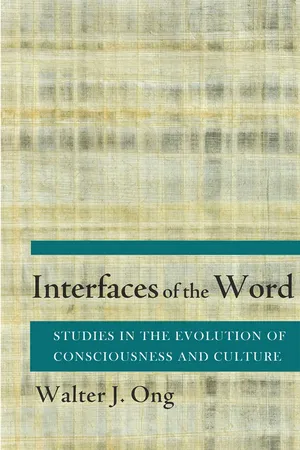
Interfaces of the Word
Studies in the Evolution of Consciousness and Culture
- 352 pages
- English
- ePUB (mobile friendly)
- Available on iOS & Android
eBook - ePub
About this book
Information
III
CLOSURE AND PRINT
6
Typographic Rhapsody: Ravisius Textor, Zwinger, and Shakespeare
Commonplaces and Their Significance
Writing in Chapters in Western Civilization, Professor Paul Oskar Kristeller notes that “the frequency of quotations and of commonplaces repeated in the moral literature in the Renaissance gives to all but its very best products an air of triviality that is often very boring to the modern critical reader.”1 The Renaissance exploitation of commonplace material is of course not restricted to moral treatises. Such material shows everywhere through the Renaissance, from speculative theology and medical treatises to lyric and dramatic poetry, where, however, its use is often less cumbersome than among the moralists. And at its best, in the “pointed” style which derives in part from Seneca, such material becomes brilliant, “illustrating” the subject with flashes of insight and wit.
A great many studies treat in one way or another what we may here style the commonplace tradition. Looking for the roots of the literary heritage of the West, in his European Literature and the Latin Middle Ages Ernst Robert Curtius devotes a great deal of attention to the various “topics” (topoi or loci, places, commonplaces) which have provided both themes and ways of managing themes to writers from classical antiquity on. Thus he treats the “topics of consolatory oratory,” “historical topics,” “topics of the exordium,” and other “topics” explicitly labelled as such.2 Many of his chapter headings indicate that individual chapters are devoted to the discussion of further individual topics. Thus, “The Goddess Natura,” “Heroes and Rulers,” “The Ideal Landscape,” “Poetry and Philosophy,” “The Book as Symbol,” and so on. A brief but tightly packed study by August Beck, Die ‘Studio. Humanitatis’ und ihre Methode, explains a great deal directly on the use of commonplaces, especially as prescribed in works on education, from Rudolph Agricola and Erasmus on to the time of Montaigne.3 Studies of sixteenth- and seventeenth-century writers, particularly by American scholars, who constitute the largest group by far of experts on the rhetorical tradition, often treat the commonplaces in various ways. One of the most thorough-going of such treatments is T. W. Baldwin’s monumental landmark, William Shakspere’s Small Latine and Lesse Greeke, which works patiently through large numbers of commonplace collections in use in Shakespeare’s milieu by schoolboys as well as by adults.4 Sister Joan Marie Lechner has provided an invaluable survey of Renaissance views and practice in her Renaissance Concepts of the Commonplaces.5
Out of these studies there emerges a major question: Why was the commonplace tradition once so important, since it now seems so affected and boring and aesthetically counterproductive? None of the studies just mentioned, nor others like them, really broach this question. The question can be answered only by situating the commonplace tradition in the broader perspectives of noetic history, examining how the tradition relates to the evolution of means of accumulation, storage, and retrieval of knowledge, and thus eventually how it relates to the history of the human psyche and of culture. This is what the present study undertakes to do, working with a certain few significant Renaissance writers. Until the commonplaces are related to the evolving noetic economy, they remain antiquarian curiosities, quaint phenomena, whose obtrusiveness in the past is no more explicable than their eclipse in the present.
“Commonplace” of course has several, more or less related, senses, some of them quite technical.6 But in all its senses the term has to do in one way or another with the exploitation of what is already known, and indeed often of what is exceedingly well known. The “places” provided access to a culture’s noetic store. In classical rhetorical doctrine, places (topoi in Greek, in Latin loci) refer to the “seats” or, as we today would commonly conceptualize them, to the “headings” to which one betook oneself to draw out of the stock of knowledge the things one could say concerning a given subject. These headings implemented analysis of one’s subject: for a person, one might, by a kind of analytic process, consider his family, descent, sex, age, education, and the like; or, more generally, for all sorts of things, one could look to definition, opposites, causes, effects, related matters, and so on. This meaning of topos or locus or “place” is approximated still in our present term “topic” (from topikos, the Greek adjectival form corresponding to the noun topos). In his Rhetoric (I.ii.21—1358a) Aristotle notes two classes of “places”: (a) “common” places, headings providing materials for any and all subjects, and (b) “special” places, headings offering matter for certain individual subjects, such as law or physics. But this distinction was too fastidious to survive the hurly-burly of rhetorical doctrine and practice, where “places” (loci) and “commonplaces” (loci communes) were often used interchangeably.7
A “commonplace” might also have another meaning, somewhat deviously related to this first: a “commonplace” could be a standard brief disquisition or purple patch on any of hundreds or thousands of given subjects—loyalty, treachery, brotherhood, theft, decadence (Cicero’s O temporal O mores! passage is a commonplace on this subject), and so on; these prefabricated disquisitions were excerpted from one’s reading or listening or worked up by oneself (generally out of material taken or adapted from others). Quintilian explains this meaning of locus communis in his Institutiones oratoriae 5. 5. 12—cf. ibid. 1. 11. 12.—after treating other usages of locus earlier in the same work (5. 10. 20).
Even in antiquity, as Quintilian testifies, commonplaces in the sense of standard brief disquisitions or purple patches were often committed to writing, and by the Middle Ages and the Renaissance came to be regularly stored in commonplace books or “copie” books or copybooks (books assuring copia, or the free flow of discourse essential for oratory). The medieval florilegia or collections of exempla and other useful bits for use in subsequent discourse belong to this tradition. To it can also be assimilated collections such as Erasmus’ De duplici copia verborum ac rerum, where the entries are often less than disquisitions, being in many instances quite short expressions, mere phrases or turns of diction, such as the Latin equivalents of “white as snow,” “soft as the ear lobe,” for these phrases, too, are presented as stock ways of treating a particular subject, however briefly, got together for subsequent use.8
It is helpful sometimes to refer to commonplaces in this latter sense of garnered standard disquisitions or purple patches on a set subject as “cumulative” commonplaces, and to places or commonplaces in the earlier sense of headings as “analytic” places or commonplaces. By the term “commonplace tradition” I shall refer here to the practice, more or less reflective, of exploiting both analytic and cumulative places or commonplaces. “Commonplace collections” here refers to assemblages in writing or print of cumulative commonplaces, these latter being understood to include both lengthy passages and briefer expressions, down to mere modus dicendi, as in Erasmus’ De copia, stocked in formulaic fashion out of the extant store of knowledge for further exploitation as occasion might demand.
As Eric Havelock has shown, the noetic economy of an oral culture demands that knowledge be processed in more or less formulary style and that it be constantly recycled orally—otherwise it simply vanishes for good unless it be discovered anew.9 The whole commonplace tradition, an organized trafficking in what in one way or another is already known, is obviously part and parcel of the ancient oral world, the primitive human noetic universe, to which the Renaissance rhetorical doctrine of imitation also obviously relates. Elsewhere I have undertaken to show that the persistence of such material in more or less conspicuous form provides one rule-of-thumb indication of how oral or resi-dually oral a given culture may be—which is also to say how oral or residually oral the culture’s typical personality structures and its state of consciousness itself may be.10
Ioannes Ravisius Textor: Exemplary Collector
As an instance of some of the workings of the commonplace tradition in the Renaissance and a point of departure for reflection on the tradition, I should like to adduce here two collections of commonplace materials got up by a much neglected sixteenth-century French Neo-Latin writer, Jean Tixier, Seigneur de Ravisi, who latinized his name as Ioannes Ravisius Textor. Although Ravisius Textor was familiar to sixteenth- and early seventeenth-century schoolboys across western Europe—including, it would appear certain, William Shakespeare11—he remains a neglected figure today and indeed promises to be neglected even more effectively in the future, for he published in Latin and the knowledge of Latin is becoming less and less common even among scholars—a fact which we should by now frankly admit is severely warping many studies of the Renaissance.
Ioannes Ravisius Textor was born very likely around 1470, but perhaps as late as 1480, probably at Saint-Saulge in the Nivemais. He studied at the University of Paris under his compatriot Jean Beluacus in the College de Navarre, with which Textor’s entire life was thereafter identified. There it was that he became professor of rhetoric, helping to make this college the best of all the Paris colleges for the study of humanities. In 1520 he was elected Rector of the University and in 1524 he died in Paris. Although a Nivemais by birth and a Parisian by adoption, Ravisius Textor, like many humanists, was international in his reputation and influence: editions of his works appear not only in Paris, Rouen, and Lyons, but also in Basel, Venice, Antwerp, Douai, and London.12 Few studies of Ioannes Ravisius Textor have ever appeared, and there is no definitive study at all, so far as I can ascertain.13 Textor’s published works—all Latin, as we have just noted—include mostly productions of a routine humanist sort: dialogues (written to be staged, as they indeed often were), epigrams, letters, and editions of Ulrich von Hutten’s Aula and Dialogus and of other authors’ works, including a collection of short pieces on distinguished women by various writers. The two works of Textor’s to be glanced at here are his Officina (a title which can be rendered into English as Workshop) and his Epitheta {Epithets). These continue the copybook (copia-book) tradition of Erasmus, whom Textor much admired, as his prefatory letter to his 1519 edition of Hutten’s Aula makes clear,14 and as his brother Iacobus (Jacques Tixier de Ravisi) also indicates in his own prefatory letter to his 1524 edition of Ioannes’s Epitheta.15 The Officina and the Epitheta, like several of Erasmus’ works, arrange in collections for subsequent use16 bits and pieces out of Latin texts.
Essentially the Officina is simply a dictionary of classified excerpts or mini-excerpts from extant writing—“examples,” such as Erasmus’ copybook program calls for. The excerpts present students with things to say and Latin words to say them with. No Greek as such appears anywhere in the work. Everything originally in Greek is put into Latin. The sources are mostly the ancients, such as Virgil or Ovid, but also extend to Textor’s own contemporaries or near-contemporaries, such as Pontanus or Erasmus, with medieval writers of course scrupulously excluded. The content of the examples in at least ninety percent of the cases is concerned with antiquity even when the citation is from one of Textor’s contemporaries, but on rare occasions citations from the later writers will have to do with a contemporary or near-contemporary matter, such as an event in the life of King Ferdinand of Spain.
The Officina first appeared in Paris in 1520 and apparently was not reprinted until 1532.17 But after this date editions of the work in its entirety and in epitomes multiplied. More will be said of the editions later. One particular section of the Officina appeared frequently as a separate work under its own section title, Cornucopia. I have record of some thirty editions of the Officina in whole or in part, the last in 1626, with most editions appearing before 1600. Some editions, revised by Conrad Lycosthenes (Wolffhardt), appear under the title Theatrum poeticum atque historicum: sive Officina.
Certainly the Officina of Ravisius Textor is in many ways one of the most intriguing collections of commonplace material that was ever assembled. If the work were in French or English or German or any other modern vernacular rather than in Latin, it would certainly be a constant point of reference for literary commentators or curio seekers, or for connoisseurs of the unconsciously comic. In its studied pursuit of conspicuously useless detail it rivals even Burton’s Anatomy of Melancholy or Sterne’s Tristram Shandy, and in its nose for the bizarre it can compete with Rabelais. Textor is somewhat apologetic about the zany confusion of his work and in a set of elegiacs to the reader at the beginning sets out to disarm criticism by protesting that the Officina is not for “learned poets” but “for uneducated boys” (rudibus pueris) who are for the first time “sweating in the dust and still imbibing...
Table of contents
- Preface
- I. CLEAVAGE AND GROWTH
- II. THE SEQUESTRATION OF VOICE
- III. CLOSURE AND PRINT
- IV. PRESENT AND FUTURE
Trusted by 375,005 students
Access to over 1.5 million titles for a fair monthly price.
Study more efficiently using our study tools.
Frequently asked questions
Yes, you can cancel anytime from the Subscription tab in your account settings on the Perlego website. Your subscription will stay active until the end of your current billing period. Learn how to cancel your subscription
No, books cannot be downloaded as external files, such as PDFs, for use outside of Perlego. However, you can download books within the Perlego app for offline reading on mobile or tablet. Learn how to download books offline
Perlego offers two plans: Essential and Complete
- Essential is ideal for learners and professionals who enjoy exploring a wide range of subjects. Access the Essential Library with 800,000+ trusted titles and best-sellers across business, personal growth, and the humanities. Includes unlimited reading time and Standard Read Aloud voice.
- Complete: Perfect for advanced learners and researchers needing full, unrestricted access. Unlock 1.5M+ books across hundreds of subjects, including academic and specialized titles. The Complete Plan also includes advanced features like Premium Read Aloud and Research Assistant.
We are an online textbook subscription service, where you can get access to an entire online library for less than the price of a single book per month. With over 1.5 million books across 990+ topics, we’ve got you covered! Learn about our mission
Look out for the read-aloud symbol on your next book to see if you can listen to it. The read-aloud tool reads text aloud for you, highlighting the text as it is being read. You can pause it, speed it up and slow it down. Learn more about Read Aloud
Yes! You can use the Perlego app on both iOS and Android devices to read anytime, anywhere — even offline. Perfect for commutes or when you’re on the go.
Please note we cannot support devices running on iOS 13 and Android 7 or earlier. Learn more about using the app
Please note we cannot support devices running on iOS 13 and Android 7 or earlier. Learn more about using the app
Yes, you can access Interfaces of the Word by Walter J. Ong in PDF and/or ePUB format, as well as other popular books in Literature & Literary Criticism Theory. We have over 1.5 million books available in our catalogue for you to explore.