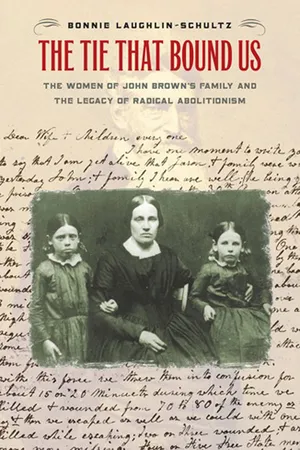
John Brown was fiercely committed to the militant abolitionist cause, a crusade that culminated in Brown's raid on the Federal armory at Harpers Ferry in 1859 and his subsequent execution. Less well known is his devotion to his family, and they to him. Two of Brown's sons were killed at Harpers Ferry, but the commitment of his wife and daughters often goes unacknowledged. In The Tie That Bound Us, Bonnie Laughlin-Schultz reveals for the first time the depth of the Brown women's involvement in his cause and their crucial roles in preserving and transforming his legacy after his death.As detailed by Laughlin-Schultz, Brown's second wife Mary Ann Day Brown and his daughters Ruth Brown Thompson, Annie Brown Adams, Sarah Brown, and Ellen Brown Fablinger were in many ways the most ordinary of women, contending with chronic poverty and lives that were quite typical for poor, rural nineteenth-century women. However, they also lived extraordinary lives, crossing paths with such figures as Frederick Douglass and Lydia Maria Child and embracing an abolitionist moral code that sanctioned antislavery violence in place of the more typical female world of petitioning and pamphleteering.In the aftermath of John Brown's raid at Harpers Ferry, the women of his family experienced a particular kind of celebrity among abolitionists and the American public. In their roles as what daughter Annie called "relics" of Brown's raid, they tested the limits of American memory of the Civil War, especially the war's most radical aim: securing racial equality. Because of their longevity (Annie, the last of Brown's daughters, died in 1926) and their position as symbols of the most radical form of abolitionist agitation, the story of the Brown women illuminates the changing nature of how Americans remembered Brown's raid, radical antislavery, and the causes and consequences of the Civil War.
eBook - ePub
The Tie That Bound Us
The Women of John Brown's Family and the Legacy of Radical Abolitionism
- 288 pages
- English
- ePUB (mobile friendly)
- Available on iOS & Android
eBook - ePub
The Tie That Bound Us
The Women of John Brown's Family and the Legacy of Radical Abolitionism
About this book
Information
Subtopic
Social Science BiographiesIndex
HistoryTable of contents
- Illustrations
- Introduction
- 1. The Brown Family’s Antislavery Culture, 1831–49
- 2. North Elba, Kansas, and Violent Antislavery
- 3. Annie Brown, Soldier
- 4. Newfound Celebrity in the John Brown Year
- 5. The Search for a New Life
- 6. Mary Brown’s 1882 Tour and the Memory of Militant Abolitionism
- 7. Annie Brown Adams, the Last Survivor
- Epilogue
- Acknowledgments
- Notes
- Bibliography
Trusted by 375,005 students
Access to over 1.5 million titles for a fair monthly price.
Study more efficiently using our study tools.
Frequently asked questions
Yes, you can cancel anytime from the Subscription tab in your account settings on the Perlego website. Your subscription will stay active until the end of your current billing period. Learn how to cancel your subscription
No, books cannot be downloaded as external files, such as PDFs, for use outside of Perlego. However, you can download books within the Perlego app for offline reading on mobile or tablet. Learn how to download books offline
Perlego offers two plans: Essential and Complete
- Essential is ideal for learners and professionals who enjoy exploring a wide range of subjects. Access the Essential Library with 800,000+ trusted titles and best-sellers across business, personal growth, and the humanities. Includes unlimited reading time and Standard Read Aloud voice.
- Complete: Perfect for advanced learners and researchers needing full, unrestricted access. Unlock 1.5M+ books across hundreds of subjects, including academic and specialized titles. The Complete Plan also includes advanced features like Premium Read Aloud and Research Assistant.
We are an online textbook subscription service, where you can get access to an entire online library for less than the price of a single book per month. With over 1.5 million books across 990+ topics, we’ve got you covered! Learn about our mission
Look out for the read-aloud symbol on your next book to see if you can listen to it. The read-aloud tool reads text aloud for you, highlighting the text as it is being read. You can pause it, speed it up and slow it down. Learn more about Read Aloud
Yes! You can use the Perlego app on both iOS and Android devices to read anytime, anywhere — even offline. Perfect for commutes or when you’re on the go.
Please note we cannot support devices running on iOS 13 and Android 7 or earlier. Learn more about using the app
Please note we cannot support devices running on iOS 13 and Android 7 or earlier. Learn more about using the app
Yes, you can access The Tie That Bound Us by Bonnie Laughlin-Schultz in PDF and/or ePUB format, as well as other popular books in History & Social Science Biographies. We have over 1.5 million books available in our catalogue for you to explore.