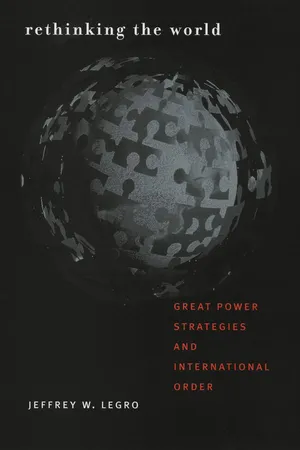
Stunning shifts in the worldviews of states mark the modern history of international affairs: how do societies think about—and rethink—international order and security? Japan's "opening," German conquest, American internationalism, Maoist independence, and Gorbachev's "new thinking" molded international conflict and cooperation in their eras. How do we explain such momentous changes in foreign policy—and in other cases their equally surprising absence?The nature of strategic ideas, Jeffrey W. Legro argues, played a critical and overlooked role in these transformations. Big changes in foreign policies are rare because it is difficult for individuals to overcome the inertia of entrenched national mentalities. Doing so depends on a particular nexus of policy expectations, national experience, and ready replacement ideas. In a sweeping comparative history, Legro explores the sources of strategy in the United States and Germany before and after the world wars, in Tokugawa Japan, and in the Soviet Union. He charts the likely future of American primacy and a rising China in the coming century. Rethinking the World tells us when and why we can expect changes in the way states think about the world, why some ideas win out over others, and why some leaders succeed while others fail in redirecting grand strategy.
- 272 pages
- English
- ePUB (mobile friendly)
- Available on iOS & Android
eBook - ePub
About this book
Information
[1]
Great Power Ideas and Change
In world politics, leaders look ahead for signs of the next wildfire. Not surprisingly, they often focus on the foreign policy ideas of major states. Will Japan adhere to its post–World War II pacifism or take a turn toward militarized autonomy? Is China bound for integration in the international system, or for a Qing-era isolationism, or a rebellion against the existing order? Might Germany one day leave behind its integrationist mind-set and revive a revisionist foreign policy, one that seeks to overturn the dominant international norms? Perhaps most important, some wonder whether the United States will persist in turning its back on the international institutions and political-military commitments built over the past sixty years in favor of a new Pax Americana.
Such enduring great power ideas matter because they guide foreign policy and are a building block of international life.1 Yet sometimes they radically change, usually with earthquake-like effects. Consider, for example, how Mikhail Gorbachev’s “new thinking” fundamentally altered both the Soviet Union’s actions and the cold war dynamic that had dominated world politics for forty-five years. Other seismic shifts have similarly marked international life over the past two centuries. When Japan emerged from two hundred years of isolation in the 1860s, a new era of great power relations in Asia began. And when the United States adopted an internationalist outlook after World War II, it spearheaded an unprecedented level of development in the institutional texture of world politics.
Yet, just as international order is made by national ideas, so is it unmade. Ideas do not always shift in the direction of harmonious engagement. When Soviet Russia rejected the dominant ethos of the international arena in 1917, a new source of tension and division frayed global politics. Similarly, when the United States reverted to aloofness from major power commitments after World War I, the nascent League of Nations was disabled and the seeds of the Great Depression were sown. And when Germany once again embraced continental domination in the interwar period, a second world war took wing. In some instances states turn toward integration in international order—what Hedley Bull called “international society”—the dominant rules, institutions, and norms that characterize the international system.2 In other situations, nations understand their interests as best served by separating themselves from that society, or even by dramatically revising it. This variation begs for analysis.
Despite the importance of these ideational transformations, scholars and policymakers have few tools with which to understand and anticipate them. Those who have paid the closest attention to the importance of the international system have paid less attention to the sources of change in that system.3 Hedley Bull and his associates, for example, focused on the nature and different forms of international society, not on its dynamic transformation. They ignored one of the primary sources of change in international life—the collective ideas of major powers. What is clear is that states have often differed in their reactions to international rules—some accepting them, others not. Such attitudes can enhance or undermine overall order.4 International relations specialists since World War II have explored in detail the importance of power, the influence of institutions, and the role of domestic politics in world politics.5 In these studies, the collective ideas of nations are often pushed to the wings: they are marginalized as “cheap talk,” a side product of more central causes, or post hoc justifications.
Starting in the 1980s, however, some scholars have devoted considerable effort to correcting this oversight by intensive study of the way ideas (norms, beliefs, identity, etc.) at the international, national, and subnational levels have affected politics.6 What remains a puzzle, despite the volume of this literature, is why collectively held (or group) ideas sometimes radically change. Max Weber compared ideas to “switchmen” who work the railroads: they point actors, like trains, down tracks in some directions and divert them from others. This famous metaphor, however, begs a critical question: What decides the direction of the switch?
Adherents of psychological and constructivist approaches have paid serious attention to ideas, yet they also illustrate the problem. The psychology literature in international relations has illuminated the dynamics of change in the ideas that individuals hold. Not surprising, given its focus on the human mind, psychology has been less helpful in explaining how individual ideas come together to affect (or in many cases not affect) national ideas, such as those that guide foreign policies.7 Constructivists, by contrast, have focused on collective ideas and illuminated their influence theoretically and empirically in a variety of national and international settings. They have also shown how ideas have played a role in periods of political change.8 Yet general explanations of change in the ideas themselves are rare. And to push the issue one step further, how ideas shape their own transformation, if they even do, remains an enigma.
Given this lacuna in the academy, policymakers—and those who would try to influence officials—face a challenge. In the absence of some general notion about the transformation of ideas, we cannot begin to think about likely outcomes in ongoing specific cases. For example, consider two big contemporary phenomena in world politics: the “rise of China” and the Bush “foreign policy revolution.”
China’s rapid economic growth and prominence has naturally been a focus of research.9 Considerable analysis, and much of the debate, has highlighted questions that link power to behavior. Will China’s emerging power lead to revisionist goals? Will it produce armed conflict as China ascends in power and other countries (e.g., Japan and the United States) decline in relative terms?10 As important as these questions are, what they miss is the way that international relations are shaped not just by the power states have but the ideas the states hold about how that power should be used.11 Power, of course, is a tool, and ideas about the uses of tools vary considerably.12 Power does not determine ideas nor do power transitions among states inevitably lead to conflict. After World War I, the United States emerged as the most powerful country on earth, but U.S. government involvement did not expand during the interwar period. China’s power has been growing since World War II, but it has adopted a range of different ideas toward the international system. And in terms of power trajectories, Britain and the United States did not go to war with each other at the turn of the twentieth century, even as the United States surpassed Britain as the dominant international power.13 In these cases enduring ideas (e.g., how much to integrate into the extant international order, which states to align with) played a central role. Positing such a role for ideas does not explain their sources, however. Lacking such an explanation, we are handcuffed in considering, for example, how China’s power trajectory will shape world politics.
Perhaps even more important is whether the United States is currently undergoing a foreign policy revolution. Since the end of World War II the United States has systematically favored active engagement in world affairs, a commitment to a liberal and open international order, and the development of multilateral practices and institutions. Many believe that in the wake of the 9/11 terrorist attacks the United States adopted a new and fundamentally different compass for navigating in the world arena.14 The new orientation features accentuated American unilateral action, the preventive use of force, and an expanded geographical vision of the areas appropriate for aggressive democratization (e.g., moving beyond the Western hemisphere into the Middle East). Clearly, if such a transformation becomes orthodoxy, it will have huge implications for the United States and the world. Thinking about such a possibility demands a broad framework. How do we account for the transformation—or continuity—of national ideas about international politics? Where do we even begin?
My short answer is that we start where we want to end—with ideas. New foreign policy ideas are shaped by preexisting dominant ideas and their relationship to experienced events, sometimes reinforcing the continuity of concepts and infrequently leading to their radical change. Yet that is still only the beginning of the story. To explain this complex variation means assessing not only ideas but how ideas interact in regular ways with the demands of strategic circumstances and domestic political pressures. Ideas, strategic circumstances, and domestic politics are typically treated as logically exclusive alternative approaches to explaining change or stability. Here I attempt to develop a synthetic explanation that captures their interactive effects. Why and how this happens is the longer account that follows.
My aim, then, is to gain some insight into the general determinants of the foreign policy concepts of various nation-states. By unraveling the general sources of foreign policy conceptual change we may also see new possibilities for future diplomacy and social action. In this chapter I lay the foundation by clarifying what it is I hope to explain, the conceptual and historical puzzles involved, the broad outlines of the argument, and why it matters.
THE END OF THE CHAIN
A good starting point is clarity as to what exactly is being explained—that is, continuity and change in the ideas of nation-states about how to relate to international society. The term “ideas” inevitably invokes a wide range of images. My concern is with foreign policy ideas that can be differentiated from others in three basic ways that relate to their level, type, and content; such ideas (1) are collectively held; (2) involve beliefs about effective means; and (3) refer specifically to national conceptions about international society. Each dimension deserves brief discussion.
Level
First, the ideas to be explored are a property of groups (i.e., states, and are therefore inherently collective and institutional, not individual and “mental.”)15 We commonly use “ideas” (or “beliefs,” “attitudes,” “views,” etc.) to refer to things people have in their head. Following this usage, a vibrant series of studies have drawn from the psychological literature for its insights on the human mind and its implications for international politics.16 From this perspective, national ideas are studied as if they are (1) a reflection of individual leaders who cause national policies, or (2) the property of states with the same psychological biases as humans, or (3) are a summation of individual ideas that somehow “add up” to cause national policy.17 The seminal work of Robert Jervis on psychology and international relations uses all these techniques. For example, he argues that “when an event affects the perceptual predispositions of many members of an organization we can speak of organizational learning.”18 In this view, collective outcomes are mostly conceptualized as the summation of individual minds.
Two broad literatures suggest that some types of ideas have to be considered as properties that are not reducible to individual minds. One comes from the classic sociological tradition and is based on the work of scholars such as Emile Durkheim and Max Weber, who have attempted to demonstrate how social beliefs and concepts shape both individuals and group policy.19 Modern philosophers such as Charles Taylor, John Searle, and Margaret Gilbert speak to the collective properties of ideas that are inter-subjective and thus distinct from the subjective ideas—personal beliefs, attitudes, and opinions—that individuals hold.20 “Far from being the product of our own will,” Durkheim notes, social facts (i.e., collective ideas and representations) determine it from without. They are like moulds unto which we are forced to cast our actions.”21 An example (borrowed from Wittgenstein) is the way that language is not reducible to physical voice capacity or individual perception. Individuals may speak a language and use it for their own purposes, but the language itself is a preexisting entity to which they must adapt. Similarly, dominant ideas are often embedded in public discourse and symbols that also represent intersubjective phenomena that attach to group, not individual, orientation. Japanese leaders at the beginning of the nineteenth century did not choose to seclude Japan from the world. It was a tradition they were born into—it was as natural to them as “Japan” itself. To say that tradition was a product of individual opinion or even public opinion would be to misstate cause and effect.
Human biology lends support to the sociological view. Humans are adapted to living in groups and to understanding group dynamics. We have lived in groups for thousands of years and have been selected to think in terms of group interests and ideas, not just self-interest.22 Our biology invites social influence. Three-quarters of the human brain develops outside of the womb, which is unique among primates. The brain grows at fetal rates for some two years after birth, and full development is not completed until puberty. We have an “ecological brain.”23 This means that humans to an important degree are not “knowledge-wired” at birth. Our postpartum social environment has a massive impact. A variety of work has begun to document the social roots of the “self,” including human cognition.24 Thus, the collective attributes of groups—for example, the ideas that characterize them—can matter both for individuals and society.
Scholars of organizations have developed a second literature that documents the way that collective ideas, that is, “organizational cultures,” mold the behavior of firms and bureaucracies in a variety of different areas.25 Organizational beliefs are a collective phenomenon that shapes the people who work within the organizations. This is not to say all individuals accept a predominant culture. Many organizations, in fact, are characterized by several cultures that compete for dominance or that give the organization a multifaceted character.26 Nonetheless, to act coherently, large organizations require dominant themes for reasons of efficiency and identity. Culture provides a set of principles regarding collective identity and appropriate behavior, and by doing so it produces more coherent coordinated behavior among the many individuals involved in the planning and conduct of, say, foreign policy.27 Organizations are certainly created and run by people, but such organizations can also constrain and shape individual ideas.
The literature on broad societies and the literature on organizations come together in the collective body that is central to this study: the modern nation-stat...
Table of contents
- List of Figures and Tables
- Acknowledgments
- 1. Great Power Ideas and Change
- 2. Explaining Change and Continuity
- 3. The Ebb and Flow of American Internationalism
- 4. Germany, from Outsider to Insider
- 5. Overhaul of Orthodoxy in Tokugawa Japan and the Soviet Union
- 6. The Next Century
- Appendix 1: The Transformation of Economic Ideas
- Appendix 2: Analysis of Presidential Discourse
- Notes
Trusted by 375,005 students
Access to over 1.5 million titles for a fair monthly price.
Study more efficiently using our study tools.
Frequently asked questions
Yes, you can cancel anytime from the Subscription tab in your account settings on the Perlego website. Your subscription will stay active until the end of your current billing period. Learn how to cancel your subscription
No, books cannot be downloaded as external files, such as PDFs, for use outside of Perlego. However, you can download books within the Perlego app for offline reading on mobile or tablet. Learn how to download books offline
Perlego offers two plans: Essential and Complete
- Essential is ideal for learners and professionals who enjoy exploring a wide range of subjects. Access the Essential Library with 800,000+ trusted titles and best-sellers across business, personal growth, and the humanities. Includes unlimited reading time and Standard Read Aloud voice.
- Complete: Perfect for advanced learners and researchers needing full, unrestricted access. Unlock 1.5M+ books across hundreds of subjects, including academic and specialized titles. The Complete Plan also includes advanced features like Premium Read Aloud and Research Assistant.
We are an online textbook subscription service, where you can get access to an entire online library for less than the price of a single book per month. With over 1.5 million books across 990+ topics, we’ve got you covered! Learn about our mission
Look out for the read-aloud symbol on your next book to see if you can listen to it. The read-aloud tool reads text aloud for you, highlighting the text as it is being read. You can pause it, speed it up and slow it down. Learn more about Read Aloud
Yes! You can use the Perlego app on both iOS and Android devices to read anytime, anywhere — even offline. Perfect for commutes or when you’re on the go.
Please note we cannot support devices running on iOS 13 and Android 7 or earlier. Learn more about using the app
Please note we cannot support devices running on iOS 13 and Android 7 or earlier. Learn more about using the app
Yes, you can access Rethinking the World by Jeffrey W. Legro in PDF and/or ePUB format, as well as other popular books in Politics & International Relations & Geopolitics. We have over 1.5 million books available in our catalogue for you to explore.