Chapter 1
Titus Andronicus and the Production of Musical Meaning
Such a lively song (now by this light)
Yet never hearde I such another note.
It was (thought me) so pleasant and so plaine,
Orphæus harpe, was never halfe so sweete,
Tereu, Tereu, and thus she gan to plaine,
Most piteously, which made my hart to greeve.
—George Gascoigne, The Complaint of Philomene
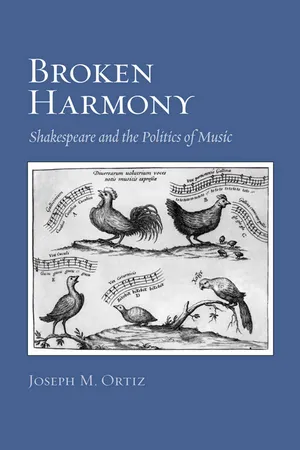
The debate over the meaning of music in the Renaissance begins not with bees, but with birds. Martin Luther, in commending music’s ability to make nature comprehensible, cites birdsong as the best example of music that praises its divine Creator: “Music is still more wonderful in living things, especially birds, so that David, most musical of all kings and minstrel of God, in deepest wonder and spiritual exultation praised the astounding art and ease of the song of birds when he said in Psalm 104, ‘By them the birds of the heaven have their habitation; they sing among the branches.’”1 In a very different context, Gascoigne’s Complaint of Philomene (1576) prefaces its adaptation of Ovid’s Philomela with a fantastic meeting between the poem’s speaker and the nightingale, whose musical warble (“Tereu”) inspires great sympathy despite the speaker’s ignorance of its verbal sense. In this way, the episode attests to music’s supposed ability to evoke true sympathy in the absence of language. At the same time, in invoking the familiar trope of the nightingale as poetic eloquence, Gascoigne necessarily effaces the focus of Ovid’s story, which reads more as a map of communicative failures. As Lynn Enterline has shown, Ovid’s version of the myth—which ends abruptly at the moment of Philomela’s transformation, thus cutting off the possibility of musical sublimation—demonstrates the utter “unspeakability” of the mutilated female, who can replicate the scene of sexual violence but not translate the experience of its horror.2 Thus the attempt to find meaning in birdsong, whether by Luther or Gascoigne, requires turning a deaf ear to the alienating effect of nonverbal sound—an effect that Ovid is so fond of re-creating.
In this chapter, I argue that Shakespeare’s Titus Andronicus returns to Ovid’s Philomela in order to explore the possibility of meaning in music. Like Gascoigne, whose poem the play frequently echoes, Shakespeare evokes music as a privileged model of nonverbal communication. Unlike The Complaint of Philomene, however, Titus raises serious doubts about music’s ability to impart understanding—or, more generally, to mean anything at all. Through the figure of Lavinia, Titus confronts the problem of a resonant body that must translate itself into language, all the while implying that music, like the mutilated woman, is in a constant state of dismemberment and inarticulateness. Against this radical “deconstruction” of music, the play offers the familiar rhetoric of musica speculativa as an antidote to meaningless. Yet Shakespeare denies this rhetoric any real persuasive power, at once by juxtaposing it with the overwhelming theatrical effect of Lavinia’s bleeding body, but also by evoking several Ovidian models of voicelessness that undermine any sense of communal understanding. The Ovidian figures of Io, Actaeon, and Hecuba, memorable for their speechlessness in the Metamorphoses, might suggest possible ways of reading Lavinia after her mutilation, but Shakespeare reminds us that it is the utter untranslatability of their sound in Ovid’s poem that marks their distance from the reader and reveals the poet’s limits of representation. Thus, by producing a second Hecuba onstage, Shakespeare forecloses on a “sympathetic” reading of Lavinia in favor of highlighting the “noisiness” of her grotesque, hyperphysicalized body.3 Counterintuitive as it may seem, music in Titus ultimately does not reveal itself as a compensatory voice for someone who has lost both hands and tongue; instead, it embodies the radical promiscuity that erupts when one’s meaning is determined by another.
Reading Titus as a meditation on music’s promiscuity—or, more unconventionally, as a kind of musical performance itself—allows us to reexamine the signifying and affective economy of Shakespeare’s theater. In order to produce intelligible meaning and “move” its audience, the theater relies on and validates a number of adjoining systems of aural and visual signification. In this respect, Susan McClary’s observation that meaning in music is “kept afloat only because communities of people … agree collectively that [its] signs serve as valid currency” accurately describes how Shakespeare’s stage participates in the construction of musical meaning even as it depends on a communally sanctioned system of musical signs to propel its own narrative.4 (A trumpet flourish denoting the monarch is a paradigmatic example.) At the same time, Shakespeare’s propensity to expose the seams of this system via Ovidian voicelessness puts him in dialogue with early modern critiques of music. In the next section, I discuss briefly the Renaissance debates over music’s affective power, in order to show that Shakespeare’s skepticism about musical sympathy has its historical analogue not in the massive corpus of Renaissance poetics, where the idea of aesthetic unity prevails, but in a strand of Reformist polemic that strongly suspects music’s independence from language. The rest of the chapter addresses Shakespeare’s deployment of music in Titus, showing how the play stages a series of increasingly ingenious and desperate acts of interpretation. In each case, the play reveals a nagging suspicion that will haunt the appearance of music in almost every Shakespearean play that follows: the suspicion that music is, in its most fundamental form, meaningless.5
“Whoryshe armonye”: Musical Meaning in Early Modern England
In The Praise of Music (1586), John Case begins his chapter on music’s “suavitie” by asserting that “poetrie … is but a part of Musicke, as Plutarch doth testifie.”6 Although the remark is conventional, Case’s assertion of music’s likeness to poetry is itself a consciously crafted defense against contemporary attacks on music’s sensuous illegibility. The problem of musical signification had already been raised in Stephen Gosson’s antitheatrical tract, The Schoole of Abuse (1579). After explaining the “right use of ancient Poetry,” Gosson argues that music should be
used in battaile, not to tickle the eare, but too teach every souldier when to strike and when to stay, when to flye, and when to followe…. Homer with his Musicke cured the sick Souldiers in the Grecians campe, and purged every mans Tent of the Plague. Thinke you that those miracles coulde bee wrought with playing of Daunces, Dumpes, Pavins, Galiardes, Measures Fancyes, or new streynes: They never came wher this grewe, nor knew what it ment.7
Gosson’s reference to Homer likely pertains to the Greek theory of musical modes, by which certain tonal structures are said to correspond to specific psychological temperaments (for example, Mixolydian and sadness). In this scheme, music always means something. At its best, Gosson implies, music functions as suasive, instinctual language that is capable of being fully articulate and precise: when to strike, when to stay, when to fly. Yet the sheer proliferation of musical forms in Gosson’s England throws this simple system of signification into chaos. The fact that Gosson’s negative examples are mostly dance forms points his argument that music’s semiotic capabilities have been subsumed by its bodily manifestations. As a result, English music has become as “meaningless” to its modern audience as it would be baffling to its classical predecessors (“they never came wher this grewe, nor knew what it ment”).
Gosson’s critique of English music is typical of much antitheatrical writing in its premise of a golden age, when the forms of music were simple and finite. Even so, Gosson’s presentation of classical sources implies that music was always susceptible to innovation (and hence, degradation). Even the seven-stringed harp, which for other writers might represent the seven notes of the Pythagorean diapason, is shown by Gosson to be a distortion of an older, superior model: “He that compareth our instruments, with those that were used in ancient times, shall see them agree like Dogges & Cattes, and meete as jump as Germans lippes. Terpandrus and Olimpus used instruments of 7.strings. And Plutarch is of opinion that the instruments of 3.strings, which were used before their time, passed al that have followed since.”8 Gosson’s subsequent example makes it clear that music’s embodiment in physical materials is largely responsible for this tendency toward innovation: it is Phrynis’s “curiosity” about his fiddle that inspires him to add more strings, thus creating more possibilities for musical sound. The history of musical embodiment is thus for Gosson necessarily a history of decline, culminating in the grotesque vision of Musick’s actual body: “To shew the abuses of these unthrifty scholers that despise the good rules of their ancient masters & run to the shop of their owne devises, defacing olde stampes, forging newe Printes, and coining strange precepts, Phaerecrates a Comicall Poet, bringeth in Musicke and Justice upon the stage: Musicke with her clothes tottered, her fleshe torne, her face deformed, her whole bodie mangled and dismembred.”9 Phillip Stubbes, whose attack on music copies faithfully entire portions of Gosson’s tract, likewise represents music’s abuses as a problem of materiality: “Their is no ship, so balanced with massie matter, as [musicians’] heads are fraught with all kind of bawdie songs, filt...