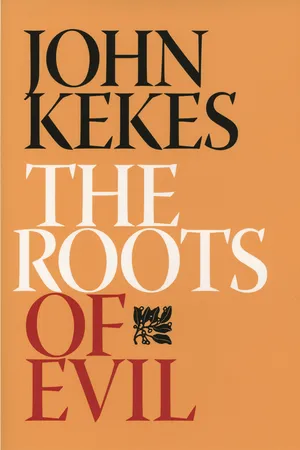
"Evil is the most serious of our moral problems. All over the world cruelty, greed, prejudice, and fanaticism ruin the lives of countless victims. Outrage provokes outrage. Millions nurture seething hatred of real or imagined enemies, revealing savage and destructive tendencies in human nature. Understanding this challenges our optimistic illusions about the effectiveness of reason and morality in bettering human lives. But abandoning these illusions is vitally important because they are obstacles to countering the threat of evil. The aim of this book is to explain why people act in these ways and what can be done about it."—John KekesThe first part of this book is a detailed discussion of six horrible cases of evil: the Albigensian Crusade of about 1210; Robespierre's Terror of 1793–94; Franz Stangl, who commanded a Nazi death camp in 1943–44; the 1969 murders committed by Charles Manson and his "family"; the "dirty war" conducted by the Argentinean military dictatorship of the late 1970s; and the activities of a psychopath named John Allen, who recorded reminiscences in 1975. John Kekes includes these examples not out of sensationalism, but rather to underline the need to hold vividly in our minds just what evil is. The second part shows why, in Kekes's view, explanations of evil inspired by Christianity and the Enlightenment fail to account for these cases and then provides an original explanation of evil in general and of these instances of it in particular.
- 278 pages
- English
- ePUB (mobile friendly)
- Available on iOS & Android
eBook - ePub
The Roots of Evil
About this book
Information
Topic
PhilosophySubtopic
Ethics & Moral PhilosophyCHAPTER 1
Introduction: The Problem and the Approach
Evil facts…are a genuine portion of reality; and they may after all be the best key to life’s significance and possibly the only openers of our eyes to the deepest levels of truth.
—WILLIAM JAMES, Varieties of Religious Experience
1.1 What Is Evil?
Evil has an ominous connotation that goes beyond badness. It is perhaps the most severe succinct condemnation our moral vocabulary affords, so it should not be used casually and the conditions of its justified ascription should be made clear. Evil involves serious harm that causes fatal or lasting physical injury, as do, for instance, murder, torture, and mutilation. Serious harm need not be physical. But since judging the seriousness of nonphysical harm, such as loss of honor, happiness, or love, involves complex questions, I shall concentrate on simple cases of physical harm whose seriousness is as obvious as it is of losing life, limb, or eye-sight, or suffering prolonged excruciating pain. Serious harm may be caused by natural disasters, animals, or viruses; and human beings may cause serious harm to the fauna or the flora. Nevertheless, evil has primarily to do with serious harm caused by human beings to other human beings. This may be excusable on moral grounds as self-defense, deserved punishment, necessary for averting worse harm, or as resulting from nonculpable ignorance, unavoidable accident, or unforeseeable contingencies. Part of what makes human actions evil, then, is that they cause serious harm and lack excuse.
The harm involved in evil actions is not just serious but also excessive. This is part of the reason why such actions are worse than morally bad. To rob someone at gunpoint is morally bad, but after having gotten the money, to torture, mutilate, and then murder the victim is evil. Evildoers cause more serious harm than is needed for achieving their ends. They are not just unscrupulous in their choice of means, but motivated by malevolence to gratuitous excesses. They treat their victims with ill will, rage, or hatred. This may be shown by the sheer quantity of the harm they do, as in the murder of thousands of innocent victims, or by the quality of their actions, such as torturing children. Evil actions go beyond breaking some ordinary moral rule; they show contempt for and flaunt fundamental moral prohibitions.
The evil of an action, therefore, consists in the combination of three components: the malevolent motivation of evildoers; the serious, excessive harm caused by their actions; and the lack of morally acceptable excuse for the actions.1 Each of these components is necessary, and they are jointly sufficient for condemning an action as evil. An action may cause serious, excessive harm and not be evil if, for instance, it is accidental, coerced, or morally justified. Nor is malevolent motivation enough to make an action evil because as a result of unexpected circumstances—the bomb failed to explode, the gun misfired—the action may fail to cause any harm. Furthermore, an action prompted by malevolent motivation and causing serious, excessive harm may still not be evil if it is morally excusable by being, for example, justified punishment or necessary for avoiding even greater harm. The justified ascription of evil to an action requires, therefore, motive, consequence, and lack of excuse.
Each of these components allows for degrees: malevolent motives may range from short-term blind rage to a lifelong hatred of humanity; serious, excessive harm may involve the torture and murder of one innocent victim or doing the same to thousands; and a morally inexcusable action may fall anywhere on a continuum from culpable ignorance or weakness to deliberately and knowingly doing evil for its own sake. The justified ascription of evil to actions, therefore, allows for a distinction between levels of evil. People can be said to be evildoers if they habitually perform evil actions, and they can be greater or lesser evildoers depending on the level of evil they do. And institutions, societies, and other collectives are evil derivatively twice over if they lead their participants to cause various degrees of evil.
Evil actions violate their victims’ physical security and thus transgress fundamental moral prohibitions that protect minimum conditions of human well-being. One essential task of morality is to safeguard these conditions. Evildoers or their defenders sometimes attempt to excuse evil actions by appealing to religious, political, aesthetic, scientific, or prudential considerations. Such excuses are morally unacceptable because the malevolent motivation and the excessive harm of evil actions go far beyond what is needed to pursue any reasonable nonmoral aim. Fundamental moral prohibitions are nevertheless routinely violated by evildoers. The reason for condemning such people and actions as evil, then, is the moral commitment to human well-being. It is a lamentable fact of life that undeniable cases of evil abound. Those in doubt have only to watch the news or read the newspapers or consult the books that catalog some of the atrocities of the past century.2 Nor is it deniable that most of this evil is caused by human beings. The problem is to explain why they cause it.
1.2 Approaches to Explanation
There is no shortage of attempts to provide an explanation. My reason for adding to their number is that the most influential previous ones—those inspired by the religious and the Enlightenment world views—try to explain evil by explaining it away. They deny what the epigraph rightly asserts, namely, that “evil facts…are a genuine portion of reality.” Both begin with a world view and then try to fit evil into it. But evil does not fit, and that is why they try to explain it away. A detailed discussion of these explanations and their shortcomings will follow, but a brief indication of what they are is needed here to contrast my approach with theirs.
A dominant tendency in the religious world view is to assume that a morally good order permeates the scheme of things and human lives go well to the extent to which they conform to it. The problem of evil, then, becomes the problem of explaining the failure to conform. There are various religious explanations, but most of them assume that the failure results from the misuse of the evildoers’ reason or will. Evil is thus seen as a defect in evildoers rather than in the scheme of things. This explanation faces two difficulties its defenders have not succeeded in overcoming despite many centuries of trying. One is to justify the belief that although experience and history provide abundant contrary evidence, there is a morally good order in the scheme of things. The other is that since human beings are part of the scheme of things, any defect in evildoers is a defect in the scheme of things. The very existence of evil thus constitutes a reason against believing in a morally good order.
A central thread in the Enlightenment world view is the belief that human beings are basically good and their well-being depends on living according to reason. The more reasonable lives are, the better they are supposed to become. The problem of evil is thus the problem of explaining our failure to be more reasonable when it is in our interest to be so. The explanation is that external influences, usually in the form of bad political arrangements, corrupt our basic goodness. Evil is thus explained as the result of interference with our basic goodness. But what reason is there for supposing that human beings are basically good? There obviously are many bad human propensities, and they often overwhelm the good ones. Why suppose that good ones are basic and bad ones are not? Furthermore, if the corruption of our supposed basic goodness is the result of bad political arrangements, it needs to be explained how these arrangements become bad. They are made and maintained by human beings. If they are bad, it is because those who make and maintain them are bad. The ubiquity of bad political arrangements is thus a reason for doubting basic human goodness, not an explanation of evil.
These two approaches differ in many ways, but they share the assumption that the good is basic and evil is derivative because it is some kind of interference with the good. The explanation they seek, therefore, is of the nature and cause of the interference. In my view, this is to seek the explanation of evil in the wrong place because the assumption underlying the search is mistaken. I shall argue that there is no convincing reason for supposing that the good is basic and evil is derivative and there is no more reason to think that evil is interference with the good than that good is interference with evil.
1.3 Toward an Adequate Explanation
A first approximation of the explanation I shall defend emerges against the background of another questionable assumption on which previous explanations rest. Most of the explanations given in the framework of the religious or the Enlightenment world view assume that evil has a single cause. Evil, however, has many causes: various human propensities; outside influences on their development; and a multiplicity of circumstances in which we live and to which we must respond. Because these causes vary with person, time, and place, an attempt to find the cause of evil is doomed. There is no explanation that fits all or even most cases of evil. Weakness of will, ignorance of the good, defective reasoning, human destructiveness, bad political arrangements, excessive self-love, immoderate pleasure-seeking, revenge, greed, boredom, enjoyment, perversity, provocation, stupidity, fear, callousness, indoctrination, self-deception, negligence, and so forth may all explain some cases of evil. None, however, explains all or even most cases. This is not because the right explanation has not been found, but because the search for it is misguided.
Some who have given serious thought to evil have concluded from the failure of single explanations that evil is ultimately incomprehensible. Kant was neither the first nor the last in believing that “the rational origin of…the propensity to evil remains inscrutable to us.”3 This leads to the desperate measure of abandoning the attempt to cope with evil. For if evil is inscrutable, then we are helpless in trying to prevent it. The realization that evil has many causes, however, will lead one to expect the failure of attempts to find its single cause and to seek a better explanation rather than pronounce it a mystery. The best argument against the incomprehensibility of evil is to provide the supposedly impossible explanation. And that is what I shall attempt to do.
This explanation does not share the assumption of the religious world view that a morally good order permeates the scheme of things. The alternative is not that the order is bad, but that there is no moral order in the scheme of things; there are only impersonal, unmotivated, purposeless, natural processes. If the scheme of things were to have a point of view, then from that point of view human well-being would not matter at all. Not because something else would matter more, but because nothing would matter. Things can matter only to fairly complex sentient beings, and the scheme of things is an abstract idea, not a sentient being. Human well-being certainly matters to us. That, however, should not lead to the age-old religious mistake of projecting human concerns onto the scheme of things. Good and evil are human values, human ways of judging whether our well-being is favorably or unfavorably affected. From the human point of view, natural processes, including our own actions, may be good, evil, mixed, or indifferent. Our judgments about whether they are one or the other can be objectively true or false because we can be right or wrong about how some natural process affects our well-being. But the effects we find good or bad are equally natural, and neither is more basic than the other.
The alternative to the religious view, then, is that the scheme of things is the context in which human life must be lived, but that scheme is nonmoral. It is, therefore, unreasonable to have any moral attitude toward or moral expectation from it. It is not for or against human well-being because it is incapable of being for or against anything. Natural processes, of course, affect human well-being, but that is a consequence of the intersection of undirected causal chains, not of design. Human life, unlike the scheme of things, is value-laden. It is the repository of possibilities and limits with which we all start out and which have important effects on our well-being. But their effects, although important, are not decisive because there is a gap between what we must and can do. We cannot transgress our limits, yet we can often decide which among several possibilities we should try to realize. There are many ways of making such decisions, and reason is one of them.
The assumption of the Enlightenment world view is that human beings are basically good and if we use reason to make such decisions, we shall decide in favor of possibilities that contribute to human well-being. This is not so much wrong as superficial and half-true. It fails to recognize that we also have other propensities, such as aggression, fear, envy, and ambition. They are no less basic than reason, and they often prompt evil actions. The explanation I favor, unlike the Enlightenment one, recognizes that acting in accordance with our propensities may lead to either good or evil, so it rejects the view that human beings are basically good.
A dominant tendency in the Enlightenment world view is to explain evil as a failure of reason. This assumes that reason requires us to pursue our well-being and prohibits evil actions because they are detrimental to it. Evildoers are supposed to fail to see this as a result of some external interference with the development or the exercise of their reasoning capacity. Coping with evil depends on removing the interference so that people can reason without impediments. And then, it is supposed, they will promote human well-being and refrain from jeopardizing it.
This may well be called the Enlightenment faith because it continues to be held in the face of overwhelming evidence against it. Its reference to “our well-being” is crucially ambiguous. It may mean the “well-being of individual human beings” or the “well-being of human beings collectively.” It matters which is meant because individual well-being often conflicts with collective well-being, and there are reasons for favoring both. Individuals may be perfectly reasonable in resolving such conflicts in favor of their own or their loved ones’ well-being, even if it damages collective well-being. As we shall see later in some detail, evildoers often have reasons for their actions and they need not be handicapped in reasoning. It has been well said that “if you are committed to secular ethics, it really does seem that all the king’s horses and all the king’s men couldn’t put reason and ethics together again in a way that shows individual wickedness to be necessarily irrational.”4 The supposition that people who reason well will promote collective well-being and those who do not must be unreasonable is wishful thinking that sustains hope at the cost of denying plain facts of human psychology. Explaining evil depends on recognizing that self-interest and the conditions of human life often make evil actions reasonable. The key to coping with it is to provide stronger reasons against doing evil than there are reasons for doing it.
Another significant difference between explanations derived from the religious or the Enlightenment world view and the one I favor concerns responsibility. All agree that evildoers should be held responsible for the evil they do, unless excused. The problem is to specify the excusing conditions. It is widely held that evildoers should be held responsible only for their intentional actions. I disagree. Evildoers may be rightly held responsible for unintentional actions if they lack knowledge they ought to have, act out of habits they ought not to have developed, or follow conventions they ought to have rejected. Responsibility depends not only on the motivation of evildoers, but also on whether they have the motivation they ought to have, on the prevailing moral sensibility that forms part of the context of their actions, and on the foreseeable consequences of their actions. This has important implications for how we explain and try to cope with evil.
The problem of evil is deep because human well-being depends on coping with it, but basic human propensities both cause evil and corrupt attempts to cope with it. Our basic good and evil propensities thus perpetually motivate us to follow incompatible courses of action. Sometimes one prevails, sometimes the other. Contrary to the religious world view, we have no reason to rely on resources external to humanity. And contrary to the Enlightenment world view, reason may favor not just good but also evil actions, depending on our characters and circumstances. Characters and circumstances can be changed, of course, but changing them guarantees nothing. For the effort to change them is as liable to corruption by evil propensities as the conditions were that we try to change. Furthermore, since our evil propensities are as basic as the good ones, if we succeed in preventing their expression in one way, they may just be expressed in some other way. This is why evil is a permanent adversity and coping with it is formidably difficult. An initial characterization of my approach, then, is that it combines the following claims: evil has many causes; the scheme of things is nonmoral; we have basic propensities for both good and evil actions, and thus we are ambivalent toward good and evil; evil actions may be reasonable; and evildoers may be held responsible for both intentionally and unintentionally evil actions.
1.4 The Approach
My aim is to provide a causal explanation of why evildoers do evil. There are excellent recent works giving historical accounts of past explanations,5 but they are relevant to my aim only insofar as they contribute to the right explanation or illustrate mistakes. The facts I appeal to are psychological propensities familiar to normally intelligent people, not the fruits of research or deep reflection. Common knowledge of them makes it possible for novelists, playwrights, biographers, a...
Table of contents
- Preface
- 1. Introduction: The Problem and the Approach
- Part One FORMS OF EVIL
- Part Two EXPLANATIONS OF EVIL
- Notes
- Works Cited
Trusted by 375,005 students
Access to over 1.5 million titles for a fair monthly price.
Study more efficiently using our study tools.
Frequently asked questions
Yes, you can cancel anytime from the Subscription tab in your account settings on the Perlego website. Your subscription will stay active until the end of your current billing period. Learn how to cancel your subscription
No, books cannot be downloaded as external files, such as PDFs, for use outside of Perlego. However, you can download books within the Perlego app for offline reading on mobile or tablet. Learn how to download books offline
Perlego offers two plans: Essential and Complete
- Essential is ideal for learners and professionals who enjoy exploring a wide range of subjects. Access the Essential Library with 800,000+ trusted titles and best-sellers across business, personal growth, and the humanities. Includes unlimited reading time and Standard Read Aloud voice.
- Complete: Perfect for advanced learners and researchers needing full, unrestricted access. Unlock 1.5M+ books across hundreds of subjects, including academic and specialized titles. The Complete Plan also includes advanced features like Premium Read Aloud and Research Assistant.
We are an online textbook subscription service, where you can get access to an entire online library for less than the price of a single book per month. With over 1.5 million books across 990+ topics, we’ve got you covered! Learn about our mission
Look out for the read-aloud symbol on your next book to see if you can listen to it. The read-aloud tool reads text aloud for you, highlighting the text as it is being read. You can pause it, speed it up and slow it down. Learn more about Read Aloud
Yes! You can use the Perlego app on both iOS and Android devices to read anytime, anywhere — even offline. Perfect for commutes or when you’re on the go.
Please note we cannot support devices running on iOS 13 and Android 7 or earlier. Learn more about using the app
Please note we cannot support devices running on iOS 13 and Android 7 or earlier. Learn more about using the app
Yes, you can access The Roots of Evil by John Kekes in PDF and/or ePUB format, as well as other popular books in Philosophy & Ethics & Moral Philosophy. We have over 1.5 million books available in our catalogue for you to explore.