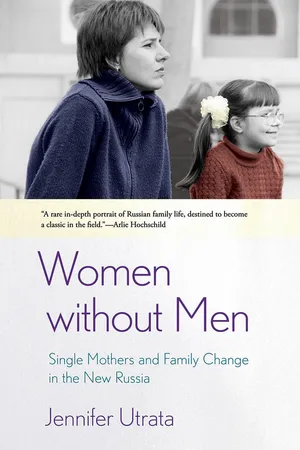
Women without Men illuminates Russia's "quiet revolution" in family life through the lens of single motherhood. Drawing on extensive ethnographic and interview data, Jennifer Utrata focuses on the puzzle of how single motherhood—frequently seen as a social problem in other contexts—became taken for granted in the New Russia. While most Russians, including single mothers, believe that two-parent families are preferable, many also contend that single motherhood is an inevitable by-product of two intractable problems: "weak men" (reflected, they argue, in the country's widespread, chronic male alcoholism) and a "weak state" (considered so because of Russia's unequal economy and poor social services). Among the daily struggles to get by and get ahead, single motherhood, Utrata finds, is seldom considered a tragedy. Utrata begins by tracing the history of the cultural category of "single mother," from the state policies that created this category after World War II, through the demographic trends that contributed to rising rates of single motherhood, to the contemporary tension between the cultural ideal of the two-parent family and the de facto predominance of the matrifocal family. Providing a vivid narrative of the experiences not only of single mothers themselves but also of the grandmothers, other family members, and nonresident fathers who play roles in their lives, Women without Men maps the Russian family against the country's profound postwar social disruptions and dislocations.
- 290 pages
- English
- ePUB (mobile friendly)
- Available on iOS & Android
eBook - ePub
About this book
Information
CHAPTER 1
From State Protections to Post-Socialist “Freedoms”
The Changed Context of Single Motherhood
Materially I lived like most people did. So I didn’t really suffer. And back then [in the late Soviet period] money wasn’t all that necessary. . . . I suffered more morally, because my children didn’t have a father. . . . But things have changed. My daughter doesn’t even want to get married! She’s quite modern in this way for it’s a different generation now. They’ve all watched Santa Barbara.
—Natalya, divorced, 65-year-old retired schoolteacher
Paradoxes abounded in the lives of Soviet-era single mothers. Natalya, unlike her daughter, did not come of age watching Santa Barbara.1 Understanding the cultural contradictions of contemporary single motherhood requires grappling with what single motherhood meant before the collapse of state socialism. Natalya knew little about the kinds of freedoms and choices considered by the younger generation of mothers today. She knew she had to get married in order to become a mother and be considered a respectable woman. Even though she ultimately divorced, she had considered divorce mostly as a last resort. Divorce had become quite common by the late Soviet period, but cohabitation and nonmarital births were still relatively rare back in the 1970s.
When Natalya was raising her daughter, narrower social mores prevailed. In spite of the more radical ideas that had been considered in the early days of Bolshevik rule, the Soviet state was rather traditional about gender, doing little to challenge the status quo apart from its strong commitment to women’s full employment. Natalya received regular child support and her job was secure, so she felt “protected” by the state in this regard. But at the same time, Natalya felt judged by society. She cared deeply about her children’s lack of a father in the home and the moral judgments surrounding her divorced status. Soviet single mothers, especially the unmarried but to a lesser extent also divorced mothers, were officially supported, but they faced considerably more social stigma than do single mothers today.
Single mothers in the New Russia, in contrast, cannot count on either child support or a lifelong job. The vast majority work, but few feel protected as mothers in the workplace. Instead, most face discrimination as mothers, at least if they aspire beyond the lowest-paying jobs. They speak of “relying on themselves alone” and are unfazed by a variety of family arrangements, with couples perhaps living together, having a child before marriage, and even getting divorced more than once if need be, all without significant social repercussions. Premarital sex, cohabitation, nonmarital childbearing, and multiple divorces are both more common today and more socially acceptable.
Of course, even beyond Russia, single mothers navigate varying amounts of contradiction and stigma. A mother may relish the increased freedom and control she has in raising her kids, yet at the same time struggle with managing on a single income. She may be proud of her efforts to make it on her own, yet at the same time wish there were more social supports for the formidable challenges of juggling solo breadwinning and caregiving. Or she may appreciate raising her kids without having to negotiate child rearing details with a partner, yet still long for some assistance when dealing single-handedly with a child’s defiance.
But beyond the contradictions one might expect to find in the lives of single mothers, Soviet mothers had to navigate mixed messages: they felt protected by the state, yet judged by society. Indeed, Soviet single mothers experienced almost the reverse of what Russian single mothers experience today. Soviet single mothers of all kinds were at least tolerated and mostly supported officially by the state as worker-mothers, but in everyday life they were made keenly aware of the stigma of their second-class single status. This was especially so for unmarried mothers, but divorced mothers faced stigma as well.
To paraphrase Natalya, Soviet single mothers materially had a standard of living similar to that of other mothers. Single mothers were not set apart from other citizens. Those who could not rely on the support of their own mothers or relatives struggled more than others to ensure that their children did not lack anything that they perceived children in two-parent families enjoyed. But when they took a four-hour train ride to Moscow every couple of weeks to locate proper-fitting shoes for their kids or sausage for the family dinner table, they did so alongside many other ordinary Russians riding that same train. Russians joke sarcastically about this “equality in poverty” they once experienced: “We were all equal back then . . . we were equally poor!”
Kalugans of all kinds relished telling me an anecdote based on a common Soviet ritual in the town: “What’s long and green and smells like sausage? An elektrichka [suburban electric train] arriving from Moscow!” Everyone knows the joke, and many Kalugans have either been on that train or had a close relative riding it for them. Of course, for some women, traveling by train to buy good shoes or sausages had been humiliating and far from a laughing matter. Many report being treated with disdain, if not scorn, by native Muscovites. Yet most ordinary people, especially women expected to be masters of mundane matters of byt, had spent time waiting in those lines and riding that same green train.2 The sense of solidarity with others struggling and facing similar problems is much weaker today, mainly because of the onset of neoliberal market capitalism and accompanying ideologies of self-reliance (see chapter 3). Soviet citizens recall feeling solidarity with others facing similar kinds of struggles in acquiring deficit goods. Fewer citizens faced the extremes of hunger or deprivation that exist today.
At the same time, Soviet citizens, including single mothers, did face inconveniences and material challenges. Sometimes this involved dealing with frustrating deficits of various consumer goods or limited choices regarding child care arrangements. But most still had a great deal that they could reliably count on. Unlike women today, most Soviet single mothers could count on getting regular child support, basic medical care, child care, on having enough provisions to get by and feed their families, and on feeling secure in their jobs even when they had to stay home with a sick child. Many enjoyed being able to travel to Eastern Europe or elsewhere in the Soviet bloc on vacation or qualifying for a voucher for a stay at a sanatorium as a single mother with a child. Today many single mothers cannot indulge in a cappuccino at a street corner café.
The context of single motherhood has changed dramatically. This is not merely an issue of Soviet single mothers looking at their years of raising children through rose-colored glasses or even one of perceptions of single motherhood changing. Although nostalgia may sometimes affect women’s recollections, and single motherhood is certainly more normalized and more common (and thus perceived differently) today than it was in the Soviet era, many of the problems single mothers face have either objectively changed or worsened. For instance, Soviet mothers did not worry much about finding a decent job because jobs were guaranteed, nor did they worry as much about children’s fathers paying child support because such support was deducted from the salaries of fathers, all of whom worked for state enterprises. In the new Russia, the state no longer guarantees anyone a job, and the enforcement of child support payments has declined precipitously even as more men are working unofficially (frequently earning more than their official salaries indicate) in the private sector. And even Soviet-era problems that are not brand-new, such as men’s heavy drinking, have only worsened in the post-Soviet period.
Moreover, during the postwar and late Soviet periods, when cracks in the system did surface, mothers felt entitled to complain to the authorities and to have their concerns addressed by the state. After all, they were workers and mothers serving the state in a respected dual role. Doing their jobs well contributed not only to their own families but to society as a whole. Women such as Irina, a Soviet single mother, observe: “It was a different time back then. All that mothers do at home is important of course, but these days it’s no longer really valued. At least not as it was before. Women are no longer protected as mothers.”
Besides the retrenchment of state support for women and families, women’s feelings of entitlement to a set of social protections have changed or are at least much more muted among the newer generation of single mothers. The ground has shifted, and most mothers feel there is little chance of going back. Few have much faith anymore in society placing considerable value on a mother’s unpaid caregiving. Women’s work used to be lauded, and however symbolic the state’s praise sometimes was, it meant something to some women. But most of this appears to be in the past. Much of the work that women once did for society is now considered a private issue and a choice, no longer a public duty deserving of tangible support, much less symbolic honor. Its problems notwithstanding, late Soviet state socialism provided some guarantees and stability. These guarantees and the accompanying sense of stability are now gone.
The Soviet Gender Order: A Façade of Liberation
Women were more protected by the state as workers and as mothers in the Soviet period, but this does not mean that they were liberated or equal to men in practice. Far from it. In spite of more equality in poverty in Soviet times than exists in today’s vastly unequal Russia, to be a Soviet single mother always raised eyebrows as to a woman’s morality or to her skill in being able to keep a man around. Marriage in Soviet society gave a woman much more than a stamp in her passport and an official status; marriage gave her a stamp of respectability. Women could turn to the state for support in what was considered women’s natural double burden in juggling paid work and motherhood, and they could turn to the Communist Party to try to keep philandering, heavy-drinking husbands in check. But a good woman was expected to quietly juggle her many responsibilities, including her man.
Having a man brought significant social status to women in everyday life. Regardless of the extent to which he was faithful, sober, or helpful, just having a man at home conferred status. Without a man, a woman was considered less respectable in society, and she might be seen as personally at fault for failing to hold onto her man. As one Soviet mother reflected: “People saw a husband as only raw material. A good woman should be able to not only keep him but to make a man out of him.” A woman on her own, Soviet mothers explained, had somehow failed as a woman. And as another Soviet mother observed, “Most of us knew that probably another woman would look at that same troubled guy and take on the challenge. Men in Russia don’t stay single for long . . . unless of course they are completely a lost cause!”
This was a peculiar kind of “liberation” indeed. In the Soviet gender order, the state mandated women’s participation in the labor force while letting gender traditionalism flourish at home and in everyday life, creating a mere façade of liberation. Soviet women had been liberated in the sense that they had no choice but to labor alongside men in factories and enterprises while occupying lower-paid, second-tier jobs relative to men. In all kinds of workplaces, women were considered second-class workers because of their many responsibilities at home. At the same time, women were expected by the state and society to do all of the “women’s work” at home, with little or no help expected from men, turning to the state as ultimate father and patriarch if and when troubles at home proved to be too much. Motherhood was politicized, and women were supported as worker-mothers by the state, whereas fatherhood was marginalized, with the state downplaying men’s patriarchal authority at home but doing little to transform gender relations. The Soviet state paid lip service to gender equality, relying on women’s paid labor while at the same time underpaying women for their work.3
Relative to what has been written about women’s “second shift” of housework and child care in the West, where inequalities at home persist in spite of women’s integration into the workplace, Russia is a more extreme case. The inequalities between women and men at home in Russia, even though women have long worked full time, are rather stark. The state did not encourage men’s participation in housework and child rearing, since men were to instead focus their efforts on working, managing, and leading state enterprises. Male dominance was left unchallenged as a norm in the Soviet period, even though the state tried to shift the basis for masculine identity to work rather than private patriarchal power. Furthermore, women’s notorious double burden was especially onerous since apart from child care the state’s social services were, according to Ashwin and other scholars, “woefully inadequate.”4 Given consumer shortages and the lack of modern conveniences in the Soviet period, many women describe going to work as a respite from all of their responsibilities and burdens at home. In spite of women’s increased participation in paid work, they were always expected to manage the home and children, all while coping with shortages of consumer goods and lacking many conveniences and shortcuts available in other parts of the world.
This chapter analyze...
Table of contents
- Acknowledgments
- Introduction
- 1. From State Protections to Post-Socialist “Freedoms”
- 2. Diminishing Material Difficulties
- 3. “Where the Women Are Strong”
- 4. It Takes a Babushka
- 5. Blurred Boundaries
- 6. Marginalized Men
- Conclusion
- Notes
- Bibliography
- Index
Trusted by 375,005 students
Access to over 1.5 million titles for a fair monthly price.
Study more efficiently using our study tools.
Frequently asked questions
Yes, you can cancel anytime from the Subscription tab in your account settings on the Perlego website. Your subscription will stay active until the end of your current billing period. Learn how to cancel your subscription
No, books cannot be downloaded as external files, such as PDFs, for use outside of Perlego. However, you can download books within the Perlego app for offline reading on mobile or tablet. Learn how to download books offline
We are an online textbook subscription service, where you can get access to an entire online library for less than the price of a single book per month. With over 1.5 million books across 990+ topics, we’ve got you covered! Learn about our mission
Look out for the read-aloud symbol on your next book to see if you can listen to it. The read-aloud tool reads text aloud for you, highlighting the text as it is being read. You can pause it, speed it up and slow it down. Learn more about Read Aloud
Yes! You can use the Perlego app on both iOS and Android devices to read anytime, anywhere — even offline. Perfect for commutes or when you’re on the go.
Please note we cannot support devices running on iOS 13 and Android 7 or earlier. Learn more about using the app
Please note we cannot support devices running on iOS 13 and Android 7 or earlier. Learn more about using the app
Yes, you can access Women without Men by Jennifer Utrata in PDF and/or ePUB format, as well as other popular books in Social Sciences & Russian History. We have over 1.5 million books available in our catalogue for you to explore.