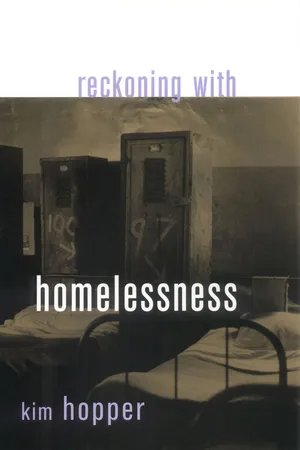
"It must be some kind of experiment or something, to see how long people can live without food, without shelter, without security."—Homeless woman in Grand Central StationKim Hopper has dedicated his career to trying to address the problem of homelessness in the United States. In this powerful book, he draws upon his dual strengths as anthropologist and advocate to provide a deeper understanding of the roots of homelessness. He also investigates the complex attitudes brought to bear on the issue since his pioneering fieldwork with Ellen Baxter twenty years ago helped put homelessness on the public agenda.Beginning with his own introduction to the problem in New York, Hopper uses ethnography, literature, history, and activism to place homelessness into historical context and to trace the process by which homelessness came to be recognized as an issue. He tells the largely neglected story of homelessness among African Americans and vividly portrays various sites of public homelessness, such as airports. His accounts of life on the streets make for powerful reading.
- 282 pages
- English
- ePUB (mobile friendly)
- Available on iOS & Android
eBook - ePub
Reckoning with Homelessness
About this book
Information
Subtopic
Poverty in SociologyIndex
Social SciencesPART I

CLASSIFICATION AND HISTORY
[1]
This Business of Taking Stock
It must be some kind of experiment or something, to see how long people can live without food, without shelter, without security.Homeless woman, Grand Central Station, winter 1980
As introductions to homelessness go, mine as a newly arrived graduate student in New York in 1972 was hardly traumatic. But it was an uneasy mix of the grim, the wrenching, and the comic. There were, first of all, those inescapable images of the city’s forsaken: the half-naked man cavorting in the steam pouring out of vents at a street construction site early one morning, wraithlike in the glow of mercury-vapor lights; the sobbing figure of a woman sitting on the stone steps of a church, the still body of a man lying prone on a sidewalk, the plaintive importuning of a beggar at the subway turnstile—each studiously ignored by passersby. There was even then the wandering army of men and women given to animated, sometimes agitated, conversations with unseen companions in what sounded like a pidgin of obscene and foreign tongues. I had recently finished a six-month stint as a psychiatric aide on an acute ward and my initial reaction was that I knew these people, or had known them in a former life as patients.1 In a city that was centuries away from a subsistence economy, it seemed incredible that they belonged nowhere, had no refuge however mean to retreat to, and were the responsibility, apparently, of no surrogate protector.
Scruffy enough in my own attire, I was occasionally taken for a fellow traveler. Leafing through a translation of Virgil’s Aeniad on the used books stand at the old Salter’s Bookstore across from Columbia University, I was joined one day by one of the Upper West Side’s regulars. Reading over my shoulder, he pronounced the translation sound. I replied, in a perverse moment of pride at having endured three years of high school Latin, that while it was a serviceable job, the original was so much more lyrical—and then went on to recite (from memory, not sight translation) the opening line of that epic poem: Arma virumque cano, Troiae qui primus ab oram.... My companion was unimpressed: “You’re not scanning correctly,” he retorted, exasperated, and proceeded to give, in a voice befitting their grandeur, an alternative reading (in Latin) of the poem’s first ten heroic lines. To my hopelessly outclassed ear, it sounded like the rendition of someone long familiar with the text.
I came, too, to know the limits of tolerance of those who were the unwitting accomplices of a graduate student’s casual charity. Confronted with the sight of my sharing a table with a large, zanily outfitted woman—and her even larger grocery cart of belongings—the owner of the West End Cafe (who knew me as a regular, all-hours customer) was hard-pressed to let us stay long enough to finish our coffee. After we were thrown out, I did, however, demur at her suggestion that we continue our conversation at my dorm room. I saw her irregularly on the street thereafter, and would remake her acquaintance at a Catholic Worker House of Hospitality a decade later.
Suffice it to say that I, like any half-sentient city dweller of that period, was acquainted with the obvious. I did the requisite tour of the Bowery, visited some of the seedier bars in the Lower East Side’s repertoire, and succumbed regularly to the entreaties of panhandlers—some of whom I occasionally queried, only to be fobbed off with (what I was later to learn were) stock responses. A vague resignation, almost an absentmindedness, slowly displaced my initial disorientation. I grew accustomed to random, visible suffering as a routine fact of urban life. I suppose I figured this was part of what acquiring a New Yorker’s toughness was all about.2
At the same time, I managed to miss altogether some subtler, more enduring signs of street poverty. One in particular stands out. Every morning, beginning around six, the queue begins to form at the St. Francis Breadline on West 31st Street Men and women have been lining up here for sandwiches and coffee for more than sixty years. Minutes after the food is gone, so are the recipients. But if one looks closely, a trace of their presence remains: the lower five feet of the beige brick wall against which they stand is several shades darker than the rest of the wall. The stain, a sort of signature, runs for half a block, becoming invisible only when it meets a darker brick in the adjacent building.
Only gradually would I come to understand that these folks were something other than the hapless conscripts of a failed psychiatric campaign. But then I was a slow learner. Even before my own alternative account took shape, I would run across puzzling parallels in the historical literature. There were the elderly homeless poor in the eighteenth-century French countryside described by Olwen Hufton:
The aged woman was a more common figure than the aged man: a black bundle of rags with permanent backache and prone to incontinence . . . and with ulcerated varicose veins.3
Then there was “Rags,” a turn-of-the-century “knight of the road” who could have stepped out of a New York City tableau eighty years later:
... a massive, hairy, lousy gentleman dressed in an assortment of clothes, including four coats, three pairs of pants, and three shirts. In each pocket was something—books, needles and thread, old pieces of iron, scraps of paper. His outside coat was covered with approximately fifty different badges and buttons. Rags was a walking trash can.4
Nearer to home and my own generation was the legacy of Jack Kerouac and crew. Among the latter was Neal Cassady, whose childhood had been spent in Denver flophouses with an alcoholic father and whose career as a writer and wayfarer (lastly with Ken Kesey’s Merry Pranksters) came to an amphetamine-accelerated end. In the span of a short lifetime, he managed to join two radically different modes of homelessness: skid row and hippie nomadism.
The closer I looked, the more I saw of both continuities and discontinuities. Meanwhile, the numbers of the street-dwelling poor continued to grow. By the later ’70s, my own perplexity, inquisitiveness, resignation—or some mixture of all three—had given way to a half-informed anger at the misbegotten policies of the mental health system. I spent the summer of 1976 doing fieldwork on an acute psychiatric ward, on which the average length of stay of (oft-returning) patients was two weeks. That experience, revisited repeatedly during a long-running interdisciplinary seminar on ethical issues in behavior control which recruited clinical participants from that ward, convinced me that to understand this small arc of these inmates’ life circuit, one would need to know more about their lives on the outside. So when chance beckoned, in the form of a phone call from Ellen Baxter in 1979 asking me to join a research project, I leapt at the prospect.
It would take a year and a half of interviews and observations, getting to know both the terrain and the people who made it their home, before we would set down what we had learned in Private Lives/Public Spaces (1981). In the end, it came down to something rather elemental: the “terribly complicated” business, as George Orwell had called it, of learning to survive on next to nothing. First and last, as one of our informants reminded me on the occasion of the opening of a new drop-in center, the folks on the street were “people just maneuvering as best as they are able.” Much later still, I would come to appreciate the maneuvering that had occurred before the threshold of homelessness had been crossed. And again, it had been in front of my eyes all along.
A Brief Look Backward
Thirty-five years ago in New York City, vagrancy was a crime, practiced (if a status can be said to be practiced) chiefly by elderly white men, who tended to congregate along a grubby mile-long corridor of the Lower East Side known as the Bowery. Here was located the city’s “skid row,” an area known for its cheap lodgings, rough taverns, petty commerce, and broken lives. In these tawdry surrounds, urban missionaries tirelessly plied their trade in soup and sermons, as they had been doing for nearly a century. Small knots of men pooled their change for bottles of wine and retired to vacant lots or street corners to drink it. Spot labor pools provided sporadic employment for some, while others turned to varieties of street enterprise: panhandling, unloading trucks, taking grimy rags to the windshields of motorists at stoplights. “Jackrollers,” muggers of the lowest order, preyed on the unwary or insentient. Discipline was lax, limited to periodic forays by the police, as likely to net a sober man as the habitual drunk. Night brought an end to the unruly sociability of the day and evening. Commercial flophouses operated at 60 percent capacity, while missions (where the berths were free) ran at triple their official capacity. By the early morning hours, perhaps a few dozen men could be found sleeping outdoors, huddled in weedy lots or ruined buildings, sprawled in doorways, or tucked away in abandoned vehicles.
The Bowery was at once familiar and alien, a place where poverty, disengagement, and “antisocial behavior patterns” intersected in a laboratory-like demonstration of “what sociologists have commonly referred to as ‘anomie,’ in this case lack of adherence to norms held by the society at large.”5 For a population untrammeled by the usual ties that bind and reportedly immune to obligations that order, Bowery men were remarkably well behaved, seldom venturing beyond the confines of skid row. The reverse was not true. Haunt of the permanent stranger, the Bowery erected few barriers to the curious. Sociologists found this convenient: “For the price of a subway ride, [one] can enter a country where the accepted principles of social interaction do not apply.”6 So did ordinary citizens: The lure of its notoriety was such that sightseeing tours regularly included it along their scheduled routes, a practice that dated back to the 1930s.7
The last three decades have seen dramatic changes in this social niche. Vagrancy is no longer a status offense; it was decriminalized by the Supreme Court in early 1972.8 By early 1980, when our work began in earnest, the average age of a man in the shelter system was in the midthirties; for the first time in the institution’s history, most new applicants for shelter were African American. While hardly insignificant as a species of “deviance,” chronic alcoholism had yielded ground to psychiatric disorders and polymorphous expressions of “substance abuse.” Spot work was considerably harder to come by. Punk rock clubs occupied the street-level floors of old flophouses. Authors, lawyers, and arbitrageurs had taken up residence in newly renovated units along the mile-long stretch of the Bowery.
Other things had changed little. The lodging houses (those that had resisted the nascent stirrings of gentrification in the area) and the missions continued to do brisk business. (Both operate at full capacity, though with different clienteles, today.) One or two of the bars, the predatory elements, the unsolicited windshield washing, and the tour buses were still there. A palpable air of dissolution still clung to the place. Its century-old reputation as the city’s back-burner melting pot of “tramps, panhandlers, whores and vagrants”—minus, perhaps, the commercial sex—showed no sign of abating.9
To be sure, the Bowery no longer could lay claim to being the city’s exclusive niche of vagrancy. Visible evidence of those without a bed for the night was scattered far and wide throughout Manhattan. And there was soon to be a shift in lexicon. Following the lead of advocates and the courts, the press would retrieve an old Victorian term, long favored by students of the problem. Instead of “derelicts,” one now referred to “homelessness.”
What follows is a hybrid account, joining the hand-to-mouth immediacy of having been there with the luxury of looking back—one troubled participant’s attempt to assay the career of homelessness among single men in the last quarter of the twentieth century.
Mongrel Methods, Applied Work
To begin with, a word about methods. In practice, ethnography means carrying out two distinct kinds of inquiry, pursuing two ways of knowing: what might be referred to as framework and fieldwork. They relate to one another as context and story, disciplinary backdrop and case-at-hand, history and action. But however formulated, a full anthropological account invariably includes both.10
Framework is concerned chiefly with “track[ing] the condition”; it monitors the changing configuration of local limits and pressures within which the object of study is situated.11 It includes all activities directed at the documentation of setting in its most encompassing sense—from the genealogy of a program, to the history of a neighborhood or client population, to the shifting configuration of relevant goods and services, to changes in the economic and political armature of a city. With respect to homelessness, archival and library work provided the indispensable material for constructing “a usable past”12 —the history of poor relief in New York City from almshouse to shelter, the legacy of skid row as an urban neighborhood, the rise of the “de facto” mental health system in the wake of deinstitutionalization, the fallout of the postwar deindustrialization of the north, and the changing configuration of the African American family over the last thirty years. Framework also refers to the intellectual backdrop against which a “problem” is defined: the work that has “gone before” and accounts for this particular question being of some interest to the field. Here, my most obvious debts are to earlier studies of homelessness in Gotham (especially those by Stuart Rice, Charles Barnes, and Nels Anderson) and of the makeshift economies of the poor, as well as the Columbia Bowery Project’s reconnaissance of what was mistakenly taken to be the twilight of that disreputable corridor. Conceptually, Ephraim Mizruchi’s construct of “abeyance mechanisms”13 and their role in accommodating surplus populations, and Victor Turner’s analysis of “liminality” and the dicey uncertainty of transitional states14 —which Jim Baumohl and I have used to reinterpret homelessness—furnish the essential flooring.
Fieldwork, on the other hand—the storied, venerable “nothing quite like being there” trial of initiation and renewal—has been de rigueur for anthropologists at least since the 1913 edition of Notes and Queries.15 That was when W.H.R. Rivers (psychiatrist, anthropologist, hero of Pat Barker’s Regeneration trilogy) insisted on “intensive participant observation studies, to be carried out by a sole researcher in a small population, over a period of at least a year.”16 This alone was to count as real anthropology. The logic was straightforward: Attempts to understand unfamiliar lives are fraught with hazards best weathered by the passage of time, trial and error, interpretive courage, and a steady dose of humiliation. Doing ethnography means taking risks and marking time; one needs room to maneuver, to construct an authentic public self which, once out there, can cease to be a cause for worry. It is notoriously inefficient, in part because the method (for which one is always, perhaps even intentionally, poorly prepared) is as much ordeal as it is discipline.17 If close documentation is fieldwork’s singular strength, it can also be its crippling obsession. Not surprisingly, then, reports from the field are typically composed of unequal measures of hard-won self-understanding, reinvented technique, and snippets of freshly appreciated ways of life.18 Fieldwork...
Table of contents
- Acknowledgments
- Part I: Classification and History
- Part II: Fieldwork and Framework
- Part III: Advocacy and Engagement
- Notes
- References
Trusted by 375,005 students
Access to over 1.5 million titles for a fair monthly price.
Study more efficiently using our study tools.
Frequently asked questions
Yes, you can cancel anytime from the Subscription tab in your account settings on the Perlego website. Your subscription will stay active until the end of your current billing period. Learn how to cancel your subscription
No, books cannot be downloaded as external files, such as PDFs, for use outside of Perlego. However, you can download books within the Perlego app for offline reading on mobile or tablet. Learn how to download books offline
Perlego offers two plans: Essential and Complete
- Essential is ideal for learners and professionals who enjoy exploring a wide range of subjects. Access the Essential Library with 800,000+ trusted titles and best-sellers across business, personal growth, and the humanities. Includes unlimited reading time and Standard Read Aloud voice.
- Complete: Perfect for advanced learners and researchers needing full, unrestricted access. Unlock 1.5M+ books across hundreds of subjects, including academic and specialized titles. The Complete Plan also includes advanced features like Premium Read Aloud and Research Assistant.
We are an online textbook subscription service, where you can get access to an entire online library for less than the price of a single book per month. With over 1.5 million books across 990+ topics, we’ve got you covered! Learn about our mission
Look out for the read-aloud symbol on your next book to see if you can listen to it. The read-aloud tool reads text aloud for you, highlighting the text as it is being read. You can pause it, speed it up and slow it down. Learn more about Read Aloud
Yes! You can use the Perlego app on both iOS and Android devices to read anytime, anywhere — even offline. Perfect for commutes or when you’re on the go.
Please note we cannot support devices running on iOS 13 and Android 7 or earlier. Learn more about using the app
Please note we cannot support devices running on iOS 13 and Android 7 or earlier. Learn more about using the app
Yes, you can access Reckoning with Homelessness by Kim Hopper in PDF and/or ePUB format, as well as other popular books in Social Sciences & Poverty in Sociology. We have over 1.5 million books available in our catalogue for you to explore.