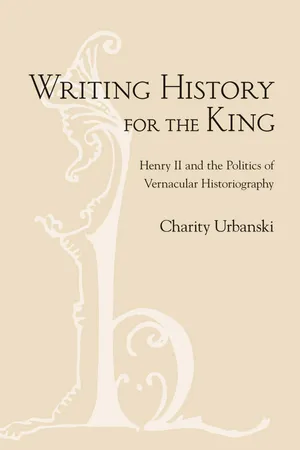
Writing History for the King is at once a reassessment of the reign of Henry II of England (1133–1189) and an original contribution to our understanding of the rise of vernacular historiography in the high Middle Ages. Charity Urbanski focuses on two dynastic histories commissioned by Henry: Wace's Roman de Rou (c. 1160–1174) and Benoît de Sainte-Maure's Chronique des ducs de Normandie (c. 1174–1189). In both cases, Henry adopted the new genre of vernacular historical writing in Old French verse in an effort to disseminate a royalist version of the past that would help secure a grip on power for himself and his children. Wace was the first to be commissioned, but in 1174 the king abruptly fired him, turning the task over to Benoît de Sainte-Maure.Urbanski examines these histories as part of a single enterprise intended to cement the king's authority by enhancing the prestige of Henry II's dynasty. In a close reading of Wace's Rou, she shows that it presented a less than flattering picture of Henry's predecessors, in effect challenging his policies and casting a shadow over the legitimacy of his rule. Benoît de Sainte-Maure's Chronique, in contrast, mounted a staunchly royalist defense of Anglo-Norman kingship. Urbanski reads both works in the context of Henry's reign, arguing that as part of his drive to curb baronial power he sought a history that would memorialize his dynasty and solidify its claim to England and Normandy.
eBook - ePub
Writing History for the King
Henry II and the Politics of Vernacular Historiography
- 256 pages
- English
- ePUB (mobile friendly)
- Available on iOS & Android
eBook - ePub
Writing History for the King
Henry II and the Politics of Vernacular Historiography
About this book
Information
Subtopic
European Medieval HistoryIndex
HistoryCHAPTER 1
Situating the Roman de Rou and Chronique des ducs de Normandie
For much of the Middle Ages there was a division between spoken and written language in Western Europe. Latin, which had been adopted by the early Christian church, continued to be used as the written language of much of Europe and the lingua franca of the Catholic Church long after it had ceased to be spoken as a native tongue. Literacy, however, was defined as the ability to both read and write in Latin, and Latin literacy was generally confined to the upper echelons of society. During the disorders of the tenth and eleventh centuries, Latin literacy declined among the laity and became the almost exclusive preserve of the Christian clergy.1 With a few notable exceptions, such as of the emergence of Old English as a written administrative and literary language in eighth-century England, vernacular writing began to reappear in Western Europe only around 1100.2 Old French was one of the first vernaculars to emerge as a literary language during this period, and the earliest literary works in Old French were produced in England.
The emergence of vernacular literature marked the beginning of the reunification of spoken and written language. Vernacular literacy rates began to climb rapidly in twelfth-century Europe, just as the patronage and production of vernacular literature began to flourish. Although Wace’s Roman de Rou and Benoît de Sainte-Maure’s Chronique des ducs de Normandie were products of this momentous shift from Latin to the vernacular, and they were commissioned by no less a patron than Henry II, they have suffered a peculiar fate at the hands of modern historians who have variously ignored, celebrated, derided, and rehabilitated them.
In this chapter I examine the place of the Roman de Rou and the Chronique des ducs de Normandie in modern scholarship, and the fraught relationship that historians have had with these texts for much of the nineteenth and twentieth centuries. Although the Roman de Rou is a special case, in that it was directly attacked and discredited as a historical source, historians have largely ignored these histories (or used them furtively) because they are written in a vernacular, in verse, and because they do not conform to modern generic expectations or distinctions. These works, however, were constructed and received as histories. Vernacular genres were still in the process of forming when they were written, and verse was a perfectly acceptable vehicle for the transmission of historical truth in the twelfth century—in fact, it was the form in which almost all twelfth-century vernacular histories appeared. The rise of prose as the language of historical truth in the thirteenth century was not the result of a crisis of confidence in verse histories. On the contrary, it was driven by a desire on the part of educated vernacular historians to distance themselves and their learned work from the jongleurs and the chansons de geste.
In this chapter I also examine the political and cultural contexts of the birth of Old French historiography in England, and the reasons that Old French vernacular historiography emerged in England almost a century before it appeared elsewhere in Europe. Post-Conquest England was unique in that it had both a newly established aristocracy with a pressing need to project its own legitimacy and integrate itself into insular culture and a native tradition of vernacular history writing in Old English that the new Norman elite could draw upon. By the turn of the twelfth century, when the first histories written in Old French began to appear, the foreign Norman and native Anglo-Saxon nobilities had largely merged into a single Anglo-Norman aristocracy through intermarriage. It was these Anglo-Norman nobles who patronized the earliest Old French histories, histories that almost invariably focused on the various inhabitants (and conquests) of Britain. For the first few generations of nobles born of unions between the Anglo-Saxons and their Norman conquerors, insular history was at once an object of fascination, a way to make sense of their own more recent history, and a means of forging a new Anglo-Norman identity. Finally, I argue that Henry II was following a well-established Norman tradition of using history to legitimize his power when he did something truly innovative—he appropriated the new genre of Old French verse historiography in an attempt to shape opinion among the Anglo-Norman aristocracy and clergy.
Poetry and History
The texts at the center of this study, Wace’s Roman de Rou and Benoît de Sainte-Maure’s Chronique des ducs de Normandie, will be unfamiliar to many medieval historians. Although they are dynastic histories commissioned by Henry II to commemorate the deeds of his Norman ancestors (and their authors are well known for their other works), these texts have been largely neglected by historians until quite recently. They present several problems for the historian: written in Old French, and in verse, neither has traditionally been regarded as a reliable, or even as an explicitly historical, text. Both have suffered the ignominy of being excluded from the historical canon and dismissed by many historians for much of the twentieth century.
The Roman de Rou in particular experienced a fall from favor in the late nineteenth century. In 1873, Edward A. Freeman promoted Wace as an “honest” authority and used the Rou as a source for his history of the Norman Conquest.3 In his vigorous objection to Freeman’s use of the Rou, J. H. Round noted that Wace had included contradictory material in his account of the Conquest, and argued that such conflicts rendered the Rou virtually useless as a historical source.4 Considering that the historians of Freeman and Round’s day were occupied with the difficult work of reconstructing a basic historical framework of ascertainable facts, and were already confronted with a morass of information requiring painstaking verification and chronological ordering, it is understandable that some of them should have deemed Wace’s penchant for including conflicting accounts drawn from a variety of Latin sources as a hindrance to their efforts. Round’s assessment that the Rou was unhelpful in establishing such historical facts proved compelling and was subsequently adopted by many prominent scholars of Norman history, most notably by David C. Douglas.5 As a result of this doubt about the Rou’s utility as a reliable source for the Conquest, both Wace and his history were shunned by historians for several generations. It has only been in the last few decades that historians such as René Stuip, Elisabeth van Houts, and Matthew Bennett have begun to rehabilitate the Roman de Rou and exonerate Wace by reexamining his list of the Conqueror’s companions, his description of warfare, and his representation of the battle of Hastings.6
The lack of interest that historians have displayed toward Benoît de Sainte-Maure’s Chronique des ducs de Normandie, on the other hand, has no root in a similar debate over its utility. Indeed, the distinction between the two texts is that the Rou was once regarded as an original and trustworthy source, but was rejected by later historians who found Wace’s tendency to include contradictory material an impediment to their work. Perhaps because Benoît stuck rather closely to his Latin sources and offered little material that was new or exceptional, no comparable attempt was ever made to promote the Chronique as an original source. It was regarded as thoroughly derivative and thus ignored.7
These histories suffer from the additional handicap of being written in a vernacular. Historians of the Middle Ages have had an uneasy relationship with vernacular sources for a rather obvious reason: the vast majority of our surviving primary sources are written in Latin. As the language of the medieval, educated elite, Latin was the language almost invariably used for the administration of the ecclesiastical and secular institutions on which historians lavished their attention for much of the nineteenth and twentieth centuries. The preponderance of surviving medieval vernacular texts, on the other hand, are literary works and have long been regarded as falling within the purview of literary scholars. It should come as no great surprise that historians developed a preference for Latin sources over time as they were quite simply what were most frequently encountered and utilized.
Medieval vernacular texts, especially those produced during the burgeoning of romance literature in the twelfth century, are still generally viewed with a degree of suspicion by historians—they are instinctively regarded as at least quasi fictional and therefore inherently inferior to their Latin cousins. This is partly due to the influence of the medieval hierarchy of language that we have absorbed from our sources. Latin was the language of the educated elite and Latinity was explicitly equated with literacy in the Middle Ages. Vernacular languages were held in such low esteem that a medieval person was considered illiteratus or idiota if he could not read and write Latin, even if he possessed the ability to read and write in a vernacular.8 Both the Rou and the Chronique were destined for an audience of illiterati as defined by these standards, a fact that contributed to their marginalization as it implies that they are inferior literary products intended for an unlearned audience. This audience of illiterati, however, was primarily royal and aristocratic, and the twelfth-century authors who adapted Latin texts into the vernacular for them, men such as Wace and Benoît, were educated clerics whose Latin literacy enabled them to work as translators. To put it another way, these histories were produced by men of learning for the upper echelons of medieval society in spite of their low form.
Although several generations of cultural historians have advanced the study of medieval vernacular texts in general, twelfth-century vernacular histories still find themselves at a disadvantage when Latin sources covering the same material are available.9 This has certainly been the case for both the Rou and the Chronique. Both have suffered from the fact that we have a wealth of alternative sources in Latin that recount the history of the Normans and that have been regarded as more worthy of serious historical study. Since these more reputable Latin histories of the Norman dukes and kings of England are the very sources that Wace and Benoît translated and adapted to construct the Rou and the Chronique, this fact has tended to legitimate our neglect of these vernacular histories rather than encourage their study.
Neglect of these histories has also been abetted by the fact that they do not conform to the expectations that modern readers attach to generic distinctions. The problem of genre is most apparent in the case of the...
Table of contents
- Acknowledgments
- List of Abbreviations
- Norman Genealogical Table
- Map of the Angevin Empire
- Introduction
- 1. Situating the Roman de Rou and Chronique des ducs de Normandie
- 2. Henry II
- 3. The Roman de Rou
- 4. The Chronique des ducs de Normandie
- Conclusion
- Bibliography
Trusted by 375,005 students
Access to over 1.5 million titles for a fair monthly price.
Study more efficiently using our study tools.
Frequently asked questions
Yes, you can cancel anytime from the Subscription tab in your account settings on the Perlego website. Your subscription will stay active until the end of your current billing period. Learn how to cancel your subscription
No, books cannot be downloaded as external files, such as PDFs, for use outside of Perlego. However, you can download books within the Perlego app for offline reading on mobile or tablet. Learn how to download books offline
Perlego offers two plans: Essential and Complete
- Essential is ideal for learners and professionals who enjoy exploring a wide range of subjects. Access the Essential Library with 800,000+ trusted titles and best-sellers across business, personal growth, and the humanities. Includes unlimited reading time and Standard Read Aloud voice.
- Complete: Perfect for advanced learners and researchers needing full, unrestricted access. Unlock 1.5M+ books across hundreds of subjects, including academic and specialized titles. The Complete Plan also includes advanced features like Premium Read Aloud and Research Assistant.
We are an online textbook subscription service, where you can get access to an entire online library for less than the price of a single book per month. With over 1.5 million books across 990+ topics, we’ve got you covered! Learn about our mission
Look out for the read-aloud symbol on your next book to see if you can listen to it. The read-aloud tool reads text aloud for you, highlighting the text as it is being read. You can pause it, speed it up and slow it down. Learn more about Read Aloud
Yes! You can use the Perlego app on both iOS and Android devices to read anytime, anywhere — even offline. Perfect for commutes or when you’re on the go.
Please note we cannot support devices running on iOS 13 and Android 7 or earlier. Learn more about using the app
Please note we cannot support devices running on iOS 13 and Android 7 or earlier. Learn more about using the app
Yes, you can access Writing History for the King by Charity L. Urbanski in PDF and/or ePUB format, as well as other popular books in History & European Medieval History. We have over 1.5 million books available in our catalogue for you to explore.