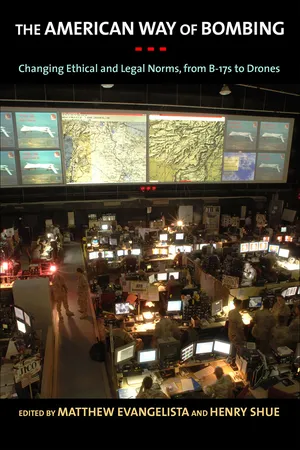
Aerial bombardment remains important to military strategy, but the norms governing bombing and the harm it imposes on civilians have evolved. The past century has seen everything from deliberate attacks against rebellious villagers by Italian and British colonial forces in the Middle East to scrupulous efforts to avoid "collateral damage" in the counterinsurgency and antiterrorist wars of today. The American Way of Bombing brings together prominent military historians, practitioners, civilian and military legal experts, political scientists, philosophers, and anthropologists to explore the evolution of ethical and legal norms governing air warfare.Focusing primarily on the United States—as the world's preeminent military power and the one most frequently engaged in air warfare, its practice has influenced normative change in this domain, and will continue to do so—the authors address such topics as firebombing of cities during World War II; the atomic attacks on Hiroshima and Nagasaki; the deployment of airpower in Iraq, Afghanistan, and Libya; and the use of unmanned drones for surveillance and attacks on suspected terrorists in Pakistan, Yemen, Sudan, Somalia, and elsewhere.Contributors: Tami Davis Biddle, U.S. Army War College; Sahr Conway-Lanz, Yale University Library; Neta C. Crawford, Boston University; Janina Dill, University of Oxford; Charles J. Dunlap Jr., Duke University; Matthew Evangelista, Cornell University; Charles Garraway, University of Essex; Hugh Gusterson, George Mason University; Richard W. Miller, Cornell University; Mary Ellen O'Connell, University of Notre Dame; Margarita H. Petrova, Institut Barcelona d'Estudis Internacionals; Klem Ryan, United Nations, South Sudan; Henry Shue, University of Oxford
eBook - ePub
The American Way of Bombing
Changing Ethical and Legal Norms, from Flying Fortresses to Drones
- 320 pages
- English
- ePUB (mobile friendly)
- Available on iOS & Android
eBook - ePub
The American Way of Bombing
Changing Ethical and Legal Norms, from Flying Fortresses to Drones
About this book
Information
PART I
Historical and Theoretical Perspectives
CHAPTER 1
Strategic Bombardment
Expectation, Theory, and Practice in the Early Twentieth Century
TAMI DAVIS BIDDLE
Even before human flight was possible, the idea of “strategic bombing” was imagined by those who envisioned the prospect of flying beyond armies and navies—the traditional guardians of nations—and attacking an enemy’s heartland directly. As this idea evolved, two subcomponents emerged. The first argued that crucial elements of an enemy’s war economy could be identified and attacked directly, destroying the enemy’s means to carry on. The second argued that an enemy population—unprotected and untrained for war—would cope poorly when bombs began to fall. That population’s acute awareness of its vulnerability would produce societal and political chaos, eroding the popular will to fight and forcing the enemy government to sue for terms. Both of these, the latter in particular, had serious ramifications for the notion of “discrimination” inherent in the just war tradition, which called on belligerents to refrain from attacking noncombatants.1
Sometimes these ideas were articulated separately, and sometimes they were merged together. Early air theorists did not always make their working assumptions clear; indeed, they rarely explained the specific logic that linked aerial attacks and enemy capitulation. But many advocates, such as Billy Mitchell, were willing to write prolifically and leverage prevailing social and political fears to promote their ideas. The argument that it would be possible to identify specific targets in an enemy war economy and then attack them directly rests on two assumptions: 1) targets can be readily located; and 2) bombers will reach their targets without suffering prohibitive losses. The argument that civilian populations will be particularly susceptible to air attack rests upon the premise that exposed citizens will be prone to disruption and panic in the face of a threat from the sky. These assumptions were highly problematic for a number of reasons, but because the interpretation of limited experience was highly colored by expectation and by cognitive and cultural bias—and because there was so little systematic analysis of First World War and interwar bombing—the foundational premises remained largely unchallenged going into the Second World War.2
For political and military elites charged with maintaining the security of states, these theories of long-range bombardment were alternately frightening and seductive. On the one hand, they threatened to nullify traditional means of preserving state security (and thus political legitimacy); on the other hand, they seemed to offer a potential “silver bullet” for both deterrence and war-fighting: a relatively inexpensive technology-intensive weapon system that might prove so daunting as to deter war, or to end it quickly should it arise. The unresolved tension between fear and seduction and the vexing issue of discrimination dominated the narrative of aerial bombing in its earliest years.
This essay will offer an overview of long-range bombing from the first years of the twentieth century through the end of the Second World War; it will compare pronouncements and expectations with actual war experience and will discuss related ideas about the possibility of protecting civilian populations in war. The failure to establish and uphold adequate protections for such populations—along with the nature of mid-twentieth-century aviation technology and the mounting pressures felt by combatants in the midst of total war—combined to produce unprecedented numbers of civilian deaths and casualties in the Second World War.3 That war and the atomic era that followed it placed civilians directly in the crosshairs of the most powerful weapons systems that had ever been imagined or created. But even though the war experience of the early twentieth century ran roughshod over norms calling for discrimination in air warfare, these were never completely abandoned. They retained a fundamental, instinctive legitimacy throughout these years and served as an essential (if battered) focal point for moral and legal discussions about air warfare.
Early Speculation about Aerial Bombing
As scientific progress continued, speculative ideas about air war were infused with the hopes, concerns, and fears of the day. In 1862, Victor Hugo prophesied that aircraft would bring about the universal abolition of borders, leading to the end of wars and a great “peaceful revolution.”4 In 1893, Major J. D. Fullerton of the British Royal Engineers theorized about an aerial “revolution in the art of war.” A year later, inventor Octave Chanute postulated that because no territory would be immune from the horrors of air war, “the ultimate effect will be to diminish greatly the frequency of wars and to substitute more rational methods of settling international misunderstandings.”5 In 1905, the British War Office’s Manual of Military Ballooning argued that balloons dropping guncotton charges might have a “moral effect” on the enemy. The “moral effect” (pronounced “morale” but spelled without the “e,” as in the French) reflected a particularly potent and widespread fixation in the European military, echoing the emphasis on “will” in warfare that Clausewitz and French writers including Foch, du Picq, Langlois, and de Grandmaison highlighted.6
This kind of speculation should not, perhaps, be surprising. After all, human flight opened up the prospect of warfare raining down from the skies, making all those below vulnerable in ways they had never been before. This prospect unsettled political leaders and military planners, who worried that those on the home front were already alienated from their governments because of the exploitation inherent in the industrial world, with its long hours of hard labor for low wages and its crowded and stressful living conditions. Frequent civil strife and workplace crises plagued industrial nations early in the twentieth century, and naturally these fueled speculation and worry about how workers would behave in wartime. In two lectures to the Royal United Services Institution in 1909, T. Miller Maguire associated what he called “the flotsam and jetsam of decaying British humanity” with the perversions of the “factory system.”7
The emphasis on “moral effects” in war emphasized the qualities valued by upper-middle-class Victorian- and Edwardian-era societies—courage, tenacity, and willpower—but it also resonated with prejudices and darker trends therein, including social Darwinism. Speculation was widespread not only about how competing states would stack up against one another but also about how different races and classes within a state might affect its overall strength and cohesion under stress. In 1908, the British anxiously watched the flight tests of Count Ferdinand von Zeppelin’s airships. Indeed, concern over Britain’s ability to defend itself was at the center of a flurry of invasion literature that peaked between 1906 and 1909.8
At the same time, it was clear that the industrial environment was eroding the ability of belligerent states to discriminate between combatants and noncombatants. Were urban workers contributing to an enemy war economy to be considered noncombatants? Were cities with governmental and administrative centers to be considered military targets in war, open to aerial bombardment? The second Hague Peace Conference of 1907, which took place after heavier-than-air flight had become a reality, sought to adapt the Rules of land bombardment from the 1899 Hague Conference. Article 25 of the land warfare convention was amended to read: “The attack or bombardment by whatever means of towns, villages, dwellings or buildings which are undefended is prohibited.” This language effectively replaced the five-year prohibition on the dropping of projectiles from aerial platforms that had been enacted at the 1899 Conference.9 But the meaning of the term “undefended” was unclear, and in any event the proscription was muddied by guidance given to naval forces that allowed for the lawful bombardment of military objects, including depots of arms or war matériel, and workshops or plants that could be utilized for the needs of the hostile fleet or army. The naval convention also absolved commanders of responsibility for “any unavoidable damage which may be caused by bombardment.”10
The language of the 1907 conference would cause subsequent confusion while failing to erect meaningful barriers in the path of air warfare. But this failure was not due solely to a lack of clarity in the wording of the law; neither the ideas nor the legal texts could exist in isolation from politics. Some states did not wish to deny themselves a potentially advantageous tool of war, and all feared the vulnerability that might arise from trusting one’s fate to documents that one’s adversaries might ignore in the heat of conflict.11 The first bombs were dropped by aircraft during the Italo-Turkish war of 1911–12, when Lieutenant Giulio Gavotti hurled projectiles onto villagers in Libya on 1 November 1911.12
The First World War
Concerns over public robustness and resilience helped shape the context for military debate and planning on the role of aircraft in war prior to 1914. But there was no consensus on what these new and still primitive machines might accomplish or how they ought to be assessed against other military resources. When war came in 1914, most of the combatant states were still integrating aerial weapons into their force structures.13 Interservice rivalries slowed progress in most states, including Britain, where aerial resources were divided between the Royal Naval Air Service (RNAS) and the army’s Royal Flying Corps (RFC). But the value of aerial reconnaissance—and thus the value of air space (both the enemy’s and one’s own)—became immediately apparent. Other roles for aircraft evolved quickly, including communication, battlefield attack and assault, and battlefield interdiction. Manuals were written and rewritten every few months.14
Most states that possessed aircraft had shown interest in strategic bombing, but the development of bombing doctrine varied. The French began aerial attacks on German industry as a way of eroding the enemy’s war-making capacity, and the Italians attacked enemy naval bases. These were pieces of integrated campaigns and were not typically seen as separate from army and navy efforts. As the French found themselves overwhelmed by the demands of the ground war in 1916 and 1917, they had fewer resources to devote to the air; increasingly, the French high command insisted that aerial efforts be concentrated on the battlefield.15
Beginning in 1915 the German Kaiser authorized the use of airships in an offensive designed to undermine both the war-making capacity and the will of their British enemy. German deputy chief of naval staff Paul Behnke speculated that the ensuing panic might “render it doubtful that the war can be continued.” In 1916, Peter Strasser, commander of the German Naval Airship Division, urged as large an offensive as possible to provoke “a prompt and victorious ending of the war.”16 Throughout 1915 and early 1916, the British were vulnerable to the onslaughts. Over time, though, the trends shifted: better fighters, special incendiary bullets, and much more efficient signals communication made flying airships over England very risky by late 1916.17
Continued stalemate in 1917 provoked the Germans to make another attempt to break the will of the British. In the spring and summer, Gotha and four-engine “giant” bombers (Riesenflugzeuge) menaced British cities. Two small daylight raids on London (13 June and 7 July) managed to cause significant casualties, raising the indignation of the British, especially in response to bombs that hit a kindergarten. The public demanded better air defenses and retaliation in kind. This public outcry—indeed, the very fact of the public’s demand for a voice in the prosecution of the war—unsettled British elites, especially in a year when strikes and industrial action had surged once again and when the Russian Revolution was in full swing.18
British field marshal Sir Douglas Haig found himself forced, against his will, to send fighters from the Western Front back to England. A commission led by South African general and statesman Jan Christian Smuts came to some radical conclusions about air warfare: “As far as can at present be foreseen there is absolutely no limit to the scale of its future independent war use. And the day may not be far off when aerial operations . . . on a vast scale may become the principal operations of war, to which the older forms of military and naval operations may become secondary and subordinate.”19 This radical text was among the catalysts for an independent air force in Britain.
The Germans bombed London again in September and then later in the autumn, under cover of night and with high hopes invested in a newly developed incendiary bomb. While it is no small thing to change one’s defense structure in the midst of a major war, British decision makers did so because of their fears of an expanded German air offensive, their anxiety about the domestic front, and the perceived need to respond to public pressure.20
Neither Haig nor Major General Sir Hugh Trenchard, then commanding the army’s air offensive on the Western Front, was interested in forming a new service. Nonetheless, by May 1918, Trenchard found himself overseeing a long-range bombing force created to wage attacks on Germany.21 A ...
Table of contents
- Acknowledgments
- Introduction: The American Way of Bombing
- Part I. Historical and Theoretical Perspectives
- Part II. Interpreting, Criticizing, and Creating Legal Restrictions
- Part III. Constructing New Norms
- Notes
- List of Contributors
Trusted by 375,005 students
Access to over 1.5 million titles for a fair monthly price.
Study more efficiently using our study tools.
Frequently asked questions
Yes, you can cancel anytime from the Subscription tab in your account settings on the Perlego website. Your subscription will stay active until the end of your current billing period. Learn how to cancel your subscription
No, books cannot be downloaded as external files, such as PDFs, for use outside of Perlego. However, you can download books within the Perlego app for offline reading on mobile or tablet. Learn how to download books offline
Perlego offers two plans: Essential and Complete
- Essential is ideal for learners and professionals who enjoy exploring a wide range of subjects. Access the Essential Library with 800,000+ trusted titles and best-sellers across business, personal growth, and the humanities. Includes unlimited reading time and Standard Read Aloud voice.
- Complete: Perfect for advanced learners and researchers needing full, unrestricted access. Unlock 1.5M+ books across hundreds of subjects, including academic and specialized titles. The Complete Plan also includes advanced features like Premium Read Aloud and Research Assistant.
We are an online textbook subscription service, where you can get access to an entire online library for less than the price of a single book per month. With over 1.5 million books across 990+ topics, we’ve got you covered! Learn about our mission
Look out for the read-aloud symbol on your next book to see if you can listen to it. The read-aloud tool reads text aloud for you, highlighting the text as it is being read. You can pause it, speed it up and slow it down. Learn more about Read Aloud
Yes! You can use the Perlego app on both iOS and Android devices to read anytime, anywhere — even offline. Perfect for commutes or when you’re on the go.
Please note we cannot support devices running on iOS 13 and Android 7 or earlier. Learn more about using the app
Please note we cannot support devices running on iOS 13 and Android 7 or earlier. Learn more about using the app
Yes, you can access The American Way of Bombing by Matthew Evangelista, Henry Shue, Matthew Evangelista,Henry Shue in PDF and/or ePUB format, as well as other popular books in Politics & International Relations & Military & Maritime History. We have over 1.5 million books available in our catalogue for you to explore.