The "Pacific War" narrative of Japan's defeat that was established after 1945 started with the attack on Pearl Harbor, detailed the U.S. island-hopping campaigns across the Western Pacific, and culminated in the atomic bombings of Hiroshima and Nagasaki, Japan's capitulation, and its recasting as the western shore of an American ocean. But in the decades leading up to World War II and over the course of the conflict, Japan's leaders and citizens were as deeply concerned about continental Asia—and the Soviet Union, in particular—as they were about the Pacific theater and the United States. In Imperial Eclipse, Yukiko Koshiro reassesses the role that Eurasia played in Japan's diplomatic and military thinking from the turn of the twentieth century to the end of the war.Through unprecedented archival research, Koshiro has located documents and reports expunged from the files of the Japanese Cabinet, ministries of Foreign Affairs and War, and Imperial Headquarters, allowing her to reconstruct Japan's official thinking about its plans for continental Asia. She brings to light new information on the assumptions and resulting plans that Japan's leaders made as military defeat became increasingly certain and the Soviet Union slowly moved to declare war on Japan (which it finally did on August 8, two days after Hiroshima). She also describes Japanese attitudes toward Russia in the prewar years, highlighting the attractions of communism and the treatment of Russians in the Japanese empire; and she traces imperial attitudes toward Korea and China throughout this period. Koshiro's book offers a balanced and comprehensive account of imperial Japan's global ambitions.
eBook - ePub
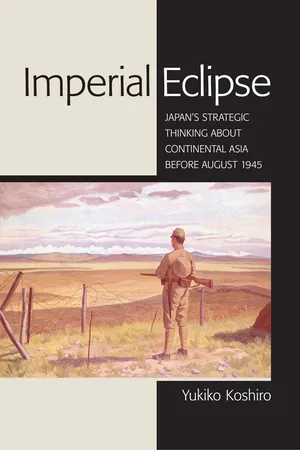
Imperial Eclipse
Japan's Strategic Thinking about Continental Asia before August 1945
- 312 pages
- English
- ePUB (mobile friendly)
- Available on iOS & Android
eBook - ePub
About this book
Information
Part I
THE PLACE OF RUSSIA IN PREWAR JAPAN
1
COMMUNIST IDEOLOGY AND ALLIANCE WITH THE SOVIET UNION
The Japanese government claims today that in “the history of the world it would be difficult to find two other nations who once engaged in war and have so rapidly established such a strong partnership as Japan and the United States.”1 The US government agrees, saying that after World War II Japan became an anchor of US security in East Asia and also one of its most important economic partners.2 So strong and self-evident do these bonds appear that other strategic configurations for postwar Japan seem implausible. This chapter recovers the plausibility, among Japanese government planners and the educated public alike during the Eurasian-Pacific War, of a postwar Japan oriented toward, even allied with, its closest geographic neighbor, the Soviet Union, America’s cold-war nemesis.
A handful of observers late in World War II insisted that a defeated Japan would decisively turn away from Asia and the Soviet Union toward the United States. John Emmerson, a member of the Dixie Mission (the US Army Observer Group) that met with Mao Zedong at Yan’an in 1944, asserted with no elaboration, “The Japanese fundamentally like us [Americans] more than they do the Russians.”3 With years of experience as a political attaché at the Tokyo Embassy, he was confident that Japan, once defeated, would never side with Russia again. If by “the Japanese” Emmerson meant a small exclusive group of Japanese businessmen, bankers, financiers, and traders who had had high stakes in the American market, he might have been right. In his famous memorandum of February 14, 1945, Prince Konoe Fumimaro signaled the danger of Japan’s reliance on the Soviet Union to Emperor Hirohito: Moscow’s ultimate interest was to turn Japan communist. The prospect of communist revolution, Konoe claimed, was ubiquitous across East Asia, from Yan’an, Manchuria, Korea, and Taiwan to Japan, and even within the Japanese Army. Emperor Hirohito should make peace with the United States before the Soviet Union joined the war against Japan in order to preclude a communist takeover of East Asia.
Emmerson and Konoe were no clairvoyants. During the war, their contentious observations represented two of many possible envisioned strategic organizations for postwar Japan. After the war, their observations became self-evident truths within the historical narrative fostered during the US occupation of Japan. The manufactured historical memory of the postwar period radically simplifies wartime Japan’s complex, diverse, and nuanced relations with, and visions of, the wider world. Through the war, Japanese leadership and the broader population alike viewed Russian and the Soviet Union with respect, and even though the relationship between the two countries was well know for competition and animosity, many Japanese also hoped to cultivate cooperation with the Soviets. Failing to recognize this complexity precludes understanding the nature of Japan’s Eurasian-Pacific War.
Japan and Russia first clashed over Korea and Manchuria in the Russo-Japanese War of 1904–5. In 1907 the Kwantung Army, a one-division force, was assigned to guard the South Manchuria Railway and the Liaotung Peninsula. After receiving independent status in 1920, the Kwantung Army increasingly assumed a politicized role in determining policy in Manchuria. From that point on the Kwantung Army monitored Russian and then Soviet forces across the Manchurian border.
When the Bolshevik Revolution challenged the ideological legitimacy of Japan’s capitalist and colonial pursuits within the imperial system, the Japanese government joined the anti-Bolshevik war at the invitation of President Woodrow Wilson and fought in Siberia from 1918 to 1920. By the early 1930s, the Japanese government had extirpated the Japanese Communist Party and battled communists across the colonial empire while denouncing the Moscow-based Comintern for aiding and instructing them.
In realpolitik terms the Soviet Union posed a double menace of military force and ideology to the Japanese empire. Despite all this, the two neighboring countries shared a pragmatism that facilitated coexistence. In establishing diplomatic relations with the Soviet Union in 1925, Japan declared that its domestic crackdown on communism and its friendship with the Soviet Union were two separate matters. The Soviet government concurred that its amity with Japan rested on mutual respect for their respective sociopolitical systems and the principle of nonintervention in each other’s domestic politics. In this spirit the Soviet embassy in Tokyo expressed uneasiness about Japanese media coverage of alleged financial ties between the Japanese Communist Party and the Soviet government, which the Japanese government identified closely with the Comintern, or the Third International.4
The establishment in 1932 of Manchukuo, whose northern border was set directly against Soviet territory, forced further compromises in Japan’s strategy concerning the Soviet Union. After two large-scale military confrontations at Changkufeng (at the convergence of the Soviet, Korean, and Manchukuo borders) in July 1938 and Nomonhan (on the Manchukuo-Outer Mongolian border) in May 1939, in both of which the Kwantung Army suffered devastating losses, the Japanese government chose not to provoke the Soviets any further and adopted a policy of “keeping peace and status quo” (seihitsu hoji). Backed up by the neutrality pact, this policy remained Japan’s strategic stance with the Soviet Union until the last stage of World War II.5
Eliminating communist influence in East Asia was Japan’s self-imposed task, as manifest in the Anti-Comintern Pact with Germany that Japan concluded in November 1936. The Japanese government situated itself as a third political force that was both anticommunist and anticapitalist. It aimed to create a self-sufficient colonial empire independent of both Soviet and Anglo-American influences. Japan’s parallel battles in China against both Chiang Kai-shek’s nationalist regime and Mao Zedong’s Chinese Communist Party (CCP) testified to its dual push against communism and capitalism. Strategically Japan could not wage a two-front war against the United States and the Soviet Union and, therefore, concluded in April 1941 the Soviet-Japanese Neutrality Pact, which became a critical precondition for the war against the United States. Amid the quagmire of war in China, Japan allied itself with the Soviet Union. While maintaining peace and the status quo, Japanese leaders constantly evaluated probable Soviet influence on the revolutionary future of East Asia.
Within the Japanese government, differences about the Soviet-Japanese Neutrality Pact existed. Not merely an exclusive product of military and geopolitical calculations, the neutrality pact also reflected Japan’s strategic goal of creating a revolutionary East Asian bloc. This inclination had its roots in wide-ranging discussions that occurred before the 1930s about Japan and communist ideas. With the outbreak of the Sino-Japanese War, a number of political and intellectual leaders sought a link between communist ideology and Japan’s revolution under its East Asian new order. The Shōwa Kenkyūkai (Shōwa Research Association), an informal organization of intellectuals engaged in discussing reforms of political and economic structures in the 1930s, envisioned a new world order that included the Soviet Union as a challenge to the Anglo-American political and economic systems. Foreign Minister Matsuoka Yōsuke shared this view when he signed the neutrality pact. By tracing the historical process of how the Japanese turned to the Soviet Union as a model and ally, this chapter demonstrates how the years 1938–40 became a watershed in Japan’s relations with the Soviet Union that led to the 1941 Neutrality Pact.
Allures of Utopia
Like their leaders, everyday Japanese had a spectrum of nuanced views about the Soviet Union and the Russians. Many people, especially those in radical antigovernment, anti-imperialistic movements, long had been inspired by their Eurasian neighbor. Some even engaged directly with Moscow. Their activities made Japan’s relationship with the Soviet Union all the more multifaceted and protean.
The Japanese people’s modern search for a utopian society began when the Meiji government launched an oppressive national project of industrialization and imperialism in the late nineteenth century. Members of antigovernment movements looked to model societies outside Japan. The Japanese looked to the revolutionary experiences of both America and Russia (and later the Soviet Union). To ask whether Japanese people had historically preferred the United States over Russia (or the Soviet Union) or vice versa is misleading. In envisioning changes suited to Japanese society, Japanese freely synthesized the two nations’ traditions as they saw fit. In this process, Japan became the junction of trans-Siberian and trans-Pacific routes on a global circuit of radical thoughts and movements.
The “opening” of Japan has been celebrated as the achievement of American Commodore Matthew Perry.6 As George Samson argues, however, “American and English historians sometime overlook the important part played by Russia in bringing about the opening of Japan.”7 Japan and Russia’s history of interactions dates back to the seventeenth century.8 The Eurasian empire situated across the Sea of Okhotsk and the Sea of Japan, Russia was long the closest geographic and cultural Western nation to Japan. After the Russian empire reached the Pacific Ocean in 1638, Russian explorers and maritime hunters in the Sea of Okhotsk crossed paths with Japanese castaways, shipwrecked merchants, fishermen, and tourists. They were rescued and taken to St. Petersburg because the Russian tsarist government, interested in opening trade with Japan, wanted to learn about their country, customs, and practices, and language. The first written record of such a case documents a Japanese trader from Osaka named Denbei, who was shipwrecked in 1695, rescued in 1697 in Kamchatka by a troop of Cossacks, and taken to meet with Peter I in 1702. Denbei spent the rest of his life in St. Petersburg as an expert on Japan. The first Japanese language school opened in 1735 as part of the Academy of Sciences and another opened in 1786 in Irkutsk, both with Japanese castaways as language instructors. The most celebrated Japanese castaway, Daikokuya Kōdayū, returned to Japan in 1793 ten years after his shipwreck and provided the Edo Bakufu, Japan’s samurai regime, with comprehensive knowledge about Russia.
Tsarist Russia continued to expand its sphere of influence beyond central Asia. In 1689 it established diplomatic contact with Qing China through the Treaty of Nerchinsk, which established a border between the two nations. Some limited trade, primarily by caravan followed. By the early nineteenth century, Russia, with growing ambitions for the Pacific Ocean, was competing against the United States and Britain to be the first nation to use Japanese ports for trade. The Russian mission occurred almost simultaneously with Perry’s expedition, but with fewer weapons. Merely a month after Commodore Perry arrived at Uraga with his gunboat tactics, Admiral Efimii Putiatin entered the port of Nagasaki in August 1853 for diplomatic negotiations. Refusing to negotiate with the Bakufu, Perry issued an ultimatum that Japan sign an agreement to open several Japanese ports for American use one year later. In contrast, Putiatin’s mission anchored at the port of Nagasaki, the only port formally open for limited foreign trade, and began full diplomatic negotiations with the Bakufu in December 1853. After the negotiation deadlocked over a territorial dispute over the Sakhalin and Kurile islands, Putiatin temporarily left Nagasaki in early January 1854 on the condition that Russia would be given the same rights should Japan conclude a commercial treaty with another nation in Russia’s absence. In February Perry returned to Kanagawa with a more threatening force of nine ships and pressed the Bakufu to sign a treaty on March 31, 1854. In December 1854 Putiatin secured a treaty of friendship similar to the one Perry had concluded.
Russia and the United States thus provided Japanese intellectuals with two portals through which they could study the outside world and think about Japan’s future. Yoshida Shōin (1830–59), a samurai revolutionary who attempted to stow away in a ship of Perry’s squadron, embodied an early Japanese desire to learn about America. Robert Louis Stevenson commemorated his heroic action in an essay about Y...
Table of contents
- List of Maps and Tables
- Acknowledgments
- Abbreviations for the Notes and Selected Bibliography
- Introduction: The World of Japan’s Eurasian-Pacific War
- Part I THE PLACE OF RUSSIA IN PREWAR JAPAN
- Part II THE FUTURE OF EAST ASIA AFTER THE JAPANESE EMPIRE
- Part III ENDING THE WAR AND BEYOND
- Part IV INVENTING JAPAN’S WAR: EURASIAN ECLIPSE
- Epilogue: Toward a New Understanding of Japan’s Eurasian-Pacific War
Trusted by 375,005 students
Access to over 1.5 million titles for a fair monthly price.
Study more efficiently using our study tools.
Frequently asked questions
Yes, you can cancel anytime from the Subscription tab in your account settings on the Perlego website. Your subscription will stay active until the end of your current billing period. Learn how to cancel your subscription
No, books cannot be downloaded as external files, such as PDFs, for use outside of Perlego. However, you can download books within the Perlego app for offline reading on mobile or tablet. Learn how to download books offline
We are an online textbook subscription service, where you can get access to an entire online library for less than the price of a single book per month. With over 1.5 million books across 990+ topics, we’ve got you covered! Learn about our mission
Look out for the read-aloud symbol on your next book to see if you can listen to it. The read-aloud tool reads text aloud for you, highlighting the text as it is being read. You can pause it, speed it up and slow it down. Learn more about Read Aloud
Yes! You can use the Perlego app on both iOS and Android devices to read anytime, anywhere — even offline. Perfect for commutes or when you’re on the go.
Please note we cannot support devices running on iOS 13 and Android 7 or earlier. Learn more about using the app
Please note we cannot support devices running on iOS 13 and Android 7 or earlier. Learn more about using the app
Yes, you can access Imperial Eclipse by Yukiko Koshiro in PDF and/or ePUB format, as well as other popular books in History & Japanese History. We have over 1.5 million books available in our catalogue for you to explore.