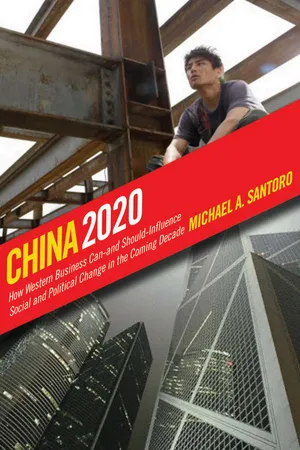
Chinese society is plagued by many problems that have a direct impact on its current and future business and political environment-worker rights, product safety, Internet freedom, and the rule of law. Drawing on knowledge gained through personal interviews, documentary sources, and almost two decades of visits to China, Michael A. Santoro offers a clear-eyed view of the various internal forces—such as regionalism, corruption, and growing inequality—that will determine the direction and pace of economic, social, and political change. Of special interest is Santoro's assessment of the role of multinational corporations in fostering or undermining social and political progress.Santoro offers a fresh and innovative way of thinking about two questions that have preoccupied Western observers for decades. What will be the effect of economic reform and prosperity on political reform? How can companies operate with moral integrity and ethics in China? In China 2020, Santoro unifies these hitherto separate questions and demonstrates that moral integrity (or lack of it) by Western business will have a profound impact on whether economic privatization and growth usher in greater democracy and respect for human rights.Offering a novel vision of China's future economic and political development, Santoro rejects the conventional view that China will muddle through the next decade with incremental social and political changes. Instead he argues that China will follow one or two widely divergent potential outcomes. It might continue to progress steadily toward greater prosperity, democracy, and respect for human rights, but it is also highly likely that China will instead fall backward economically and into an ever more authoritarian regime. The next decade will be one of the most important in the history of China, and, owing to China's global impact, the history of the modern world.China 2020 describes various tectonic social and political battles going on within China. The outcomes of these struggles will depend on a number of powerful indigenous forces as well as the decisions and actions of individual Chinese citizens. Santoro strongly believes that Western businesses can-and should-influence these developments.
eBook - ePub
China 2020
How Western Business Can—and Should—Influence Social and Political Change in the Coming Decade
- English
- ePUB (mobile friendly)
- Available on iOS & Android
eBook - ePub
China 2020
How Western Business Can—and Should—Influence Social and Political Change in the Coming Decade
About this book
Information
Subtopic
Business EthicsIndex
Business1
BEYOND THE SHADOW OF TIANANMEN
The Role of Foreign Business in China’s Uncertain Path to Democracy and Human Rights
When the Olympic cauldron rose into the night sky above Beijing’s National Stadium on August 8, 2008, it marked a momentous step in China’s emergence as a global power. The riveting spectacle, a combination of fireworks, high-tech wizardry and precisely choreographed routines executed by thousands of Chinese citizens was extravagant even by Olympic standards. When the elaborate ceremony was completed without a misstep, most ordinary Chinese people, some 1.3 billion of them, collectively exhaled—a sigh of relief mixed with nationalistic pride. With the Olympics, China’s moment on the world stage had arrived. For two weeks, global attention was riveted on China, and China put on a spectacular show. Chinese athletes performed with distinction, accumulating more gold medals than any other nation. Outside the stadium, Beijing seemed transformed into a modern metropolis, with soaring skyscrapers, (almost) clear air, a prosperous workforce, and orderly traffic. Teary-eyed basketball star Yao Ming summed up the feelings of a nation when he declared that these Olympics were about “optimism and hope for the future.” President Hu Jintao declared that the Olympics were “an opportunity not only for China but for the whole world” to “deepen mutual understanding.” With these Olympic Games, China had truly put its best foot forward.
China’s Olympic moment was especially poignant for millions of older Chinese who remembered that on October 1, 1949, less than ten miles directly south of the Olympic Stadium, Mao Zedong stood at the Gate of Heavenly Peace overlooking Tiananmen Square and declared that “the Chinese people have stood up.” As he spoke from the exact spot where for centuries emperors had addressed their loyal subjects, every Chinese person knew what Mao meant. The founding of the People’s Republic of China marked the end of the “century of shame” when this proud and ancient nation had been occupied by foreigners, first by Europeans starting in the nineteenth century and then by Japan during the Second World War. Now, nearly sixty years later, China was having its coming-out party. While there had certainly been significant setbacks—like the tens of millions who starved to death during Mao’s disastrous economic folly of “the Great Leap Forward” in the late 1950s and the millions more who suffered extreme degradation, humiliation, forced labor, and physical abuse during the Cultural Revolution of the 1960s—these setbacks seemed rooted in a distant past as China basked in the glow of the Olympic torch.
Nearly three decades have passed since Deng Xiaoping declared that “to get rich is glorious.” In that time, China has embraced free market economics, enjoying approximately 10 percent annual economic growth. Hundreds of millions of Chinese have been lifted out of poverty. Foreign investors are eager to invest billions to bet on the country’s future. In 1997, China reacquired Hong Kong from the United Kingdom, ending another humiliating chapter in its history. The Olympics marked the strongest sign yet of China’s power and prestige. In this shining moment, China could even dream of being reunited with Taiwan. What power, riches, and glory could lie ahead in the twenty-first, the Asian, the Chinese Century?
Although China’s Olympic moment was domestically exhilarating, many Western observers had a decidedly different perspective; these negative images and attitudes could be termed the “Shadow of Tiananmen.” Many Westerners still cannot forget the searing images of China from June 1989: students occupying Tiananmen Square and erecting the Goddess of Democracy; the same students and workers being slaughtered in the streets by People’s Liberation Army soldiers; and a brave, solitary man defiantly standing in front of a column of rolling tanks. For many Westerners, the dark legacy of Tiananmen will always define China no matter how prosperous and powerful it becomes.
In the years leading up to the Olympic Games, the collective concept of the Shadow of Tiananmen permeated the Western media through a steady drumbeat of negative stories: lead paint in toys, environmental catastrophes, child labor scandals, Internet censorship, toxic toothpaste, crackdowns on human rights, deadly pet food, counterfeit medicine, and on and on. Seemingly every day one organization or another issued a formulaic press release about the Olympic torch “shining a light” on corruption, incompetence, or human rights violations. Much of the criticism about China is warranted—in its rush to the future, corners have been cut, which have resulted in numerous catastrophes—but the larger truth is that China has become the country that many in the West love to hate. In the Shadow of Tiananmen mirror, every negative media report only serves to confirm the view that China is a growing menace, run by a ruthless dictatorship that has little regard for its own people and which poses a grave threat to freedom, global safety, and public health.
Eventually, the Olympic torch itself, ostensibly a symbol of global unity, became for some a symbol of Chinese oppression. In Paris in March 2008, a French protester, upset over China’s military crackdown in Tibet, climbed onto the balustrade of the Chinese embassy, tore down the Chinese flag, and unfurled a Tibetan flag. Later, another group of protesters broke through security forces and attacked Jin Jing, a wheelchair athlete, as she carried the torch through the streets of Paris. The Olympic torch was briefly extinguished, and security forces had to rescue Jin Jing from an unruly mob.
The reaction in China was swift and virulent. As news of the incident circulated on the Internet, anger and nationalistic pride boiled over. Protesters threatened to boycott French products and expressed their outrage at French-owned Carrefour department stores. The anger and resentment became so intense that the Chinese government soon took steps to tamp it down, including censoring related Internet discussions. Eventually, the president of the French Senate traveled to China to apologize to Jin Jing. On the other side, China, realizing that Carrefour employed forty thousand Chinese workers and that French investment in China amounted to billions, was also eager to move on. Jin Jing appeared on Chinese television to start a “China Smiles for the World” campaign, presenting a welcoming face to the world in anticipation of the Olympics.
China’s Olympic moment was meant to herald its emergence as a global power. After the Olympic Games concluded, however, when the medals had been awarded and the closing ceremony ended, China’s relationship with the West remained an uneasy one. Even the spectacular opening ceremony, which had engendered awe and pride among Chinese citizens, left many in the West perplexed and uncomfortable. Behind the overwhelming glitz, human spectacle, and technical wizardry, Zhang Yimou, the ceremony’s impresario, had concocted a not so subtle ideological mélange clearly meant to explain and justify China to the world. Progress and openness were celebrated but so too were the sublimation of the individual to society and the hope for a “harmonious society” free of messy conflict or dissonance. Many Westerners viewing the spectacle looked on uneasily as goose-stepping People’s Liberation Army soldiers raised the Olympic flag. China, which had cautioned foreigners to keep politics out of the Olympics, made its own political ideology the overwrought and self-absorbed centerpiece of its glittering welcome to the world.
The Shadow of Tiananmen proved to be so great that it continues to loom over China long after the Olympic flame has been extinguished. For many Chinese, conversely, the fact that so many in the rest of the world would not allow them to fully enjoy their Olympic moment tempered their pride and joy somewhat, and endures as a bitter and lingering resentment. After two weeks of athletic excellence and good will, China and the West returned to their complicated, perplexing, and often worrisome relationship.
In this book I focus on the cluster of social, economic, and political problems that constitute the Shadow of Tiananmen. As the title China 2020 implies, the book looks forward. The Olympic moment has passed. So, too, have the twentieth anniversary of the Beijing Massacre, three decades of economic reform, and nearly a decade of China’s membership in the World Trade Organization. China today is struggling to restructure its eco nomic model to respond to a global financial meltdown. It’s a good time to ask “what’s next.” This book is primarily addressed to those Westerners who would like to understand China’s challenges and how they are likely to be solved—or not—in the next decade. The book is not simply descriptive or historical. It also considers moral and ethical questions stemming from China’s increasing role as a world financial power: What role can, or should, foreigners play in helping to define and solve China’s social problems? Do multinational companies have moral and ethical responsibilities within China other than maximizing profits? Although this book’s intended audience is the West, it might also provide a basis for China to better understand the perspectives and concerns of foreigners and result in more constructive engagement with them.
China’s Problems: From the Outside Looking In
The number and variety of concerns Westerners have about China is remarkable—from Tibet to Sudan, from human rights to environmental degradation, from Internet freedom to toy safety, from sweatshop labor to the development of a fair and modern legal system. The list is seemingly endless. It is worth noting, however, that foreigners have a very different set of priorities than do Chinese citizens. According to a 2008 Chinese Academy of Social Sciences “blue paper,” the top concern of both urban and rural Chinese residents is the rising price of consumer goods, closely followed by growing income inequality and corruption.1 A 2008 Pew Research Center Study corroborated these results. Only about 10 percent of Chinese citizens reported being very concerned about the environment and product safety, whereas nearly half were very concerned about inequality and corruption and over 70 percent about inflation.2
The disparity between foreign and domestic views of China’s problems does not mean that the concerns of foreigners are illegitimate. One could, in fact, argue that the domestic list would be quite different if the researchers felt free to ask, and ordinary citizens were free to answer, questions about democracy and human rights. However, what is crucial to our understanding of modern China is that the concerns and priorities of foreigners are not necessarily shared by the Chinese people. Moreover, behind all of the problems that foreigners focus on, there are numerous pragmatic concerns and broad social problems, such as rural poverty, health care, and lack of coordination among central, provincial, and local governments, which have much greater impact on the day-to-day lives of Chinese citizens. This book considers the broad impacts of such indigenous forces as it analyzes a representative sample of the problems that most concern foreigners.
Why do so many foreigners have such strong opinions about China? Certainly, selfless humanitarianism is one important motivation. Westerners care about China because we see its government systematically and pervasively violating what we believe to be the most basic and fundamental human rights of Chinese citizens. We feel ambivalent about buying cheap Chinese imports because we worry that we are contributing to child labor abuses or the violation of workers’ rights. We are concerned about multinational corporations that invest billions in China because we think they might be contributing to suppression of basic freedoms. We are horrified by corruption and lack of governmentally enforced safety measures that result in poisonous food, products, and medicine. We worry that corporate investment might be legitimating and enriching an authoritarian regime. We are appalled at China’s heavy-handed repression of Tibetan and Uighur cultural and religious heritages.
Humanitarian concerns are not, however, the only reason Westerners care about what happens inside China; a good amount of self-interest is also at work. Because so many of our manufactured goods and, increasingly, our food and drugs come from there, China’s health and safety problems have de facto become our health and safety problems. Sometimes our concerns are a blend of humanitarian concern and self-interest. We care about sweatshop workers—but we also want to protect our own factory jobs, and we hope that if we can get China to raise its labor standards we might be able to make Western manufacturing industries more competitive. Our concern for China’s environment is also driven by the same kind of mixed motivations. We care about the many millions of villagers being displaced by the Three Gorges Dam and we worry about the toxic algae in Tai Lake in Jiangsu Province because we care about the health of Chinese citizens. But we also worry about the effect of China’s rapidly growing carbon footprint on global warming. (China has surpassed the United States as the world’s largest emitter of carbon dioxide [CO2] and is responsible for two-thirds of the annual global growth in CO2.)
A final set of concerns is about sharing global power with an illiberal, authoritarian government. The economic rise and heightened profile of a country with one-fifth of the world’s population is bound to have a profound effect on the global world order. China is not only beginning to exercise significant influence in Southeast Asia; its economic power now extends to Africa and South America. It is one of the five permanent members of the United Nations Security Council. Many in the West believe that democracies, at least those that respect civil and political liberties, do not go to war with one another.3 Hence, we worry that China will be a destabilizing presence, unless it evolves to the point where its government displays greater accountability to its citizens and respect for human rights.
The four subjects discussed in this book were selected as a representative sample of the broad array of foreigners’ concerns about China. The sweat-shop problem in chapter 2 primarily attracts global interest out of humanitarian concern, although a good deal of old-fashioned protectionism is also at work. In chapter 3 the discussion of pharmaceutical safety is about the negative externalities that Chinese manufacturing creates for consumers outside of China. Chapter 4 is about how China deals with Internet freedom, and chapter 5 provides a glimpse into the rule of law. The promise of Internet technology and the evolving rule of law may go a long way in signaling what kind of impact China is likely to have on the future of the global world order, and both subjects also involve fundamental human rights issues. The four topics I have chosen are meant to be representative of the broad range of subjects that have a combination of internal or external effects or which involve systemic issues. In each case I seek to illuminate how these problems are likely to unfold in the coming decade, as well as the critical role of foreigners. In chapter 6, I conclude by considering how the resolution of these and other issues, such as environmental sustainability, will impact China’s economic and political development in the next decade.
From Inside Looking Out: Chinese Resentment of Foreign Criticism
As the furor over the Olympic torch protests illustrates, many Chinese people are weary of and even hostile to foreign criticism. In the past two decades there has been a gradual transition in China’s collective attitude toward foreign criticism, from defensiveness to defiance. In the wake of the Beijing Massacre in 1989, there was a firestorm of global outrage. In November 1991, China’s State Council issued a “white paper,” Human Rights in China, defending the government’s actions. The white paper made three basic contentions: (1) China must give priority to political stability and economic opportunities over political rights; (2) human rights fall within the purview of national sovereignty, and so foreigners should not meddle with China’s internal affairs; and (3) human rights must be interpreted and implemented in accordance with China’s distinctive cultural values and norms, which prioritize the needs of the group over that of the individual. The white paper concludes that “the right to subsistence is the most important of human rights, without which the other rights are out of the question.”4 In the two decades since the Beijing Massacre, these now-familiar arguments have formed the bedrock of China’s defense against foreign criticism of its human rights record.
In contrast to the defensive posture outlined in the 1991 white paper, the Chinese response to the Olympic torch protests was not only defiant but also hostile. Fueling this virulence are decades of nationalist fervor deliberately cultivated by the Communist Party, through schools and state-controlled media, over issues ranging from human rights and territorial controversies with Japan to relations with Taiwan and Tibet. Before the founding of the People’s Republic in 1949, China lived under foreign domination for nearly a century. Appeals to sovereignty and national pride thus have deep resonance for most Chinese, many of whom believe that foreign powers still conspire to keep their nation from its rightful place as a world power. The government has also used nationalism to divert attention from domestic issues. Political scientist David Shambaugh has observed that this “hyper-nationalism is also fueled by the deep feelings of discontent and resentment currently gripping large sectors of Chinese society—wage arrears, stagnant incomes, unemployment, inflation, corruption, severe class disparities, environmental deterioration, a moral vacuum and a deep sense of losing ground in China’s Hobbesian economy.”5 This rising tide of nationalism will be a significant factor in China’s foreign relations in the coming decade. In her book China: Fragile Superpower, Susan Shirk argues tha...
Table of contents
- Preface
- 1. Beyond the Shadow of Tiananmen
- 2. The Clipboard, the Megaphone, and Socialist Characteristics
- 3. Drug Safety Races to the Bottom
- 4. China 2.0
- 5. Soft Seat on the Long March
- 6. Conclusion
- Notes
Trusted by 375,005 students
Access to over 1.5 million titles for a fair monthly price.
Study more efficiently using our study tools.
Frequently asked questions
Yes, you can cancel anytime from the Subscription tab in your account settings on the Perlego website. Your subscription will stay active until the end of your current billing period. Learn how to cancel your subscription
No, books cannot be downloaded as external files, such as PDFs, for use outside of Perlego. However, you can download books within the Perlego app for offline reading on mobile or tablet. Learn how to download books offline
Perlego offers two plans: Essential and Complete
- Essential is ideal for learners and professionals who enjoy exploring a wide range of subjects. Access the Essential Library with 800,000+ trusted titles and best-sellers across business, personal growth, and the humanities. Includes unlimited reading time and Standard Read Aloud voice.
- Complete: Perfect for advanced learners and researchers needing full, unrestricted access. Unlock 1.5M+ books across hundreds of subjects, including academic and specialized titles. The Complete Plan also includes advanced features like Premium Read Aloud and Research Assistant.
We are an online textbook subscription service, where you can get access to an entire online library for less than the price of a single book per month. With over 1.5 million books across 990+ topics, we’ve got you covered! Learn about our mission
Look out for the read-aloud symbol on your next book to see if you can listen to it. The read-aloud tool reads text aloud for you, highlighting the text as it is being read. You can pause it, speed it up and slow it down. Learn more about Read Aloud
Yes! You can use the Perlego app on both iOS and Android devices to read anytime, anywhere — even offline. Perfect for commutes or when you’re on the go.
Please note we cannot support devices running on iOS 13 and Android 7 or earlier. Learn more about using the app
Please note we cannot support devices running on iOS 13 and Android 7 or earlier. Learn more about using the app
Yes, you can access China 2020 by Michael A. Santoro in PDF and/or ePUB format, as well as other popular books in Business & Business Ethics. We have over 1.5 million books available in our catalogue for you to explore.