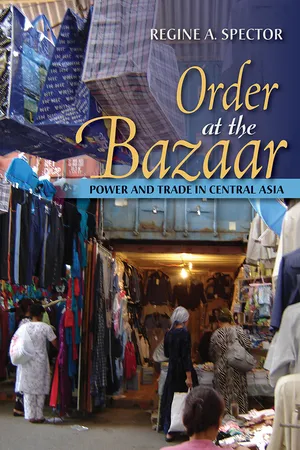
Order at the Bazaar delves into the role of bazaars in the political economy and development of Central Asia. Bazaars are the economic bedrock for many throughout the region—they are the entrepreneurial hubs of Central Asia. However, they are often regarded as mafia-governed environments that are largely populated by the dispossessed. By immersing herself in the bazaars of Kyrgyzstan, Regine A. Spector learned that some are rather best characterized as islands of order in a chaotic national context.
Spector draws on interviews, archival sources, and participant observation to show how traders, landowners, and municipal officials create order in the absence of a coherent government apparatus and bureaucratic state. Merchants have adapted Soviet institutions, including trade unions, and pre-Soviet practices, such as using village elders as the arbiters of disputes, to the urban bazaar by building and asserting their own authority. Spector's findings have relevance beyond the bazaars and borders of one small country; they teach us how economic development operates when the rule of law is weak.
- 266 pages
- English
- ePUB (mobile friendly)
- Available on iOS & Android
eBook - ePub
About this book
Information
Table of contents
- List of Illustrations
- Introduction. The Possibility of Order
- 1. Varieties of Order in a New Market Context
- 2. Changing Meanings of Bazaar Trade in Central Asia
- 3. Organizing Collectively at Dordoi Bazaar
- 4. Adapting to Bazaar Ownership through Diplomacy
- 5. Centralizing to Modernize at Osh Bazaar
- 6. Becoming Trading Elders and Local Authorities
- 7. Local Orders in Post-Soviet Bazaars and Beyond
- Conclusion. Rethinking Policy, Politics, and Development
- Acknowledgments
- Research Appendix
- Notes
- Index
Trusted by 375,005 students
Access to over 1.5 million titles for a fair monthly price.
Study more efficiently using our study tools.
Frequently asked questions
Yes, you can cancel anytime from the Subscription tab in your account settings on the Perlego website. Your subscription will stay active until the end of your current billing period. Learn how to cancel your subscription
No, books cannot be downloaded as external files, such as PDFs, for use outside of Perlego. However, you can download books within the Perlego app for offline reading on mobile or tablet. Learn how to download books offline
Perlego offers two plans: Essential and Complete
- Essential is ideal for learners and professionals who enjoy exploring a wide range of subjects. Access the Essential Library with 800,000+ trusted titles and best-sellers across business, personal growth, and the humanities. Includes unlimited reading time and Standard Read Aloud voice.
- Complete: Perfect for advanced learners and researchers needing full, unrestricted access. Unlock 1.5M+ books across hundreds of subjects, including academic and specialized titles. The Complete Plan also includes advanced features like Premium Read Aloud and Research Assistant.
We are an online textbook subscription service, where you can get access to an entire online library for less than the price of a single book per month. With over 1.5 million books across 990+ topics, we’ve got you covered! Learn about our mission
Look out for the read-aloud symbol on your next book to see if you can listen to it. The read-aloud tool reads text aloud for you, highlighting the text as it is being read. You can pause it, speed it up and slow it down. Learn more about Read Aloud
Yes! You can use the Perlego app on both iOS and Android devices to read anytime, anywhere — even offline. Perfect for commutes or when you’re on the go.
Please note we cannot support devices running on iOS 13 and Android 7 or earlier. Learn more about using the app
Please note we cannot support devices running on iOS 13 and Android 7 or earlier. Learn more about using the app
Yes, you can access Order at the Bazaar by Regine A. Spector in PDF and/or ePUB format, as well as other popular books in Economics & Central Asian History. We have over 1.5 million books available in our catalogue for you to explore.