Since its rediscovery in 1934, the fifteenth-century Book of Margery Kempe has become a canonical text for students of medieval Christian mysticism and spirituality. Its author was a fifteenth-century English laywoman who, after the birth of her first child, experienced vivid religious visions and vowed to lead a deeply religious life while remaining part of the secular world. After twenty years, Kempe began to compose with the help of scribes a book of consolation, a type of devotional writing found in late medieval religious culture that taught readers how to find spiritual comfort and how to feel about one's spiritual life. In Margery Kempe and the Lonely Reader, Rebecca Krug shows how and why Kempe wrote her Book, arguing that in her engagement with written culture she discovered a desire to experience spiritual comfort and to interact with fellow believers who also sought to live lives of intense emotional engagement.An unlikely candidate for authorship in the late medieval period given her gender and lack of formal education, Kempe wrote her Book as a revisionary act. Krug shows how the Book reinterprets concepts from late medieval devotional writing (comfort, despair, shame, fear, and loneliness) in its search to create a spiritual community that reaches out to and includes Kempe, her friends, family, advisers, and potential readers. Krug offers a fresh analysis of the Book as a written work and draws attention to the importance of reading, revision, and collaboration for understanding both Kempe's particular decision to write and the social conditions of late medieval women's authorship.
- 256 pages
- English
- ePUB (mobile friendly)
- Available on iOS & Android
eBook - ePub
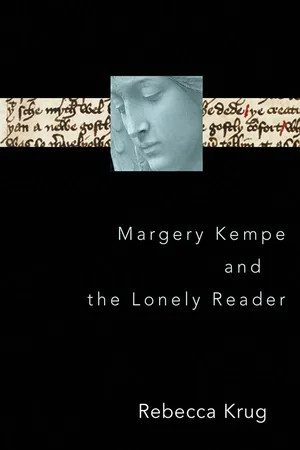
Margery Kempe and the Lonely Reader
About this book
Information
Chapter One
Comfort
Some books ask us to forget that they were written over time. The Book of Margery Kempe, in contrast, demands that readers notice the link between its production—a lived performance occurring at specific moments and in particular contexts—and the finished work. The three passages excerpted here illustrate this point. Considered in chronological order of composition, the passages form a narrative of textual production in which reading and writing are part of a search for joy, wholeness, and comfort that spans thirty years, from the early decades of the fifteenth century, when Kempe—an aural reader—began to hear books read aloud, to completion of her Book in the late 1430s. The sequence demonstrates that Kempe’s attraction to books was predicated on a belief in the ability of writing to offer “solace and comfort,” and it outlines a transitional process in which Kempe-the-reader became a writer.
- “She never heard any book—neither Hilton’s book, nor Bridget’s book, nor the Pricking of Love, nor the Fire of Love, nor any other book that she heard read aloud—that spoke more highly of the love of God than—if she knew how to or otherwise might have shown her feelings—she felt it working in her soul” (chap. 17, 51).
- “And she was many times sick while this treatise was being written, and as soon as she would begin to go about the writing of this treatise, she was suddenly hale and whole” (chap. 89, 205).
- “Here begins a short treatise and a comforting one for sinful wretches wherein they may find great solace and comfort for themselves” (preface, 17).
The first passage, from chapter seventeen of book one, refers to Kempe’s reading of well-known devotional works.1 Early in the fifteenth century, the Book’s author began visiting with an unnamed Dominican anchor who “many tymes refreschyd” her with God’s “holy worde”—an expansive term that includes other “holy books.”2 Several years later, the anchor, who had brought her such “solas and comforte” (chap. 58, 140), died. After his death, Kempe and another friend, a young priest, began, around 1413, to read devotional books together, including those named in chapter seventeen (and fifty-eight, where a similar list appears)—and did so over the course of seven or eight years. In the context of this syllabus, her eagerness for reading books is emphasized and the great value of the tutorials for both Kempe and her “lister”—her reader, the young priest—described.
Yet, despite her enthusiasm for reading, the Book indicates that Kempe found, over time and on reflection, that her encounters with devotional works were never completely satisfying. In retrospect, the books seemed an imperfect match with her emotional experiences: they left her, despite her deep desire to hear them read aloud, “hungry” and longing for something more (chap. 58, 140). Kempe, according to chapter seventeen, experienced a distance—a difference at least—between her own understandings of spiritual joy and those represented in the books she and her friends read together. She felt “as hyly” as the descriptions of spiritual joy articulated by the books’ authors, equal to the representations, that is, in degree but at the same time, different from them in kind. As a result of this lack of identity between the reader and her books, the chapter suggests, Kempe felt compelled to put her own feelings into words.
Presented in retrospect, chapters seventeen and fifty-eight explain that Kempe came to write her own book because she could no longer countenance the disjunction between her personal experiences of joy and comfort and the descriptions in written accounts. Her inability, emphasized in chapter seventeen, to describe the precise nature of her dissatisfaction and the roundabout phrasing in which speaking and writing both seem to be implied—“yf sche cowd or ellys mygth a schewyd as sche felt” (chap. 17, 51)—draw attention to her struggle to find ways to make sense of the differences between the authority of the books she read and her experiences. These chapters show Kempe, over the course of more than twenty years, coming to see reading as a catalyst for textual production. By the time the Book records her thoughts on the subject, instead of allowing books to speak for her, she had begun to write her own.
The second passage, from the very last chapter of the Book’s first part, describes the consolatory effects of composition. As Kempe, depicting her much older self (she was in her early sixties by this time), neared completion of this part of the treatise, she experienced the act of writing as deeply therapeutic. Now that she has learned to “schew as sche felt” in the process of composing her own book, the chapter explains, composition has become a remedy for ongoing “sickness.” Writing makes her “heil and hoole”—vocabulary that draws attention to its ability to heal and restore. In this passage, Kempe’s earlier uneasiness about the imperfect ability of reading to reflect her own experience is supplanted by the efficacy of composition: solace comes from recounting her feelings in writing. Because individual experience is particular, singular, and idiosyncratic, it is in need of written articulation if someone desires to “say as she felt.” Composition, the chapter suggests, allows for private expression and personal emotional fidelity.
And yet the Book locates the consolation of writing in communal sharing as well as personal expression. As Kempe and her scribe work together to compose and revise her “tretys in felyng and werkyng”—as they read over “every word” (preface, 20) of the draft, according to the preface—they both experience “holy teerys and wepingys” (chap. 89, 205–6). The shared circumstances of composition, the mutual investment in describing how Kempe felt in written words, draws author and scribe together in an emotional outpouring that merges their separate identities. Although we might understand the Book as Kempe’s alone—that is, as her own hygienic encounter with her earlier life—in refusing the distinction between author and scribe/writer/reader, chapter eighty-nine underscores the collaborative, therapeutic aspects of writing. Kempe’s feelings and reflections are the catalyst for writing, but as amanuensis and author work through her recollections, they both become active participants in the consolatory process.
This consolatory sharing occurs over time. Before becoming engaged in the work of writing the book, the scribe had been critical of Kempe. Swayed by popular opinion and official condemnation of her by a famous preaching friar, the scribe was “in purpose nevyr to a levyd hir felyngys” and he “fled and enchewyd [avoided]” her whenever possible (chap. 62, 149–50). But as they worked together, he changed his opinion about her, first, by reading books about spiritual ecstasy, like The Prickingye of Love (chap. 62, 150), which helped him understand her experiences, and then, as the excerpt quoted earlier suggests, by participating actively in the Book’s composition. In the second passage, books and personal experience become one, and the consolation of reading makes the consolation of writing possible.
Finally, the last of the three excerpts shows that the Book’s consolatory fusion of writing and reading is extended to the Book’s implied readers. In the Book, it is usually people who bring Kempe “solas and comfort.” The phrase is used, for example, in chapter fifty-eight to refer to Kempe’s friend and first reader, the Dominican anchor. Similarly, in chapter eighty-five, consolation comes from a person, in this case a childlike angelic figure who “gaf” her “comfort” by showing her, in a dream vision, that her name was written in the “boke of lyfe” (chap. 85, 195). Furthermore, the Book records Kempe’s frequent requests that Jesus should ease her fears and bring her assurance, and she herself comforts many individuals including her guides, fellow pilgrims, and fellow parishioners.
In contrast, in the passage from the preface, readers are invited to find “solas and comfort” in the pages of the Book: instead of a person, the book itself brings consolation. The scribe’s identification of the Book’s genre—a book of comfort—comes after the fact of composition, of course: the scribe wrote the revised preface after having read through the draft with Kempe, after having written a shorter, original proem, and after having rewritten the first “qwayr” of the Book.3 By the time the revised preface was composed, Kempe and the scribe had come to associate their own book with the kind of solace that Kempe had, before, gotten from other people. The preface’s generic identification focuses attention on the link between the Book’s author, who writes to find comfort, and her readers, who are invited to read to find solace.
In this story of textual production, Kempe’s dissatisfaction with other people’s books results in the composition of a book that provides her with solace of the same kind that she had found in her personal relationship with the anchor. Her Book will, in turn, allow its readers (beginning with Kempe herself and her scribes) to be comforted. It identifies itself as written by readers for readers and outlines the active and ongoing search for consolation as shared by authors, scribes, and readers. Although the Book is, finally, completely drafted, and therefore “finished,” in this narrative of textuality, writing and reading are conceived of as dynamic, unending, and ever-changing. The act of writing becomes part of the ongoing search for spiritual comfort and understanding. She thus records successes and failures, joy and misery, wholesome emotions and destructive tendencies. As she does so, Kempe invites those who read her Book to claim for themselves its assertion of the right to speak the truth of one’s feelings, to share in spiritual communities of desire, and to continue to explore the possibilities of finding comfort.
Writing her own book of consolation became the means by which Kempe sought, discovered, and created communal relationships in which she could share her desire for sustaining, emotionally realized spiritual joy. But how did she come, over the course of her life, to experienc...
Table of contents
- Preface
- Acknowledgments
- Introduction
- 1. Comfort
- 2. Despair
- 3. Shame
- 4. Fear
- 5. Loneliness
- Afterword
- Bibliography
- Index
Trusted by 375,005 students
Access to over 1.5 million titles for a fair monthly price.
Study more efficiently using our study tools.
Frequently asked questions
Yes, you can cancel anytime from the Subscription tab in your account settings on the Perlego website. Your subscription will stay active until the end of your current billing period. Learn how to cancel your subscription
No, books cannot be downloaded as external files, such as PDFs, for use outside of Perlego. However, you can download books within the Perlego app for offline reading on mobile or tablet. Learn how to download books offline
Perlego offers two plans: Essential and Complete
- Essential is ideal for learners and professionals who enjoy exploring a wide range of subjects. Access the Essential Library with 800,000+ trusted titles and best-sellers across business, personal growth, and the humanities. Includes unlimited reading time and Standard Read Aloud voice.
- Complete: Perfect for advanced learners and researchers needing full, unrestricted access. Unlock 1.5M+ books across hundreds of subjects, including academic and specialized titles. The Complete Plan also includes advanced features like Premium Read Aloud and Research Assistant.
We are an online textbook subscription service, where you can get access to an entire online library for less than the price of a single book per month. With over 1.5 million books across 990+ topics, we’ve got you covered! Learn about our mission
Look out for the read-aloud symbol on your next book to see if you can listen to it. The read-aloud tool reads text aloud for you, highlighting the text as it is being read. You can pause it, speed it up and slow it down. Learn more about Read Aloud
Yes! You can use the Perlego app on both iOS and Android devices to read anytime, anywhere — even offline. Perfect for commutes or when you’re on the go.
Please note we cannot support devices running on iOS 13 and Android 7 or earlier. Learn more about using the app
Please note we cannot support devices running on iOS 13 and Android 7 or earlier. Learn more about using the app
Yes, you can access Margery Kempe and the Lonely Reader by Rebecca L. Krug in PDF and/or ePUB format, as well as other popular books in Literature & Religious Biographies. We have over 1.5 million books available in our catalogue for you to explore.