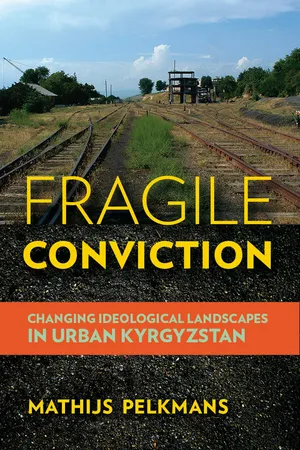
How do specific secular and religious ideologies—such as nationalism, neoliberalism, atheism, Pentecostalism, Tablighi Islam, and shamanism—gain popularity and when do they lose traction? To answer these questions, Mathijs Pelkmans critically examines the trajectories of a range of ideologies as they move into the post-Soviet frontier in Central Asia. Ethnographically rooted in the everyday life of a former mining town in southern Kyrgyzstan, Fragile Conviction shows how residents have dealt with the existential and epistemic crises that arose after the collapse of the Soviet Empire. Residents became enchanted by the truths of Muslim and Christian missionaries, embraced the teachings of neoliberal and nationalist ideologues, and were riveted by the visions of shamanic healers. But no matter how much enthusiasm and hope these ideas first engendered, the commitment to any of them rarely lasted very long.Pelkmans finds that there is an inverse relationship between the tenacity and the effervescence of collective ideas, between their strength to persist and their ability to trigger committed action. Introducing the concept of pulsation, he argues in Fragile Conviction that ideational power must be understood in relation to three aspects: the voicing of the idea, its tension with everyday reality, and its reverberation within groups of listeners. The conclusion that the power of conviction is rooted in the instability of sociocultural contexts is a message that has relevance far beyond urban Central Asia.
- 232 pages
- English
- ePUB (mobile friendly)
- Available on iOS & Android
eBook - ePub
About this book
Information
Subtopic
Central Asian HistoryIndex
Social SciencesPart I
Uncertain Times and Places
1
Shattered Transition
The Reordering of Kyrgyz Society
Located in the middle of Bishkek, Kyrgyzstan’s capital, Ala-Too Square stands out for its immensity and emptiness. Created in 1984 to mark the sixtieth anniversary of the Kyrgyz Soviet Socialist Republic (SSR), it was designed to accommodate oversized state spectacles and military parades. The square is traversed by two parallel roads and lined with buildings covered in marble: a massive cube that houses the National History Museum to the north; the presidential office building, or White House, behind a row of poplars in the northwest; arched white buildings along the square’s east and west flanks; and, to the south, the robust Ministry of Agriculture, behind which the snow-covered Ala-Too Mountains can be seen on clear, smog-free days.
If a time-lapse video had been made of the square between 1984 and the present day, it would reveal meaningful details about the political rhythms and their transformations in Kyrgyzstan over those three decades. During the first seven years of coverage, the video would draw attention to the yearly Victory Day celebrations and October Revolution parades that punctuated time in what was then a quiet, Soviet provincial backwater. Those expecting to see turbulence in the period directly before or after Kyrgyzstan gained independence, on August 31, 1991, would be disappointed—the square remained eerily quiet, a visual indicator of the reticence and wariness with which the political elite and the population at large greeted the disintegration of the Union of Soviet Socialist Republics.1 The economic crisis of the 1990s caused the square to deteriorate, leaving the fountains waterless and causing the pavement to crack open, which even the colorful new state spectacles such as those on Independence Day could not conceal. It was not until the turn of the century that the square began to play a more active role in the public life of the newly independent country. Collective prayers started to fill the square at the end of Ramadan (orozo ait) and the Feast of the Sacrifice (kurban ait), marking the return of Islam to public life and triggering debate about the proper place of religion in an ostensibly secular state. In this period the square also became an important site for expressing political discontent, featuring frequent demonstrations and meetings, and forming the center stage of two revolutions. During the largely peaceful Tulip Revolution of March 2005, the square was occupied by students and others dressed in pink and yellow shirts, before groups of young men stormed and occupied the White House (Lewis 2008, 142). Similarly, in April 2010 the square filled up just before the grand finale, when demonstrations culminated in an open clash with security forces, resulting in a battle in which at least eighty-six people lost their lives and numerous buildings around the square were burned down.
These public events are suggestive of the rhythms of Kyrgyz political life, and the issues that fueled collective action. We will return to these events, but not before considering the more slow-paced ideological currents that informed them. To gain an overview of these slower trends we could do worse than to take our time-lapse video camera and zoom in on the three statues that successively occupied the square’s central fifteen-meter-high pedestal. In 1984, the first statue to adorn what was then still named the Lenin Square was, unsurprisingly, a statue of Lenin, ten meters tall and with his outstretched right arm pointing southward toward the Ala-Too mountain range. What is unique about this Lenin is that he remained standing on his pedestal long after 1991. While in the following months and years Lenins were being removed from the central squares of most Soviet successor state capitals, Bishkek’s Lenin ended up having a longer post-Soviet than Soviet life by the time he was moved in 2003. Then, at midday on August 16, Lenin was carefully lifted from his pedestal, watched in silent protest by only a handful of people waving a flag of the USSR.2 But instead of being destroyed, Lenin was reinstalled only a hundred meters away behind the National History Museum, placed on a lower pedestal, faced northward, with his outstretched hand pointing to the Jogorku Kenesh (parliament) and the American University of Central Asia.
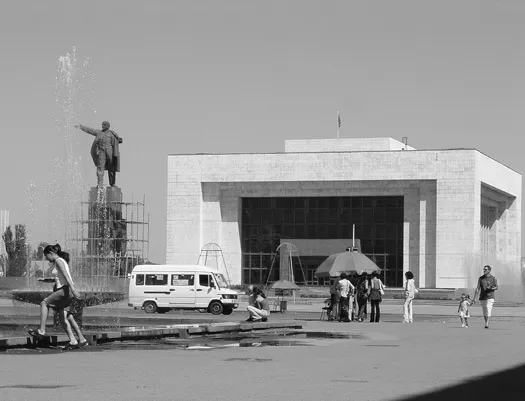
Bishkek’s Ala-Too Square in August 2003, with Lenin statue, soon to be removed, and the National History Museum
Back on Ala-Too Square, the statue replacing Lenin was the Erkindik (Liberty) statue, modeled after the Greek goddess of liberty but given a Kyrgyz face and holding in her outstretched hand not a torch but a tunduk, the wooden centerpiece of the roof of a yurt and symbol of the Kyrgyz nation. It might be fitting that Erkindik oversaw two revolutions (in 2005 and 2010), but this was a “liberty” quite different from what Akaev, Kyrgyzstan’s first president, had envisioned when he commissioned the statue. Erkindik had been designed to underscore the values of democracy and sovereignty that Akaev’s government had promoted since independence, and which had earned the country the international reputation as an “island of democracy” in the mid-1990s. However, as soon as Erkindik was placed on her pedestal, she started to draw criticism, ranging from objections to her short-sleeved dress that revealed too much bare bronzed skin and was therefore deemed non-Kyrgyz and un-Islamic, to the complaint that holding the tunduk is a sacrosanct act reserved for elderly men, and suspicion that the president’s wife had been the model for Erkindik’s face (see Cummings 2013, 612–13).
Plans to replace Erkindik were made under the authoritarian presidency of Kurmanbek Bakiev, who had come to power after the Tulip Revolution of 2005 and was ousted in Kyrgyzstan’s second revolution, in 2010. Bakiev had consulted with advisers and artists about the construction of a new statue, but “most of the concepts put forward were too local or marginal, and thus unsustainable and unworkable at a national level” (Morozova 2008, 19). As a result, Erkindik remained on the square until 2011, when she was unceremoniously removed and replaced by the solid national hero Manas, who was seated in full armor on his mighty stallion.
Manas was a legendary medieval king who had united the forty Kyrgyz tribes to lead them to victory on the battlefield, as narrated in the Epic of Manas. This epic poem developed over centuries, and although several versions have been written down since the late nineteenth century, it continues to be recited orally by narrators called manaschi. Since independence, the epic and its hero have become a key symbol of the nation-building effort, increasingly presented as the epitome of Kyrgyz culture (van der Heide 2008). Despite official attempts to boost Manas’s internationalist credentials, this Kyrgyz symbol was ultimately exclusionary for many of the republic’s non-Kyrgyz citizens (see also Wachtel 2013, 977). The Manas statue, designed by a Kyrgyz sculptor and cast in bronze in Moscow, was said to have arrived in Kyrgyzstan in 2011 on Kadyr-tun (the holy night of the Ramadan) and was unveiled during Orozo ait, cleverly tapping into a combination of religious and nationalist sentiment that had become increasingly prominent during the preceding years.
The passing away of the communist Lenin, who made way for the liberal Erkindik, who in turn was replaced by the national hero Manas, provides one glimpse of the ideological shifts that unfolded in Kyrgyzstan. But while the succession of statues reflects broader ideological currents, it does so in a rather out-of-sync manner. Thus, Lenin entered the square at a moment when the Soviet Union was already in decline, and he outlived the USSR by more than a decade. Likewise, Erkindik was erected in 2003 when the “freedom” buzz of the 1990s had lost its allure and “democratic” president Akaev had become increasingly autocratic, only two years before he was ousted in the Tulip Revolution. Finally, although the medieval Manas with his message of Kyrgyzness was supposed to be timeless, he entered the square after Kyrgyz nationalism had shown its dark side during clashes with the Uzbek minority in June 2010, and after the new government had pledged to promote an inclusive model of statehood.3
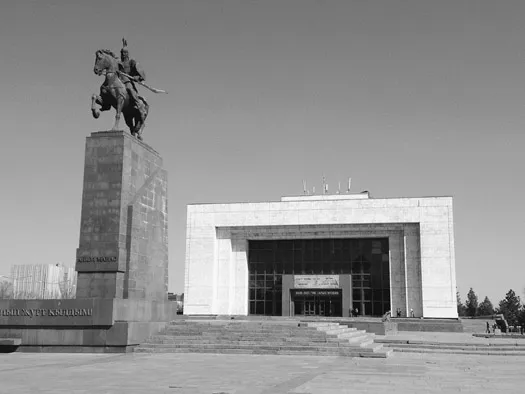
Bishkek’s Ala-Too Square with the new Manas statue, April 2014
Statues, and certainly statues on the central squares of capital cities, carry significant symbolic weight. They are designed to root state ideology in territory (literally anchoring it to the soil), to make abstract ideas concrete (even give them a face), and to allow otherwise fleeting messages to transcend time (by making them immemorial). These are some of the reasons why the toppling of prominent statues—Saddam Hussein in Baghdad, Lenin in Kiev—are powerful symbolic gestures that mark the end of epochs, bold acts that desacralize former leaders or ideologies (Verdery 1999; Grant 2001). Similarly, the erection of a new statue can be a powerful act of inaugurating a new beginning or marking a passage. Clearly these potentials informed the rotation of statues on Ala-Too Square; they were erected and removed to signal ideological change and to legitimate state power. However, the delays in the removal of Lenin and then Erkindik, and the belatedness, whether in arrival or departure, of all three statues, illustrate the difficulties that successive regimes experienced in gaining and maintaining symbolic hegemony. If we agree with Philip Abrams (1988) that the “nature of state power lay first and foremost in its ideational force, as a discursive effect of political discourse” (Grant 2001, 336; see also Comaroff and Comaroff 2000, 322–23), then the awkward dance of statues on Ala-Too Square revealed the difficulty of producing a “state idea” able to infuse a sufficiently sacred aura, one providing the legitimacy and authority necessary for effective government. Indeed, Lenin’s belated removal and the ridiculing of Erkindik, as well as Erkindik’s and Manas’s untimely arrivals, highlighted the precariousness of producing symbols sufficiently encompassing and powerful to connect with the population at large and instill a sense of inclusion and purpose.4
So what was being symbolized? I already noted that the succession of socialist, liberalist, and nationalist statues reflected real changes in the larger ideological landscape, even if the timing was off. But there is more to it. Lenin’s gaze projected a communist utopia onto the Kyrgyz horizon, his arm gesturing the people toward this bright future. By contrast, Erkindik’s message of liberty failed to outline a future, relying instead on the universal trope of “freedom” that was as detached from the local reality as she herself was floating through the air. And Manas—well, he stands firmly on the ground, but his gaze is primarily directed into a mythical past determined by kinship relations. The succession of statues, then, suggests the gradual loss of political vision, the erosion of progressive civic ideology. Moreover, while Lenin reached out to all nations, such an encompassing stance remained unrealized by his successors. Erkindik mixed Kyrgyz particularity with a universal vision of freedom but did so unsuccessfully, while the archetypal Kyrgyz hero Manas represented an ethnic world with which few Russians, Uzbeks, or representatives of other minorities identified. The statues seem to have become not only increasingly shortsighted but also exclusionary, changes that, as we will see, have had real-time parallels in Kyrgyzstan’s recent political history.
Obviously none of the above claims, which are based on a reading of just three statues, should be taken at face value. Instead they should be seen as hypotheses to be examined by following the trajectories of socialism, (neo) liberalism, and nationalism in the post-Soviet period. In the remainder of this chapter I explore how these ideologies translated into political practice, and analyze the tensions between rhetoric and reality that has characterized Kyrgyzstan’s so-called transition. Moreover, by connecting the succession of statues to the political events unfolding on the square and beyond we can see how Kyrgyzstan’s unraveling transition became interspersed with recurrent eruptions of political turmoil. This complex relationship provides insight into the reconfigurations of political and social space in the decades that followed the Soviet collapse.
Projections of Transition
“Transition” has the dubious honor of being one of the terms used most frequently to characterize post-Soviet trajectories, both by those who lived through the period and by those who observed and wrote about it. Although the dictionary meaning of “transition” is simply a period of change from one to another relatively stable situation, in its application to postsocialist countries, “transition” obtained distinct teleological qualities, that is, the observed changes were all viewed in relation to a predetermined final endpoint. As others have noted, transition ideas were essentially a slightly modified version of modernization theory, both of which convey a linear progressive and teleological kind of thinking, assuming the final stage to be a version of market democracy (e.g., Carothers 2002).
These assumptions drove the reform agenda of the first independent government of Kyrgyzstan headed by President Askar Akaev. In the early 1990s, when the country was on the brink of economic collapse, Akaev’s government opted for a transition strategy of “shock therapy” and closely cooperated with the International Monetary Fund (IMF), the World Bank, and various multilateral development institutions to carry out a comprehensive structural adjustment program. The reforms included the liberalization of markets, the privatization of property, and the reduction of welfare programs. Kyrgyzstan introduced its own currency in May 1993, and by mid-1997 it had privatized approximately two-thirds of the state sector (Anderson 1999, 71). Preparations for this comprehensive restructuring of the economy were carried out in close cooperation with international organizations. To illustrate, over 50 percent of bills passed through parliament in the 1990s were drafted by international organizations and international NGOs (Cooley and Ron 2002, 19). No surprise then that Kyrgyzstan became essentially the poster child for the Washington consensus. For example, a high-ranking Western diplomat commented in 1994 that “politically, Kyrgyzstan is light-years ahead of the other new republics. Economically, it is carefully and methodically preparing the way for a market economy.”5
Although international pressure on Kyrgyzstan’s government to adopt the structural adjustment package was significant, it would be wrong to see the Akaev government as merely a passive recipient of an externally imposed neoliberal agenda. In fact the president was a very vocal spokesperson of (neo) liberal ideology (Anderson 1999, 81). Possibly his rather excessive references to former US presidents such as Abraham Lincoln and Thomas Jefferson (Akaev 1993, 9, 18; see also McGlinchey 2011, 87; Cummings 2013) were intended to impress US donors, but they were also indicative of the kind of future society he envisioned. A good example is a published speech from 1993 in which Akaev presented a straightforward view of the direction of transition. He started by positing that Kyrgyzstan would have been prosperous if not for “some irrational path in history” due to which the country spent “seventy years … in the grip of a totalitarian system” (1993, 10–11). The way to rectify this perceived historical travesty was full-out liberalization: religious freedom, political freedom, economic freedom (1993, 11–12). This was neoliberalism in almost its purest form, which optimistically hoped (or naively assumed) that when given “freedom,” society would rid itself of the imposed “irrationalities” and be guided by a natural or intrinsic drive toward the final destination of liberal modernity.
The...
Table of contents
- List of Illustrations
- Acknowledgments
- A Note on Transliteration and Translation
- Introduction: Ideational Power in Times of Turmoil
- Part I: Uncertain Times and Places
- Part II: Dynamics of Conviction
- Conclusion: Pulsation and the Dynamics of Conviction
- Notes
- References
- Index
Trusted by 375,005 students
Access to over 1.5 million titles for a fair monthly price.
Study more efficiently using our study tools.
Frequently asked questions
Yes, you can cancel anytime from the Subscription tab in your account settings on the Perlego website. Your subscription will stay active until the end of your current billing period. Learn how to cancel your subscription
No, books cannot be downloaded as external files, such as PDFs, for use outside of Perlego. However, you can download books within the Perlego app for offline reading on mobile or tablet. Learn how to download books offline
Perlego offers two plans: Essential and Complete
- Essential is ideal for learners and professionals who enjoy exploring a wide range of subjects. Access the Essential Library with 800,000+ trusted titles and best-sellers across business, personal growth, and the humanities. Includes unlimited reading time and Standard Read Aloud voice.
- Complete: Perfect for advanced learners and researchers needing full, unrestricted access. Unlock 1.5M+ books across hundreds of subjects, including academic and specialized titles. The Complete Plan also includes advanced features like Premium Read Aloud and Research Assistant.
We are an online textbook subscription service, where you can get access to an entire online library for less than the price of a single book per month. With over 1.5 million books across 990+ topics, we’ve got you covered! Learn about our mission
Look out for the read-aloud symbol on your next book to see if you can listen to it. The read-aloud tool reads text aloud for you, highlighting the text as it is being read. You can pause it, speed it up and slow it down. Learn more about Read Aloud
Yes! You can use the Perlego app on both iOS and Android devices to read anytime, anywhere — even offline. Perfect for commutes or when you’re on the go.
Please note we cannot support devices running on iOS 13 and Android 7 or earlier. Learn more about using the app
Please note we cannot support devices running on iOS 13 and Android 7 or earlier. Learn more about using the app
Yes, you can access Fragile Conviction by Mathijs Pelkmans in PDF and/or ePUB format, as well as other popular books in Social Sciences & Central Asian History. We have over 1.5 million books available in our catalogue for you to explore.