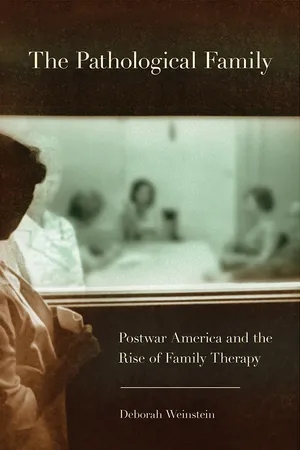
While iconic popular images celebrated family life during the 1950s and 1960s, American families were simultaneously regarded as potentially menacing sources of social disruption. The history of family therapy makes the complicated power of the family at midcentury vividly apparent. Clinicians developed a new approach to psychotherapy that claimed to locate the cause and treatment of mental illness in observable patterns of family interaction and communication rather than in individual psyches. Drawing on cybernetics, systems theory, and the social and behavioral sciences, they ambitiously aimed to cure schizophrenia and stop juvenile delinquency. With particular sensitivity to the importance of scientific observation and visual technologies such as one-way mirrors and training films in shaping the young field, The Pathological Family examines how family therapy developed against the intellectual and cultural landscape of postwar America.As Deborah Weinstein shows, the midcentury expansion of America's therapeutic culture and the postwar fixation on family life profoundly affected one another. Family therapists and other postwar commentators alike framed the promotion of democracy in the language of personality formation and psychological health forged in the crucible of the family. As therapists in this era shifted their clinical gaze to whole families, they nevertheless grappled in particular with the role played by mothers in the onset of their children's aberrant behavior. Although attitudes toward family therapy have shifted during intervening generations, the relations between family and therapeutic culture remain salient today.
- 280 pages
- English
- ePUB (mobile friendly)
- Available on iOS & Android
eBook - ePub
About this book
Information
CHAPTER ONE
PERSONALITY FACTORIES
“What’s the matter with the family?” asked eminent American anthropologist Margaret Mead in Harper’s in the spring of 1945, several months before World War II ended. In the remaining years of the 1940s, academic journals and popular magazines alike published articles that echoed Mead’s query: “The American Family: Problem or Solution?,” “What’s Wrong with the Family?,” and “The American Family in Trouble,” among many others, debated such issues as the rising rates of divorce and the deleterious impact on juvenile delinquency of fathers’ overseas service and mothers’ wartime employment. Whether concerned with the state of marriage, the ferment of race relations, or patterns of child rearing, public commentators of the postwar years fretted over the American family.1
Such anxieties drew support from the contemporaneous expansions of psychoanalysis and psychiatry in American culture, for they were often framed in terms of the psychological shaping of children. The sociologist Talcott Parsons underscored this conception of the modern American family with the vivid comment that families “are ‘factories’ which produce human personalities.”2 The discourse of “momism” further instantiated the postwar links among upbringing, mental health, and national security. Coined by Philip Wylie in 1942 in his bestselling Generation of Vipers, “momism” proved a particularly influential term, suggesting the psychic damage that bad mothering could inflict on individual offspring and ultimately on the state of the nation. According to Wylie and others such as psychiatrist David Levy in his 1943 book Maternal Overprotection, momism entailed a warped maternal instinct in overly materialistic mothers who appeared loving, doting, and selfless, but were in fact calculating and self-centered. Such mothers wreaked havoc on their children through their smothering attention, which left the children unprepared for being self-reliant.3
Family therapy’s emergence in the 1950s was symptomatic of the culturally intertwined concern with family life and confidence in psychiatric expertise that underwrote the formulation of momism, even though it undid the logic of momism by shifting attention away from the mother-child relationship to a view of the family system as patient. Family therapists produced a new definition of what a family could be—namely, a unit of disease, which had previously been contained in individual bodies. Furthermore, twentieth-century American views of the family as the site of both reproduction and socialization, nature and culture, shored up the legitimacy of therapists’ focus on the family as such.
The new definition of family as a unit of disease not only transformed the category of “family” and the meaning of “disease” but also prompted the development of new therapeutic techniques and goals. By shifting their clinical acumen from the individual to the family, early family therapists opened up space for a new set of practices that would then be appropriate for treating family-based disease. In so doing, they reconfigured the relationship between midcentury therapeutic culture and contemporaneous concerns about family life. That reconfiguration happened not just in prescriptive literature about what families should be but in the active realm of therapeutics and the development of new practices and techniques that shaped what happened in therapy sessions during the 1950s and 1960s. This chapter examines the earlier modes of expertise that informed the field’s emergence and shows how the novel clinical practices developed by early family therapists made the family itself into a therapeutic subject.
A Genealogy of Family Expertise
Family therapy of the 1950s represented a new approach to psychotherapy, but it did not arise sui generis. Rather, early family therapists drew on long-standing concerns among marital relations experts, child guidance professionals, and psychoanalysts about issues such as marital stability, child rearing, motherhood, deviancy, and mental distress. The rise of family therapy similarly built on a much longer history of the intersection between the family and the state, in which the postwar period became a critical moment of transition. During the first half of the twentieth century, the relevance of family life was variably framed in terms of mate choice and sexuality, reproduction and child care, and personality and democratic citizenry. “Family” was itself an unstable category, at once naturalized and denatured. By the 1950s, it was the target of competing theories and agendas both within psychoanalytic and psychological theory and within broader social and cultural discourses in postwar America.
The proliferation of marriage experts during the early twentieth century illustrates the centrality of the relationship between husband and wife to modern family life.4 In the United States, marital relations experts came from fields as varied as sexology, sociology, psychiatry, psychology, social work, and education. In university classes, traveling workshops, textbooks, and advice literature beginning in the 1920s, Ernest Groves and other sociologists built a family-life education movement that included material on courtship and marriage.5 The ideal of the “companionate marriage” proved particularly influential as a model to emulate. The term was coined by Judge Ben Lindsey in the 1920s and later picked up by family sociologists such as Groves and Ernest Burgess to redefine successful marriage in terms of intimacy and emotional compatibility, in contrast to the older ideals of duty, sacrifice, economic partnership, and spiritual union.6 As Jane Gerhard has argued, marriage experts such as Theodore H. Van Der Velde acknowledged the importance of female sexuality to successful marriages. However, they did so within a narrowly defined, psychoanalytically informed, heterosexual framework that defended women’s passivity and dependency and, by the 1940s, became increasingly focused on reproduction rather than pleasure.7
In addition to advice and education, counseling became a medium through which professionals tried to intervene in marital relations in order to promote marital happiness, prevent divorce, improve sexual relations, and encourage eugenic marriages among native-born whites for racial betterment.8 Marriage counseling as a field developed in the late 1920s and 1930s through the efforts of physicians (particularly from the new specialty of gynecology), clergy, social workers, and family educators such as Paul Popenoe. Its practitioners drew on the work of European sexologists with a wide range of political views, such as Havelock Ellis of Britain, Richard von Krafft-Ebing of Austria, and Magnus Hirschfeld of Germany.9 The field also had links to Progressive Era reform movements, including eugenics, mental hygiene, and social hygiene.
The case of Paul Popenoe is illustrative. Popenoe established one of the first marriage counseling centers in the United States in 1930. A strong advocate of eugenics, he served as editor of the Journal of Heredity prior to World War I and became research director at the Human Betterment Foundation in California and an advocate of sterilization of the “unfit” after the war.10 He augmented his support for the negative eugenic policies of institutionalization and sterilization of the feebleminded and other “defectives” with the positive eugenic goals of helping fit couples overcome marital discord and produce healthy offspring. Popenoe also popularized marriage counseling through a 1954 Ladies’ Home Journal series, “How to Be Marriageable,” which featured cases from the files of his American Institute of Family Relations; a syndicated newspaper column titled “Modern Marriage” (1947–57), later renamed “Your Family and You” (1958–72); and a television show, Divorce Hearing (1957–60), on which Popenoe and other “judges” listened to the problems of couples on the verge of divorce and tried to help them reconcile.11
The inspiration for Popenoe’s marriage clinic came from the marriage consultation centers established in Austria and Germany in the wake of World War I to promote racial hygiene and race betterment.12 Some of the European marriage counseling centers of the 1920s and 1930s were focused on encouraging eugenically “responsible” marriages, while other clinics were more oriented toward sex education, child-rearing advice, and birth control. Staffed by physicians, social workers, midwives, and psychoanalysts such as Wilhelm Reich, the centers often aimed to reach working-class populations. Some were private and independent, while others were state-sponsored and established by municipal or health insurance officials. Although the Austrian and German sex and marriage counseling clinics had nationally specific features, such as their dependence on the working-class politics of the Weimar Republic and national health insurance policies, their amalgamation of sex reform, eugenics, and marriage counseling influenced contemporaneous American efforts to establish marriage counseling.13 Britain’s marriage counseling movement, institutionalized in 1938 in the National Marriage Guidance Council, also served as a model for its American colleagues.14
A national organization for professional marriage counselors in the United States began meeting informally in 1942, then more formally in 1945, with the stated purpose of maintaining standards, holding meetings, and sponsoring research and publications. According to a 1948 report from a joint subcommittee of the National Council on Family Relations and the American Association of Marriage Counselors, marriage counseling as a specialty centered “largely on the interpersonal relationship between husband and wife.”15 Demonstrating a multifaceted view of marriage, this report advocated that an accredited training should cover sexual anatomy, personality development, and legal aspects of marriage, in addition to counseling techniques.
Although the field of family therapy merged with marriage counseling in the 1970s, in its early years it developed in ways that were distinct from marriage counseling. Founding family therapists of the 1950s drew their conceptions of the family more directly from psychoanalysis and psychiatry than from the eugenic, legal, religious, and gynecological backgrounds of early marriage counselors. Family therapy also differed from marriage counseling in its attention to child rearing, not just marital relations, and its early focus on schizophrenia and delinquency rather than marriage saving, sexual relations, or eugenic fitness.
Early family therapists’ approaches to parent-child relations emerged from perceptions of a deepening association between family structure and democracy during the twentieth century, as well as the growing psychologization of parenthood.16 Whereas the connection between mothering and the production of democratic citizens was long-standing, by the 1940s concerns about child rearing and political formation became increasingly informed by psychology.17 The concentration of responsibility for the socialization of children in the nuclear family during the 1920s–1940s solidified the role of parents, especially mothers, in the “enterprise of rearing psychologically healthy and productive citizens,” as historian Julia Grant has argued.18 This conjoining of psychological health with the formation of a democratic, productive citizenry in the crucible of the family marked many of the child-oriented movements of the early and mid-twentieth century.
Given the high stakes of child rearing, experts in many guises aimed to help parents guide their children’s development in the right way. They were part of a general proliferation of expert administrators in the Progressive Era. Early twentieth-century child reformers were concerned about the psychological and sociological dimensions of child rearing, as well as infant mortality, domestic hygiene, and child labor. The medicalization of motherhood and the “ideology of scientific motherhood” laid out a contrast between views of motherhood as common sense and as a profession that required training and depended on expert advice.19 The ideology of scientific motherhood buttressed women’s long-espoused maternal role in the domestic sphere but with increased emphasis on the importance of scientific and medical input for preparing women for their proper “profession” of motherhood. In baby books, magazine columns, parent education courses, pediatricians’ offices, and child guidance clinics, an array of experts offered parenting advice to audiences with varying degrees of interest and receptivity.20 Better baby contests and maternal- and infant-health programs also promoted expert guidance in child rearing that was informed by eugenic ideals.21
The mental hygiene and child guidance movements provided further avenues for expert interventions into family life and child-rearing practices. Rooted in Progressive Era confidence in scientific solutions to societal problems, the mental hygiene movement grew out of the joint efforts of a former mental patient, Clifford Beers, who wrote a critique of mental hospital abuses and established the National Committee for Mental Hygiene in 1909, and the prominent psychiatrist Adolf Meyer, who wanted to promote a role for psychiatry beyond the walls of asylums by focusing on the prevention and treatment of noninstitutional problems such as alcoholism, crime, and feeblemindedness. Although there remained significant heterogeneity within the movement among psychiatrists, other helping professionals, and lay social reformers, by the 1920s, psychiatrists’ emphasis on prevention and the popularization of psychiatry overshadowed Beers’s interest in institutional reform.
The mental hygiene movement was based on an environmental view in which childhood experiences laid the groundwork for adult mental health. Meyer defined mental health in terms of adjustment between an individual and his environment, whereas maladjustment served as the explanation for insanity, alcoholism, delinquency, prostitution, and other social problems. He believed that childhood experiences laid the groundwork for adult adjustment or maladjustment. William A. White, a psychoanalytic leader in the movement, wrote that...
Table of contents
- List of Figures
- Acknowledgments
- Introduction: The Power of the Family
- 1. Personality Factories
- 2. “Systems Everywhere”: Schizophrenia, Cybernetics, and the Double Bind
- 3. The Culture Concept at Work
- 4. Observational Practices and Natural Habitats
- 5. Visions of Family Life
- Epilogue
- Notes
- Bibliography
Trusted by 375,005 students
Access to over 1.5 million titles for a fair monthly price.
Study more efficiently using our study tools.
Frequently asked questions
Yes, you can cancel anytime from the Subscription tab in your account settings on the Perlego website. Your subscription will stay active until the end of your current billing period. Learn how to cancel your subscription
No, books cannot be downloaded as external files, such as PDFs, for use outside of Perlego. However, you can download books within the Perlego app for offline reading on mobile or tablet. Learn how to download books offline
Perlego offers two plans: Essential and Complete
- Essential is ideal for learners and professionals who enjoy exploring a wide range of subjects. Access the Essential Library with 800,000+ trusted titles and best-sellers across business, personal growth, and the humanities. Includes unlimited reading time and Standard Read Aloud voice.
- Complete: Perfect for advanced learners and researchers needing full, unrestricted access. Unlock 1.5M+ books across hundreds of subjects, including academic and specialized titles. The Complete Plan also includes advanced features like Premium Read Aloud and Research Assistant.
We are an online textbook subscription service, where you can get access to an entire online library for less than the price of a single book per month. With over 1.5 million books across 990+ topics, we’ve got you covered! Learn about our mission
Look out for the read-aloud symbol on your next book to see if you can listen to it. The read-aloud tool reads text aloud for you, highlighting the text as it is being read. You can pause it, speed it up and slow it down. Learn more about Read Aloud
Yes! You can use the Perlego app on both iOS and Android devices to read anytime, anywhere — even offline. Perfect for commutes or when you’re on the go.
Please note we cannot support devices running on iOS 13 and Android 7 or earlier. Learn more about using the app
Please note we cannot support devices running on iOS 13 and Android 7 or earlier. Learn more about using the app
Yes, you can access The Pathological Family by Deborah Weinstein in PDF and/or ePUB format, as well as other popular books in Psychology & Psychotherapy. We have over 1.5 million books available in our catalogue for you to explore.