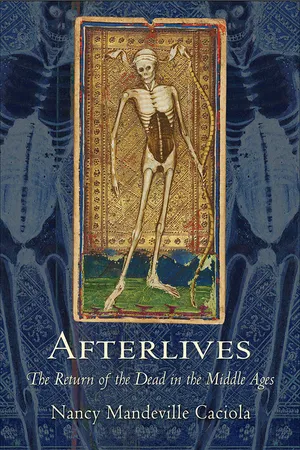
Simultaneously real and unreal, the dead are people, yet they are not. The society of medieval Europe developed a rich set of imaginative traditions about death and the afterlife, using the dead as a point of entry for thinking about the self, regeneration, and loss. These macabre preoccupations are evident in the widespread popularity of stories about the returned dead, who interacted with the living both as disembodied spirits and as living corpses or revenants. In Afterlives, Nancy Mandeville Caciola explores this extraordinary phenomenon of the living's relationship with the dead in Europe during the five hundred years after the year 1000.Caciola considers both Christian and pagan beliefs, showing how certain traditions survived and evolved over time, and how attitudes both diverged and overlapped through different contexts and social strata. As she shows, the intersection of Christian eschatology with various pagan afterlife imaginings—from the classical paganisms of the Mediterranean to the Germanic, Celtic, Slavic, and Scandinavian paganisms indigenous to northern Europe—brought new cultural values about the dead into the Christian fold as Christianity spread across Europe. Indeed, the Church proved surprisingly open to these influences, absorbing new images of death and afterlife in unpredictable fashion. Over time, however, the persistence of regional cultures and beliefs would be counterbalanced by the effects of an increasingly centralized Church hierarchy. Through it all, one thing remained constant: the deep desire in medieval people to bring together the living and the dead into a single community enduring across the generations.
- 384 pages
- English
- ePUB (mobile friendly)
- Available on iOS & Android
eBook - ePub
About this book
Information
Table of contents
- List of Maps and Illustrations
- Acknowledgments
- Abbreviations
- Introduction
- Part One: Imagining Mortality
- Part Two: Corporeal Revenants
- Part Three: The Disembodied Dead
- Conclusion
- Index
Trusted by 375,005 students
Access to over 1.5 million titles for a fair monthly price.
Study more efficiently using our study tools.
Frequently asked questions
Yes, you can cancel anytime from the Subscription tab in your account settings on the Perlego website. Your subscription will stay active until the end of your current billing period. Learn how to cancel your subscription
No, books cannot be downloaded as external files, such as PDFs, for use outside of Perlego. However, you can download books within the Perlego app for offline reading on mobile or tablet. Learn how to download books offline
Perlego offers two plans: Essential and Complete
- Essential is ideal for learners and professionals who enjoy exploring a wide range of subjects. Access the Essential Library with 800,000+ trusted titles and best-sellers across business, personal growth, and the humanities. Includes unlimited reading time and Standard Read Aloud voice.
- Complete: Perfect for advanced learners and researchers needing full, unrestricted access. Unlock 1.5M+ books across hundreds of subjects, including academic and specialized titles. The Complete Plan also includes advanced features like Premium Read Aloud and Research Assistant.
We are an online textbook subscription service, where you can get access to an entire online library for less than the price of a single book per month. With over 1.5 million books across 990+ topics, we’ve got you covered! Learn about our mission
Look out for the read-aloud symbol on your next book to see if you can listen to it. The read-aloud tool reads text aloud for you, highlighting the text as it is being read. You can pause it, speed it up and slow it down. Learn more about Read Aloud
Yes! You can use the Perlego app on both iOS and Android devices to read anytime, anywhere — even offline. Perfect for commutes or when you’re on the go.
Please note we cannot support devices running on iOS 13 and Android 7 or earlier. Learn more about using the app
Please note we cannot support devices running on iOS 13 and Android 7 or earlier. Learn more about using the app
Yes, you can access Afterlives by Nancy Mandeville Caciola in PDF and/or ePUB format, as well as other popular books in History & European Medieval History. We have over 1.5 million books available in our catalogue for you to explore.