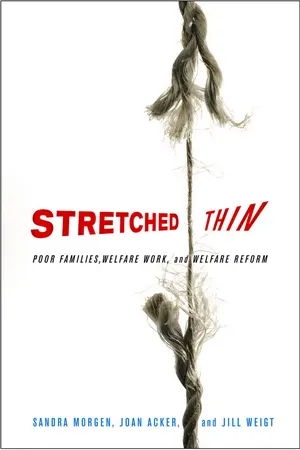
When the Personal Responsibility and Work Opportunity Reconciliation Act became law in 1996, the architects of welfare reform celebrated what they called the new "consensus" on welfare: that cash assistance should be temporary and contingent on recipients' seeking and finding employment. However, assessments about the assumptions and consequences of this radical change to the nation's social safety net were actually far more varied and disputed than the label "consensus" suggests.By examining the varied realities and accountings of welfare restructuring, Stretched Thin looks back at a critical moment of policy change and suggests how welfare policy in the United States can be changed to better address the needs of poor families and the nation. Using ethnographic observations, in-depth interviews with poor families and welfare workers, survey data tracking more than 750 families over two years, and documentary evidence, Sandra Morgen, Joan Acker, and Jill Weigt question the validity of claims that welfare reform has been a success. They show how poor families, welfare workers, and welfare administrators experienced and assessed welfare reform differently based on gender, race, class, and their varying positions of power and control within the welfare state.The authors document the ways that, despite the dramatic drop in welfare rolls, low-wage jobs and inadequate social supports left many families struggling in poverty. Revealing how the neoliberal principles of a drastically downsized welfare state and individual responsibility for economic survival were implemented through policies and practices of welfare provision and nonprovision, the authors conclude with new recommendations for reforming welfare policy to reduce poverty, promote economic security, and foster shared prosperity.
eBook - ePub
Stretched Thin
Poor Families, Welfare Work, and Welfare Reform
- English
- ePUB (mobile friendly)
- Available on iOS & Android
eBook - ePub
Stretched Thin
Poor Families, Welfare Work, and Welfare Reform
About this book
Information
Subtopic
Social Policy1
HISTORY AND POLITICAL ECONOMY
OF WELFARE IN THE UNITED STATES
AND OREGON
To understand welfare restructuring in the late 1990s, it is important to understand the history of the contested but fundamental interconnections among an evolving capitalism, poverty, and assistance to the poor. This context is essential to make sense of the political energy and rhetorical excess that often propel public discussions of the poor by the more affluent. This brief detour into history is also important background for sorting out the complexity of positions that seek to define good public policy: how much, in what forms, and under what conditions should public assistance be given to the poor (Polanyi 1957). Social welfare programs in capitalist states are shaped by the demands of powerful economic elites and represent political compromises hammered out between these elites and organized labor, political leaders, and social movement advocates. Thus, the issues at stake in contemporary debates about welfare are not new. These debates reflect the contentious ideological, political, and material assumptions that have been and remain present in many economic and political developments and in the theories and ideologies that justify and explain those developments.
“Welfare” has been continually restructured over the two-hundred-year history of industrial capitalism in the United States. Some moments of restructuring have been so thorough that they effectively constitute public policy “paradigm changes” or, using Sanford Schram’s term, new “policy regimes” (2006). The restructuring of welfare in the 1990s is one such moment. The people whose lives we followed are participating in this paradigm change even when they do so reluctantly. They were actors in historically grounded processes in which capitalist economies recurrently produce poverty and low incomes; those who suffer the resultant poverty struggle to cope somehow; and states, under political pressures, deal, in varying ways, with the resulting problems. To understand the experiences of those in our study, we need to see them within this history, although our account in this chapter is necessarily brief and schematic.1
As industrial capitalism emerged in the early nineteenth century, a paradigmatic transition took place in both the United States and England: Poor Law reform resulted in significant changes in the provision of poor relief. As Karl Polanyi (1957) argues, these reforms eliminated previous access to support or provisioning from local public sources, as inadequate as it often was, and made the “able bodied” poor completely dependent on the vagaries of uncertain labor markets. Politically, Poor Law reform was meant to control low-wage labor and to force the working-class poor to work for any wage offered.2 The ideological rationale for these changes was that relief to the “able bodied” was believed, by elites, to undermine independence, discourage diligence in paid work, and encourage indolence and vice. These claims resonate eerily with the discourse of “welfare reform” a century and a half later.
During the nineteenth and early twentieth century in the United States, such poor relief policies shaped the programs offered by the local governments and private charities that provided minimal aid to the poor. The ideology and practices of relief typically distinguished between groups defined as either the “deserving” or the “undeserving” poor.3 The deserving poor, then regarded as the disabled, the blind, the infirm elderly, and white widows or abandoned wives, were largely exempt from the assumption that immorality or sloth caused their financial woes. But the able-bodied poor, including mothers of color and white women who were neither widows nor abandoned wives, were judged responsible for their own poverty and undeserving of charitable aid. In the United States, in particular, these distinctions encoded a variety of racist and sexist assumptions about the morals, human worth, and proper place of men and women, whites, and people of color.4 Other than some modest reforms won during the Progressive Era (1880s–1920s) (including Worker’s Compensation and Mothers’ Pension programs), there was no meaningful challenge to the Poor Law ideology and its underlying classical liberal views until the economic crisis of the 1930s (Piven and Cloward 1993).
From the New Deal to the War on Poverty
The first significant expansion of social provisioning accompanied by a fundamental paradigm shift took place in the midst of the Great Depression, when political and economic elites faced massive social unrest and the declining legitimacy of capitalism. In the wake of protracted, intense popular protests, the viability of the mostly unregulated market and inadequacy of available assistance gave way as demands for change became impossible for policy makers to ignore. The wage as the primary means of distribution crashed not long after the stock market crashed in 1929; unemployment and poverty skyrocketed. These developments created the political conditions for a broad challenge to the ideas that the poor were responsible for their own misery and should be coerced into proper labor market behavior.
In 1935 the landmark Social Security Act was passed, establishing the basic infrastructure of the U.S. welfare system in the form of social insurance, means-tested programs, and work relief programs. Even in the face of this crisis, many corporations did not relinquish their claims to nonresponsibility (Acker 2006), opposing most New Deal measures and effectively limiting their scope and scale (Piven and Cloward 1993; Sunstein 2006). Their main allies were southern congressmen intent on defending their states’ highly racialized low-wage labor markets (Quadagno 1994). The Social Security Act established a central role for the federal government in providing poor relief and economic security programs, including partnerships between the federal government and states in funding and regulating social welfare (and the poor). These programs were designed to affect relations of distribution and redistribution in fundamental ways, drawing on Keynesian principles that justified activist federal government intervention in the market. Such intervention, Keynesians argued, would benefit the larger economy by spurring consumption, which would promote production (demand-side economics), contributing to the widely accepted goals of full employment, shared affluence, and, thus, social stability and economic growth.5 These New Deal programs—compromises between disparate political interests dominated by powerful white men—confirmed and reinforced long-standing gender and racial divisions and inequalities (Quadagno 1994).
The liberal U.S. welfare state was built on two unequal tiers—social insurance programs and means-tested public assistance programs; gender and race inequalities consigned most women and people of color to the means-tested programs.6 The social insurance programs were designed as contributory “wage replacement” programs. At the inception of these programs, most women and people of color were ineligible to participate because the occupations to which they were largely restricted—domestic and agricultural labor, much human service work, and government employment—were excluded from coverage in the legislation. The less generous and more stigmatized tier included means-tested programs such as Aid to Dependent Children (ADC),7 renamed Aid to Families with Dependent Children (AFDC) in the early 1960s.8 Eligibility for these programs was ostensibly based on need (means-testing), but, in practice eligibility was also shaped by race-, class-, and gender-inflected state and local social norms about who deserved support. ADC institutionalized the assumption that worthy mothers should be supported to raise their children in their own homes. While this reinforced the gender division of labor and the traditional family ethic (Abramovitz 1996), it nevertheless recognized as socially valued the care work provided by worthy (i.e., white) mothers (Pateman 2005). Many income-eligible women did not get ADC, stymied by state regulations that excluded applicants from “unsuitable” homes or whom officials or employers deemed “employable”; in practice this excluded many African American, Native American, and Latino women and many immigrant families.9
Despite extensive federal involvement and investment in the economy, high unemployment and economic insecurity persisted well into the 1940s. It was only after the United States entered World War II, sending millions of men overseas and priming the economy through war-related production, that the economic crisis ended. What followed was a sustained period of economic growth for U.S. capital, with Keynesian tax, labor, and welfare policies promoting economic growth and considerable income redistribution. Congressional passage of the G.I. Bill at the end of World War II constituted a major, though often unrecognized, expansion of the welfare state. The G.I. Bill provided tuition and a family support allowance for returning veterans to pursue education and a vast veterans’ mortgage program that subsidized home purchases for many, mostly white, male veterans. Again, gender and race exclusions limited who benefited from this expansion of public assistance (Brodkin 1997; Williams 2003).10 So, while the white middle class expanded as public subsidies supported suburbanization, home ownership, and occupational and income mobility for white men, families of color and white women not attached to men with access to the G.I. Bill, failed to reap the benefits of this form of public welfare.11
Gender, race, and class inequalities have been integral to the production of poverty and differential economic opportunity throughout U.S. history. In the mid-twentieth century, as the white middle class was expanding, the “Other America” (as an influential book of the period referred to the poor) included up to fifty million Americans, including most African Americans, Native Americans, and Latinos (Harrington 1968). In 1964, as popular unrest intensified in the United States, especially in poor African American communities, the Democratic administration of Lyndon B. Johnson expanded social welfare programs again, launching the “War on Poverty.” The 1964 Economic Opportunity Act, the establishment of Medicaid and Medicare in 1965, and other social spending led to another period of significant expansion of the welfare state, including new means-tested programs, new jobs and economic opportunity programs, and innovative community-based social services. From 1965 to 1972, federal antipoverty and social welfare expenditures more than doubled (Katz 1996, 266). Access to AFDC, especially for families of color, grew as a powerful welfare rights movement secured changes in program policies and practices.12 Ideologically, these programs recognized, sometimes quite explicitly, that poverty was produced by extant and historical race and gender discrimination, lack of economic and educational opportunity, the failure of low-wage employers to provide pensions and health insurance, and other structural failings. This period of public policy was different from the past in that the welfare state was expanded and because the program was specifically defined as an essential dimension of an explicit anti-poverty policy.
Federal investments in antipoverty programs paid off. Poverty rates were cut in half between 1959 and 1973 (Mishel, Bernstein, and Allegretto 2007, 284), and improvements were felt even among groups with historically very high rates of poverty. For example, poverty rates among black children dropped from almost 66 percent in 1965 to 39.6 percent in 1960 (Spriggs 2007). Among female-headed families with children, poverty rates fell from almost 60 percent in 1959 to below 40 percent in 1979 (Mishel, Bernstein, and Allegretto 2007: 287). Further improvements might have occurred, but political realities intervened as the policy framework that addressed poverty through public investments, regulation, social welfare, and antidiscrimination policy came to a screeching halt with the rise of the political power of the Republican right wing and the election of Ronald Reagan in 1980.
The Campaign for Welfare State Reform
The assault on the U.S. welfare state that climaxed in the paradigm shift that is the focus of this book began in earnest with the election of Ronald Reagan in 1980. A dramatic shift in public policy ensued, as the “Reagan Revolution”13 sought to contract public spending, especially for social programs; slash taxes, especially on businesses and investment income; and challenge key policies enacted in the previous decade that involved the federal government in supporting antidiscrimination and equity policies. Conservatives legitimized social program budget cuts by claiming that the “war on poverty” had been lost. But the U-turn in public policy had less to do with an objective assessment of “war on poverty” programs than with the growing hegemony of conservative and neoliberal ideologies and policy agendas.14
Conservatives took aim at the liberal “equity” agenda, challenging the underlying social analysis that defined race and gender discrimination and economic inequality as major causes of both poverty and the continuing disadvantages experienced by white women and people of color. Instead, the new policy architects focused on rebuilding declining U.S. economic and political power, supporting traditional morality and “family values” and cutting “big government” (i.e., the welfare state). The highly audible leaders of the rising Republican right wing, a mix of fiscal and social conservatives, argued that a free market, shed of excessive regulation and a high tax burden, would unleash prosperity, allowing America to regain its global position as an economic and political leader.
Aid to the poor was vilified for ostensibly having failed the poor and the nation by promoting dependency and enabling promiscuity, teen pregnancy, single parenthood, matriarchal African American families, and the growth of an urban “underclass.” Right-wing thinkers and policy makers identified two main villains in their antiwelfare ideology: (1) the poor, especially the inner-city African American poor, whose poverty was allegedly the fault of individual pathologies or familial deficiencies and (2) misguided and expensive government social programs that failed because they perpetuated dependency and poverty. Conservatives argued that the nation could not afford to support those who refused to support themselves, especially when those needing support were sexually promiscuous, lacked work discipline, lived in “broken” families, and failed to value marriage and self-sufficiency.
A racialized discourse about welfare queens, an inner-city “underclass,” and cross-generational welfare dependency took root, fertilized by vehement right-wing Republican politicians and advocacy organizations and blossoming in the media (Hancock 2004; Gilens 1999), the poverty research industry (O’Connor 2001), and the culture at large.15 The combination of racist imagery and assumptions about poverty and welfare with an antitax political rhetoric that blamed social programs for soaking up “hard earned” tax dollars, reinvigorated old arguments about the deserving and undeserving poor and social nonresponsibility.
Changing assumptions about gender and families were also entangled in the attack on welfare. Even as social conservatives bemoaned declining family values, the growth in women’s labor force participation, especially among mothers, began to further erode the cultural assumption that the public has a responsibility to support poor mother’s care work. In Reagan’s first term, social welfare programs were cut drastically. In his second term the administration promoted a variety of changes in social welfare policy, including tightening program eligibility, increasing work requirements, and giving states more flexibility in how they met federal program mandates. In 1988 Congress passed the Family Support Act (FSA). This legislation began in earnest the process of transforming AFDC from “a program that helped single mothers to stay home with their children into a mandatory work program” (Abramovitz 1996, 357), focusing both on employment for single mothers and financial “responsibility” by absent fathers. Although there had been experiments with work-promotion programs in earlier periods (Piven and Cloward 1993; Mittelstadt 2005), the Family Support Act created unprecedented opportunities for states to encourage or require welfare recipients to participate in employment, jobs training, or education. The FSA reinforced the view that poverty was an individual problem resulting not from capitalism, racial or gender discrimination, or failures of the market, but from the poor choices, values, and behaviors of individuals and families and the alleged dependency-producing impact of intergenerational poverty and welfare (Naples 1997; Fraser and Gordon 1994).
With Bill Clinton’s election in 1992 the employment mandates of the FSA were accompanied by important changes in tax and minimum wage policies designed to “make work pay.” Clinton had campaigned on the promise to “end welfare as we know it,” but before he could advance his vision Republicans took control of Congress in 1994. Once again welfare “reform” became a priority for the right wing intent on dismantling or privatizing social programs. The issue united social and religious conservatives concerned about “family values” with fiscal conservatives intent on cutting taxes and limiting government (Weaver 2000; Haskins 2007). Congress passed welfare “reform” as the Personal Responsibility and Work Opportunity Reconciliation Act (PRWORA) in 1996, a restructuring of welfare designed by Republicans in Congress and signed by a Democratic President who agreed in principle (if not with each provision) with a bill that abolished poor mothers’ entitlement to cash assistance and subjected them to a new time-limited, “work-first” policy paradigm. PRWORA represented a fundamental change in the political landscape, as the center of the Democratic Party shed much of its commitment to the legacy of the New Deal and a redistributive/activist welfare state.
PRWORA replaced AFDC with Temporary Assistance for Needy Families (TANF), a time-limited program that makes receipt of public assistance contingent on compliance with work requirements. The end of the right, or entitlement, to aid if certain conditions were met was the most radical element in this legislation. A number of provisions of PRWORA, including expanded child care and health care subsidies, were designed to “make work pay.” PRWORA also devolved considerable authority to states to design their TANF programs, changed federal funding into a block grant, legislated a five-year lifetime limit for receipt of cash assistance, and held states accountable for targeted reductions in caseloads and proportions of clients meeting work req...
Table of contents
- Acknowledgments
- Introduction
- 1 HISTORY AND POLITICAL ECONOMY OF WELFARE IN THE UNITED STATES AND OREGON
- 2 VELVET GLOVES, IRON FISTS, AND ROSE-COLORED GLASSES
- 3 DOING THE WORK OF WELFARE
- 4 NEGOTIATING NEOLIBERAL IDEOLOGY AND “ON THE GROUND” REALITY IN WELFARE WORK
- 5 THE OTHER SIDE OF THE DESK
- 6 LIFE AFTER WELFARE
- Conclusion
- Appendix
- Notes
- Bibliography
Trusted by 375,005 students
Access to over 1.5 million titles for a fair monthly price.
Study more efficiently using our study tools.
Frequently asked questions
Yes, you can cancel anytime from the Subscription tab in your account settings on the Perlego website. Your subscription will stay active until the end of your current billing period. Learn how to cancel your subscription
No, books cannot be downloaded as external files, such as PDFs, for use outside of Perlego. However, you can download books within the Perlego app for offline reading on mobile or tablet. Learn how to download books offline
Perlego offers two plans: Essential and Complete
- Essential is ideal for learners and professionals who enjoy exploring a wide range of subjects. Access the Essential Library with 800,000+ trusted titles and best-sellers across business, personal growth, and the humanities. Includes unlimited reading time and Standard Read Aloud voice.
- Complete: Perfect for advanced learners and researchers needing full, unrestricted access. Unlock 1.5M+ books across hundreds of subjects, including academic and specialized titles. The Complete Plan also includes advanced features like Premium Read Aloud and Research Assistant.
We are an online textbook subscription service, where you can get access to an entire online library for less than the price of a single book per month. With over 1.5 million books across 990+ topics, we’ve got you covered! Learn about our mission
Look out for the read-aloud symbol on your next book to see if you can listen to it. The read-aloud tool reads text aloud for you, highlighting the text as it is being read. You can pause it, speed it up and slow it down. Learn more about Read Aloud
Yes! You can use the Perlego app on both iOS and Android devices to read anytime, anywhere — even offline. Perfect for commutes or when you’re on the go.
Please note we cannot support devices running on iOS 13 and Android 7 or earlier. Learn more about using the app
Please note we cannot support devices running on iOS 13 and Android 7 or earlier. Learn more about using the app
Yes, you can access Stretched Thin by Sandra L. Morgen,Joan Acker,Jill Weigt in PDF and/or ePUB format, as well as other popular books in Politics & International Relations & Social Policy. We have over 1.5 million books available in our catalogue for you to explore.