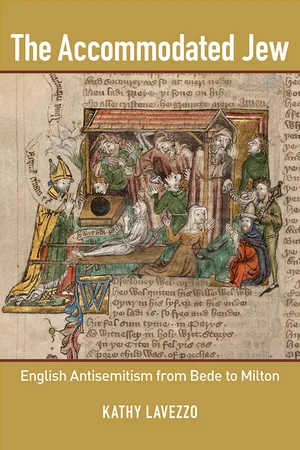
England during the Middle Ages was at the forefront of European antisemitism. It was in medieval Norwich that the notorious "blood libel" was first introduced when a resident accused the city's Jewish leaders of abducting and ritually murdering a local boy. England also enforced legislation demanding that Jews wear a badge of infamy, and in 1290, it became the first European nation to expel forcibly all of its Jewish residents. In The Accommodated Jew, Kathy Lavezzo rethinks the complex and contradictory relation between England's rejection of "the Jew" and the centrality of Jews to classic English literature. Drawing on literary, historical, and cartographic texts, she charts an entangled Jewish imaginative presence in English culture. In a sweeping view that extends from the Anglo-Saxon period to the late seventeenth century, Lavezzo tracks how English writers from Bede to Milton imagine Jews via buildings—tombs, latrines and especially houses—that support fantasies of exile. Epitomizing this trope is the blood libel and its implication that Jews cannot be accommodated in England because of the anti-Christian violence they allegedly perform in their homes. In the Croxton Play of the Sacrament, Marlowe's The Jew of Malta, and Shakespeare's The Merchant of Venice, the Jewish house not only serves as a lethal trap but also as the site of an emerging bourgeoisie incompatible with Christian pieties. Lavezzo reveals the central place of "the Jew" in the slow process by which a Christian "nation of shopkeepers" negotiated their relationship to the urban capitalist sensibility they came to embrace and embody. In the book's epilogue, she advances her inquiry into Victorian England and the relationship between Charles Dickens (whose Fagin is the second most infamous Jew in English literature after Shylock) and the Jewish couple that purchased his London home, Tavistock House, showing how far relations between gentiles and Jews in England had (and had not) evolved.
Arguably, the primary form of religious difference that occupied the minds of Anglo-Saxon Christians was paganism. One of the two writers on which this chapter focuses, Bede, was born in 672/73, less than a hundred years after the Gregorian mission to convert the Anglo-Saxons and only decades after Celtic missionaries joined that effort.1 We know very little about Cynewulf, the poet whom I pair with Bede. He likely was an ecclesiastic and seems to have flourished a generation or more after Bede.2 But we can be sure that during Cynewulf’s life, paganism continued to lurk not far from Christianity, especially with the onset of Viking invasions. Both Bede’s and Cynewulf’s works confirm this interest in pagans. Texts like Bede’s Ecclesiastical History (ca. 731) and Cynewulf’s Fates of the Apostles evince a deep investment in the apostolic mission of extending the Roman Christian imperium to its English border, where a newly converted Germanic and, later, Norse people were asked to renounce long-held polytheistic attachments.3
However, Jews were just as much if not more of a concern for Anglo-Saxon Christians. This was not due to the presence on the island of Jews, who did not inhabit England until after the Norman Conquest, but rather to the proximity of Judaism and Christianity. While Anglo-Saxon writers like Bede and Cynewulf didn’t live alongside Jews, they were keenly cognizant of both their status as God’s original chosen people, whose holy books formed the basis of Christianity, and the vexing fact that contemporary Jews did not follow the new Christian religion. Thanks to the close and difficult relationship between Christianity and Judaism, Jewishness haunted Christian life and thought. As Andrew Scheil and other scholars affirm, fundamental to Anglo-Saxon writers’ efforts to negotiate their relationship to the Jew was an ideology of supersession or, in a more strictly textual register, a typological hermeneutic.4 According to supersession, which first emerged in the complex intertwining of “ontology, hermeneutics, anthropology, and christology” in Paul’s epistles, Jews adhere to an outmoded carnality and literal-mindedness that Christianity supplants with its embrace of the spirit and figurative thinking.5 For example, in 2 Corinthians 3:3, Paul contrasts the literal inscription of the old law on the tablets containing the Ten Commandments to the figurative writing of the new law by “the Spirit of the living God” on “the fleshly tables of the heart.”6 Later writers, most influentially Augustine, invoked a version of supersession to manage the problematic priority—that is, the exalted venerability—of the Hebrew Bible. Persons, places, and events in the Old Testament, Augustine and other theologians asserted, both look toward and are superseded by their counterparts in Christian history, although Jews fail to grasp such a relationship due to the literal mindset that their carnality entails.7 Supersession, to be sure, was not unique to Anglo-Saxon writers but appears in Christian discussions of Jews produced throughout the medieval West. However, Bede and Cynewulf engaged supersession in spatial ways that both set them apart from previous writers and adumbrate English notions of Jews and geography evinced in later texts.
For anyone familiar with contemporary Anglo-Saxon studies, my emphasis on space and Jews will bring to mind the topic of migration. Important work by scholars such as Scheil, Patrick Wormald, Nicholas Howe, and Samantha Zacher has made clear how the Anglo-Saxons exhibited a distinctive interest in the Israelites of Exodus, whose migratory experience and chosen status offered a template for understanding Anglo-Saxon identity.8 My discussion diverges from such work by taking as its starting point the Anglo-Saxon interest in not migration but Jerusalem and, more particularly, the privileged materialisms associated with that holiest of sites. Instead of attending to expansive tribal movements, this chapter tracks smaller-scale investments in the former Jewish homeland and the exalted objects and buildings located there.9
My analysis centers on Bede’s Latin exegetical work On the Temple (ca. 729–31), which interprets the description in 3 Kings 5:1–7:51 of Solomon’s erection of the Temple of Jerusalem, and Cynewulf’s Old English poem Elene, which retells the legend of the discovery of the “true” cross.10 Bede, one of the most sophisticated, nuanced, and brilliant thinkers in medieval Christianity, offers an excellent starting point for examining supersession, a rhetoric that informs nearly all the works covered in this book. Cynewulf’s Elene complements and supplements Bede by showing how an Anglo-Saxon writer understood supersession not in a Latinate and theological register, but rather in a vernacular and explicitly literary context. In what follows, I slowly tease out the stakes, slippages, and tensions informing both Bede’s and Cynewulf’s accounts of Jews and “Jewish” materialism. I take as my premise the belief that while we already know that supersession is both omnipresent in early Christian writings and doomed to failure, its articulation in certain places and periods generates lines of development and breakdown that diverge and overlap in important and telling ways. In the case of Bede and Cynewulf, their charged engagements with supersession and “Jewish” places contribute both to our understanding of Anglo-Saxon material culture and to the important role that ideas of the Jew played in such materialisms.11
As we shall see, in many respects, both Bede and Cynewulf affirm the usual Christian elevation of the spirit over matter and letter. At the start of On the Temple, Bede claims he will locate “the spiritual mansion of God” in the “material structure” of the temple, foregrounding his interest in reading the building typologically, or what Christian theologians later would describe as “in the accommodated sense.”12 And Elene features a Jew, Judas, whose carnal investment in the well-being of his fellow Jews prevents him from assisting Queen Helena in her quest to uncover the cross as a vehicle of faith. However, other aspects of those works exhibit Christian materialisms that both shed light on important aspects of the Anglo-Saxon world and radically undermine the usual denigration of the Jew as carnal. These elements hint at a fuller picture of early Christian identity in England than supersession would, on the face of it, suggest. Effectively turning the import of supersession on its head, these texts reveal how Christians not only are carnal but also are fascinated by and even envious of what emerges as not a debased but rather a privileged Jewish materialism.
Crucial to my analysis of Bede’s and Cynewulf’s spatial rhetorics of supersession is their engagement with a material long associated with the “carnal” Jew, stone. Stone plays a central role in Paul’s elevation of Christian over Jew; in 2 Corinthians 3:7–8, he describes how the Christian life-giving “ministry of the spirit” supersedes a Jewish “ministry of death” that was “engraved with letters upon stone.”13 Paul elaborates on the Jew’s stony materialism, writing that Jewish minds are hardened—their senses ossified, dull, and unchanging—so much so that “to this day” they are incapable of “beholding the glory of the Lord” witnessed under Christianity.14 Stonily clinging to a carnal mentality, Paul’s Jews are cognitively handicapped, incapable of comprehending new Christian truths.15 While ideas of the stone-hearted or stony Jew appear in writings in medieval England and elsewhere, Bede offers a distinctively architectural and notably offensive version of this rhetoric in a sermon that I pair with his temple exegesis.16 In this homily, Bede connotes the Jew’s lithic materialism via the degraded space of a tomb closed by a stone. Cynewulf makes a similar move in Elene by linking Judas’s stony carnality to the notorious moment when Queen Helena tortures him in a grave-like pit for refusing to help her find the cross.
Both Bede’s and Cynewulf’s texts depict what I call the “sepulchral Jew,” the idea that the Jew’s recalcitrant investment in the dead letter of the old law merits his association with a grave or tomb-like space. I argue that, by using Bede’s and Cynewulf’s respective depictions of the stony, sepulchral Jew as a heuristic for both Elene and On the Temple, we gain an important means of tracking the geopolitical stakes of those writings, that is, their conception of the place of both Christians and Jews in the contemporary world. Bede’s and Cynewulf’s sepulchral Jews adumbrate the tomb-like houses of Shylock in Merchant and Manoa in Samson Agonistes. They also look toward the political acts of displacement that would occur in England in 1290. In the same way that the expulsion removed Jews from English soil, Bede’s tomb and Cynewulf’s pit exile the carnal Jew from Christian life, consigning him to a stony space of death located underground or inside a rocky escarpment. Indeed, the offensive image of the sepulchral Jew the writers connote lends chilling support to theories that during the Anglo-Saxon period, Jews were “deliberately excluded from the country.”17
Importantly, however, even as the depiction of stone in Bede and Cynewulf points to a disturbing burial or entombment of the Jew, it also undermines the very rhetoric of supersession on which that spatial rejection is based. A close look at Bede’s interpretations of the stones of Solomon’s Temple reveals moments where he proves invested in that building material in ways that point to the role of stone monuments and architecture in establishing the faith in England. Such links suggest how not just Roman but also Jewish materialisms shaped Christianity on the island, where religious sought both to incorporate England within an imperial Roman ecclesia and to bring the holy, Jewish spaces of Jerusalem to their isolated island. Cynewulf’s Elene exhibits similar contradictions, though those tensions emerge more overtly in relation to the materialism of Anglo-Saxon secular culture and Germanic paganism. Namely, references to the stones used in a building program led by Queen Helena, a Roman queen who also resembles Anglo-Saxon aristocrats, expose her deep investment in “Jewish” materialisms. Taken together, Bede’s and Cynewulf’s works give us a new vantage point for appreciating how the Anglo-Saxons’ conversion to Christianity entailed no easy supplanting of pagan carnality with a pure and ascetic-minded Christian spirituality, but rather involved the messy and necessary entanglement of pagan, Christian, and Jewish materialisms.
Supersession and the Sepulchral Jew
Bede’s engagement with supersession appears in one of his fifty homilies on the Gospels. Likely late career products, the sermons are organized into two volumes and are found in their entirety in two ninth-century parchment continental manuscripts (Boulogne, Bibliothèque municipale, MS 75, 339 fols.; Zurich, Zentralbibliothek, MS C. 42, 81 fols.).18 The sermon, the tenth of volume 2, focuses on an Easter pericope or gospel passage from Luke where the evangelist recounts how, after the Crucifixion, Mary Magdalene and other women wishing to anoint Christ’s corpse with spices “found the stone rolled back from the sepulcher. And going in, they found not the body of the Lord Jesus” (Luke 24:2–3). As Bede does throughout his homilies, he teases out several meanings of the episode for his fellow monks.19 Bede begins with the historical sense, by reminding his readers that Matthew’s gospel “tells us that an angel came down from heaven and rolled the stone away from the mouth of the tomb”; the angel, Bede stresses, did not move the stone to “make a way for the Lord to go out, but so that the open and empty space of the tomb might divulge to human beings that he had risen again.”20 The usual function of a sepulcher—to protect a corpse—does not pertain to Christ, whose Resurrection rendered the built environment unnecessary. Indeed, Christ’s triumph over the physical world and mortality is such that he didn’t need his tomb opened by an angel in order to depart from it. The angel turns away the stone not to assist Jesus but to disclose his Resurrection to those left on earth. Instead of sheltering Christ, the empty sepulcher manifests Christ’s transcendence of material objects like tombs. Physical absence signifies as spiritual presence in Bede’s reading of the homily. Through its obsolescence, the tomb morphs into a vehicle of faith.
Bede elaborates on Christ’s triumph as he considers the spiritual meanings of the passage. Employing the pericope to assert supersession, Bede writes that “mystically, the rolling away of the stone implies the disclosure of the divine sacraments, which were formerly hidden and closed up by the letter of the law. For the law was written on stone” (II.10, 90).21 Echoing Paul, Bede reads rolling away the stone as a figure for the revelation of a higher, spiritual Christian order, one that displaces and supplants a Jewish law that is bound to a literal and earthly sensibility. Bede’s use of stone to connote Jewish carnality is twofold. The letter of the law is both “written on stone” in the manner of the Ten Commandments and covers over or encloses the new law in the manner of a tomb. The sealed tomb signifies the Jews’ inability to see or witness the new law, while its architectural function—the sheltering of a corpse—signifies the lethal nature of the old law, as articulated by Paul’s claim that “the letter kills.” Bede engages in a kind of historical sleight of hand here. For Jews, that is, Mary Magdalene and the other Marys, are portrayed in...
Table of contents
List of Illustrations
Acknowledgments
List of Abbreviations
Introduction
1. Sepulchral Jews and Stony Christians: Supersession in Bede and Cynewulf
2. Medieval Urban Noir: The Jewish House, the Christian Mob, and the City in Postconquest England
3. The Minster and the Privy: Jews, Lending, and the Making of Christian Space in Chaucer’s England
4. In the Shadow of Moyse’s Hall: Jews, the City, and Commerce in the Croxton Play of the Sacrament
5. Failures of Fortification and the Counting Houses of The Jew of Malta
6. Readmission and Displacement: Menasseh ben Israel, William Prynne, John Milton
Coda
Notes
Bibliography
Index
Trusted by 375,005 students
Access to over 1.5 million titles for a fair monthly price.
Study more efficiently using our study tools.
Frequently asked questions
Yes, you can cancel anytime from the Subscription tab in your account settings on the Perlego website. Your subscription will stay active until the end of your current billing period. Learn how to cancel your subscription
No, books cannot be downloaded as external files, such as PDFs, for use outside of Perlego. However, you can download books within the Perlego app for offline reading on mobile or tablet. Learn how to download books offline
Perlego offers two plans: Essential and Complete
Essential is ideal for learners and professionals who enjoy exploring a wide range of subjects. Access the Essential Library with 800,000+ trusted titles and best-sellers across business, personal growth, and the humanities. Includes unlimited reading time and Standard Read Aloud voice.
Complete: Perfect for advanced learners and researchers needing full, unrestricted access. Unlock 1.5M+ books across hundreds of subjects, including academic and specialized titles. The Complete Plan also includes advanced features like Premium Read Aloud and Research Assistant.
Both plans are available with monthly, semester, or annual billing cycles.
We are an online textbook subscription service, where you can get access to an entire online library for less than the price of a single book per month. With over 1.5 million books across 990+ topics, we’ve got you covered! Learn about our mission
Look out for the read-aloud symbol on your next book to see if you can listen to it. The read-aloud tool reads text aloud for you, highlighting the text as it is being read. You can pause it, speed it up and slow it down. Learn more about Read Aloud
Yes! You can use the Perlego app on both iOS and Android devices to read anytime, anywhere — even offline. Perfect for commutes or when you’re on the go. Please note we cannot support devices running on iOS 13 and Android 7 or earlier. Learn more about using the app
Yes, you can access The Accommodated Jew by Kathy Lavezzo in PDF and/or ePUB format, as well as other popular books in Literature & English Literary Criticism. We have over 1.5 million books available in our catalogue for you to explore.