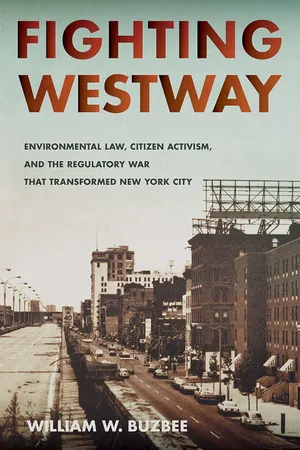
From 1971 to 1985, battles raged over Westway, a multibillion-dollar highway, development, and park project slated for placement in New York City. It would have projected far into the Hudson River, including massive new landfill extending several miles along Manhattan's Lower West Side. The most expensive highway project ever proposed, Westway also provoked one of the highest stakes legal battles of its day. In Fighting Westway, William W. Buzbee reveals how environmentalists, citizens, their lawyers, and a growing opposition coalition, despite enormous resource disparities, were able to defeat this project supported by presidents, senators, governors, and mayors, much of the business community, and most unions. Although Westway's defeat has been derided as lacking justification, Westway's critics raised substantial and ultimately decisive objections. They questioned claimed project benefits and advocated trading federal Westway dollars for mass transit improvements. They also exposed illegally disregarded environmental risks, especially to increasingly scarce East Coast young striped bass often found in extraordinarily high numbers right where Westway was to be built.Drawing on archival records and interviews, Buzbee goes beyond the veneer of government actions and court rulings to illuminate the stakes, political pressures, and strategic moves and countermoves that shaped the Westway war, a fight involving all levels and branches of government, scientific conflict, strategic citizen action, and hearings, trials, and appeals in federal court. This Westway history illuminates how high-stakes regulatory battles are fought, the strategies and power of America's environmental laws, ways urban priorities are contested, the clout of savvy citizen activists and effective lawyers, and how separation of powers and federalism frameworks structure legal and political conflict. Whether readers seek an exciting tale of environmental, political, and legal conflict, to learn what really happened during these battles that transformed New York City, or to understand how modern legal frameworks shape high stakes regulatory wars, Fighting Westway will provide a good read.
eBook - ePub
Fighting Westway
Environmental Law, Citizen Activism, and the Regulatory War That Transformed New York City
- 296 pages
- English
- ePUB (mobile friendly)
- Available on iOS & Android
eBook - ePub
Fighting Westway
Environmental Law, Citizen Activism, and the Regulatory War That Transformed New York City
About this book
Information
Subtopic
North American HistoryIndex
Social Sciences1
THE WESTWAY PLAN
WESTWAY’S INCEPTION can be traced to two key events, one local and one federal. When, in the early 1970s, large chunks of the elevated West Side Highway (also known as the Miller Highway) started falling, including an infamous much-photographed 1973 collapse that deposited a truck on the surface road below, a transportation fix was inevitable. Planners and city officials quickly began to look at ways to link highway replacement with major development plans. The other key event happened years earlier.
The federal government in the post–New Deal era, especially during the presidency of Dwight Eisenhower, became centrally involved in funding construction of interstate highways.1 At first these highway dollars were focused on linking cities to create a national interstate highway network, but eventually such funds could be used for interstate highways running through urban centers. The prospect of federal dollars that could underwrite substantial local patronage and fund urban improvements encouraged cities like New York to think big but at little local cost. So long as a transportation route was designated for construction and addition to the interstate system, federal-aid highway funds would be available.2 The traditional terms of that federal funding were remarkably good, with 90 percent paid by the federal government, including cost escalations, and 10 percent by the state. As the West Side Highway aged and started to fall apart, a replacement funded by federal dollars held an obvious allure. Westway grew out of this confluence of genuine transportation need and the promise of federal funding for a huge public works project in New York City. In the words of mayoral adviser and lawyer Edward Costikyan, no one “in his or her right mind” would suggest Manhattan needed a new six-lane highway. But Westway was a strategy allowing New York to take advantage of “federal largess.” “The genius of Westway is that its planners were capable of seizing upon an existing Federal program, designed for other purposes, and using it to accomplish an essential municipal purpose: the reconstruction of Manhattan’s Lower West Side waterway.”3

Figure 1.1. The 1973 collapse of a segment of the West Side Highway under the weight of a truck was often mentioned by Westway advocates as evidence that a replacement highway was unavoidable. (Source: 1974 Draft Environmental Impact Statement; United States Army Corps of Engineers; Federal Highway Administration; New York State Department of Transportation; photographer Ted Cowell.)
Project planners no longer had to consider competing maritime uses of Manhattan’s lower West Side piers. For well over a century, New York City was one of the world’s most active ports, with schooner and later freight and passenger ships docking at dozens of piers along the West Side of Manhattan, as well as along the East River. After the elevated West Side Highway was built for use by cars, mostly during the 1930s, access to piers, nearby shops, warehouses, and entertainment was possible by passing under the elevated highway. By 1970, however, Manhattan’s Lower West Side was no longer a bustling port, having lost much of that work to the large, flat spaces in nearby New Jersey, Brooklyn, and other parts of the country that were more suitable for new containerized shipping. Occasional passenger ships would still utilize a West Side pier, but the era when massive bows of ships would tower over adjacent streets had come to an end. Many of the dozens of piers jutting close to a thousand feet into the Hudson had fallen into disuse. Some were now twisted metal frames disappearing into the waters.
Planners hoped that a massive public works project like Westway would improve New York City’s dire fiscal situation. In the late 1960s and early 1970s, the city was still mired in economic woes.4 It was just starting to emerge from a sustained fiscal crisis that had left it teetering on the edge of bankruptcy, desperate for state or federal support.5 The city’s crime rate had skyrocketed. Unhappy municipal unions in sector after sector went on strike, with transit workers, teachers, and sanitation workers all taking their turn. The cascade of bad news led to a real estate downturn and the exodus of many workers and families to the surrounding suburbs. Times Square and adjacent midtown blocks were overrun with strip joints.6 New York City residents had long depended on subways far more than cars, but subways were increasingly decrepit, dangerous, unreliable, and covered in graffiti.7 Movies highlighted the city and especially its subways as filled with criminals on the prowl. As the economy slipped further, city services suffered, as did the city’s balance sheet. After New York City sought federal help in 1975, the federal rebuff provoked one of the New York Daily News’s most famous deadlines: “Ford to City: Drop Dead.”8 Just two years later, during a blackout, looting devastated the city.9 For good reason, city planners in the early 1970s desperately sought ways to bring money, jobs, vitality, and hope to the embattled city.
Figure 1.2. This photograph shows a southern perspective from Twenty-Third Street, with the elevated West Side Highway overhead to the left, the then-vacant Chelsea Piers to the right, and the World Trade Center Towers in the distance. The elevated highway was soon demolished, and the areas in the foreground would have been replaced with surface roads, five blocks of newly developable land, and a river-edge park and sunken highway to the right (west). (Source: 1974 Draft Environmental Impact Statement; United States Army Corps of Engineers; Federal Highway Administration; New York State Department of Transportation.)

Building next to and even in the Hudson to create land and business opportunity was an opportunistic habit dating back to Manhattan’s earliest days. Washington Irving’s History of New York quotes an early Dutch resident as suggesting driving “piles into the bottom of the river, on which the town should be built,” thus “rescu[ing] a considerable space of territory from those immense rivers.”10 More recently, when the World Trade Center was built between 1966 and 1973, the massive resulting excavation material was placed in adjacent Hudson River waters. The center’s two massive towers fell during the attacks of September 11, 2001, but the adjacent river fill now sits under the Battery Park City development. Virtually none of Manhattan’s shores remain the same as when the island first started being settled by Europeans.11
In Westway environmental impact documents, the Army Corps dated the earliest consideration of West Side Highway replacement to 1956. Serious work on it, however, really began around 1970, during the administration of Mayor John Lindsay. Ed Logue, the head of New York State’s Urban Development Corporation, in late 1970 set up a special Wateredge Development Study to look at plans for the road and surrounding area.12 Headed by Samuel Ratensky, a senior city planner in the city’s Housing and Development Administration, the study group developed an array of plans. Ratensky had studied with Frank Lloyd Wright and, along with his assistants, sought to find means to meet transportation needs, foster development, and provide citizens greater access to the river.13 Among Ratensky’s aides was Craig Whitaker, then a mere twenty-nine. Whitaker had studied architecture at Yale and worked with the Peace Corps in the Philippines. He started his work on Westway with the perspective that many large-scale projects were “very destructive”; he was interested in avoiding such ravages.14 Through circumstance and his own persistence, Whitaker ended up one of Westway’s most experienced designers and advocates over the long planning process and battles. He remains fascinated by Westway and its fate. Ratensky, Whitaker, and the others worked through an array of planning options before they devised the basics of the plan that became Westway.15
In the early 1970s, state legislation allowed preliminary work on replacing the elevated West Side Highway but included requirements that planners consider environmental effects. Planning for a replacement accelerated after the photogenic 1973 road collapse and after surveys revealed widespread deterioration, much caused by salt use during winter months. The New York City transportation commissioner, Michael Lazar, stated that the “salami-ing of the highway has brought us to the point where we must come to grips with the fact that the West Side Highway, as it presently exists, does not exist.”16 A city policeman captured well New Yorkers’ reactions to yet more news of West Side Highway decrepitude: “It’s just the dirty old West Side Highway falling apart.”17
Planners hence were thinking about much more than just replacement of a dilapidated elevated roadway. Whatever would replace the West Side Highway had the potential to transform the Lower West Side up to midtown, spur development, and provide citizen access to the Hudson. As the 1966 Tri-State Transportation Commission stated, “replacement” or “renewal” of the West Side Highway “coupled with new land uses provides an unparalleled opportunity for civic improvements.”18
In May 1971, New York State, through the State Urban Development Corporation, issued its Wateredge Development Study. The study included recommendations that closely tracked elements and goals of the overall package that soon became known as Westway; it also involved many of the same planning personnel. The study explicitly called for fashioning a replacement road so it would be eligible for federal and state interstate highway dollars. Again and again, the study emphasized the benefit of “potential for major new development,” especially if the space between the bulkhead and pier-head lines could be turned into “new land.” It spoke of “the liberation of the waterfront for optimum major development.” In addition to language focused on business development, the study also emphasized opportunities for “improving the environmental quality of upland areas along the Hudson River.” It rejected use of filling as too expensive and instead mainly relied on a deck erected on vertical posts known as piles. Reluctance to use a filling strategy would soon disappear.
Once the city and state in November 1971 successfully added the planned Westway highway segment to the federal interstate highway system map and hence made the replacement highway eligible for 90 percent federal funding, with a 10 percent state match, an institutional vehicle to keep the project moving was essential. The West Side Highway Project, a city-state joint project, was created in December 1971 to move Westway’s incipient plans to reality. Although Westway was a city-state government project ultimately funded mainly by federal highway dollars, this umbrella organization, the West Side Highway Project, was run by a private consultant, the former federal highway administrator under President Lyndon Johnson, Lowell K. Bridwell, and his company, Sydec. One of Westway’s attorneys, Frederick “Fritz” Schwarz, describes Bridwell as a big man with a powerful mind and presence. Others characterized Bridwell as “brilliant, a genius.”19 He created a small working group for Westway decision making. Bridwell sought to avoid unwieldy regulatory structures and dispersed decision making, instead creating a “single-manager structure,” with himself as the key manager.20 He stayed in this role for eight years. Like hundreds of others across the private and public sectors, Bridwell devoted years of his life to Westway.
The somewhat uneasy quasi-private and quasi-public nature of the West Side Highway Project during the Bridwell-Sydec phase started Westway on a strong footing but also created vulnerabilities. In one respect, the project reflected a dramatically different mind-set from earlier large-scale New York City and regional developments, especially those involving Robert Moses. At several different points during the early 1970s, the project sponsored public hearings at which Westway proposals were discussed and responses, critical and favorable, voiced. This was not a secret project or one jammed down citizens’ throats without opportunities for interested parties to speak. It was also apparent, however, that a priority for the project was to keep Westway moving. Bunny Gabel, an opponent of Westway who allowed her home to become the New York City office of the Friends of the Earth, recalls that opponents initially thought that they might win their arguments on the merits and were “pacified” by these “participatory exercises.” Opponents soon discerned that little if anything they said made a difference. In her words, “[i]t took us too long to realize that public participation doesn’t neces...
Table of contents
- List of Figures
- List of Acronyms
- Westway Chronology, 1971–1985
- Introduction
- 1 The Westway Plan
- 2 Highways, Subways, and the Seeds of Dissent
- 3 The Art of Regulatory War
- 4 The Road Warriors and the New Environment
- 5 Searching for Westway’s Achilles’ Heel: Air Pollution?
- 6 Westway’s Fill and America’s Protected Waters
- 7 The Public Fish Story
- 8 Enter the Independent Federal Judiciary and the Power of Law
- 9 Reexamining the 1971–1982 Debacles
- 10 Westway’s Second Chance
- 11 The Trial Crucible
- 12 The Cross-Examination
- 13 Judgment Days
- 14 Assessing Westway’s Outcome
- Epilogue: If Westway Were Proposed Today?
- Acknowledgments
- Notes
Trusted by 375,005 students
Access to over 1.5 million titles for a fair monthly price.
Study more efficiently using our study tools.
Frequently asked questions
Yes, you can cancel anytime from the Subscription tab in your account settings on the Perlego website. Your subscription will stay active until the end of your current billing period. Learn how to cancel your subscription
No, books cannot be downloaded as external files, such as PDFs, for use outside of Perlego. However, you can download books within the Perlego app for offline reading on mobile or tablet. Learn how to download books offline
Perlego offers two plans: Essential and Complete
- Essential is ideal for learners and professionals who enjoy exploring a wide range of subjects. Access the Essential Library with 800,000+ trusted titles and best-sellers across business, personal growth, and the humanities. Includes unlimited reading time and Standard Read Aloud voice.
- Complete: Perfect for advanced learners and researchers needing full, unrestricted access. Unlock 1.5M+ books across hundreds of subjects, including academic and specialized titles. The Complete Plan also includes advanced features like Premium Read Aloud and Research Assistant.
We are an online textbook subscription service, where you can get access to an entire online library for less than the price of a single book per month. With over 1.5 million books across 990+ topics, we’ve got you covered! Learn about our mission
Look out for the read-aloud symbol on your next book to see if you can listen to it. The read-aloud tool reads text aloud for you, highlighting the text as it is being read. You can pause it, speed it up and slow it down. Learn more about Read Aloud
Yes! You can use the Perlego app on both iOS and Android devices to read anytime, anywhere — even offline. Perfect for commutes or when you’re on the go.
Please note we cannot support devices running on iOS 13 and Android 7 or earlier. Learn more about using the app
Please note we cannot support devices running on iOS 13 and Android 7 or earlier. Learn more about using the app
Yes, you can access Fighting Westway by William W. Buzbee in PDF and/or ePUB format, as well as other popular books in Social Sciences & North American History. We have over 1.5 million books available in our catalogue for you to explore.