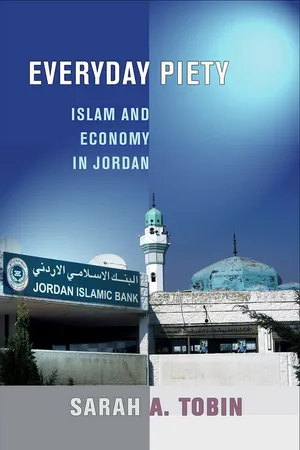
Working and living as an authentic Muslim—comporting oneself in an Islamically appropriate way—in the global economy can be very challenging. How do middle-class Muslims living in the Middle East navigate contemporary economic demands in a distinctly Islamic way? What are the impacts of these efforts on their Islamic piety? To what authority does one turn when questions arise? What happens when the answers vary and there is little or no consensus? To answer these questions, Everyday Piety examines the intersection of globalization and Islamic religious life in the city of Amman, Jordan.
Drawing on in-depth ethnographic fieldwork in Amman, Sarah A. Tobin demonstrates that Muslims combine their interests in exerting a visible Islam with the opportunities and challenges of advanced capitalism in an urban setting, which ultimately results in the cultivation of a "neoliberal Islamic piety." Neoliberal piety, Tobin contends, is created by both Islamizing economic practices and economizing Islamic piety, and is done in ways that reflect a modern, cosmopolitan style and aesthetic, revealing a keen interest in displays of authenticity on the part of the actors. Tobin highlights sites at which economic life and Islamic virtue intersect: Ramadan, the hijab, Islamic economics, Islamic banking, and consumption. Each case reflects the shift from conditions and contexts of highly regulated and legalized moral behaviors to greater levels of uncertainty and indeterminacy. In its ethnographic richness, this book shows that actors make normative claims of an authentic, real Islam in economic practice and measure them against standards that derive from Islamic law, other sources of knowledge, and the pragmatics of everyday life.
- 248 pages
- English
- ePUB (mobile friendly)
- Available on iOS & Android
eBook - ePub
About this book
Information
CHAPTER 1
A Muslim Plays the Slot Machines
It was a hot July day when the 19-year-old Jordanian girl walked into the Las Vegas casino. It was 1969, and young Asma was in awe of what she saw: Chandeliers softly illuminated the brown-carpeted walls and floors. Table after table hosted card games of poker and blackjack. Slot machines lined the walls, their flashing lights and bells heralding new fortunes. Showgirls with styled hair and feathered costumes rushed through on the way from performance to performance. Men in tuxedos brought drinks and cigarettes around, while Creedence Clearwater Revival’s “Proud Mary” played in the background. The floor was alive with hope and opportunity. The energy was palpable.
Despite her best efforts to blend in, Asma’s self-consciousness at being a Muslim in a casino showed through. As though out of habit, she tugged her miniskirt down low on her hips, trying to cover another inch or two of her thighs. She kept pulling her long brown hair over her exposed shoulders, embarrassed by the sunburn’s betrayal of her skimpy swimsuit. Asma inched closer to her older brother, her escort and protector on this trip, as he walked confidently through the dimly lit maze of tables and machines, loud bells and cheers from winners and losers alike, a haze of cigarette smoke, odors of spilled drinks and perfume. Surely he knew that this was all so wrong. Didn’t he? He led her to a row of slot machines. She looked up at him.
Ahmed leaned down and whispered in her ear, “Go on.” He pushed a nickel into her sweaty palm and urged, “It’s not going to kill you. Try it.” Asma turned slowly toward the slot machine. With trembling fingers she pushed the nickel into the slot. Her other hand reached up to the lever. She took a breath, uttered the invocation recited before all Islamic prayers, “Bismillah Al-Rahman Al-Raheem,” and pulled the lever.
“And I won! I won a lot of money! I still can’t believe I won!” Asma laughed and shook her head in lingering disbelief.
I was sitting across from a now middle-aged Asma in the living room of her suburban home in Amman, Jordan. I visited her and her family often, familiar with the softened hues of the couches and chairs in the late afternoon sun, its summer heat bearing down on us. We sipped Turkish coffee and ate the cupcakes I had brought with me, surrounded by three of her five adult children and her husband. Asma sat comfortably in her professional working clothes: a brown-and-white, long-sleeved, button-down shirt and floor-length corduroy skirt. Her head was covered with a matching headscarf, or hijab, and her plastic house slippers tapped on the floor from time to time as she chatted. She continued the story:
But I felt too guilty keeping the money. Even then I knew in Islam that gambling was haram [forbidden]. I knew Sura Al-Baqara said, “They ask you about wine and gambling. Say, ‘In them is great sin and yet, some benefit for people. But their sin is greater than their benefit’ ” [Qurʾan 2:219]. So it was a sin, and I knew that it was wrong. I had to make it right. I gave the money away to create some good from this and for an eternal reward. I gave some money to family members, and I gave some to charity to purify it. But I couldn’t keep it. Even then I knew gambling was a sin and haram and forbidden in Islam.
You know, we had so many modern ideas back then. We used to think we were so free and liberated. [Starts chuckling] I used to wear really short skirts, like up to here [signaling her mid-thigh] and low-cut shirts [makes a sweeping motion of the top of her breasts]. Not just women. Men thought this too. My brother was the one who showed me the casino!
Things were really changing then. They called it the “Islamic Resurgence.” People were thinking about Islam more and more. Everyone was talking about it all the time. Everyone was becoming more Muslim. I came back to Amman, and I too started to think about this life. I started reading and learning about Islam, and I learned that how I was living was really haram. Well, it wasn’t really really haram; I was a good person. But I wasn’t taking every opportunity to be the best Muslim and do the most with Islam in my life. And there were so many different opinions about what to do! So, I went on ʿOmrah. You know, the “mini-Hajj.” I did it for spiritual purification and forgiveness. I started wearing the proper hijab, showing only my hands and face. I decided to study Islam for myself, and I am so happy that I did.
We don’t know our religion. We have this long history and scholarship that we never learn about. We just take it all for granted. But I studied it, and my life is better now. I pray. I fast for Ramadan. I even have my accounts at the Islamic bank. I am enlightened and educated about Islam, and I am now living as a real Muslim. So, Al-hamdulilah [Praise God], my sins and my past are forgiven, and now I’m living the real Islam.
I tell the story of Asma to illustrate a certain anxiety that exists today among many Muslims of Amman, Jordan. People like Asma—who is far from atypical among today’s Ammanis or those living in Amman—are concerned that they practice an Islam that is authentic or “real.”1 They wonder, “Am I Muslim enough?” and “How can I be a better Muslim?” In my research I focused on one aspect of this desire to be a better Muslim—specifically, the need to reconcile personal piety on the one hand with matters of money and personal finance on the other. Asma and Muslims like her struggle deeply with the challenge of living their daily lives in a modern economy that requires them to purchase goods and services, have a bank account, use a credit card, or perhaps even invest in stocks or business ventures. They are concerned with engaging in economic practices that are “really” Islamic, but they are often uncertain and anxious as to what that should look like because public opinion on this issue varies greatly not only in Amman but throughout the Muslim world. Furthermore, other factors complicate aspirations for the “real” Islam—for instance, whether one is male or female, middle-class or upper-class. Taken together, these uncertainties and anxieties reveal an underlying desire to firmly engage in contemporary economic life and to do so with Islamic authenticity, or “realness.”
In this book, I explore these issues in greater depth, drawing on my research, which included twenty-one months of participant observation at sites in and around Amman. The focus on Amman is significant. Economically, the city is a major regional hub and growing at a swift pace. With a population of more than 2.5 million people, Jordan’s capital city is both a popular tourist destination and a major business center, with a strong regional economy bolstered by foreign direct investment and U.S. foreign aid. Along with Doha and Dubai, Amman is a favorite location for the regional offices of multinational corporations. One of the Middle East’s largest banks, International Islamic Arab Bank, is headquartered in Amman; during my time in Jordan I obtained an internship there. Politically, the country’s leader, King ʿAbdullah, is known as a close ally of the United States and is well known for quipping that Jordan is a “safe home in a rough neighborhood.” And socially, the country maintains peaceful coexistence of millions of Muslim Jordanians and Palestinians with refugees from surrounding countries. Due to this relative economic, political, and social stability in the Middle East, Amman has also seen the emergence of a consumer-oriented and market-friendly Muslim middle class.
Amman also hosts a growing Islamic banking and finance sector. Islamic banking in Amman is a particularly salient lens for understanding the processes described in this book, as it is a technologically and institutionally new space in Jordan’s economy, with a history that traces back only to the mid-1980s. Islamic banking and finance is known regionally for its more explicit and conservative expressions of Islam and Islamic law. The field constitutes an important area in which questions of the role of and place for Islamic economic practice are readily debated, challenged, and—at least to some degree—accepted and promoted.
While I was conducting this research in Amman, I also taught English at the University of Jordan and at the United Nations Relief and Works Agency for Palestine Refugees (UNRWA), where I met and had opportunities to talk with students, professionals, and their families. I was a participant observer in the homes of more than a dozen Muslim and two Christian families. I studied Arabic intensively and attained a very high level of proficiency, which made all these connections deep and productive. All told, my time in Amman provided rich opportunities to explore the ways in which middle-class Muslims negotiate their everyday economic and pious practices in this global and Islamic-dominant city.
A major theme in the lives of those who I interviewed—and therefore, in this book—is the role of Islamic Law, or Shariʿa, which is the moral code and religious law of Islamic life. In the West Shariʿa is often portrayed as a static body of laws meting out punishments for civil and religious crimes. It is associated with the stoning of adulterers, cutting off thieves’ hands, and killing of apostates. In the West Shariʿa is understood to be medieval: something backward and nonmodern that ought to be feared and abhorred.
In reality, Shariʿa is a set of reference points for questions about moral comportment and ethics of everyday life for Muslims. It is highly interpretive and flexible. Shariʿa is a process of knowledge cultivation that Muslims use when addressing the challenges of everyday life. Muslims living in Amman put Shariʿa to work as a means to engage in their daily economic lives in an authentically or “real” Islamic way and to entrench their religious practices in a globalized world. Shariʿa is both a tool and a standard Muslims employ in pious endeavors.
Muslims in urban Amman resolve their moral uncertainties and anxieties for the “real” Islam in economic life in two ways. First, they engage in efforts that mark their economic practices as distinctly “Islamic.” Economic practices of all kinds—from gambling at a casino and banking and finance, to dining out during Ramadan and wearing the hijab—are subject to scrutiny and Shariʿa-based judgments regarding their authenticity or “real Islamicness.” Economic practices are subject to all sorts of “Islamizing” or attempts to incorporate religion into them. Second, Muslims in urban Amman are thinking about Islam and acting on it in ways that reflect economic calculations, which include evaluations of value, profit, and risk; rationalization of processes and outcomes; audits of “performance indicators”; or ways of judging and assessing actions in religious life. These calculative agencies make Islamic piety measurable and assessable. There is a simultaneous Islamizing of economic practices and an economizing of Islamic pious practice.
Neoliberal Piety
The fields of economic action and piety merge when Ammanis fuse neoliberalism and their Islamic practice. This results in what I call “neoliberal piety.” Neoliberalism is a political-economic theory asserting that societal and individual well-being is best advanced through private property rights, free markets, and free trade (Harvey 2005, 2). This requires that capitalist arrangements be largely unfettered by governmental regulations, thereby diminishing the role and influence of the state. Individuals are included in neoliberal theory in aims to liberate personal freedoms and skills in market-friendly areas, and by requiring people to rely on and regulate themselves in most areas of life. Neoliberalism asserts the ascendency of the market and the primacy of the individual, and it emphasizes their combination as the solution to complex local and global relationships. The pursuit of these ideas is an ethical endeavor (Oueslati-Porter 2011, 65). Free markets, the position holds, make for more freedoms for individuals and more just societies.
At first blush, this may seem unrelated to one’s Islamic piety. Rather, similar to Atia (2012, 2013) I found that the challenges and opportunities between economic life and Islam are pronounced. As Asma experienced, the act of obtaining cash is questioned for its Islamicness, and charitable giving is infused with religious intention. Asma saw her fashion options in skirts and tops as something to be altered and Islamized. Ammanis wrestle with the “Islamicness” of a bank account or a credit card for heightened consumer spending. Neoliberal piety is also social, which creates public pressure to eat certain foods at certain restaurants at certain times during Ramadan and to defend a relationship between the fabric on a woman’s head with the moral fabric of her being. These challenges and opportunities are further intensified by the proliferation of compulsory schooling, ubiquitous mass media, and regional and global popular culture. Ammanis are unable to avoid the presence and pressures of neoliberal influences on their lives and lifestyles.
Neoliberal piety also derives from contemporary understandings of Islamic law, or Shariʿa. It is considered a truism in the Middle East that more women don the headscarf, more men pray in mosques, and more children are conversant in the Islamic scriptures today than in the twentieth century.2 This is because the Islamic Resurgence that Asma referenced amplified the expectations for a public and visible Islam in everyday life in Jordan.3 Today’s Ammanis engage neoliberal piety while using Shariʿa to claim that they are practicing “the real Islam.” The resulting claims are then debated and judged in terms of authenticity, or “realness,” emphasizing “correct” religious practice and demanding competency in referencing and utilizing Islamic Law, or Shariʿa.
Neoliberal piety emerges because neoliberalism and Islamic piety share similar temporal sensibilities. Both produce a sense of shortcoming and a de...
Table of contents
- Acknowledgments
- Note on Transliteration
- 1 A Muslim Plays the Slot Machines
- 2 The History of Amman
- 3 Making It Meaningful
- 4 Love, Sex, and the Market
- 5 Making It Real
- 6 Uncertainty Inside the Islamic Bank
- 7 Consuming Islamic Banking
- 8 Branding Islam
- Notes
- Glossary of Arabic Terms
- Bibliography
- Index
Trusted by 375,005 students
Access to over 1.5 million titles for a fair monthly price.
Study more efficiently using our study tools.
Frequently asked questions
Yes, you can cancel anytime from the Subscription tab in your account settings on the Perlego website. Your subscription will stay active until the end of your current billing period. Learn how to cancel your subscription
No, books cannot be downloaded as external files, such as PDFs, for use outside of Perlego. However, you can download books within the Perlego app for offline reading on mobile or tablet. Learn how to download books offline
Perlego offers two plans: Essential and Complete
- Essential is ideal for learners and professionals who enjoy exploring a wide range of subjects. Access the Essential Library with 800,000+ trusted titles and best-sellers across business, personal growth, and the humanities. Includes unlimited reading time and Standard Read Aloud voice.
- Complete: Perfect for advanced learners and researchers needing full, unrestricted access. Unlock 1.5M+ books across hundreds of subjects, including academic and specialized titles. The Complete Plan also includes advanced features like Premium Read Aloud and Research Assistant.
We are an online textbook subscription service, where you can get access to an entire online library for less than the price of a single book per month. With over 1.5 million books across 990+ topics, we’ve got you covered! Learn about our mission
Look out for the read-aloud symbol on your next book to see if you can listen to it. The read-aloud tool reads text aloud for you, highlighting the text as it is being read. You can pause it, speed it up and slow it down. Learn more about Read Aloud
Yes! You can use the Perlego app on both iOS and Android devices to read anytime, anywhere — even offline. Perfect for commutes or when you’re on the go.
Please note we cannot support devices running on iOS 13 and Android 7 or earlier. Learn more about using the app
Please note we cannot support devices running on iOS 13 and Android 7 or earlier. Learn more about using the app
Yes, you can access Everyday Piety by Sarah A. Tobin in PDF and/or ePUB format, as well as other popular books in Social Sciences & Middle Eastern History. We have over 1.5 million books available in our catalogue for you to explore.