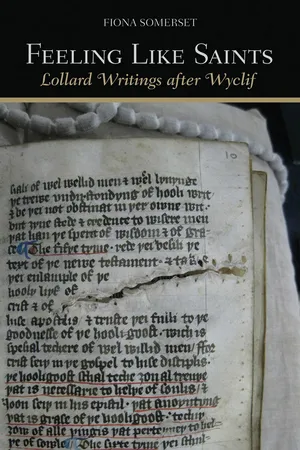
"Lollard" is the name given to followers of John Wyclif, the English dissident theologian who was dismissed from Oxford University in 1381 for his arguments regarding the eucharist. A forceful and influential critic of the ecclesiastical status quo in the late fourteenth century, Wyclif's thought was condemned at the Council of Constance in 1415. While lollardy has attracted much attention in recent years, much of what we think we know about this English religious movement is based on records of heresy trials and anti-lollard chroniclers. In Feeling Like Saints, Fiona Somerset demonstrates that this approach has limitations. A better basis is the five hundred or so manuscript books from the period (1375–1530) containing materials translated, composed, or adapted by lollard writers themselves.These writings provide rich evidence for how lollard writers collaborated with one another and with their readers to produce a distinctive religious identity based around structures of feeling. Lollards wanted to feel like saints. From Wyclif they drew an extraordinarily rigorous ethic of mutual responsibility that disregarded both social status and personal risk. They recalled their commitment to this ethic by reading narratives of physical suffering and vindication, metaphorically martyring themselves by inviting scorn for their zeal, and enclosing themselves in the virtues rather than the religious cloister. Yet in many ways they were not that different from their contemporaries, especially those with similar impulses to exceptional holiness.
- 304 pages
- English
- ePUB (mobile friendly)
- Available on iOS & Android
eBook - ePub
About this book
Information
PART ONE
CHAPTER 1
The Lollard Pastoral Program
Reform from Below
At some point in the 1390s, a parish priest in the West Midlands formulated a large ambition: to reconfigure traditional pastoral teaching so that it would reflect his new convictions and lead his own little flock toward salvation.1 What he produced in pursuit of this goal has broad implications for our understanding of the lollard movement.2 The written record of his efforts is a lengthy cycle of sermons (SS74 ) that throughout its length bears the marks of intended (or very thoroughly imagined) oral delivery, even if in its most complete and earliest extant copy it has been compiled into an anthology for devotional reading.3 We can tell from the results that the SS74 sermon writer had close links with the group of early Wycliffites who were engaged in producing the vast sermon cycle that would become the English Wycliffite Sermons (E WS). He also had a wide-ranging acquaintance with Wyclif’s thought, as well as mainstream religious writing more generally. But his aims in producing his own sermon cycle were both narrower and broader than those of the E WS writers. Rather than 294 model sermons in five sets to cover every liturgical occasion on which a sermon might be required over the course of the whole year—54 sermons on the Sunday gospels, 31 sermons on the gospel readings assigned for feast days for general types of saints, such as apostles, evangelists, and martyrs, 37 sermons on the gospels for feast days for specific saints, 120 sermons on the gospels for weekdays that are not feast days, and 55 sermons on the Sunday epistle readings—the SS74 sermon writer aimed only to compile sermons for Sunday preaching across the year.4 But on the other hand, rather than the E WS’s tightly focused and usually polemical exposition of the assigned lection, in most cases proceeding systematically through it section by section, in what is sometimes called the “ancient” style, the SS74 sermon writer aimed to provide a comprehensive program of pastoral instruction, pitched throughout toward characteristically lollard emphases and preoccupations and covering a syllabus that includes but also exceeds the usual pastoral basics over the course of the liturgical year. Thus, SS74 is one lollard writer’s fully realized version of a distinctively lollard pastoral program. Both in its extensive similarities with a broad range of more pastoral and devotionally oriented writings in lollard manuscripts and in the more unusual aspects of its development of key lollard themes, it will allow us in this chapter to lay the groundwork for a newly broadened understanding of the audiences and purposes of lollard writings and a newly sharpened picture of their central characteristics.
Each of the sermons in SS74 combines a range of materials chosen to serve the cycle’s overall purposes.5 It begins by quoting its thema, a verse taken from the Sunday epistle reading. Before pursuing that thema, it inserts a protheme, that is, an introductory exposition, often treating a different scriptural passage. Prothemes were often designed to develop a preacher’s relationship with his audience in advance of the main thema and followed by an exhortation to prayer. In this sermon cycle, the prothemes are unusually lengthy and elaborate, and nearly all of them come from the same source: the SS74 sermon writer inserts as his protheme the whole of the sermon on the gospel for that same Sunday from the E WS.6 The SS74 sermon writer seems to have approved the E WS Sunday gospel sermons’ most fundamental overall assertion, reiterated in nearly every sermon: that Christ’s religion is the best, and its adherents follow God’s law, while many who make claims to religion, or even simply to be Christian, instead wrongly give precedence to rules or laws established only recently by men. He also seems to have endorsed the gospel sermons’ more occasional development of other central lollard themes, such as what constitutes proper confession, what proper preaching consists in and how present practices undermine or hinder it, and the need to curb the clergy’s excessive wealth and the practices that accumulate it. He appreciates, too, topics of more narrow academic interest that are treated only once or twice, such as the eucharist, God’s absolute and ordained powers, and the modes of scriptural interpretation, for he does not tone down any of these. The SS74 sermon writer’s only significant modifications to each of the E WS gospel sermons are to add at its end a bridging passage, longer or shorter, that exhorts his readers to attend to what he sees as the sermon’s central moral lesson, and sometimes (not often) to sharpen his E WS sermon’s opening statement of the topic and content of the lection. Following his bridging exhortation and an invitation to prayer, the SS74 sermon writer repeats and then pursues his own thema.
The SS74 sermon writer’s homiletic style in discussing his epistle thema differs markedly from that of the E WS. His preference is for “modern” rather than “ancient” exposition: he spins most of his discussion from a single verse, rather than a systematic exposition of all or most of the liturgical reading, and concatenates with this verse a range of biblical, patristic, and other quotations to undergird his argument. This means that his selection of the verse he places at the center of his exposition is crucial to his sermon’s overall theme and development, rather than simply the starting point of what will be a longer selection. His choices of epistle themata are anything but accidental, as rapidly becomes clear; rather, they are carefully chosen to knit together his prothemes with his added material in a planned thematic sequence.7 There are many signs of large-scale as well as local coherence, even if the cycle as a whole seems to have been written incrementally, perhaps in a series of concentrated bursts of work designed to address the liturgical demands of the parish year. The writer often structures his exposition by distinguishing the meanings or kinds of a given term: the six branches of pride, the three tokens of love, etc. While he agrees with the E WS writers’ disdain for the common contemporary practice of incorporating exemplary stories in sermons, and like them he stringently avoids doing so, his prose style is more overtly rhetorical than theirs. He is fond of sequences of oppositions and of heavily alliterative flights of heightened style, and he often incorporates similitudes, or moralized comparisons with the natural world, to enliven his prose. After some discussion of his thema, finally, the writer adds a third section, usually of roughly the same length as the first and second. Here, he moves on to treat the next item in his overarching syllabus of pastoral instruction, stretching across the course of the cycle. This syllabus covers in turn the seven gifts of the Holy Spirit, the five wits, the seven works of mercy, the seven deadly sins, the commandments, then finally, an extended allegory of the city of the soul stretching across twenty sermons that canvasses the five wits (again), the seven virtues, the creed, and the sixteen conditions of charity.8 The result has been described by Helen Spencer, in her comprehensive study of later medieval English sermons, as the most thoroughgoing experiment in integrating pastoral instruction into a sermon cycle in any medieval English manuscript.9
It will be readily apparent that the pastoral lists the SS74 sermon writer uses to structure his teaching are in and of themselves anything but heterodox. Nor are they distinctively lollard, except in that the SS74 sermon writer omits any systematic treatment of the seven sacraments while covering the rest of what was standardly covered in manuals of pastoral instruction in depth.10 Nor were many of the SS74 sermon writer’s sources and reference books lollard; this is obvious, even if few of them have yet been traced. A work as vastly encyclopedic as SS74 would of course in the textual culture of late medieval English manuscripts be expected to draw extensively on a range of contemporary sources, and even quote from them at length, without acknowledgement. Smaller and larger units of text from a variety of older and newer sources (older ones tend to be attributed, but not always) migrate fluidly through a variety of manuscript contexts in this written culture, from anthologies to florilegia to compilations, each potentially more or less tightly organized and carefully ordered. Any collection of received wisdom will dip into these materials, though some such collections will modify what they gather more thoroughly and more consistently than others. Not only do a wide range of later sermon collections (and probably other as yet untraced writings as well) draw on SS74, but SS74 itself clearly draws on previous materials and on the kinds of reference works that preachers often used in constructing sermons, such as distinction collections, indices, and penitential manuals.11
Yet what is distinctive about lollard pastoral teaching, here and elsewhere, is not that it strives to reinvent the enterprise of pastoral instruction from the ground up or radically to alter its content. Lollards agreed with their contemporaries, broadly speaking, about what the fundamentals of lay pastoral teaching should be. Nor is lollard pastoral teaching distinctive because it seeks, always and everywhere, to smuggle in anticlerical complaint and heterodox doctrine of the kind bishops were seeking in their investigations of heresy. While lollard writers do sometimes indulge in polemical asides, their pastoral instruction is far more than a mere camouflage for the dissemination of polemical claims. Instead, it presents a new and distinctive basis for thinking about church membership and religious practice.
Loving Together
Even if this cycle draws on a broad array of mainstream sources, there are several ways in which its author departs from convention to shift the emphasis of his pastoral instruction. Unlike every other copy of the E WS or of materials derived from them, this cycle begins at Pentecost, a key episode for lollard writers, who commonly derive their sense of special mission, even in the absence of institutional approval, from the model of the apostles and claim direct inspiration by the Holy Spirit.12 While the opening pages of the manuscript are now missing, we can be fairly certain that it began with the E WS gospel sermon for Pentecost beginning from John 14:23, “If ony man loueth me, he schal kepe my word; and my fadir schal loue hym, and we schulen come to hym, and we schulen dwelle with hym.” Dwelling together with God in love is the governing metaphor of the cycle as a whole, frequently reiterated at the conclusion of prothemes and completed sermons and developed at length across the extended architectural metaphor of its final twenty sermons. What remains of the end of SS74’s first sermon for Pentecost shows that the SS74 sermon writer’s added material on a protheme from the day’s epistle reading similarly exhorts his audience to dwell together in love, this time on the basis of an exposition of Acts 2. Just as he dwelt in the apostles, the Holy Spirit will “dwelle in vs þorugh his grace oure lyfe for to reule to plese to hym in al oure myȝt þe while we here schule lyfe. And graunte vs whenne we heþen wende [depart from here] heuen blisse foreuer. Amen” (fol. 3). The writer’s account of how the human community conforms its will to God’s through love emphasizes mutuality through its rapid alternation of plural subject and singular object pronouns and the rather dizzying switches in focus they require: the Holy Spirit will dwell in us through his grace, to rule our life to please him in all our power while we here shall live. A relationship in which God rules our life so that we please him with all our might requires a human effort of will, of cleaving to God in love and maintaining virtue by keeping God’s word, as well as grace.
This account of how to attain salvation is characteristic of lollard writings, and indeed of Wyclif’s. Not long ago, lollards, like Wyclif, were thought to be strictly determinist predestinarians, convinced that God’s selection of the recipients of salvific grace had already been made and could not be influenced by our actions. However, recent research has done much to advance our understanding of what had seemed simple categories.13 In the context of a closer-grained and more fully contextualized understanding of later medieval views on salvation, it is clear that nearly all writers gave human effort a place alongside divine grace; what differs is how that effort is described. Similarly, most medieval people thought that God knew who would be saved in the future, since God was understood to know everything. But nearly all thinkers strove to explain how God’s foreknowledge was compatible with human free will; very few were comfortable with the proposition that God both knew and had predetermined all human actions in advance. Wyclif certainly was not, and neither were lollard writers. Certainly Wyclif was condemned by his opponents for what were characterized as determinist views, and certainly both Wyclif and lollards use terms and metaphors in their polemical writings that at times might seem to imply a strict, predetermined separation between t...
Table of contents
- Acknowledgments
- List of Abbreviations
- Introduction
- PART ONE
- PART TWO
- PART THREE
- Conclusion
- Bibliography
- Appendix A: Brief Descriptions of Frequently Cited Manuscripts
- Appendix B: The Pastoral Syllabus of SS74 and a Detailed Summary of the Sermons
Trusted by 375,005 students
Access to over 1.5 million titles for a fair monthly price.
Study more efficiently using our study tools.
Frequently asked questions
Yes, you can cancel anytime from the Subscription tab in your account settings on the Perlego website. Your subscription will stay active until the end of your current billing period. Learn how to cancel your subscription
No, books cannot be downloaded as external files, such as PDFs, for use outside of Perlego. However, you can download books within the Perlego app for offline reading on mobile or tablet. Learn how to download books offline
Perlego offers two plans: Essential and Complete
- Essential is ideal for learners and professionals who enjoy exploring a wide range of subjects. Access the Essential Library with 800,000+ trusted titles and best-sellers across business, personal growth, and the humanities. Includes unlimited reading time and Standard Read Aloud voice.
- Complete: Perfect for advanced learners and researchers needing full, unrestricted access. Unlock 1.5M+ books across hundreds of subjects, including academic and specialized titles. The Complete Plan also includes advanced features like Premium Read Aloud and Research Assistant.
We are an online textbook subscription service, where you can get access to an entire online library for less than the price of a single book per month. With over 1.5 million books across 990+ topics, we’ve got you covered! Learn about our mission
Look out for the read-aloud symbol on your next book to see if you can listen to it. The read-aloud tool reads text aloud for you, highlighting the text as it is being read. You can pause it, speed it up and slow it down. Learn more about Read Aloud
Yes! You can use the Perlego app on both iOS and Android devices to read anytime, anywhere — even offline. Perfect for commutes or when you’re on the go.
Please note we cannot support devices running on iOS 13 and Android 7 or earlier. Learn more about using the app
Please note we cannot support devices running on iOS 13 and Android 7 or earlier. Learn more about using the app
Yes, you can access Feeling Like Saints by Fiona Somerset in PDF and/or ePUB format, as well as other popular books in Literature & European Medieval History. We have over 1.5 million books available in our catalogue for you to explore.