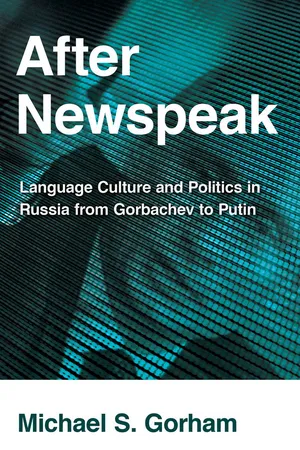
In After Newspeak, Michael S. Gorham presents a cultural history of the politics of Russian language from Gorbachev and glasnost to Putin and the emergence of new generations of Web technologies. Gorham begins from the premise that periods of rapid and radical change both shape and are shaped by language. He documents the role and fate of the Russian language in the collapse of the USSR and the decades of reform and national reconstruction that have followed. Gorham demonstrates the inextricable linkage of language and politics in everything from dictionaries of profanity to the flood of publications on linguistic self-help, the speech patterns of the country's leaders, the blogs of its bureaucrats, and the official programs promoting the use of Russian in the so-called "near abroad."Gorham explains why glasnost figured as such a critical rhetorical battleground in the political strife that led to the Soviet Union's collapse and shows why Russians came to deride the newfound freedom of speech of the 1990s as little more than the right to swear in public. He assesses the impact of Medvedev's role as Blogger-in-Chief and the role Putin's vulgar speech practices played in the restoration of national pride. And he investigates whether Internet communication and new media technologies have helped to consolidate a more vibrant democracy and civil society or if they serve as an additional resource for the political technologies manipulated by the Kremlin.
eBook - ePub
After Newspeak
Language Culture and Politics in Russia from Gorbachev to Putin
- 260 pages
- English
- ePUB (mobile friendly)
- Available on iOS & Android
eBook - ePub
About this book
Information
Topic
Scienze socialiSubtopic
Lingue1
THE SOVIET LEGACY
From Political to Cultural Correctness
“The literary language is the highest form of the national language, a symbol of national distinctiveness (samobytnost′), a vehicle and medium for culture and civilization.”
—LEV SKVORTSOV, “Foundations for the Normalization of the Russian Language” (1969)
Кто с правилами дружен, тот твёрдо убеждён: ФарфОр нам очень нужен, а фАрфор не нужЁн! Нельзя сказать «алфАвит», а можно—«алфавИт». Кто говорит «алфАвит», неверно говорит!
Не говори «катАлог», а только «каталОг». А «твОрог»? Можно «твОрог», а можно и «творОг». А если в магазин вдруг портфЕли завезли— Только не в «магАзин»: не купишь «портфелИ»!
—ALEKSANDR LIVSHITS AND ALKSANDR LEVENBUK, Radio Nanny
One obvious reason for post-Soviet reticence toward Western notions of political correctness is that the Soviet era featured a state-sponsored form of PC that was both ubiquitous and hypertrophied. The well-documented clichéd, wooden language of official speeches, documents, and newspapers assumed such a degree of dominance that it came to symbolize, in the Gorbachev-era revolts against that system, all that was wrong with it. Stale passive constructions veiled authority while deflecting responsibility, convoluted deverbal noun constructions symbolized official inertia, and superlatives meant to spark pride and elation simply stupefied like a worn cant.
Less obvious was an additional source of linguistic correctness that emerged as a dominant, authoritative discourse on language in the Soviet era. As Soviet citizens and school children were provided with explicit models from the Marxist-Leninist annals for describing the world around them, they underwent a parallel process of linguistic shaping that had more to do with cultural correctness than political correctness. As influential in shaping speech practices and language culture of the Soviet era was the “speech culture” or kul′tura rechi movement that had its roots in linguistic theories of the early Soviet period and the more conservative attitudes toward language, writing, and speech espoused by such influential figures as Maxim Gorky (Gorham 2003, 103–19). Particularly on the frontlines of Russian language methodology and instruction and in contrast to other, more well-researched keywords of the time (such as “dialogicity” or skaz), speech culture came to enjoy enormous cultural and linguistic capital over the decades of Stalin’s rule—despite its decidedly unproletarian, unrevolutionary, and un-Marxist orientation. And its capital has lasted well into the postcommunist era.
Lineage of Linguistic Engineering
From the post-Stalin era to the present day, the study of “speech culture” has largely occupied itself with tracking, documenting, and proscribing speech practices of the Russian speaking and writing population. Practitioners pride themselves in their role as negotiators of norms and arbiters of proper usage. Comparisons of prefaces to speech-culture manuals from the 1950s and 1990s reveal little substantive difference—despite the enormous political and social transformations that had taken place over the decades dividing them. “Speech culture,” according to a 1956 textbook on the topic, is dedicated to the study of “those norms of the literary language, the stepping back from which leads to a worsening of speech” (Golovin 1956, 3–4). Forty-three years later the editors of a comparable textbook geared toward a university audience remark in their introduction that “one of the main tasks of speech culture is the protection of the literary language, its norms. It behooves us to note that such protection is a matter of national importance, inasmuch as the literary language is the very thing that, on the linguistic level, unites a nation” (Graudina and Shiraev 2000, 12).
The continuity of this norm-oriented understanding of kul′tura rechi might not be so remarkable if not for its stark contrast to the original spirit of the term as introduced by its Russian progenitor, Grigorii Vinokur. Particularly in his earlier writings, the term had far more radical, even revolutionary, implications. For the Vinokur of 1923, language was a “social fact”; language culture, a means of “overcoming language inertia.” In his first published article on language culture, he wrote about language as something that was “constructed” and, in its stagnated state, a domain ripe for human organization and control: “In so much as it is a social process, the speech process is realized in the widest variety of environments of social order. We build our language, be it written or oral, in dependence on these environments. Our language must obviously be constructed. It is the object of cultural management (preodolenie), requiring a certain organization from the outside” (Vinokur 1923, 105 [emphasis original]). While he did show some concern for nurturing basic linguistic competence that presumed pre-existing norms, Vinokur devoted far greater attention to metaphors of “technology” and “organization” that led him ultimately to conclude that language could and should be “material for cultural construction” (1923, 110, 106).
Implicit or explicit throughout his early writings was a language ideology that ascribed to speakers both the power and the responsibility to construct and organize their speech, to engage in a process of “cultural negotiation.” Rather than viewing language as a pre-existing set of rules and norms that must be obeyed for speakers to earn the badge of proper speech culture, he focused instead on linguistic self-consciousness and invention. Language was a technology that was rightly the object of human engineering, rather than an organic and essential precursor to human identity.
The contrast between the linguistic ideology underlying Vinokur’s original discussions of language and that implicit in the speech culture movement dominant through the final decades of the Soviet era and beyond leads one to wonder what became of this more proactive, or constructive, strain of discourse on language. One certainly does see vestiges of it in the writings of some of the more frequently studied linguists. Valentin Voloshinov’s main criticism of Saussure and others was directed precisely at the basic assumption that language consisted of objective, self-replicating norms and thus constituted an objectively identifiable “system” that existed apart from individual and collective users. He argued that this was neither what language was, nor how it was perceived by users—that such a norm-oriented view of language was based on a philological tradition that placed priority on dead, written texts. Language, he countered, could not be isolated from its social and ideological context, and it was not isolated by ordinary users. We choose the words and phrases we do, not out of some pressure from abstract norms, but rather in order to express ourselves in a concrete, dialogic context (Voloshinov [1929] 1993, 71–90). Norms hold some sway, he argued, but “they exist only in relationship to the subjective consciousness of the members of a given collective”: “for the individual speaker, linguistic form is important not as a stable signal that is always one and the same, but rather as a constantly changing and flexible sign” (72, 74).
Curiously enough, in terms of language ideology, Nikolai Marr shared common space with Voloshinov to the extent that each viewed language as a constructed or created product of society prone to significant “re-creation” during times of “truly new social forms of life and everyday existence (byt′)” (Marr 1927, 19). In an article on writing and grammar reform, Marr argued that norms were outdated and reflected different class relations; and he called for a complete “speech revolution” using the “new language material.” The main reason teachers and scholars were reluctant to abandon norms and grammar was that they recognized it would mean abdicating their power and authority in this area (Marr 1930, 46–47). Echoing the creative and constructive tenor of Vinokur’s early writings, Marr emphasized the need for “language creation” (iazykotvorchestvo) and “creativity of speech” (tvorchestvo rechi), contrasting the primacy of spoken, colloquial language to “obsolete (otzhivshie) systems of speech” (Marr [1931] 1977, 32). Tellingly, he also acknowledged that the practical application of his theories must be deferred to a time when they would be better “understood and accepted,” implying (correctly) that they were not yet understood or accepted—a gap between theory and practice that was to persist throughout the 1930s and 1940s, when his ideas were in ideological favor (Marr [1931] 1977, 34–35).1 As late as 1949, one Marr sympathizer asked point blank on the pages of Russian Language in the School, “How are they understanding and teaching language in school? The profound teaching of N. Ia. Marr has not penetrated the schools because of the strength of resistance from formalists. Our textbooks in no way provide a correct understanding of language” (Petrova 1949, 52).
From a purely political standpoint, we are accustomed to viewing Marr and Voloshinov through quite different lenses. And yet, when examined more closely, they, together with the early Vinokur, shared a language ideology that viewed the individual speaker as a creative force in the process of language production. They also shared the more dubious distinction, despite attempts to drape their work in Marxism (at least in the cases of Voloshinov and Marr), of being patently ignored by language practitioners—not only the professionals responsible for disseminating language models, be it through grammars, guides, dictionaries, curricular guidelines, or classroom instruction, but also the folk linguists, everyday citizens engaged in language production in Stalinist Russia. Instead, the linguistic ideology that came to dominate linguist practice of the Stalin era turned out to be one that ignored Marxist ideology and relied instead for its symbolic authority on the parallel discourses of culturedness, or kul′turnost′, and norms.
The Quiet Conservatism of the Practitioners
It is in the quiet conservatism of the practitioners—the mavens, the codifiers, and the pedagogues—where we witness the emergence of “speech culture,” or kul′tura rechi, as a dominant linguistic ideology. While some mention of norms could be found in the writings of the philologist Aleksei Shakhmatov (1864–1920), he and most prerevolutionary linguists viewed the task of the linguist as one of describing “how people speak,” not prescribing “how they should speak” (Shvartskopf 1970). In this earlier period it was widely held that norms and language could not be managed or manipulated by society, linguists, or individual speakers. One exception, however, came in the form of Vasilii Chernyshev’s Correctness and Purity of Russian Speech (Pravil′nost′ i chistota russkoi rechi) (1911), a book the Petersburg philologist intended as a practical guide to the “frequently asked questions” of “how to speak better and more properly” (Chernyshev 1911, 3). Noting the frequency of “violations of unquestionable rules of speech in books, newspapers, letters, and conversation…,” Chernyshev identified four different source models for “literary language”: “(1) generally accepted contemporary usage, (2) the works of representative/model Russian writers, (3) the best grammars and grammar research on the literary Russian language,” and, finally, (4) the language of the people (narodnyi iazyk)” (1911, 3).
Lev Shcherba was among the first linguists in Soviet times to employ a more norm-oriented discourse—perhaps because he also worked in the trenches as a Petrograd school director and later became involved in curricular design. In a 1931 essay he acknowledged that more “catastrophic” events might spark significant change in a language, but attributed change under more normal circumstances to forces that lay beyond the individual speaker. Speakers, in his view, were passive objects of normative change from more abstracted “language material”: “People usually say that change in a linguistic system occurs upon generational change. This is in part true, but the experience of our revolution has shown that a sharp change in the language material inevitably entails change in the speech norms even of the elderly. A massive number of words and phrases that several years ago would have seemed wild and unacceptable have now entered into everyday use” (Shcherba [1931] 1974, 29). Unlike many of his contemporaries, Shcherba embraced the notion of norms, albeit in a somewhat qualified manner (“I shall now touch on another issue of so-called norms in language. Our spoken language activity is in fact guilty of numerous deviations from the norm” [36]). That embrace became less guarded by 1939, when he unequivocally asserted that it was the “literary language,” based on the literary classics, that served as the source for linguistic “norms” (Shcherba [1939] 1957, 113, 126).
Shcherba’s equation of linguistic norms with the literary language proved the rule rather than the exception in Soviet language studies, where more generic notions of “standard language” were all but non-existent (Paulsen 2009, 66–80).2 Linguistic authority, according to this narrative, rested in the lofty lair of the literary tradition as it developed from the time of Pushkin, a move that enhanced the value of essentialist notions of language as an innate marker of Russian national identity. This discourse on language as a marker of national identity and pride became more notable in metalinguistic commentary of the early 1940s, by which time even Shcherba would invoke organic and biological metaphors of language in lieu of those describing it as a tool, weapon, or technology: “And, truly, the word ‘native’ (rodnoi) is a magical word and touches on the most treasured side of our essence. With its intimate warmth it heats up everything it is placed next to as a modifier: ‘native country,’ ‘native home,’ ‘birth mother,’ ‘native language’ ” (Shcherba [1939] 1957, 113).
Dictionaries by definition presume the existence of norms and the need for codification, but in his preface to the 1935 Interpretive Dictionary of the Russian Language, Dmitrii Ushakov distinguished his compendium apart from its predecessors precisely because of its “normative goal—of being a guide for the model literary language.” In his own rendition of constructing publics, Ushakov claimed that the events of 1917 had increased the need for a dictionary that was “intended for a broad readership, indicate[d] the norms of usage for words, and [was] close to the here and now (blizkii k sovremennosti)” (Ushakov 1935, 1–2, 3). The speaking and writing public, according to his linguistic-ideological slant, consisted not of newly empowered proletarian or popular innovators, but rather of needy seekers of codified rules.
As the cofounder and first director of the Academy of Sciences Russian Language Institute (established in 1944), Sergei Obnorskii could claim a fair amount of a...
Table of contents
- Preface
- Acknowledgments
- Note on Transliteration and Translations
- Introduction: Ideologies, Economies, and Technologies of Language
- 1. The Soviet Legacy: From Political to Cultural Correctness
- 2. Glasnost Unleashed: Language Ideologies in the Gorbachev Revolution
- 3. Economies of Profanity: Free Speech and Varieties of Language Degradation
- 4. In Defense of the National Tongue: Guardians, Legislators, and Monitors of the Norm
- 5. Taking the Offensive: Language Culture and Policy under Putin
- 6. “Cyber Curtain” or Glasnost 2.0? Strategies for Web-based Communication in the New Media Age
- Conclusion
- Appendix: Sayings and Proverbs about Language
- Works Cited
Trusted by 375,005 students
Access to over 1.5 million titles for a fair monthly price.
Study more efficiently using our study tools.
Frequently asked questions
Yes, you can cancel anytime from the Subscription tab in your account settings on the Perlego website. Your subscription will stay active until the end of your current billing period. Learn how to cancel your subscription
No, books cannot be downloaded as external files, such as PDFs, for use outside of Perlego. However, you can download books within the Perlego app for offline reading on mobile or tablet. Learn how to download books offline
Perlego offers two plans: Essential and Complete
- Essential is ideal for learners and professionals who enjoy exploring a wide range of subjects. Access the Essential Library with 800,000+ trusted titles and best-sellers across business, personal growth, and the humanities. Includes unlimited reading time and Standard Read Aloud voice.
- Complete: Perfect for advanced learners and researchers needing full, unrestricted access. Unlock 1.5M+ books across hundreds of subjects, including academic and specialized titles. The Complete Plan also includes advanced features like Premium Read Aloud and Research Assistant.
We are an online textbook subscription service, where you can get access to an entire online library for less than the price of a single book per month. With over 1.5 million books across 990+ topics, we’ve got you covered! Learn about our mission
Look out for the read-aloud symbol on your next book to see if you can listen to it. The read-aloud tool reads text aloud for you, highlighting the text as it is being read. You can pause it, speed it up and slow it down. Learn more about Read Aloud
Yes! You can use the Perlego app on both iOS and Android devices to read anytime, anywhere — even offline. Perfect for commutes or when you’re on the go.
Please note we cannot support devices running on iOS 13 and Android 7 or earlier. Learn more about using the app
Please note we cannot support devices running on iOS 13 and Android 7 or earlier. Learn more about using the app
Yes, you can access After Newspeak by Michael S. Gorham in PDF and/or ePUB format, as well as other popular books in Scienze sociali & Lingue. We have over 1.5 million books available in our catalogue for you to explore.