1
Origins and Consequences of the Real Estate Turn
A company is a country. A country is a company. They are the same. The management is the same. It is management by economics. From now onwards this is the era of management by economics, not management by other means. Economics is the deciding factor.
—Thaksin Shinawatra, quoted in Pasuk 2003, 8
The quote above, from Thailand’s former prime minister Thaksin Shinawatra, is a particularly clear and direct expression of an idea that began to shape political discourses in Asia during the 1990s, that of political leaders as chief executive officers (CEOs). While seldom expounded upon in detail, the idea of a CEO politician expresses a certain kind of aspiration to power. First and foremost, it expresses a desire for the extent of authority and autonomy of action enjoyed by a corporate CEO. It further expresses the idea that, if it is to be sustained, this capacity to act must be used to financially empower the state, and by extension the nation, by exploiting the commercial value of its land, labor, and natural resources. It calls for a new role for the state as a market actor that achieves goals of fiscal strength and national economic growth (increasingly seen as the primary measures of state legitimacy) through the market delivery of goods and services. Such explicit references to countries as corporations and to political leaders as CEOs have become common in the popular press, in academic analyses of the changing role of the state, and in the pronouncement of Asian government leaders themselves (see for example Low 2002; Kalbag 2011; Economic Planning Unit 2013).1
This chapter contends that urban land has come in many contexts to be a central focus for this explicit market orientation of governments, and that the politics of land has consequently come to fundamentally reshape relationships between government, business, and citizens. Urban land has, of course, always been subject to political struggle. Land management forms the basis for place making and consequently for state projects of political and social engineering. Being fixed in place, land is also relatively easily subject to state control, surveillance, regulation, and taxation, and therefore becomes central to the nation-building projects of governments. As property values have exploded in much of Asia since the 1980s, however, governments have increasingly viewed urban land differently. Long-standing state interests in political control and the creation of symbolic space have come to be overlaid with a speculative interest in potential windfall financial gains to be realized through the monetization of land. The question of how states might capitalize on this new potential source of wealth, either by directly tapping into land as a source of revenue or by using powers of land management to allocate this wealth to political supporters, has arisen as a major focus of state-directed urban redevelopment and urban governance reform. What has resulted has, in many cases, been an unprecedented meeting of the minds and marriage of the interests of state and real estate actors. This meeting of minds has sometimes led to a dramatic transformation of urban space, and where it has not it has at least redefined debates about what cities should look like and what criteria should be applied to the right to use urban space.
These changes are a critical part of the story of the embrace of urban real estate megaprojects throughout Asia that is the central focus of this book. These massive projects represent a marriage of two state objectives: the creation of symbolically powerful landscapes of development and the release of massive amounts of value that can be captured by the state and its allies in the corporate sector. Hence the flashy architectural renderings of imposing new skylines serve a dual purpose; they are both a reflection of a nation’s development and a vehicle for a new model of urban governance.
As this new business orientation of the state has taken shape, however, it has also implicated both state actors and their business allies in new processes of dispossession and displacement, as developers and state actors seek to delegitimize and systematically undermine (and sometime reconstitute in new, market-friendly form) people’s existing claims to neighborhood and livelihood. And these processes of dispossession and displacement have in turn instigated a new moral politics of citizenship, as those displaced by redevelopment—low- and moderate-income communities, markets, street vendors, small manufacturers, and others—have raised questions of the fairness and legitimacy of these new state roles. That these communities are themselves often critical centers of production for both domestic and international markets raises the issue of how and why the production of corporate entities is included in the accounting of national development, while the production that occurs outside corporate spaces is not (Simone and Rao 2012). In their reach to transform urban space, states have revisited long-contested questions of property rights and have launched controversial new initiatives aimed at displacing entrenched claims to urban space and in some cases at integrating the poor into commercial property markets. Yet communities have, in many instances, successfully turned the tables to question the legality and political propriety of state interventions in real estate markets. This market-oriented shift in governance is therefore a part of a larger reshaping of the political and social landscape of cities that has played out as much in political contestations as in physical space.
The shifts in the politics of land development discussed in this chapter unfold against a backdrop of the changing relationships between national and local governments in urban planning and development, or what Brenner (2004) has discussed as the rescaling of state action. As cities have emerged as critical centers for economic growth within international networks of trade, Brenner (2004, 3) argues, they have consequently emerged as “key institutional sites in which a major rescaling of national state power has been unfolding.”
One aspect of this rescaling revealed in a focus on land management is a “real estate turn” in national urban policy, as national governments have proactively sought to capitalize on the economic, fiscal, and developmental opportunities presented by the escalation of land prices. They have been motivated to do so by the political gains to be had from growing urban economies, from the cultivation of powerful new interest groups like corporate leaders and a growing consumer class, and from the fiscal gains to be had by tapping into the new power of real estate markets. They have also been spurred to act, as powerful agencies like the World Bank and global consulting firms like McKinsey have increasingly emphasized the importance of large, extended urban regions as economic drivers. As it has become clear that national governments are often the only entities with the inherent interests and geographic scope of authority to capitalize on the potential of sprawling and rapidly expanding urban regions, they have increasingly concentrated the thrust of their political will on the management of the political economy of urbanization. They have done so with great variety in their capacity to achieve their aims. Nonetheless, the past three decades have seen creative efforts to develop new legal and institutional vehicles for state land acquisition, for the creation of public-private partnerships in land development, and for the sale or lease of state land to corporate developers, among other measures. Many national governments have also rolled out reform agendas—liberalization of the financial sector, reforms to urban land-use planning frameworks, fiscal decentralization, and others—that are explicitly intended to empower local governments and prod them toward a more commercial orientation in their land management. In some instances, national government actors themselves have gotten into the game of real estate, formulating commercial developments in which national agencies are key partners.
Despite this commercial thrust of public policy, the analogy of the “state as corporation” implicit in Thaksin’s quote will, of course, never fully be realized. A nation is not a commercial enterprise, and the logic of state political power and legitimation does not equate to the simple logic of corporate profitability. Particularly in electoral systems, politics reflect the simple fact that societies embody competing interests and that the institutionalization of these interests necessarily requires that government institutions will not cohere to a unitary set of goals. The analogy particularly breaks down when we consider the role of citizens in a commercially oriented state. Are they shareholders in this corporation? Consumers of its products? Or are they instead providers of labor and their communities’ raw material, to be exploited to maximize profit for a much smaller set of shareholders? Or are their demands for space and livelihood simply an obstacle to corporate and government efforts to maximize their power and profitability through the gradual commodification of everything? In fact, in varying circumstances and to varying degrees, citizens play each of these contradictory roles, sometimes in combination. What they are in every instance is vulnerable, as their political interests are increasingly subject to reassessment in light of a new set of criteria for citizenship and social and economic inclusion. States posing as corporations face thorny contradictions and questions. Can the state’s drive to capitalize financially on urban development, and the dispossessions that necessarily result, be reconciled with its role as an arbiter of national citizenship? Can governments be held accountable, and can the impulse to reward allies and exploit nonallies be reined in, within the framework of a commercially oriented state? Can the financial benefits of urban development be allocated equitably and fairly? And even if they can, do citizens deserve the right to retain ways of life and livelihood that do not fit neatly into a corporate paradigm?
Many of these issues were apparent in the case of Thaksin himself. A multibillionaire telecommunications and information technology entrepreneur who was prime minister of Thailand from 2001 to 2006, Thaksin was unseated in a coup following allegations of corruption. While in office Thaksin combined efforts to seek new sources of state revenue with proposals for the most ambitious spending program on infrastructure megaprojects and grassroots economic development initiatives in Thailand’s history. These policies constituted an effort to pump prime the economy and stimulate economic growth in the aftermath of the Asian financial crisis of 1997–1998. His model for doing so came to be known as “Thaksinomics,” referring to an approach to managing the economy in which an activist and entrepreneurial state uses policy and public expenditure to exploit opportunities for economic growth while also maximizing its fiscal capacity (Pasuk and Baker 2004). In practice this meant pump priming and retooling the economy through the aggressive use of state financial institutions to finance infrastructure megaprojects and economic development schemes, while simultaneously encouraging state enterprises to be entrepreneurial in exploiting their assets for commercial gain (Pasuk 2003; Charoen, 2004; NESDB 2005; The Nation, January 13 and September 1, 2006, Internet edition).
One specific strategy promoted by Thaksin’s government, which had precedents in the pre-Thaksin era, was the promotion of real estate megaprojects intended to exploit state landholdings as a source of revenue. This was often to be achieved by crafting public-private partnerships initiated by state-owned enterprises or government ministries.2 One such project, conceived in the pre-Thaksin era but which gained traction while he was in office, was the National Housing Authority’s (NHA’s) Din Daeng Redevelopment Project. The initiative was planned for three proximate 1960s public housing complexes covering a total of one hundred hectares of land. While once a garbage dump at Bangkok’s edge, the area around Din Daeng had transformed over the decades into a vibrant commercial area that the NHA increasingly viewed as an alluring development opportunity. In 1999 a team of Thai and multinational consulting firms issued a preliminary redevelopment master plan for the site that included hotels, office buildings, serviced condominium units, a shopping mall and other retail spaces, a convention center, and a theater (Attaporn 2005). This concept gained some momentum in the early to mid-2000s, but the project foundered on controversy over the displacement of forty thousand existing public housing residents, the vast majority of whom were not slated to be rehoused on site. To the seeming surprise of the NHA, the residents valued both the community ties they had developed in Din Daeng and the access to jobs and amenities that its centrality provided. To the distress of NHA officials, they proved quite adept at asserting their interests in the popular press and in countering government-promoted images of the housing complex as dangerously derelict and socially dysfunctional. The intensity of the conflict engendered by this particular project and the incapacity of entrenched bureaucratic cultures to adapt to new modes of public relations and political action, ensured the failure of the Din Daeng Redevelopment Project. Other proposed developments in Thailand have similarly foundered on controversies over social displacement and over competing bureaucratic and political interests.
In the pages that follow I will argue that the central tensions of the Din Daeng case—the moral quandaries and political contradictions inherent in reframing questions of rights to the city involved in this new state/developer nexus—resonate through many contexts in Asia. The chapter will begin by reviewing the historical circumstances that have led to the surge in property development that has fostered fundamental changes in the political economy of urbanization in different Asian cities. The following section will then discuss three common categories of issues that have emerged wherever urban real estate megaprojects have been pursued: the politics of state rescaling and questions of what state actors should shape land development; the spatial politics that emerge around the enclosures, displacements, and exclusions associated with large-scale land commodification; and a new moral politics, as debates over rights to housing and livelihood, and over questions of formality and informality, legality and illegality, have become increasingly central to questions of state legitimation, citizenship, and social justice. Finally, the chapter will preview the three case studies that are the focus of this book (Jakarta, Chongqing, and Kolkata), examining how these three issues have played out in urban development in three Asian cities.
Real Estate Booms and Megaproject Development: A Brief Historical Review
One intent of focusing attention on the monetization of land in this book is to take a step toward the development of stronger, more empirically rooted comparative frameworks for analyzing the political economy of urban development in Asia. The development of such frameworks has proven a persistent challenge. One approach to addressing Asia comparatively has been to ask whether Asian cities are experiencing spatial change akin to that found in the globalizing and neoliberalizing cities of the West, such as the emergence of gated communities, the privatization of urban space, and the rote translation of Western architectural and urban design forms to other contexts (Wu and Webber 2004; Glasze, Webster, and Frantz 2006). Yet this idea of convergence has been subject to critique on both theoretical and empirical grounds.
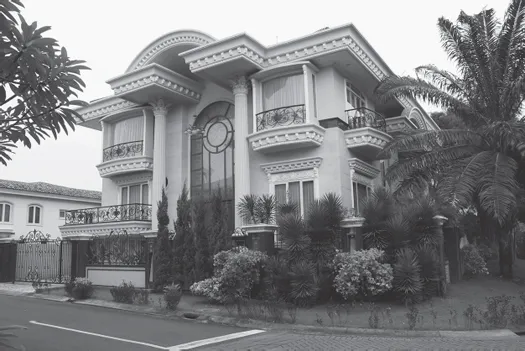
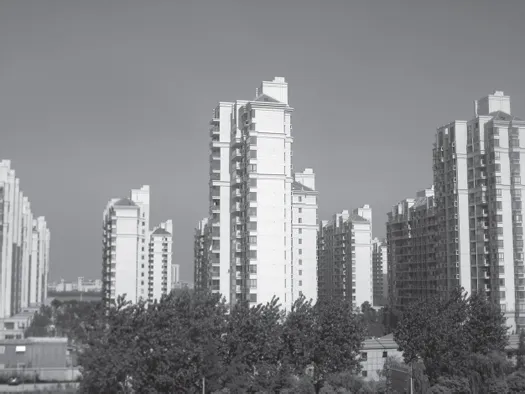
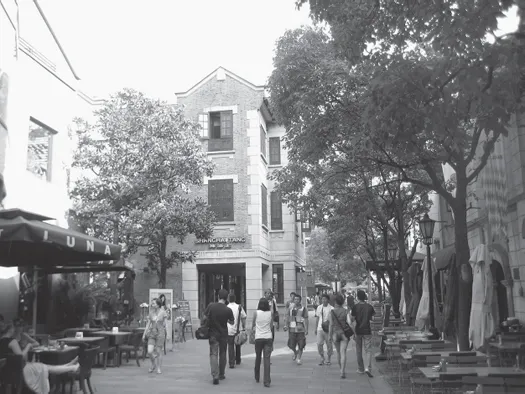
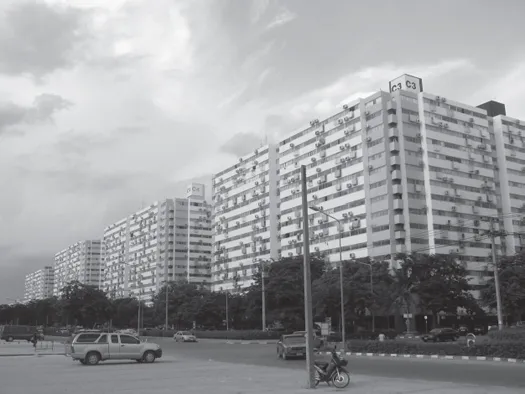
From an empirical perspective, the idea of convergence does not appear to capture the diversity of urban form evident in Asia’s new master-planned urban spaces. An exhaustive discussion of typologies and models of urbanism in urban real estate megaprojects is beyond the scope of this volume and has been the subject of other excellent books and articles (see for example Marshall 2003). A quick comparison of commercial and residential typologies in several developments, however, is useful to illustrate their diversity of form. Figures 1.1 through 1.4, which contains examples drawn from Shanghai, Jakarta, and Bangkok, is intended to illustrate some of this diversity.
Some urban real estate megaprojects have indeed borrowed directly from architectural and urban design models originating in the West. Many of Jakarta’s new towns are designed by Southern California–based architecture and design firms and include prototypical auto-oriented, elite “gated community” suburban subdivisions containing rows of single-family houses designed in a pastiche of architectural styles (see figure 1.1). Yet the example of high-rise housing Shanghai’s Songjiang New Town, in figure 1.2, illustrates a typology resembling Singapore’s new towns. Such projects are planned for transit orientation, with streets intended as pedestrian thoroughfares connecting high-rise structures to schools, shopping centers, and other facilities located within the residential complex. The example of Shanghai’s Xintiandi development, in figure 1.3, is akin to other global experiments in new urbanist planning in its focus on the scale of development, pedestrian orientation, and mix of commercial and residential land uses (He and Wu 2005). Yet its architectural motif is intended to remain consistent with the distinctive and architecturally significant shikumen style of the original neighborhood, the French Quarter, which contains historically important sites. Finally, the low-cost condominiums that characterize a substantial portion of Muang Thong Thani in Bangkok, in figure 1.4, illustrate a distinct typology that emerged from the Australian architect’s interpretation of the mix of residential, commercial, and recreational space that typifies Thai working-class urban settlements (Marshall 2003). The result is a block of functionalist, medium-rise residential cubes, each with rows of small shops occupying their ground floors, fronting on broad sidewalks that are intended as spaces of leisure and everyday commerce.
Figure 1.1. Villa in Lippo Karawaci, Jakarta Metropolitan Region. Source: Author.
Figure 1.2. Songjiang City in Songjiang Province near Shanghai. Source: Author
Figure 1.3. Xintiandi, Shanghai. Source: Author
Figure 1.4. Muang Thong Thani, Nonthaburi Province near Bangkok. Source: Author.
These examples illustrate the mix of logics that inform the choices of ...