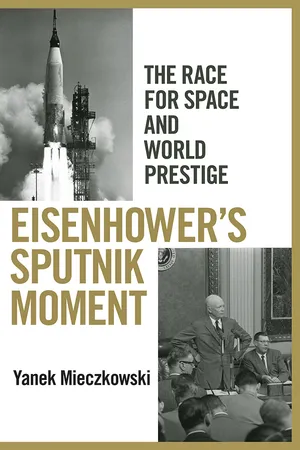
In a critical Cold War moment, Dwight D. Eisenhower's presidency suddenly changed when the Soviet Union launched Sputnik, the world's first satellite. What Ike called "a small ball" became a source of Russian pride and propaganda, and it wounded him politically, as critics charged that he responded sluggishly to the challenge of space exploration. Yet Eisenhower refused to panic after Sputnik—and he did more than just stay calm. He helped to guide the United States into the Space Age, even though Americans have given greater credit to John F. Kennedy for that achievement.
In Eisenhower's Sputnik Moment, Yanek Mieczkowski examines the early history of America's space program, reassessing Eisenhower's leadership. He details how Eisenhower approved breakthrough satellites, supported a new civilian space agency, signed a landmark science education law, and fostered improved relations with scientists. These feats made Eisenhower's post-Sputnik years not the flop that critics alleged but a time of remarkable progress, even as he endured the setbacks of recession, medical illness, and a humiliating first U.S. attempt to launch a satellite. Eisenhower's principled stands enabled him to resist intense pressure to boost federal spending, and he instead pursued his priorities—a balanced budget, prosperous economy, and sturdy national defense. Yet Sputnik also altered the world's power dynamics, sweeping Eisenhower in directions that were new—even alien—to him, and he misjudged the importance of space in the Cold War's "prestige race." By contrast, Kennedy capitalized on the issue in the 1960 election, and after taking office he urged a manned mission to the moon, leaving Eisenhower to grumble over the young president's aggressive approach.
Offering a fast-paced account of this Cold War episode, Mieczkowski demonstrates that Eisenhower built an impressive record in space and on earth, all the while offering warnings about America's stature and strengths that still hold true today.
Eisenhower enjoyed his home in Gettysburg, Pennsylvania. In 1950, when he and his wife, Mamie, had purchased the property, a bucolic piece of land that was once part of the Civil War battlefield, they had planned to retire there. They remodeled the house, and the residence assumed greater importance after the president’s 1955 heart attack, when doctors advised Eisenhower to avoid the high altitude of the First Lady’s home state, Colorado, where they had liked to vacation. So the couple began to use their Gettysburg house and 496-acre farm as a getaway, going there almost every weekend. It was just twenty minutes from Camp David, and the scenic drive from Washington to southern Pennsylvania was relaxing. Once at the house, the Eisenhowers had plenty of creature comforts. They particularly enjoyed the home’s back room, with its expansive glass ceilings and walls, which gave a marvelous view of their backyard and drenched them in sunlight on nice days. There they would sit, with Ike typically reading or painting and Mamie watching television.
For the weekend beginning Friday, October 4, 1957, Eisenhower returned to Gettysburg, anticipating pleasant diversions from the grind of his presidential duties. He could watch over a herd of prized Angus cattle, which provided steak for barbecues where he cooked and entertained. He could go trapshooting, golf, or paint. Eisenhower was looking forward to these diversions when he received a telephone call from Washington. Something big had happened in the Soviet Union.
The news first hit the United States on Friday evening, just after six o’clock. The event’s epicenter was a desert in the Kazak Republic, east of the Aral Sea, site of the Soviet Union’s rocket launch complex but an area so barren and remote that NASA engineer James Oberg remarked after a visit, “If Earth has any human settlement halfway into outer space, this is it.” The spot was secretive, and Soviets called their spaceport “Baikonur,” after a distant mining town; the deceptive name was part of an attempt to keep their space activities concealed, even though American U-2 spy planes had detected the spaceport’s construction. Near the rocket launchpad, a group of Soviet engineers and military officials shoehorned themselves into a small, bunkered room, listening anxiously to radio receivers. The room was so quiet with anticipation, one colonel later recalled, that the only audible sounds were people breathing and radios crackling with static. When they finally heard beeping over the radio, the room erupted in cheers.1
The Soviets had fired an R-7 ICBM rocket that carried the world’s first artificial satellite, “Sputnik” (abbreviated from Iskustvennyi Sputnik Zemli, meaning “artificial fellow traveler around the earth”), and the beeps confirmed that it was orbiting the earth. Sputnik was simple: just a small, shiny aluminum sphere, 22 inches in diameter—about the size of a beach ball—with four metal antennae protruding from it, two of them almost 10 feet long. Its scientific payload was meager: a radio transmitter, batteries, and temperature gauges.2 But for its role in history, Sputnik was gigantic. It had ushered in the Space Age.
Scientists debate where “outer space” begins, but some peg it at roughly 100 kilometers, or 62 miles, above the earth’s surface. The rocket that launched Sputnik consisted of three stages, with the third stage reaching 142 miles in altitude before the satellite (essentially, a fourth stage) separated to begin orbit. The satellite raced around the earth at 18,000 miles per hour, the speed needed to counteract gravity and achieve orbit, at a maximum altitude of 560 miles. Every hour and a half, it made a complete orbit.3 To maximize its propaganda value, Russian scientists directed the satellite to circle the earth’s most populated areas. They had polished its metal surface to reduce friction heat and increase reflection of the sun’s rays, making it more visible. Astronomers tracked its path, and at dawn and dusk Americans nationwide strained to see it, visible as a glowing dot arcing across the sky. Radio operators in Riverhead, Long Island, were the first to hear Sputnik’s eerie “beep . . . beep . . . beep.” One NBC commentator dramatically announced, “Listen now for the sound which forever more separates the old from the new.” The satellite also created a cascade of events that nearly paralyzed Eisenhower’s presidency.4
“They’re Miners and They’re Peasants”
George Reedy, an assistant to Senate Majority Leader Lyndon Johnson and later his presidential press secretary, recalled that Sputnik’s launch hit Americans “like a brick through a plate-glass window, shattering into tiny slivers the American illusion of technical superiority over the Soviet Union.” Before Sputnik, Americans had looked down on their adversary, ridiculing crude, clunky Russian equipment prone to breakdowns. “How do you double the value of a Soviet car?” went one joke. The answer: “Fill up its gas tank.” According to another wisecrack, the Soviets could never smuggle a nuclear bomb inside a suitcase because they still needed a good suitcase. Harry Truman, who dismissed Russians as “those Asiatics,” once predicted, “Do you know when Russia will build the [atom] bomb? Never.”5
The cartoonish vituperations had a point: the Soviet Union had formidable military strength but a backward economy. Just two months before Sputnik, Fortune magazine reported that the Soviets “want to slow down the arms race, at least for a while, because the U.S. pace is too stiff for their existing technical resources to match.” Soviet technology and workmanship were suspect. Premier Nikita Khrushchev acknowledged that in the past Soviet helicopters “weren’t too reliable, and we had quite a few accidents with them,” prompting recommendations that he avoid flying in them. During the Korean War, spectacular dogfights featured American-built Sabre jets battling Russian-made MiG-15 fighters. The Soviets enjoyed a fearsome reputation in aircraft design, and in some respects the MiGs outperformed the Sabres. Overall, though, the U.S. warplane’s superiority was clear. After a North Korean pilot defected, U.S. engineers examined his MiG-15. Chuck Yeager, the World War II ace and test pilot, commended it as “a pretty good fighting machine” but noted that it was “a quirky airplane that’s killed a lot of its pilots.” The MiG had a host of mechanical problems, and the North Korean defector warned against activating a fuel pump that could destroy part of the plane. Before he flew the Soviet jet, Yeager recalled thinking, “Man, that thing is a flying booby trap, and nobody will be surprised if I get killed.”6
Aware of poor Soviet technology, disdainful of their political and economic system, Americans underestimated their Russian counterparts. The mere notion of the USSR trumping the United States in a scientific endeavor seemed far-fetched. Hans Bethe, the Cornell University physicist who worked on the Manhattan Project and served on Eisenhower’s Presidential Science Advisory Committee, recalled that before Sputnik, Americans “were terribly conceited. We thought only we could do great [scientific and engineering] achievements.”7 In fact, during the twentieth century, Americans had grown used to being first, and they bathed in the glow of prestige that accompanied historic technological firsts.
After World War II, the United States enjoyed an atom bomb monopoly and unparalleled economic and military strength. Rivals such as Japan and Germany lay ruined, as did former superpowers Great Britain and France. Had any of those countries launched the world’s first satellite, the effect on the United States would hardly have been severe. They lay prostrate enough that Americans felt sorry for them.
In a way, the Soviet Union had also been vanquished during World War II, suffering tremendous losses even though on the Allied side. Nearly thirty million of its people died, and Adolf Hitler’s troops inflicted great physical damage when they invaded Russia. The country was “flat on its back” after the war, recalled Spurgeon Keeny, an arms control expert who worked for the Defense Department’s Office of Research, Development, and Engineering. In August 1945, when Eisenhower visited Moscow, he remembered that “damn near all [Josef Stalin] talked about was all the things they needed, the homes, the food, the technical help.” As Eisenhower flew back to Europe, he crossed a ravaged Russia, with not a single house standing from Moscow westward.8
As a result, Americans grew accustomed to thinking of Russians as a backward, beaten people, an impression that lasted into the 1950s. One of the most crippling problems that Soviet citizens endured was a housing shortage so severe that entire families lived in one room of an apartment. Conditions in Moscow were so bad, Americans learned, that the question “Is the bathroom free?” was actually inquiring whether someone lived in it. One New Yorker recalled that when Sputnik was launched, “the public mood was, ‘How could this happen to us? How could we be second to the Russians?’ ” They seemed little more than a “cold people in a cold land,” he remembered. “They’re not scientists—they’re miners and they’re peasants. . . . How could they beat us?” Sputnik came as a big surprise. Ralph Nader, the future consumer advocate and third-party presidential candidate, was a Harvard Law School student at the time of the launch, and he remembered that the news “hit the campus like a thunderbolt.”9
It should not have been so. Although ravaged by World War II, the Soviet Union was still America’s rival, an economic competitor with growth averaging a spectacular 11–12 percent during the early 1950s.10 Russians could achieve technological breakthroughs, and Americans had already raced against them in various arenas. Using stolen secrets, the Soviets implemented a crash program to develop weapons of mass destruction, exploding their first atomic bomb in 1949 and first hydrogen device in 1953, just one year after America’s H-bomb. Americans suddenly “recognized that we did not have a monopoly on scientific and engineering developments,” Bethe said. The atomic and hydrogen bombs, horrifying yardsticks of scientific progress, intensified American feelings that their Cold War rival offered stiff competition. Moreover, the 1950 capture of German scientist Klaus Fuchs in Britain for funneling atomic bomb secrets to the Soviet Union led some Americans to assume that the Russians were privy to all U.S. secrets and stepping-stones to development. “Suddenly people said, ‘Everything we know, the Soviets now know,’ ” Keeny commented.11
During a 1956 visit to the Soviet Union as a Senate Armed Services Committee member, Henry Jackson observed the paradox of a supposedly backward country that could achieve breakthroughs. He noted that Soviet living standards lagged far behind those in the United States, and few Soviet citizens had cars or modern home appliances. “Daily life in Russia is still drab and largely without comforts,” he wrote. “One sees deprivation on every hand—in the stores and on the streets, in people’s clothes and in their homes.” Soviet infrastructure was primitive; Jackson noticed that “many of the airfields in the Soviet Union lack concrete or hard-surface runways. Sod or grass runways are quite common.”12 Yet Jackson believed that the backwardness belied a latent capacity for progress. Ironically, the poverty of its people allowed Russia to make industrial gains. “Just because civilian consumption is held down, a large proportion of Russian production can be reinvested—notably in new machines,” he believed. “The Kremlin ploughs the standard of living of the people into new capital equipment.”
Moreover, Jackson noted, the Russians relished a race. “On my trip I found the Russians constantly talking in terms of industrial competition with us,” he said. “The Russians think in terms of only one probable outcome to this competition—beating us. . . . Of course, beating us industrially is a polite way of saying that they intend to achieve a position where they can have their way in the world.” Jackson also saw schools emphasizing math, physics, chemistry, and technology, and he visited a large observatory whose director said that “they expected to view from this observatory the new satellite that is to be launched by the Soviet Union.”13
What Sputnik Signified
The notion of a “race” with the Soviet Union permeated Cold War thought, and it applied not only to space but to nuclear arms. On August 26, 1957, the USSR proclaimed that it had tested an intercontinental ballistic missile that flew more than 4,000 miles. That successful test encouraged Khrushchev to give final approval to use the ICBM rocket to launch a satellite, in effect getting two propaganda victories for the price of one. To the United States, the ICBM test plus Sputnik demonstrated that Russia indeed had rockets powerful enough to launch nuclear weapons that could reach Western Europe or even North America. A scientist working on the U.S. satellite project acknowledged that Sputnik signified that “the Russians must have the intercontinental ballistic missile as they claim.” Before Sputnik, U.S. intelligence had predicted that...
Table of contents
List of Acronyms and Abbreviations
Introduction
Part One: Sputnik
Part Two: Setbacks
Part Three: Space
Conclusion
Acknowledgments
Notes
Bibliography
Trusted by 375,005 students
Access to over 1.5 million titles for a fair monthly price.
Study more efficiently using our study tools.
Frequently asked questions
Yes, you can cancel anytime from the Subscription tab in your account settings on the Perlego website. Your subscription will stay active until the end of your current billing period. Learn how to cancel your subscription
No, books cannot be downloaded as external files, such as PDFs, for use outside of Perlego. However, you can download books within the Perlego app for offline reading on mobile or tablet. Learn how to download books offline
Perlego offers two plans: Essential and Complete
Essential is ideal for learners and professionals who enjoy exploring a wide range of subjects. Access the Essential Library with 800,000+ trusted titles and best-sellers across business, personal growth, and the humanities. Includes unlimited reading time and Standard Read Aloud voice.
Complete: Perfect for advanced learners and researchers needing full, unrestricted access. Unlock 1.5M+ books across hundreds of subjects, including academic and specialized titles. The Complete Plan also includes advanced features like Premium Read Aloud and Research Assistant.
Both plans are available with monthly, semester, or annual billing cycles.
We are an online textbook subscription service, where you can get access to an entire online library for less than the price of a single book per month. With over 1.5 million books across 990+ topics, we’ve got you covered! Learn about our mission
Look out for the read-aloud symbol on your next book to see if you can listen to it. The read-aloud tool reads text aloud for you, highlighting the text as it is being read. You can pause it, speed it up and slow it down. Learn more about Read Aloud
Yes! You can use the Perlego app on both iOS and Android devices to read anytime, anywhere — even offline. Perfect for commutes or when you’re on the go. Please note we cannot support devices running on iOS 13 and Android 7 or earlier. Learn more about using the app
Yes, you can access Eisenhower's Sputnik Moment by Yanek Mieczkowski in PDF and/or ePUB format, as well as other popular books in History & North American History. We have over 1.5 million books available in our catalogue for you to explore.