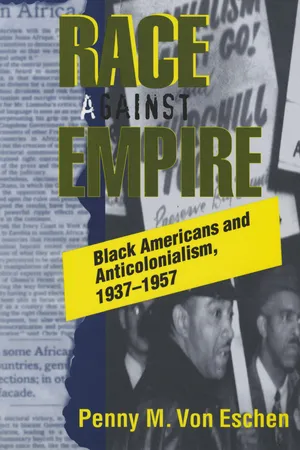
During World War II, African American activists, journalists, and intellectuals forcefully argued that independence movements in Africa and Asia were inextricably linkep to political, economic, and civil rights struggles in the United States. Marshaling evidence from a wide array of international sources, including the black presses of the time, Penny M. Von Eschen offers a vivid portrayal of the African diaspora in its international heyday, from the 1945 Manchester Pan-African Congress to early cooperation with the United Nations.Race against Empire tells the poignant story of a popular movement and its precipitate decline with the onset of the Cold War. Von Eschen documents the efforts of African-American political leaders, intellectuals, and journalists who forcefully promoted anti-colonial politics and critiqued U.S. foreign policy. The eclipse of anti-colonial politics—which Von Eschen traces through African-American responses to the early Cold War, U.S. government prosecution of black American anti-colonial activists, and State Department initiatives in Africa—marked a change in the very meaning of race and racism in America from historical and international issues to psychological and domestic ones. She concludes that the collision of anti-colonialism with Cold War liberalism illuminates conflicts central to the reshaping of America; the definition of political, economic, and civil rights; and the question of who, in America and across the globe, is to have access to these rights.Exploring the relationship between anticolonial politics, early civil rights activism, and nascent superpower rivalries, Race against Empire offers a fresh perspective both on the emergence of the United States as the dominant global power and on the profound implications of that development for American society.
- 274 pages
- English
- ePUB (mobile friendly)
- Available on iOS & Android
eBook - ePub
About this book
Information
Subtopic
African American HistoryIndex
History CHAPTER ONE
THE MAKING OF THE POLITICS OF THE AFRICAN DIASPORA
In the deep, heavy darkness of the foul-smelling hold of the ship, where they could not see the sky, nor hear the night noises, nor feel the warm compassion of the tribe, they held their breath against the agony. . . . In a strange moment, when you suddenly caught your breath, did some intimation from the future give to your spirits a hint of promise? In the darkness did you hear the silent feet of your children beating a melody of freedom to words which you would never know, in a land in which your bones would be warmed again in the depths of the cold earth in which you will sleep unknown, unrealized and alone?—Howard Thurman, On Viewing the Coast of Africa
THE SENSE THAT AFRICAN AMERICANS shared a common history with Africans and all peoples of African descent had long been an important part of African American thought, but the global dynamics unleashed by World War II brought it to the forefront of black American politics and animated political discourse at an unprecedented level. Many African American political leaders and journalists analyzed the war through a prism of anticolonialism. A new political constellation emerged as anticolonial issues acquired a new prominence and stood side by side with domestic demands in the political agendas of leading African American protest organizations.1
From the 1935 Italian invasion of Ethiopia to the strikes that swept the Caribbean and West Africa in the late 1930s, from Nigerian responses to Roosevelt and Churchill’s dispute over the meaning of the Atlantic Charter to India’s dramatic challenge to the British during the war, African American political discourse was keenly informed by and deeply responsive to events in Africa, in the Caribbean, and throughout the colonized world. Even issues which on the surface appeared strictly domestic, such as the use of black American troops in the war, were approached from an anticolonial perspective and guided by the premise that the struggles of black Americans and those of Africans were inseparably bound. By the end of the war in 1945, even mainstream civil rights leaders such as Walter White, executive director of the NAACP, could declare that “World War II has given to the Negro a sense of kinship with other colored—and also oppressed—peoples of the world.” Black Americans, he continued, sense that “the struggle of the Negro in the United States is part and parcel of the struggle against imperialism and exploitation in India, China, Burma, Africa, the Philippines, Malaya, the West Indies, and South America.”2
Although the articulation of inextricable ties between African Americans and others of African descent and the attention to anticolonialism were widespread among African American leaders and journalists by the mid-1940s, these issues did not arise uniformly. The crafting of a new international political language and new political strategies, as well as how these came to animate a broader political discourse, can be understood only by looking at the initiatives of the men and women who created this politics both through political organizing and through print capitalism and the black press. The years of World War II and its immediate aftermath were a golden age in black American journalism. Newspapers with national circulations such as the Pittsburgh Courier and the Chicago Defender more than doubled in size between 1940 and 1946. The Courier reached a circulation of more than a quarter-million, with an actual readership easily three times that size.3 This was also the heyday of Claude Barnett’s Associated Negro Press—a syndication service subscribed to by nearly two hundred papers, or 95 percent of black American newspapers—which made international reporting widely available to small black papers that otherwise would not have had the resources to carry reports on African, Caribbean, and international affairs.
The black press was the main vehicle through which public intellectuals spoke to one another and to their main audiences: the black middle classes and working classes, including teachers, ministers, other professionals, and blue-collar and domestic workers.
Moreover, creatively employing the new technologies and new possibilities in communication that came out of World War II, a cast of activists, journalists, and editors clustered in black American newspapers—the Chicago Defender, the Pittsburgh Courier, the Crisis, and the New York Amsterdam News—formed a dense nexus with journalists and publishers from London to Lagos and Johannesburg, marshalling the resources of important black middle-class and entrepreneurial institutions to create an international anticolonial discourse. From Pittsburgh to Lagos to Chicago to London to New York to Johannesburg—the nodal points of production—print journalism both provided the vehicle for the creation of this imagined diaspora and unified intellectuals and activists across the globe.4
THE ROOTS OF THE POLITICS OF THE AFRICAN DIASPORA
In linking the struggles of African Americans to African peoples worldwide, architects of the politics of the African diaspora drew on a body of thinking dating back to the eighteenth and nineteenth centuries. In the mid-nineteenth century black American nationalists such as Martin R. Delany and Henry Highland Garnet combined a vision of independent black organizing in the United States with calls for black emigration, sometimes to South America or Canada, sometimes to Africa. Delany, especially, pioneered the creation of a global analysis and a vision of black solidarity that embraced a truly Pan-African sensibility. Inspired by slave revolts that had revealed Pan-African aspirations—such as the South Carolina freedman and artisan Denmark Vesey’s plans in 1820 to establish ties with Haiti—Delany created the character Henry Holland in his novel Blake (1859–61). Holland, a free black man, tries to organize a revolt involving all the slaves in the Western Hemisphere. Moreover, Delany’s presentation of slavery as an international system of economic exploitation further links him to the politics of the 1940s.5
Although worlds apart from the projects and aspirations of the internationalists of the 1940s, the civilizing missions of black Christians such as the nineteenth-century black nationalist missionary Alexander Crummell, who spent twenty years in Liberia, and the Ethiopianist tradition in black thought also embodied a belief in universal black solidarity and salvation. Through their wide reach in black American middle-class institutions, these earlier projects were a critical part of the milieu in which later activists formed their own world views and aspirations.6
In the twentieth century, a vision of the African diaspora was given a voice in the NAACP’s journal the Crisis—which, under the long editorship of W. E. B. Du Bois, consistently presented the struggles of the black world in international terms—and in Carter Woodson’s Journal of Negro History as well.7 In a life that spanned the rise and fall of colonialism, from the European partition of Africa in Berlin in 1884 and 1885 when he was still a child to his death in Ghana in 1963, six years after the new nation’s independence, Du Bois possessed a keen awarness of history. He resisted the prevailing discourses that naturalized colonialism and race. From the earliest issues of the Crisis, readers were reminded that colonialism had a beginning. And in the gift of historical imagination, whatever has a beginning, constructed by human actions, may also have a middle and an end.
Du Bois was also a founder of the Pan-African Congress movement. From the turn of the century, Pan-Africanist intellectuals gathered in the 1900, 1919, 1921, and 1927 Pan-African Congresses to challenge the excesses of colonial rule, to establish intellectually the existence of a bond between Africans and persons of African descent in the diaspora, and to demonstrate the importance of Pan-African unity for building an emancipatory movement.8 Delegates to the early congresses articulated an elite ideology and, more accommodationist than anticolonial, appealed as intellectuals to European powers to act more humanely (see Chapter 2). The carnage of World War I and the mistreatment of colonial subjects, however, demonstrated that colonial metropoles were unreceptive to humanitarian appeals. The war also deepened the integration of African societies into the world economy and unleashed a major migration of peoples of African descent within the Western Hemisphere, setting the stage for the emergence of new kinds of movements and new forms of Pan-Africanism.9
The early Pan-African Congresses, however, remained the province of intellectuals and a small African American elite. It was Marcus Garvey and his Universal Negro Improvement Association that brought the notion of the links between the black world and Africa to a mass audience, creating a new working-class diaspora consciousness. By linking the entire black world to Africa and its members to one another, Garvey made the American Negro conscious of his African origins and created for the first time a feeling of international solidarity between Africans and peoples of African descent. In a brutal era of Jim Crow, lynchings, and political disenfranchisement, Garvey transformed African Americans from a national minority into a global majority.10
Garvey remained ambiguous in his critique of the West. His thought and movement embodied unprecedented forms of organization and a modern diasporic sensibility, yet at the same time he embraced many of the ideals and forms of Western imperialism and colonialism. The same period, however, also saw a flowering of nationalists on the left such as Hubert Harrison, Cyril Briggs, and the African Blood Brotherhood, who unequivocally rejected beliefs in the superiority of Western civilization. Historians have documented the rich cross-fertilization of leftist and Pan-African movements, beginning most visibly after the Russian Revolution. Although these movements were partly inspired by Bolshevist ideals, the Soviet Comintern and the American Communist Party were also pushed to acknowledge—implicitly if not explicitly—the distinct histories of black laborers throughout the globe, leading to their advocacy of black self-determination and formations such as the Negro Trade Union Committee. As Robin D. G. Kelley has argued, the Communist Party often provided, if inadvertently, spaces in which black nationalists were able to carve out considerable autonomy. Thus, by the 1930s, not only had the left helped to reshape nationalist thought, but the internationalism of the left—responding to assertions of black nationalism—had already been transformed by its appropriation of Pan-African thought.11
In addition to traditions of Pan-Africanism and left internationalism, the broad anticolonial alliances of World War II built on the rich black oppositional politics of the 1930s. Through diverse protest efforts such as the “Don’t Buy Where You Can’t Work” campaign, the Scottsboro case, and the NAACP’s anti-lynching crusade, the modern civil rights struggle was beginning to get under way with an increasing emphasis on economic issues. The development of alliances among liberals, leftists, and nationalists around a broad agenda for black working-class empowerment and social and economic justice crystallized in the formation of the National Negro Congress in 1936 with A. Philip Randolph as its president.12 The loyalties forged in these movements, alongside continuing personal, ideological, and organizational divides, would all playa role in the new wartime alliances and shape the emerging anticolonial movement.
THE ETHIOPIAN CRISIS
The Italian invasion of Ethiopia in 1935 marked an especially critical moment in the articulation of diaspora thought and politics. Paul Robeson claimed it was a watershed for black American consciousness, since it exposed “the parallel between [black American] interests and those of oppressed peoples abroad.”13 As the historian William R. Scott has demonstrated, the black American press and churches played major roles in publicizing the Ethiopian crisis in the United States. The invasion also ushered in a new chapter in the organizational history of anticolonialism with the formation of numerous new nationalist groups such as the Ethiopian World Federation.14
Many black nationalists viewed the invasion of Ethiopia as a skirmish in a race war of European (and Japanese) colonial expansion, in which Ethiopia was the last holdout of real independence in Africa. Black nationalists also viewed as racist the indifference of Western nations to a clear fascist attack. Communists, in contrast, through the Provisional Committee for the Defense of Ethiopia (PCDE) in Harlem, attempted to redirect antiwhite sentiment toward a critique of fascism.15 The tensions between these differing interpretations of the Ethiopian conflict, between the racial interpretations of the war held by many black nationalists and the strictly antifascist interpretation advanced by the Communist Party, would be overcome in part during World War II. Like black supporters of the Republican cause in Spain—who, as Kelley has demonstrated, combined Pan-African and internationalist sentiments in a way that “accepted the Communists’ vision of internationalism and inter-racial unity” which “allowed them to retain their nationalism and to transcend it”—architects of the politics of the African diaspora would successfully bridge and transform these two world views by arguing that anticolonialism and antiracism were necessary pre-conditions for democracy everywhere.16
BLACK BRITAIN
In Britain, the invasion of Ethiopia led to the politicization of Harold Moody’s League of Coloured Peoples, previously devoted to education, and to the formation of the International African Service Bureau.17 The founding of the bureau in 1937 formalized the gathering in London of a remarkable group of black intellectuals. Led by Trinidadians George Padmore and C. L. R. James, along with Jomo Kenyatta, the future president of Kenya, the bureau attracted students, intellectuals, trade unionists, and political activists from Africa and the Caribbean, who had traveled to London (sometimes via the United States) for the educational, intellectual, and political opportunities it afforded.
To catapult back into the black Britain of the 1930s is to discover a tiny, close-knit community of intellectuals who had formed longstanding and dense relationships—social, inte...
Table of contents
- PREFACE
- INTRODUCTION
- 1 THE MAKING OF THE POLITICS OF THE AFRICAN DIASPORA
- 2 DEMOCRACY OR EMPIRE?
- 3 TO FORGE A COLONIAL INTERNATIONAL
- 4 THE DIASPORA MOMENT
- 5 DOMESTICATING ANTICOLONIALISM
- 6 HEARTS AND MINES
- 7 REMAPPING AFRICA, REWRITING RACE
- 8 NO EXIT: FROM BANDUNG TO GHANA
- CONCLUSION
- NOTES
Trusted by 375,005 students
Access to over 1.5 million titles for a fair monthly price.
Study more efficiently using our study tools.
Frequently asked questions
Yes, you can cancel anytime from the Subscription tab in your account settings on the Perlego website. Your subscription will stay active until the end of your current billing period. Learn how to cancel your subscription
No, books cannot be downloaded as external files, such as PDFs, for use outside of Perlego. However, you can download books within the Perlego app for offline reading on mobile or tablet. Learn how to download books offline
Perlego offers two plans: Essential and Complete
- Essential is ideal for learners and professionals who enjoy exploring a wide range of subjects. Access the Essential Library with 800,000+ trusted titles and best-sellers across business, personal growth, and the humanities. Includes unlimited reading time and Standard Read Aloud voice.
- Complete: Perfect for advanced learners and researchers needing full, unrestricted access. Unlock 1.5M+ books across hundreds of subjects, including academic and specialized titles. The Complete Plan also includes advanced features like Premium Read Aloud and Research Assistant.
We are an online textbook subscription service, where you can get access to an entire online library for less than the price of a single book per month. With over 1.5 million books across 990+ topics, we’ve got you covered! Learn about our mission
Look out for the read-aloud symbol on your next book to see if you can listen to it. The read-aloud tool reads text aloud for you, highlighting the text as it is being read. You can pause it, speed it up and slow it down. Learn more about Read Aloud
Yes! You can use the Perlego app on both iOS and Android devices to read anytime, anywhere — even offline. Perfect for commutes or when you’re on the go.
Please note we cannot support devices running on iOS 13 and Android 7 or earlier. Learn more about using the app
Please note we cannot support devices running on iOS 13 and Android 7 or earlier. Learn more about using the app
Yes, you can access Race against Empire by Penny M. Von Eschen in PDF and/or ePUB format, as well as other popular books in History & African American History. We have over 1.5 million books available in our catalogue for you to explore.