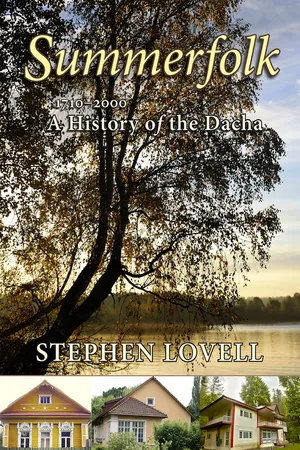
The dacha is a sometimes beloved, sometimes scorned Russian dwelling. Alexander Pushkin summered in one; Joseph Stalin lived in one for the last twenty years of his life; and contemporary Russian families still escape the city to spend time in them. Stephen Lovell's generously illustrated book is the first social and cultural history of the dacha. Lovell traces the dwelling's origins as a villa for the court elite in the early eighteenth century through its nineteenth-century role as the emblem of a middle-class lifestyle, its place under communist rule, and its post-Soviet incarnation.A fascinating work rich in detail, Summerfolk explores the ways in which Russia's turbulent past has shaped the function of the dacha and attitudes toward it. The book also demonstrates the crucial role that the dacha has played in the development of Russia's two most important cities, Moscow and St. Petersburg, by providing residents with a refuge from the squalid and crowded metropolis. Like the suburbs in other nations, the dacha form of settlement served to alleviate social anxieties about urban growth. Lovell shows that the dacha is defined less by its physical location"usually one or two hours" distance from a large city yet apart from the rural hinterland—than by the routines, values, and ideologies of its inhabitants.Drawing on sources as diverse as architectural pattern books, memoirs, paintings, fiction, and newspapers, he examines how dachniki ("summerfolk") have freed themselves from the workplace, cultivated domestic space, and created informal yet intense intellectual communities. He also reflects on the disdain that many Russians have felt toward the dacha, and their association of its lifestyle with physical idleness, private property, and unproductive use of the land. Russian attitudes toward the dacha are, Lovell asserts, constantly evolving. The word "dacha" has evoked both delight in and hostility to leisure. It has implied both the rejection of agricultural labor and, more recently, a return to the soil. In Summerfolk, the dacha is a unique vantage point from which to observe the Russian social landscape and Russian life in the private sphere.
- 280 pages
- English
- ePUB (mobile friendly)
- Available on iOS & Android
eBook - ePub
About this book
Information
1
Prehistory
The dacha, now largely synonymous with life in a private sphere free from public surveillance, was in its medieval origins the result of a gift bestowed publicly. Derived from the verb “to give,” the word “dacha” was present in Old Russian from the eleventh century, but by the seventeenth century it tended to denote specifically land given out to servitors by the state. It became a key concept in land surveys conducted from the time of Ivan the Terrible on; during the General Survey that was carried out from early in the reign of Catherine II right up to Emancipation, the dacha was the main legal and administrative form for the allocation of property rights.1 This brief overview attests both to a long-term semantic transition and to a tension persistent in Russian history and rather significant for an analysis of the modern dacha; namely, the problematic relationship between the role of informal arrangements (the dacha received as a mark of grace and favor) and the public imperative to institute formalized legal relations (the dacha as a piece of property guaranteed by rights).
This tension was exacerbated—some would say created—by the Petrine era, a period that, among many other things, brought into being a new kind of dacha. Peter the Great, like the rulers of the sixteenth and seventeenth centuries, had plenty of land available for distribution; but, unlike his predecessors, he was particularly eager to hand out dachas in order to accelerate the development of a modern urban space—St. Petersburg, his new city on the Gulf of Finland. Thus, for example, city-center plots between the Fontanka River and the tree-lined Sadovaia Street were doled out to the families of courtiers in the 1710s—but on strict condition that these families actually built on them and saw to their upkeep. As one historian has it:
After you had received a plot of land for nothing, it was impossible just to offer your thanks and relax—Peter the Great might accidentally pay you a visit in his chariot to see how the recipient of his gift was getting on in his new place, and if the Emperor found that diligence had been lacking, justice and punishment were summary: Peter the Great was never parted from his cudgel.2
But Peter and his eighteenth-century successors were also able to offer land in locations that lay well outside the city’s boundaries. Here dachas began to be developed as suburban residences designed primarily for leisure. The first such instance came in 1710, when Peter, as a response to his successful campaign against the Swedes, started to hand out plots of land on the route running between St. Petersburg and his new palace at Peterhof. Terraces were built, trees were planted, and the shore was banked up so as to give protection against flooding. The dimensions of the plots were regular—100 sazhens wide by 1,000 deep; they were thus laid out like the keys of a giant piano pressed up against the south shore of the Gulf of Finland.3
The Dacha as Court Residence
Peter conceived of the Peterhof Road as a single architectural ensemble modeled on the route from Paris to Versailles. Residents were, for example, required to take good care of their property and strictly forbidden to chop down trees along the road: the more land owned and the wealthier the owner, the greater were Peter’s architectural expectations of the residence erected on a dacha plot.4 Subsequent eighteenth-century rulers took further measures to smarten the road up and improve its infrastructure. A decree of 23 August 1739 allocated funds for setting up milestones. In the mid-1750s paving of the road was undertaken, and in 1769 owners of dachas were made responsible for its maintenance (although in practice the money continued to be drawn from state revenues). In the early 1770s birch trees were planted along the road at public expense.5 In 1777 came a proposal for rebuilding a substantial portion of the route. Throughout the eighteenth century, special measures were taken to ensure that public order was maintained for the entire length of the road. In April 1748, for example, the chief of police received instructions to conduct a thorough inspection in advance of the imperial party so as to avoid “disorders”; taverns were to be removed from the roadside.6
The desired result of these measures was to create a row of imposing residences with elaborate and extensive gardens stretching all the way to the southern shore of the Gulf of Finland. As early as 1736, Peder von Haven, arriving in St. Petersburg as secretary and preacher for a Norwegian sailor, commented on the row of “extremely fine out-of-town households” that he saw as he was driven into the city along the Peterhof Road.7 Eyewitness accounts of the Peterhof Road, like those of St. Petersburg itself, were not uniformly enthusiastic in its early days,8 but by the mid-eighteenth century they were consistently rapturous. Particular attention was lavished on the gardens of the princes Naryshkin, which were left open to the public.9 The positive assessments lasted well into the nineteenth century. A visitor of 1805 admired the view on heading out of Strel’na toward St. Petersburg: “As a parting gift my eyes were taken up by an unbroken chain of picturesque dachas—each one finer than the last—right up to the barrier at the entrance to St. Petersburg.”10 Fifteen years later, the author of an early guidebook found that the view from Strel’na had lost none of its charm: “From here a splendid mounded road leads to the magnificent dachas of the grandees and the wealthy.”11
The prime function of these dachas was public sociability: their owners were able to receive a stream of visitors from foreign delegations, prominent noble families, and of course the imperial court. In July 1772, for example, Prince L. A. Naryshkin laid on a lavish set of entertainments at his dacha eleven versts along the Peterhof Road. The guests started assembling at three o’clock and were able to amuse themselves by wandering through the gardens with their intriguing patterns of streams and paths. At seven o’clock the empress arrived and a “Temple of Victory” (in honor of the recent victory over the Turks and Tatars) was spectacularly unveiled. The entertainment was completed with fireworks and a masked ball.12 Five years later the Swiss scholar Jean Bernoulli called in at the Naryshkin dacha and commented especially on the tasteful English-style design of the gardens; he also noted with interest that the property was opened to the public twice a week.13 Count Stroganov, similarly, liked to entertain in the grand style: his generous hospitality cost him 500 rubles each Sunday as he threw open his dacha for music, dancing, and refreshments.14
The Naryshkin and Stroganov dachas in several ways conformed to the pattern of life often held to be characteristic of the elite country estate in the same period: display was valued over substance, short-term ostentatious hospitality over longer-term comfort. But this assessment needs to be qualified on two counts. First, the way of life on the Peterhof Road and at the country estate was not simply fixated on public spectacle. The Catherinian period was to a significant extent constructed by the new empress and her ideologues as a reaction against the artifice, luxury, and corruption of the reign of Elizabeth (1741–1762) and as a return to the austerity of Peter I’s time. The turn away from showy festivity and toward the “English” virtues of practicality and emotional depth found expression in the taste for Romantic garden designs; it also led to a change of culture at the country estate, where far niente went out of fashion, the simple country life (or its appearance) came to be more highly valued, and greater emphasis was laid on purposeful and reflective pursuits—notably reading.15 Life out of the city was, moreover, associated with a rejection of the status distinctions that underpinned social contacts in the city and at court. This relaxation of social rules prefigured an important and enduring cultural stereotype that would be articulated more forcefully in the nineteenth and twentieth centuries: exurbia was seen as a uniquely “democratic” site for social interaction. As the poet and state servant Gavriil Derzhavin observed of parties de plaisir he attended in the 1770s:
Leaving behind in the cityAll that our minds does trouble,In simple cordial fresh airDo we spend our time.. . .We resolved among friendsTo preserve the laws of equality;To abandon the conceitsOf wealth, power, and rank.Оставя беспокойство в градеИ все, смущает что умы,В простой приятельской прохладеСвое проводим время мы.[. . .]Мы положили меж друзьямиЗаконы равенства хранить;Богатством, властью и чинамиСебя отнюдь не возносить.16
Second, the social and economic functions of the dacha in eighteenth-century Russia were quite distinct from those of the country estate. A residence on the Peterhof Road enabled people to have a break from the city without taking themselves too far afield. It allowed a lifestyle of short, habitual holidays instead of a single annual absence of several months at a far-flung country estate. The emergence of a modern (that is, post-Petrine) dacha depended on an administrative order that required regular and reasonably continuous attendance in the office or at the court by a class of state functionaries and noblemen. Its prime function was to enable prominent families to maintain contact with the grandees on whose favor their advancement depended, to safeguard their position in Petersburg’s peculiarly patrimonial bureaucracy. This point was understood perfectly by F. F. Vigel’, a memoirist unusually well placed to observe the overlapping worlds of aristocracy and elite civil service. In 1800 Vigel’ was driven out to the residence of Count F. V. Rostopchin to request in person an appointment in the prestigious Board of Foreign Affairs. Not yet fourteen years of age, Vigel’ was traveling along the Peterhof Road for the first time, and he marveled at the chain of splendid dachas that extended “almost uninterruptedly” on both sides for twenty-six versts. This was, he commented, the only place around Petersburg where “rich folk of all estates [vsekh soslovii]” could spend their summers; people of lesser means could not afford such a luxury. His remarks confirm the Peterhof Road as a place for the social elite; equally, however, they suggest that membership in this elite was determined not simply by aristocratic lineage but also by money and by position in state service. As an older man, Vigel’ was less admiring of the dacha habits of St. Petersburg’s mandarins, who, in his opinion, h...
Table of contents
- List of Illustrations
- Acknowledgments
- Glossary
- Abbreviations
- Maps
- Introduction
- 1. Prehistory
- 2. Between City and Court The Middle Third of the Nineteenth Century
- 3. The Late Imperial Dacha Boom
- 4. Between Arcadia and Suburbia The Dacha as a Cultural Space, 1860–1917
- 5. The Making of the Soviet Dacha, 1917–1941
- 6. Between Consumption and Ownership Exurban Life, 1941–1986
- 7. Post-Soviet Suburbanization? Dacha Settlements in Contemporary Russia
- Conclusion
- Note on Sources
- Bibliography
Trusted by 375,005 students
Access to over 1.5 million titles for a fair monthly price.
Study more efficiently using our study tools.
Frequently asked questions
Yes, you can cancel anytime from the Subscription tab in your account settings on the Perlego website. Your subscription will stay active until the end of your current billing period. Learn how to cancel your subscription
No, books cannot be downloaded as external files, such as PDFs, for use outside of Perlego. However, you can download books within the Perlego app for offline reading on mobile or tablet. Learn how to download books offline
Perlego offers two plans: Essential and Complete
- Essential is ideal for learners and professionals who enjoy exploring a wide range of subjects. Access the Essential Library with 800,000+ trusted titles and best-sellers across business, personal growth, and the humanities. Includes unlimited reading time and Standard Read Aloud voice.
- Complete: Perfect for advanced learners and researchers needing full, unrestricted access. Unlock 1.5M+ books across hundreds of subjects, including academic and specialized titles. The Complete Plan also includes advanced features like Premium Read Aloud and Research Assistant.
We are an online textbook subscription service, where you can get access to an entire online library for less than the price of a single book per month. With over 1.5 million books across 990+ topics, we’ve got you covered! Learn about our mission
Look out for the read-aloud symbol on your next book to see if you can listen to it. The read-aloud tool reads text aloud for you, highlighting the text as it is being read. You can pause it, speed it up and slow it down. Learn more about Read Aloud
Yes! You can use the Perlego app on both iOS and Android devices to read anytime, anywhere — even offline. Perfect for commutes or when you’re on the go.
Please note we cannot support devices running on iOS 13 and Android 7 or earlier. Learn more about using the app
Please note we cannot support devices running on iOS 13 and Android 7 or earlier. Learn more about using the app
Yes, you can access Summerfolk by Stephen Lovell in PDF and/or ePUB format, as well as other popular books in History & Architecture General. We have over 1.5 million books available in our catalogue for you to explore.