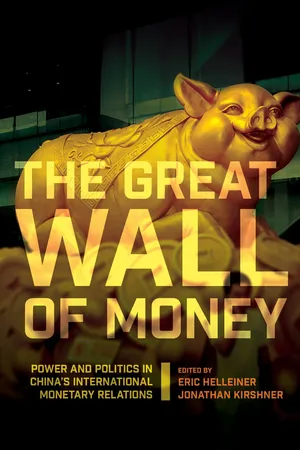
As an economic superpower, China has become an increasingly important player in the international monetary system. Its foreign exchange reserves are the largest in the world and its exchange rate policy has become a major subject of international economic diplomacy. The internationalization of the renminbi (RMB) raises critical questions in international policy circles: What kinds of power is China acquiring in international monetary relations? What are the priorities of the Chinese government? What explains its preferences?In The Great Wall of Money, a distinguished group of contributors addresses these questions from distinct perspectives, revealing the extent to which China's choices, and global monetary affairs, will be shaped by internal political factors and affect world politics. The RMB is a likely competitor for the dollar in the next couple of decades; its emergence as an important international currency would have substantial effects on the balance of power between the United States and China. By illuminating the politics of China's international monetary relations, this book provides a timely account of the global economy, the role of the renminbi in international relations, and the trajectory of China's continuing ascendency in the coming decades.Contributors: Gregory Chin, York University; Benjamin J. Cohen, University of California, Santa Barbara; Eric Helleiner, University of Waterloo and Balsillie School of International Affairs; Yang Jiang, Danish Institute for International Studies; Jonathan Kirshner, Cornell University; Bessma Momani, University of Waterloo and Balsillie School of International Affairs; David Steinberg, University of Oregon; Andrew Walter, University of Melbourne; Hongying Wang, University of Waterloo and Balsillie School of International Affairs
eBook - ePub
The Great Wall of Money
Power and Politics in China's International Monetary Relations
- 288 pages
- English
- ePUB (mobile friendly)
- Available on iOS & Android
eBook - ePub
The Great Wall of Money
Power and Politics in China's International Monetary Relations
About this book
Information
Subtopic
Chinese HistoryIndex
Economics1
THE CHINA QUESTION
Can Its Rise Be Accommodated?
Benjamin J. Cohen
Whether measured by the size of its reserves, the role of its exchange rate, or the use of its currency, Beijing’s growing influence in the international monetary system is unmistakable. The issue to be addressed in this chapter is: Can the proverbial Middle Kingdom be smoothly absorbed into the leadership ranks of the global system, or could it instead become a force for instability or even conflict? Call it the China question.
The answer to the China question depends, in particular, on two critical factors. First is the issue of systemic flexibility. How adaptable are the institutions and procedures of global monetary governance? How easy is it for the monetary system to adjust to significant changes in the distribution of power? And second is the issue of China’s intentions. What do the Chinese want? Can Chinese preferences be successfully accommodated? Both factors are essential, and much rides on the outcome.
Happily, historical analysis suggests that there is little problem on the first score. Other emergent powers in the past have been effectively absorbed without lasting disruption or irreparable damage. On the second score, however, there may be more cause for concern, since we know so little about China’s strategic priorities. As several contributors to this volume note, Beijing repeatedly sends mixed signals about its intentions. To say the least, its ultimate goals remain shrouded in mystery.
Analytical Framework
The China question confronts us with two analytical challenges. First, how do we know when a newcomer is big enough to challenge the system’s status quo? And second, how do we know when the emergence of a big newcomer has been successfully accommodated? Both challenges call for historical interpretation, which is inherently subjective. Each, therefore, is an issue on which reasonable people might reasonably disagree. Interpretation will be more persuasive if it can be grounded in a systematic analytical framework with well-articulated standards to provide an acceptable basis for judgment.
Monetary Power
Begin with the notion of “big.” This of course is an issue of power. How do we know when an actor has gained sufficient power to challenge the established order?
Measuring monetary power is notoriously difficult. Until not long ago, the very concept of power in international monetary relations was, as Jonathan Kirshner noted in a seminal work, “a neglected area of study.”1 More recently, considerable progress has been achieved in parsing the meaning and uses of monetary power.2 Yet for all the insight that has been gained, we still have no easy way to distinguish scales or levels of power in the monetary system.
For the purposes of this chapter, monetary power will be equated with influence: an ability to shape the behavior of others. This approach is in keeping with the conventions of mainstream international relations theory, as highlighted in a recent survey by David Baldwin—a tradition stretching back to the early work of Robert Dahl, who argued that “A has power over B to the extent that he can get B to do something that B would not otherwise do.”3 The focus here is on the effects rather than the sources of power. An actor will be considered “big” if its actions (or inactions) can have systemic consequences, altering or controlling the outcome of events. Influence will be considered synonymous with authority or leadership.
How would we know when monetary influence is at work? The exercise of power is not always self-evident, particularly if it is indirect or passive. Power does not regularly announce itself. The most practical approach is to focus on specific roles—identifiable functions that can be considered as tangible manifestations of power. A “big” actor is one that is seen to act with authority or leadership in monetary affairs.
And what might those roles be? For inspiration, this chapter will look to the work of the late Charles Kindleberger, who wrote a great deal about monetary power. In his justly celebrated book, A World in Depression, Kindleberger suggested that a monetary leader would be expected to play three distinct roles: (1) maintaining a relatively open market for distress goods; (2) providing contracyclical, or at least stable, long-term lending; and (3) acting as a lender of last resort at times of crisis.4 In later work, he added two additional functions: (4) policing a relatively stable system of exchange rates; and (5) ensuring some degree of coordination of macroeconomic policies.5 All five of these roles clearly imply a measure of influence. Together, they define the scope of monetary power.
Accordingly, this chapter will look to these five roles as tangible manifestations of monetary power. A newcomer will be considered big enough to challenge the system if it has become: (1) a major, if not dominant, import market; (2) a sizable capital exporter; (3) a significant influence on exchange rates; (4) a substantial influence on macroeconomic conditions; and/or (5) a potential source of crisis financing. Some combination of these five roles will be considered sufficient to qualify an actor as a major influence on the distribution of monetary power. The greater the number of the roles played, the larger is the scope of the actor’s power.
Accommodation
So how, then, do we know when the emergence of a big newcomer has been successfully accommodated? That too is a difficult question. The emergence of a new pole of influence is hardly apt to be frictionless and will certainly not occur overnight. Authority in human affairs is not readily shared, and that is particularly true of relations among sovereign states with their distinct and often divergent political and economic interests. Some resistance on the part of incumbents is naturally to be expected, at least initially.
Broadly speaking, three alternative outcomes are possible. At one extreme, resistance to a newcomer might remain adamant, leading to rising tensions and the risk of serious policy conflict—hardly a denouement to be desired. Second, the newcomer might be co-opted by existing powers, persuaded or coerced into aligning its preferences with the prevailing rules of the game—in effect, into acquiescing with the status quo. Or third, opposition could eventually give way to some measure of acceptance of the newcomer’s priorities, with space carved out for the rising power to join in playing a leadership role. The last may be considered the meaning of accommodation: a successful transition to a new sharing of authority with due deference to the interests of the newcomer. For the purposes of this chapter, three criteria will be used to judge whether a big new actor has been or can be successfully accommodated in this sense.
The first criterion will focus on the nature of the actor’s impact on the overall stability of the system. Effects may be transmitted via the trade balance or the capital account and will be felt in exchange rates, payments balances, and general macroeconomic conditions. The emergence of a new power, determined to assert its own interests, is often destabilizing—at least at the start. The question is: Does its impact remain disturbing, or do priorities eventually come into alignment? A gradual movement toward a new overall balance in the system, while respecting the preferences of the newcomer, will be taken as a sign of successful accommodation.
A second criterion will have to do with crisis financing. Emerging powers usually accumulate a sizable stock of central bank reserves; in time, as well, their currencies may begin to play important international roles in trade, financial markets, or the reserves of other economies. Both ample reserves and an internationalized currency enable a country to act, if it wishes, as a lender of last resort in time of crisis—a source of liquidity for others. Voluntary acceptance of the role of crisis lender may also be seen as a sign of successful accommodation. Has the actor willingly become a recognized credit source when others get in trouble?
The third criterion has to do with governance mechanisms. Has the actor been formally incorporated into prevailing leadership councils? Governance of the global monetary system is famously complex, if not obscure, comprising not only the formal structures and rules of the IMF but also the more informal decision-making procedures of regularized negotiating bodies like the G7 and the G20. A third sign of successful accommodation would be effective inclusion into some or all of these governance mechanisms. In short the newcomer would be accepted, implicitly or explicitly, as a full member of the club.
The Rise of China
Judging by these standards, there seems little doubt that China has now become a big player in monetary affairs. The signs of the country’s newfound monetary power are unmistakable, as the editors of this volume emphasize in their introduction. After three decades of double-digit growth, the Middle Kingdom has emerged to become the second largest economy in the world, surpassing the former number two, Japan, in 2010. As a voracious importer of raw materials and energy, China has become the dominant market for a wide swath of commodity producers, from close neighbors in Southeast Asia and Australia to South America and Africa. At the same time, as the “world’s workshop” manufacturing or assembling vast amounts of goods for export, the country has enjoyed trade surpluses that have exceeded even those of Japan and Saudi Arabia in their prime. China today sells everything from textiles and apparel to wind turbines and solar panels. In the mid-2000s, the Middle Kingdom’s surpluses on current account amounted to as much as 10 percent of GDP.
Correspondingly, these surpluses have cumulatively made China one of the world’s greatest creditor nations, with external claims far exceeding liabilities. For many years most foreign earnings went directly into the currency reserves of the People’s Bank of China, the Middle Kingdom’s central bank, reaching a new high of some $3.5 trillion in mid-2013—the greatest stockpile of reserves for any one country in history. Even today, the PBOC’s reserves account for as much as three-quarters of China’s international claims. More recently, as Yang Jiang notes in this volume, some of these assets have been deployed in the form of foreign aid, often quite obviously for politico-strategic purposes. Additionally, an increasing emphasis has been put on economically profitable forms of overseas placement. This can be seen in the country’s rising level of outward direct investment, led by state-owned enterprises, which since 2005 has accelerated rapidly to as much as $70 billion a year in 2010 and 2011. More than 80 percent of the total involved minerals or energy projects.6 It can also be seen in the creation of the China Investment Corporation, a sovereign wealth fund, with an initial endowment in 2007 of some $200 billion. By 2012, CIC’s assets had more than doubled, to some $440 billion. The value of China’s accumulated claims abroad is still small as compared with those of the United States or other mature economies, with their much longer histories of foreign investment. But even with its late start, the Middle Kingdom clearly is well on its way to becoming a major capital exporter.
China’s massive reserves have also put the country in a position to act as a key source of crisis financing for others. In this regard, the Middle Kingdom’s new capabilities were signaled as early as 2000 when Beijing signed on to the Chiang Mai Initiative (CMI), a regional framework for the provision of emergency liquidity assistance negotiated by the so-called ASEAN + 3 group—the ten members of the Association of Southeast Asian Nations plus the three Northeast Asian countries of China, Japan, and Korea (the “Plus Three” countries). CMI established the basis for a new network of bilateral swap arrangements between the Plus Three countries on the one hand and members of ASEAN on the other hand. The Plus Three countries promised to make dollar resources available to AS...
Table of contents
- Preface
- The Politics of China’s International Monetary Relations
- 1. The China Question: Can Its Rise Be Accommodated?
- 2. The Hidden History of China and the IMF
- 3. Why Has China Accumulated Such Large Foreign Reserves?
- 4. Global Imbalances and the Limits of the Exchange Rate Weapon
- 5. China’s Engagement with International Macroeconomic Policy Surveillance
- 6. The Limits of China’s Monetary Diplomacy
- 7. China’s Rising Monetary Power
- 8. Regional Hegemony and an Emerging RMB Zone
- References
Trusted by 375,005 students
Access to over 1.5 million titles for a fair monthly price.
Study more efficiently using our study tools.
Frequently asked questions
Yes, you can cancel anytime from the Subscription tab in your account settings on the Perlego website. Your subscription will stay active until the end of your current billing period. Learn how to cancel your subscription
No, books cannot be downloaded as external files, such as PDFs, for use outside of Perlego. However, you can download books within the Perlego app for offline reading on mobile or tablet. Learn how to download books offline
Perlego offers two plans: Essential and Complete
- Essential is ideal for learners and professionals who enjoy exploring a wide range of subjects. Access the Essential Library with 800,000+ trusted titles and best-sellers across business, personal growth, and the humanities. Includes unlimited reading time and Standard Read Aloud voice.
- Complete: Perfect for advanced learners and researchers needing full, unrestricted access. Unlock 1.5M+ books across hundreds of subjects, including academic and specialized titles. The Complete Plan also includes advanced features like Premium Read Aloud and Research Assistant.
We are an online textbook subscription service, where you can get access to an entire online library for less than the price of a single book per month. With over 1.5 million books across 990+ topics, we’ve got you covered! Learn about our mission
Look out for the read-aloud symbol on your next book to see if you can listen to it. The read-aloud tool reads text aloud for you, highlighting the text as it is being read. You can pause it, speed it up and slow it down. Learn more about Read Aloud
Yes! You can use the Perlego app on both iOS and Android devices to read anytime, anywhere — even offline. Perfect for commutes or when you’re on the go.
Please note we cannot support devices running on iOS 13 and Android 7 or earlier. Learn more about using the app
Please note we cannot support devices running on iOS 13 and Android 7 or earlier. Learn more about using the app
Yes, you can access The Great Wall of Money by Eric Helleiner, Jonathan Kirshner, Eric Helleiner,Jonathan Kirshner in PDF and/or ePUB format, as well as other popular books in Economics & Chinese History. We have over 1.5 million books available in our catalogue for you to explore.