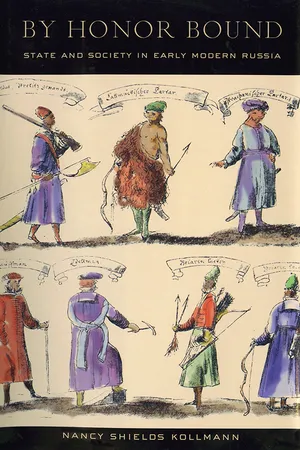
In the sixteenth and seventeenth centuries, Russians from all ranks of society were bound together by a culture of honor. Here one of the foremost scholars of early modern Russia explores the intricate and highly stylized codes that made up this culture. Nancy Shields Kollmann describes how these codes were manipulated to construct identity and enforce social norms—and also to defend against insults, to pursue vendettas, and to unsettle communities. She offers evidence for a new view of the relationship of state and society in the Russian empire, and her richly comparative approach enhances knowledge of statebuilding in premodern Europe. By presenting Muscovite state and society in the context of medieval and early modern Europe, she exposes similarities that blur long-standing distinctions between Russian and European history.Through the prism of honor, Kollmann examines the interaction of the Russian state and its people in regulating social relations and defining an individual's rank. She finds vital information in a collection of transcripts of legal suits brought by elites and peasants alike to avenge insult to honor. The cases make clear the conservative role honor played in society as well as the ability of men and women to employ this body of ideas to address their relations with one another and with the state. Kollmann demonstrates that the grand princes—and later the tsars—tolerated a surprising degree of local autonomy throughout their rapidly expanding realm. Her work marks a stark contrast with traditional Russian historiography, which exaggerates the power of the state and downplays the volition of society.
- 312 pages
- English
- ePUB (mobile friendly)
- Available on iOS & Android
eBook - ePub
About this book
Information
chapter 1
Cultural Concepts of Honor
Institutions and laws to defend personal honor appeared first in Muscovite law codes and practice in the midsixteenth century. The timing is no coincidence. The protection of honor in various forms was a response to social tension, and the sixteenth century was a time of intense political and social change. I explore here the social setting in which Muscovite protections of honor emerged on the background of long-standing cultural traditions of honor and then turn to Muscovite definitions of honor in practice.
Social Tensions in Sixteenth-Century Russia
As detailed in the Introduction, the sixteenth century was in many respects the classic century of pre-Petrine Russian history. It was the century when Muscovy leapt into the status of imperial power with aggressive conquests stretching from Belarus’ to western Siberia; the century when Moscow created enduring institutions of governance based on a privileged landed military elite; the century when the grand princes officially became “tsars,” claiming the imperial heritage of Byzantium and of the Golden Horde; the century, according to some schemes, when “centralization” was achieved by defeating “remnants of feudal opposition.”1 However one construes it, the sixteenth century was one of consolidation of power and institution building.
It was, however, also a century of disruption and recasting of communities. Free peasant communes were being transferred to landlords; peasants and townsmen were being recruited into petty gentry, into the contract servitor military units (musketeers, Cossacks, artillery); peasants were being burdened with serving on local tax-collection boards and with other tasks of local government, responsibilities that were generally not welcomed. Local landed elites were being recast with population transfers, new recruitment, new strictures on landholding and inheritance, and new duties presiding over local law and order in the brigandage reform of the 1530s. The boyar elite doubled in size by the midsixteenth century, with newcomers hailing from both newly arrived princely families and indigenous nonprincely families. Whole new social categories were being created—privileged merchants (gosti, first attested at midcentury), bureaucratic scribes (d’iaki and pod’iachie), contract servitors. More and more people were selling themselves into slavery to escape poverty. At the broadest level, the state itself was becoming multiethnic and far more socially diverse with the absorption of non-Slavic lands, although, because colonial policy did not attempt assimilation, imperial expansion may not have had any direct impact on the life experience of people in the rest of the realm, except for the highest elites.
These changes were the result of the state’s concerted effort to mobilize its resources in the sixteenth century. It was an intense but not catastrophic process, one that yielded social stress and tension nonetheless. At the same time, however, the state suffered catastrophic disruption that further upset social patterns. Although the hundred years from the mid-1400s to the mid-1500s was a time of economic and demographic growth, the decades from the 1570s through the end of the century witnessed economic devastation from causes natural (famine, epidemic) and political. Ivan IV’s Oprichnina (1564–72) wreaked havoc on gentry and peasants in the Center and the North. The Livonian War (1558–82) decimated populations in the northwest regions (Novgorod, Pskov areas). The state financed its military and bureaucratic expansion throughout the century with predatory taxation that crippled the populace. The result of these various depredations was impoverishment and depopulation; peasants fled the lands northwest of Moscow and some parts of the Center to the various frontiers or to more accommodating owners. Other peasants and poor gentry opted for personal servitude to landlords as one of the few social safety nets available to them. The state responded with limitations on peasant mobility (limitations that proved nearly impossible to enforce) and cadastral recording to bind peasants to their villages; together these strategies paved the way for enserfment. The state also intensified efforts to prevent peasants, townsmen, and poor gentry from becoming slaves voluntarily.2
The life experience of many Muscovites in the sixteenth century challenged social hierarchy and undermined personal security. Traditional communities were recreating themselves. It was in very similar circumstances of social disruption and increasing social stratification in Elizabethan England that J. A. Sharpe observed a sharp rise in defamation suits,3 and Muscovite concerns about honor also erupted in sixteenth-century conditions. Later a resurgence of suits over honor in the last decades of the seventeenth century can be observed, when social categories again were in flux (see Epilogue). In such circumstances, honor was used as a response to social tensions from the bottom of society up and from the state down.
It was as a very practical mechanism to cope with new configurations at court, in villages, and on the frontier that honor was deployed. People did not respond to disruption with works of narrative literature pondering social change and its causes or with reflections on social structure that were comparable to medieval European essays on the “great chain of being” or early modern disquisitions on civility and honor. Rather, the state responded with the opportunity to litigate and with laconic law codes that listed scales of recompense for insult to honor. For the state, honor was a mechanism for building social stability; for individuals, it was a way to reinforce social status when communities were changing all around. Thus Muscovy’s juridical institutions to defend honor can be seen as offspring of change. They were grounded, however, in East Slavic tradition and derived their strength from that link with the past.
Honor before Muscovy
Judging by the evidence of the earliest legal sources, a consciousness of personal dignity that could be publicly defended had long existed among the East Slavs. Legal sources of the eleventh to fifteenth centuries4 protected personal dignity, although they do not use the Muscovite-era term for “honor” (chest’); in the pre-Muscovite period, that term was associated with military glory5 or with the godliness attributed to saints and heavenly figures.6 The short and expanded redactions of the Russian Law (Russkaia pravda) are replete with references to offenses to personal honor, which are often (but not consistently) termed injury (obida) or disgrace (sram, sorom, sramota).7 The short redaction of the Russian Law reflects legal norms of the eleventh century, whereas the expanded redaction represents norms of earlier generations compiled by the thirteenth century and remaining in effect in the later Rus’ and Muscovite lands well into the sixteenth century. In the sixteenth century, the Russian Law was edited again, indicating that this collection of East Slavic customary law complemented the mainly procedural Muscovite law codes of 1497 and 1550 and was still in use.8
In the Russian Law, humiliating actions were singled out for punishment. In the short redaction alone, several such affronts are identified, some not even called “injury” (obida): a blow of a sheathed sword or hilt of a sword (art. 4); striking with an object or back of a hand (art. 3); cutting off a mustache or beard (art. 8); threat with a sword (art. 9); a slave striking a free man (art. 17); and pushing and shoving that does not result in serious bodily harm (art. 10). Those labeled “injury” suggest affront to dignity as well as physical damage: bloody or bruising assault (art. 2); severed finger (art. 7); theft of a slave, horse, weapon, hunting dog or bird, clothing (arts. 13, 29, 37); failure to repay a debt (art. 15). In some of these cases, the fine mandated compensation over and above restitution; in others, a humiliating assault was compensated more than a less-humiliating blow (four times the fine for a blow from the back of the hand, as opposed to a bloodying assault). The expanded redaction repeats many of these clauses, although it less often awarded supplemental compensation and added compensation to the grand-princely court. Still, the Expanded Russian Law maintained the short redaction’s protections against humiliating affronts and injuries. Interestingly, neither code cites verbal insult specifically but concentrates on actions detrimental to dignity.
The concept of dignity evinced in Kievan law codes was socially inclusive; the codes used subjects such as “men” (muzhi) or “whosoever” (kto kogo). A few social distinctions are evident: In the Expanded Russian Law, for example, a higher bloodwite (a monetary compensation to kinsman of a murdered person) for elite men is indicated, but all social groups had the right to avenge murder; also, different compensations were mandated for a peasant and a prince’s official who were unjustly tortured (arts. 1, 19–27, 33). However, the social inclusiveness of clauses reflecting dignity is striking. The expanded redaction, for example, extends the categories of persons protected from humiliating assault beyond the norms of the short redaction to include slaves and indentured servants who suffered at the hands of their masters (arts. 56, 59–62). Other twelfth- and thirteenth-century law codes often use the terminology of “disgrace” or “shame” (sram, sorom, sramota) for affronts to an individual’s decorum, reputation, and status as a free and law-abiding subject, while maintaining social inclusiveness. The Expanded Russian Law uses this term to refer to a freeman’s compensation for the “shame” of being struck by a slave (art. 65). Twelfth- and thirteenth-century Novgorod and Smolensk trade treaties consider false arrest “shameful.” These treaties and a church legal statute label as “disgrace” such offenses against women as impugning a woman’s reputation and hitting a woman not one’s wife,9 uncovering a woman’s hair (as insulting as damaging a man’s beard in Russian Orthodox custom), and sexual offenses such as adultery.10 Paralleling later Muscovite practice, these provisions support social breadth even while respecting social hierarchy; compensation for rape, for example, was usually calculated according to social status.11
Later legal sources from Novgorod, the church, and fifteenth-century Muscovy continue the defense of personal dignity. Laws protected individuals from such insults as the assault of a pregnant woman, the beating of a slave (whereupon he or she should be freed), a woman fighting or striking her husband,12 and the uncovering of a woman’s hair or the cutting of a man’s mustache or beard.13 Threat of harm and false arrest continued to be compensated.14 Verbal insult and solicit...
Table of contents
- Abbreviations
- Preface
- Introduction
- Chapter 1. Cultural Concepts of Honor
- Chapter 2. Patriarchy in Practice
- Chapter 3. The Praxis of Honor
- Chapter 4. Honor in the Elite
- Chapter 5. Strategies of Integration in an Autocracy
- Chapter 6. Toward the Absolutist State
- Epilogue: The Endurance of Honor
- Glossary
- Bibliography
- Index
Trusted by 375,005 students
Access to over 1.5 million titles for a fair monthly price.
Study more efficiently using our study tools.
Frequently asked questions
Yes, you can cancel anytime from the Subscription tab in your account settings on the Perlego website. Your subscription will stay active until the end of your current billing period. Learn how to cancel your subscription
No, books cannot be downloaded as external files, such as PDFs, for use outside of Perlego. However, you can download books within the Perlego app for offline reading on mobile or tablet. Learn how to download books offline
We are an online textbook subscription service, where you can get access to an entire online library for less than the price of a single book per month. With over 1.5 million books across 990+ topics, we’ve got you covered! Learn about our mission
Look out for the read-aloud symbol on your next book to see if you can listen to it. The read-aloud tool reads text aloud for you, highlighting the text as it is being read. You can pause it, speed it up and slow it down. Learn more about Read Aloud
Yes! You can use the Perlego app on both iOS and Android devices to read anytime, anywhere — even offline. Perfect for commutes or when you’re on the go.
Please note we cannot support devices running on iOS 13 and Android 7 or earlier. Learn more about using the app
Please note we cannot support devices running on iOS 13 and Android 7 or earlier. Learn more about using the app
Yes, you can access By Honor Bound by Nancy Shields Kollmann in PDF and/or ePUB format, as well as other popular books in History & Russian History. We have over 1.5 million books available in our catalogue for you to explore.