THE JOB
Bike messengers provide on-demand delivery. During normal business hours (usually eight in the morning to six at night), messengers will deliver any item (with obvious limits to physical size) anywhere within the downtown core of a city and its surrounding area in a short span of time. Many companies offer early-morning and late-night service, and many even provide longer-distance delivery. Some Seattle messengers, for example, make regular runs to Bellevue, Washington (over ten miles from downtown Seattle). Size and weight are also negotiable. Although it is rare, some companies use cargo bikes that allow them to deliver hundreds of pounds in one trip. Even without a cargo bike, a messenger can fit at least one banker’s box (i.e., a standard-size filing box) in her bag and balance one to two more on her handlebars. Most bike messenger companies offer options ranging from same-day service to deliveries completed in fifteen minutes. It is this “on-demand” aspect of messengering that distinguishes it from the services offered by the U.S. Postal Service, DHL, FedEx and UPS (all of which follow set schedules and routes). FedEx, for example, can deliver a package from New York to Los Angeles by tomorrow, but only a bike messenger can get something from midtown to downtown by lunchtime.
The Historical Context of Bike Messengers
Since their invention, bicycles have been used to make deliveries. At the turn of the twentieth century, telegraph companies like Western Union had “bicycle boys” working in every major U.S. city. Even UPS got its start on two wheels. While the automobile and urban sprawl drastically reduced the comparative efficiency of bicycle delivery, Western Union continued using bikes well into the mid-1900s. In 1962, for example, it was Western Union bicyclists who mediated the missile crisis by delivering encoded messages from the Soviet embassy in Washington, D.C., to the White House.1 In fact, pedal-powered couriers never entirely disappeared from the occupational landscape, but for decades the job appeared to be nearly extinct. Then, at the end of the twentieth century, there was a major resurgence. In New York, for example, a handful of bike couriers working for the film industry in the 1970s surged to several thousand by the mid-1980s.2
Telegraph Bicycle Boys and the Postindustrial Bike Courier
The resurrection of bicycle delivery can only be understood within the context of global economic restructuring. As historian and geographer Gregory Downey shows, bicycle boys were a by-product of the first wave of industrial urbanism in the United States.3 These bikers provided the first and last steps in a nationwide system of communication by physically picking up telegrams from their original destinations and delivering them to their final destinations. The telegrams themselves were transmitted across the country through wires, but the transmission and reception points were telegraph stations. It was the bicycle boys, therefore, who connected the telegraph with its users. In addition to intercity telegraphs, the boys relayed intracity messages. Thus early messengers were part of a complex flow of information. Even as the telephone became more common, bicycle boys served as errand runners and temporary workers for the telegraph companies’ clients. By the early 1940s, however, telephones and cars made the bicycle boys’ occupation largely redundant.
Today’s bike couriers are not industrial, but postindustrial messengers. That is, the bike messenger revival is a by-product of globalized international finance. Like their predecessors, bike messengers provide a crucial link between information nodes—a link that cannot currently be connected electronically. The biggest difference between the past century’s bicycle boy and the contemporary bike messenger relates to their economic functions and their relations with employers and clients. That is, today’s messengers service a new economic niche, and their labor relations are drastically different from those of the bicycle boys of the past.
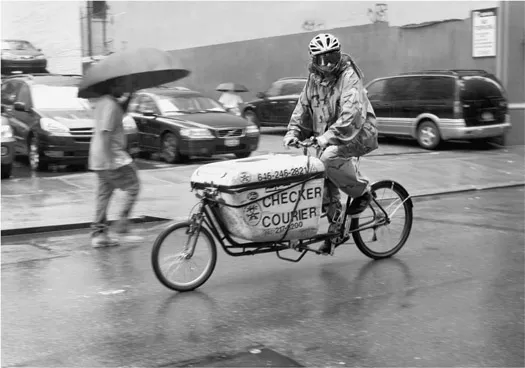
Figure 1. New York messenger riding a cargo bike
Keeping the Global City Rolling
Since the 1980s, finance has superseded manufacturing as the backbone of the world economy.4 Capital is now highly mobilized and continually shifting around the world. The best way to understand this is to contrast the relative stability of Fordism (named after the business model developed by Henry Ford) with contemporary production models. From the mid-1900s through the 1960s, industrial production in the United States and Western Europe was premised on a unionized blue-collar workforce laboring in relatively stable factory locations. One can think here of the heyday of manufacturing in places like Detroit. Since the 1970s, however, advances in communication, production, and shipping technologies have reduced the cost of operating factories in far-off locations. Geographer David Harvey refers to this new production model as flexible accumulation, and its consequences for cities like Detroit are well known.5 Many industries are no longer wedded to specific locations and move from country to country to exploit cheaper labor and less stringent environmental regulations. This reorganization of the economy can be characterized by the term globalization. The global mobility of capital also comes with new forms of urban concentration.6
Even as industrial production shifts around the globe, management of the worldwide economy has remained relatively stable. While their factories move, transnational corporations have continued to locate their the headquarters in select cities, including London, New York, and Tokyo.7 Such “global cities” are the control nodes of the worldwide economic system. One should not assume, however, that these cities are populated only by high-powered button-pushers ensconced in glass skyscrapers—a popular image that even the most cursory glance shows to be horribly myopic. Sociologist Saskia Sassen corrects such a one-sided view by emphasizing how the process of globalization requires the agglomeration of services utilized by international financial firms. That is to say, global cities are still sites for low-wage production, but it is production increasingly oriented to the management function of cities, not to traditional factory labor. According to Sassen, the companies ancillary to transnational trade cluster within central business districts. Their services include everything from financial and legal management to storage and cleaning. Sassen refers to these companies as producer services. Global cities, therefore, are not just the location of corporate headquarters. Even more importantly, they are the location for the producer services used by international corporations in the management of their worldwide operations.8
In recent years, advances in global telecommunications have created a lot of excitement about a “death of distance.”9 Without a doubt, the world has become a much smaller place. Regardless, telephones, the Internet, and video conferencing have not dissolved the significance of place. Physical proximity still improves communication within firms and facilitates contact between firms, and companies are willing to pay astronomically high rents for this access.10 The advertising industry provides an excellent illustration of why urban centralization still exists, and why postindustrial production still requires bike messengers. Advertising agencies, photographers, graphic designers, postproduction companies, magazine publishers, clothing designers, fabric manufacturers, and printers are all part of a vast network (which spirals out into other networks as well). A photographer requires a dress for a photo shoot. The clothing designer requires fabric from a manufacturer. Obviously, these things cannot be e-mailed. Once developed (or in the case of digital photography, once the image has been toned), the photograph is sent on to the graphic designer. The designer, advertising agency, and printer are equally connected. Calibrating computer monitors and printers across different offices (using different software and different machines) is highly problematic. So photographs and other color-sensitive items are generally not sent electronically. People within the network must be given a hard-copy proof in order to verify the exact colors being reproduced, and advertisers and their clients can be very specific about the exact color being reproduced.
In places like New York, there are countless networks of this kind. Within the networks, proofs in various stages of development are constantly circulating from firm to firm, and bike messengers are the ones providing the actual connections. The bulk of Dragonfly’s deliveries, for example, came from just one of these networks. Dragonfly primarily serviced a graphic-design firm, the three ad agencies it worked with, its postproduction company, and a printing company. Five days a week, nine hours a day, information that could not be e-mailed or faxed flowed between these firms via bike messengers. Thus bicycle delivery—“the fastest known way through the morass of Manhattan traffic”11—is an essential (if not somewhat paradoxical) aspect of the information age. Similarly, legal firms comprise another major network for messenger service. This network, however, it is a bit simpler: opposing counsels and courthouses. Like the advertising industry, legal work involves a continual flow of documents circulating throughout the city. In this case, though, it is the need for personal signatures on documents and the desire to have physical proof of delivery that hamper the transition to full digitalization.
There are significant similarities and differences between bike messengering now and messengering in the past. Telegraph companies used bicycles because it was the most efficient option. Companies today also use bike messengers because it is the most efficient option. At the same time, technology has advanced, and the economy has shifted. In both cases, messengers deliver what cannot be sent via electrical currents, but contemporary bike messengers do not deliver some kind of postmodern letters via bicycle (thus making them futuristic telegraph messengers). They use old technologies to aid the entirely new processes of the global city. In other words, it is not only high-tech button-pushers driving the new economy. Even in the most prosperous of urban centers, low-tech, unskilled, and informal labor is still required for the postindustrial production of the global system, and bike messengers are part of this.
Figure 2. Messenger riding next to a bus in New York’s Times Square
A Python Squeezing Its Prey
Just as technological changes reduced and eventually replaced telegraph messengers, new forms of telecommunication coupled with the financial contractions of the late 1980s, late 1990s, and late 2000s have (again and again) reduced the need for bike deliveries. While the advertising industry is an example of why bike couriers are still useful, it should be apparent that much of what messengers were delivering in the early 1980s can now be digitized. In the early 1990s the fax machine reigned. Now the Internet has become increasingly useful for relaying data. In fact, messengers today are delivering little more than the table scraps remaining from the grand conversion to virtual data. For example, Breakaway Courier Systems, one of New York’s largest messenger companies, claims that from 2001 to 2006 they cut over 60 percent of their riders.12 Nevertheless, the messenger industry continues to survive in the new millennium. It is estimated that there are around one thousand bicycle messengers still working in New York City; by contrast, when I worked there the estimate was double that. There are hundreds of messengers working in Chicago, San Francisco, and Washington, D.C. Even after the dot-com fallout in the late 1990s, there were over sixty messengers working in Seattle’s small downtown core. However, this number was much larger in years past. Boston and Philadelphia have comparable numbers to Seattle. Smaller cities (with proportionally small central business districts) like Atlanta, Milwaukee and San Diego maintain messenger populations under twenty.13
Beyond what I have already described, architectural blueprints, court filings and other legal documents, film, medicine, and model portfolios either cannot currently be digitized or, if they can be, as in the case of court filings, are preferred by many clients in hard-copy form. For legal work, couriers are given duplicate copies of what they are delivering. These “conform copies” are stamped on delivery, thereby providing proof that the court or opposing counsel received the documents. In the not-too-distant future, however, much of this will change. The courts of King County, where Seattle is located, actually made e-filing mandatory in 2009—which is why their messenger population has recently contracted yet again. As Robert Koch, the president of Breakaway notes, “There is a slow erosion in the business because of the growth of digital documents. . . . It’s like a python squeezing its prey.”14 Likewise, the manager of a Seattle legal messenger firm bluntly informed me in 2006: “Five years from now what we do will be gone.” To this end, the manager was trying to find new services for bicycle delivery. Among the possibilities is a shift away from deliverables for the legal industry to the delivery of unalterably tangible consumer goods, such as cigarettes, clothes, food, and medicine. This model was vigorously, but unsuccessfully, attempted by a nationwide courier company called Kozmo.com in the late 1990s.
And You Don’t Wear a Tie Either
In solving the puzzle of the messenger subculture, in understanding the lure of delivering packages, much of this book will focus on the issue of labor relations (at least indirectly). For now, in explaining how postindustrial messengers differ from the bicycle boys of old, two simple points should be made. First, in the heyday of the telegraph, the messengers were literally boys. Hiring young workers allowed companies to severely suppress wages.15 Second, and more importantly for my argument, the telegraph companies were obsessed with control. Western Union believed its riders required supervision and surveillance. This was not only a matter of profits, but of moral fortitude. Further, Western Union considered uniformed and cordial riders integral to their business strategy.
Contemporary messenger companies have little interest in their riders’ appearance or demeanor. Small messenger companies purposely reject efforts to make rules, save making deliveries on time and getting a signature to verify the delivery. Larger companies like Sprint and CLS do provide their new employees with handbooks filled with rules, but it is understood that these formal regulations will be routinely disregarded. My first day at Sprint, for example, I was told that to work for the company I needed a helmet. The company sold helmets along with other messenger supplies at a discount. The manager asked me if I wanted to buy a helmet. I told him no,...