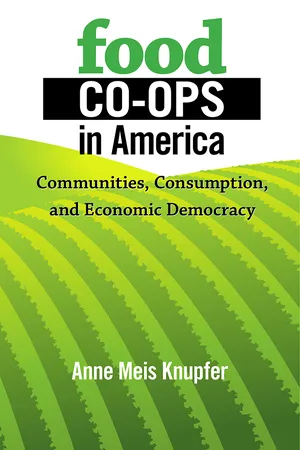
In recent years, American shoppers have become more conscious of their food choices and have increasingly turned to CSAs, farmers' markets, organic foods in supermarkets, and to joining and forming new food co-ops. In fact, food co-ops have been a viable food source, as well as a means of collective and democratic ownership, for nearly 180 years.In Food Co-ops in America, Anne Meis Knupfer examines the economic and democratic ideals of food cooperatives. She shows readers what the histories of food co-ops can tell us about our rights as consumers, how we can practice democracy and community, and how we might do business differently. In the first history of food co-ops in the United States, Knupfer draws on newsletters, correspondence, newspaper coverage, and board meeting minutes, as well as visits to food co-ops around the country, where she listened to managers, board members, workers, and members.What possibilities for change—be they economic, political, environmental or social—might food co-ops offer to their members, communities, and the globalized world? Food co-ops have long advocated for consumer legislation, accurate product labeling, and environmental protection. Food co-ops have many constituents—members, workers, board members, local and even global producers—making the process of collective decision-making complex and often difficult. Even so, food co-ops offer us a viable alternative to corporate capitalism. In recent years, committed co-ops have expanded their social vision to improve access to healthy food for all by helping to establish food co-ops in poorer communities.
eBook - ePub
Food Co-ops in America
Communities, Consumption, and Economic Democracy
- 264 pages
- English
- ePUB (mobile friendly)
- Available on iOS & Android
eBook - ePub
About this book
Information
Subtopic
North American HistoryIndex
History1
FOOD COOPERATIVES BEFORE THE GREAT DEPRESSION
When the Frenchman Alexis de Tocqueville visited the United States in 1831, he was astonished at the number of associations formed by Americans. He stated, “I have often admired the extreme skills with which the inhabitants of the United States succeed in proposing a common object for the exertions of a great many men and in inducing them voluntarily to pursue it.”1 Such organizing, in his estimation, provided evidence of a democratic impulse. His visit also coincided with the growth of workingmen’s associations, which established some of the first producer and consumer cooperatives. The history of food cooperatives in the United States is an enduring one, one that is at least 180 years old. In fact, the first American cooperatives predate the Rochdale Society of Equitable Pioneers, started in Rochdale, England in 1844.2
These first co-ops were created as economic alternatives to industrial capitalism. A working-class and ethnic consciousness fostered members’ participation in decisions related to their co-ops’ daily operations and utopian ideals. Collectively sharing their money and labor gave them more control over their work conditions, the opportunity to share in whatever profit or surplus they earned, and to reinvest their dollars back into their co-ops. But would their food cooperatives be able to compete with grocery chain stores during the early twentieth century?
By then the vision of food cooperatives had enlarged as middle-class reformers advocated for safe food legislation, educated consumers about their rights, and protested the rising costs of food. As such, consumer activism grew out of various constituencies, ideologies, and political affiliations. These differences sometimes led to heated discussions and debates about the goals and purposes of cooperative associations. How should the Rochdale principles of political neutrality and democracy be practiced? How should ideological and political differences be resolved? Could co-ops be both successful businesses and engage in participatory democracy? These debates reflected the growing pains of an emerging national cooperative movement.
The First Food Co-ops
During the 1830s, laborers organized cooperatives to protect their own economic interests. At one meeting in 1836, where 200 workers discussed cooperatives, a worker sharply asked who was “reaping the profits of your labor”? Later that year, hatters, tailors, saddlers, and harness makers pooled their monies to start their own producer cooperatives,3 ensured workers’ control of labor conditions, wages, and sales. But how to control for the rising prices of food and other necessities, to strengthen their purchasing power? As early as 1829, workers in Philadelphia had opened their own store so that they could buy at cost.4 In 1832, a group of workers and farmers formed the New England Association of Farmers, Mechanics, and Other Workingmen. They, too, were interested in consumer cooperatives and buying clubs. But the Association’s goals were larger as well: to reduce the twelve-hour working day; to eradicate the trucking system, through which they were paid in goods, not wages; and to promote education for themselves and their children.5
However, it was the Working Men’s Protective Union, started in Boston in 1845, that led to the establishment of more cooperative stores. Inspired by the Union, a number of workingmen’s associations federated into the New England Workingmen’s Association, later named the New England Protective Union. The Union started its own stores where members could buy groceries and other supplies.6 Originally, the Union stores were open only to members of “men of good character,” those who did not drink or sell liquor.7 Later, Union members agreed to open their stores to nonmembers who paid market prices for goods. By 1852, the Union boasted 167 stores, with a capital of $241,000 and sales of $1.69 million. Five years later, there were at least 800 union stores in thirteen states, mostly in the Northeast.8
The union stores were part of a utopian vision to change society. Members were concerned about working conditions, especially the twelve-hour work day. Toward this end, they invited a representative from the women workers of Lowell to their 1845 convention to advocate for the ten-hour work day. At the same time, members did not want to pay higher prices for food and hoped that their union stores would replace grocery stores. Despite its rapid growth, the New England Protective Union did not survive through the Civil War. Labor historian Philip Foner has argued that other grocery stores lowered their prices to undersell the union stores, as well as sold on credit. Another historian surmised the opposite: that many of the union co-ops sold their products at cost and extended too much credit.9 Both historians were probably right on the issue of credit.
Post–Civil War Co-ops
Following the Civil War, labor groups renewed their interest in cooperatives. From 1865 to 1890, cooperators were “practical utopians,” to use historian Steve Leikin’s phrase. The nearly 500 producer cooperatives and thousands of consumer cooperatives established then allowed workers to have greater control over their labor and their purchasing power. Workers believed that the democratic practices of cooperatives would grant them their due claim as “citizens of the republic” and that they would no longer be subject to industrial corruption.10 The National Labor Union (NLU), organized in Baltimore in 1866, encouraged members to form cooperative stores, as they were “the only true protection which the working man has against the over-shadowing influence of capital.”11 Even so, the union was short-lived and no records exist of cooperatives being organized through the NLU.
Two other labor groups—the Knights of St. Crispin (1867–1874) and the Knights of Labor (1869–1890)—supported buying clubs and cooperative stores, although most of those also failed. Loosely organized, the Knights of Crispin was especially concerned with the introduction of machinery into the workplace. One alternative was to start its own producer co-ops, although few workers did so because of little capital.12 The Knights of Labor’s mission was also an economic one: “the complete emancipation of the wealth producers from the thralldom and loss of wage slavery.”13 As Lawrence Glickman has discussed, workers hoped to replace their “wage slavery” with a living wage so that they could contribute to “a democratic political economy.” In fact, many hoped that cooperation would eventually replace capitalism. The Knights of Labor organized a number of successful boycotts during the 1880s, which led to a surge in membership of over 750,000 by 1886. However, some of its leaders stymied workers’ activism by insisting that workers’ education precede boycotts. Despite the leaders and members’ interests in producer and consumer co-ops, these co-ops largely failed because of lack of workers’ capital, the railroad companies and wholesalers’ opposition to them, and technological changes in factories.14
When workers in Springfield, Massachusetts organized the Sovereigns of Industry in 1874, they too were determined to eradicate monopolies and the “evils of the existing industrial and commercial system.”15 This group proposed, among other ideas, “to establish a better system of economical exchanges and to promote, on a basis of equity and liberty, mutual fellowship and co-operative action among the producers and the consumers of wealth throughout the earth.”16 Members started buying clubs according to the Rochdale principles. These principles of democracy (one member, one vote) limited buying of shares, and the redistribution of surplus through a patronage refund ensured a collective solidarity. At the height of the movement in 1875, there were over 280 local councils, each with its own buying club. The depression of 1877–1878 forced many clubs to close. Five, though, remained open until 1913, including the Sovereigns Trading Company of New Britain, Connecticut. One of the largest co-ops in New England by 1910, it had 237 members, a real estate value of $470,000, and a surplus of almost $15,000 returned to its members.17
Ethnic Co-ops
Not surprisingly, many co-ops during the late 1800s formed along ethnic lines. To be sure, the sharing of language and culture facilitated their establishment within communities. The oldest cooperative in Massachusetts, the German Co-operative Association in Lawrence, was started by cotton and woolen mill operatives in 1874. As of 1890, this association had almost 350 members and over $90,000 in dividends distributed to its members. In Quinsigamond, a suburb of Worchester, the First Swedish Co-operative Store Company started in 1882. Other Swedish cooperatives were established throughout the state, including the Swedish Mercantile Co-operative Company in Worchester (1884), the Scandia Co-operative Grocery Company in Fitchburg (1894), and the People’s Co-operative Store in Orange (1901).18
Beyond New England, there were ethnic and religious groups who established cooperative stores to ensure their very survival in their westward settlements. Alongside settlements of immigrants and religious sects, cooperatives spread from the Midwest to the West. As early as the 1870s, Mormon women had formed their own co-ops in Salt Lake City under the church auspices. By the end of the 1800s, there were at least 150 cooperatives in Utah, which sold clothing, food, and other goods.19 In California, the first cooperative was started in San Francisco as early as 1867. More co-ops followed, especially after the passage of a state law in 1894 that required cooperatives to practice the Rochdale principle of the “one member, one vote.” The reason for the law is not clear, as many co-ops started by single ethnic groups fiercely protected their members’ rights. Finnish immigrants were especially active in forming Rochdale cooperatives in the state; by 1917, they had opened over 140 of them.20
Food Co-ops, 1900–1930
That the cooperative movement expanded during the Progressive era was not coincidental. Alan Brinkley and Michael McGerr have argued that “reform” liberals of the early 1900s were opposed to unbridled industrial capitalism. Some of them, Gary Gerstle noted, even advocated for “industrial democracy” in hopes that the disproportionate imbalance of economic and political power would be redressed.21 One of these reformers was John Dewey, who argued that democracy was both political and economic. As he phrased it, “What does democracy mean, save that the individual is to have a share in determining the conditions and the aims of his own work.”22 Other agreed with him, including Henry Carter Adams, Dewey’s colleague at the University of Michigan, who openly favored a “cooperative commonwealth of owner-workers” as early as 1881. For this and other public statements, he was fired from Cornell University and then forced to retract his political views to keep his professorship at the University of Michigan.23
Women’s Advocacy and Food Legislation
Specific concerns about food safety and consumer protection, as well as ones of labor and agriculture, prompted women reformers, socialists, intellectuals, farmers, immigrants, and labor unionists to advocate for food cooperatives. During the Progressive era, the number of food and other co-ops grew at a tremendous pace, with over 2,500 cooperative societies and buying associations as of 1920.24 This growth also had been fostered by the establishment of regional and national organizations, especially the Co-operative League of the U.S.A. (CLUSA), founded in 1916. Such organizations, as well as a number of colleges and universities, offered summer institutes and courses to train managers and bookkeepers for co-ops, as well as to widen the public’s knowledge about cooperative history, principles, and ideologies. Some ardent co-opers and socialists even believed that co-ops would contribute to a new economic and democratic society. This often led to fierce debates and ideological divides, especially within the CLUSA.
Women had expanded their public roles as municipal housekeepers, arguing that all issues relating to families required their involvement. Women’s clubs helped to shape legislation and public policy through their reformist activities. To add to this complexity was women’s role as primary consumers for their households, a role that advertisers tried to use to their advantage.25 Even so, women were a major, although often invisible, force behind consumer advocacy and food cooperatives. For example, the members of the American Home Economics Association, started in 1908 by chemist Ellen Swallow Richards, were interested in food safety. The American Pure Food League was organized by the General Federation of Women’s Clubs (GFWC), the National Consumers League (NCL), and the State Food Commissioners. In 1904, the GFWC organized a Pure Food Committee to interest citizens in food legislation, which resulted in Clean Food Clubs. One of these clubs, the Fifty-First Street Club, along with the Housewives League of Chicago, protested the unsanitary conditions and high prices of retail grocery stores. In 1912, they held an egg sale on Chicago’s street corners to break the price of storage eggs that were sold as fresh ones. Other club women joined them and sold eggs at ten cents below store price.26 The NCL, organized in 1899, was concerned with what Landon Storrs called “ethical consumption.” Through networks of women’s organizations, such as the GFWC and the Young Women’s Christian Association (YWCA), the League encouraged women to buy clothing from factories that followed fair labor practices. The NCL’s label indicated those clothes that followed state factory regulations and whose factories were inspected by a League agent.27
Many women also participated through the cooperative women’s guilds. Similar to women’s clubs, these groups engaged in social welfare and educational activities, pointing again to their tremendous esprit de corps, as well as their invisible work. For example, the Women’s Co-operative Guild of Minneapolis, in collaboration with other women’s auxiliaries and organized labor, gave a benefit program for flood victims in the South in 1927. Through this effort, they donated clothing and $35,000. They also contributed to a striking miners’ fund and provided a scholarship for a young local woman to attend the Northern States Co-operative League Training School. At Christmas, they gave baskets of food to poor families. Through the Women’s International League for Peace and Freedom, of which the guild was a member, they fought “to see the outlawry of war.”28 And they studied the cooperative movement. As one article encouraged the members: “Women, take your share of the responsibility! Organize, study Co-operation,...
Table of contents
- Acknowledgments
- Abbreviations
- Introduction
- 1. Food Cooperatives before the Great Depression
- Part I. Collective Visions of the Depression
- Part II. Food for People or Profit?
- Epilogue
- Appendix
- Notes
- Bibliography
Trusted by 375,005 students
Access to over 1.5 million titles for a fair monthly price.
Study more efficiently using our study tools.
Frequently asked questions
Yes, you can cancel anytime from the Subscription tab in your account settings on the Perlego website. Your subscription will stay active until the end of your current billing period. Learn how to cancel your subscription
No, books cannot be downloaded as external files, such as PDFs, for use outside of Perlego. However, you can download books within the Perlego app for offline reading on mobile or tablet. Learn how to download books offline
Perlego offers two plans: Essential and Complete
- Essential is ideal for learners and professionals who enjoy exploring a wide range of subjects. Access the Essential Library with 800,000+ trusted titles and best-sellers across business, personal growth, and the humanities. Includes unlimited reading time and Standard Read Aloud voice.
- Complete: Perfect for advanced learners and researchers needing full, unrestricted access. Unlock 1.5M+ books across hundreds of subjects, including academic and specialized titles. The Complete Plan also includes advanced features like Premium Read Aloud and Research Assistant.
We are an online textbook subscription service, where you can get access to an entire online library for less than the price of a single book per month. With over 1.5 million books across 990+ topics, we’ve got you covered! Learn about our mission
Look out for the read-aloud symbol on your next book to see if you can listen to it. The read-aloud tool reads text aloud for you, highlighting the text as it is being read. You can pause it, speed it up and slow it down. Learn more about Read Aloud
Yes! You can use the Perlego app on both iOS and Android devices to read anytime, anywhere — even offline. Perfect for commutes or when you’re on the go.
Please note we cannot support devices running on iOS 13 and Android 7 or earlier. Learn more about using the app
Please note we cannot support devices running on iOS 13 and Android 7 or earlier. Learn more about using the app
Yes, you can access Food Co-ops in America by Anne Meis Knupfer in PDF and/or ePUB format, as well as other popular books in History & North American History. We have over 1.5 million books available in our catalogue for you to explore.