Many activists worry about the same few problems in their groups: low turnout, inactive members, conflicting views on racism, overtalking, and offensive violations of group norms. But in searching for solutions to these predictable and intractable troubles, progressive social movement groups overlook class culture differences. In Missing Class, Betsy Leondar-Wright uses a class-focused lens to show that members with different class life experiences tend to approach these problems differently. This perspective enables readers to envision new solutions that draw on the strengths of all class cultures to form the basis of stronger cross-class and multiracial movements.The first comprehensive empirical study of US activist class cultures, Missing Class looks at class dynamics in 25 groups that span the gamut of social movement organizations in the United States today, including the labor movement, grassroots community organizing, and groups working on global causes in the anarchist and progressive traditions. Leondar-Wright applies Pierre Bourdieu's theories of cultural capital and habitus to four class trajectories: lifelong working-class and poor; lifelong professional middle class; voluntarily downwardly mobile; and upwardly mobile.Compellingly written for both activists and social scientists, this book describes class differences in paths to activism, attitudes toward leadership, methods of conflict resolution, ways of using language, diversity practices, use of humor, methods of recruiting, and group process preferences. Too often, we miss class. Missing Class makes a persuasive case that seeing class culture differences could enable activists to strengthen their own groups and build more durable cross-class alliances for social justice.
eBook - ePub
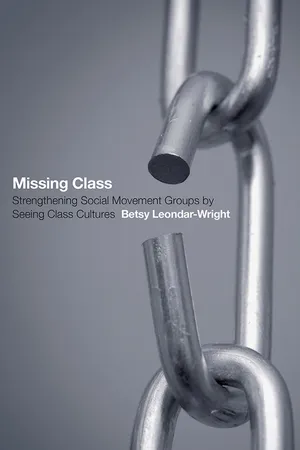
Missing Class
Strengthening Social Movement Groups by Seeing Class Cultures
- 272 pages
- English
- ePUB (mobile friendly)
- Available on iOS & Android
eBook - ePub
About this book
Information
PART I
Class Diversity
among Activists
CHAPTER 1
Why Look through a Class Lens?
Five Stories through Three Lenses
Small voluntary groups run into trouble: there are internal conflicts, difficult decisions, and clashes with other groups. Where can members turn for ideas on how to set things right? They may turn to their movement traditions. They may frame problems in terms of race or gender, or turn to practices from their ethnic roots or their gender identities. Or they may draw from their class cultures—but usually much less consciously, without naming them as class.
Any story of small-group troubles can be told in these three ways: through the lens of movement traditions, through a race and/or gender lens, or through a class lens. The goal of this chapter is to persuade readers that it is worthwhile to look through a class-culture lens.
In this chapter I introduce five of the twenty-five groups included in this book by telling one brief story of an intragroup problem in three ways: framing the story in terms of movement traditions; looking through a race and gender lens; and revealing participants’ class identities to see new patterns and hypothesize about class cultures. In each case, something new is learned by looking through the class lens—usually something not articulated by the participants themselves because of the scarcity of class discourse among activists in the United States today.
To begin to illustrate the value of adding the class lens, here’s one very small incident.
First Story: The Long-Underwear Dilemma
A core member of the Parecon Collective, Rupert, began wearing an unusual garment that left little to the imagination. Several members were disturbed to learn that he wore his colorful, slinky long underwear when representing the collective to the public, but they didn’t say anything directly to him.
1. Movement Tradition Lens: Can Anarchists Put Social Pressure on Each Other?
The Parecon Collective defined itself as radical and antiauthoritarian, and many members identified themselves as anarchists. This antiauthoritarian political tendency was the fastest-growing subculture among young white activists in the 1990s and the first decade of the twenty-first century (Starr 2005; Kutz-Flamenbaum 2010).
To Parecon members, autonomy was a core value, which any kind of peer pressure threatened to violate. They didn’t mind having procedures for their shared work, although they joked about how often they failed to follow them. But in an area as personal as clothing, where many prided themselves on being unconventional, it wasn’t comfortable to try to influence someone to become more mainstream. What to do?
Two members spoke privately to Olivia, a member who was a personal friend of Rupert, asking her to intervene. In response, she teased him during a meeting, laughing as she said, “I can’t believe you’re wearing underwear!” Rupert replied, “They’re pants! I don’t know what you’re talking about.” To which Olivia said, “You’d wear those! You’re pushing boundaries, dude! Amazing!” The next time I saw Rupert, he was wearing jeans.
Olivia bringing up the clothing problem so lightly allowed the group to avoid imposing its norms in a heavy way that might trigger concerns about hierarchy and authoritarian control. Other members’ view on the long underwear was able to hold sway, without the majority dictating to the minority.
In their interviews, both Rupert and Olivia laughed about this incident and reiterated that they are close friends. As a nonhierarchical relationship, friendship was a more acceptable basis on which anarchists could apply pressure than a leader/follower relationship. In this case the friendship bond worked well to transmit some group feedback to a member who had violated an unspoken norm without requiring unacceptable levels of collective control.
2. Adding the Race and Gender Lens to the Long-Underwear Dilemma
Unusual clothing that flouts mainstream standards is a valued subcultural marker among anarchists and other young radicals, but women use it far more often than men. While anarchist men might sport dreadlocks or tattoos, their clothing tends to differ from mainstream male styles only in being used and/or all black, not by dramatically different types of garments than most mainstream men wear. Rupert seemed to have been violating gender norms by being so revealing and eccentric.
Olivia stood out in the mostly male Parecon Collective for her flamboyant postmodern pastiche of retro garments, an art form practiced by many of her age, gender, and subculture. By wearing his colorful long johns, Rupert was dressing a little like her. Thus it’s not surprising that she was the one asked by two plain-dressing men to speak with him. Did those two men also ask Olivia to carry their feedback to Rupert not only because of their friendship, and not only because of her bohemian clothing, but because of her gender as well? Women are sometimes expected to handle tricky interpersonal situations in mixed-gender groups (Tannen 1990 and 1994).
Everyone in this situation was white. Discomfort with directly expressing criticism or conflict has been described as more typical of whites than of some other ethnic groups, such as African Americans (Kochman 1981; Bailey 1997). While the Parecon Collective joked around a lot, the joking didn’t usually involve rough teasing of anyone in the room. In a mixed-race or all-black group, might Rupert have heard people’s reactions to his long-underwear pants the first moment he walked in wearing them, instead of a month later?
The race and gender lens suggests these interesting questions. What more could a class lens add?
3. Adding the Class Lens: Indirectness versus Bluntness
Olivia was not just Rupert’s friend, and not just one of the few women in the Parecon Collective, but she was also a lifelong-poor person, one of only two people in the core group who wasn’t raised by college-educated homeowner parents. Olivia had been recruited to the Parecon Collective by a working-class woman who explicitly said she wanted another woman from a working-class background to keep her company in the group but who had since quit. Olivia’s willingness to be jokingly blunt about a touchy subject was a resource to the group—a resource that may have come from her low-income roots and her lack of socialization into professional norms. Teasing is a much more common form of humor among working-class and poor activists than among any other class.
Two studies of US white and black men’s values found that upper-middle-class (UMC) men emphasized getting along with everyone and diplomacy (Lamont 1992), while working-class men valued blunt honesty (Lamont 2000).
During meetings, the Parecon Collective appeared to be a casual, friendly, youthful group, sprawled on worn couches, laughing together at Republicans, religious people, and consumers of corporate products. But interviews with members revealed a startling level of unspoken conflict. A founding member, Edrin, was messing up a core aspect of their work and never showed up to meetings to discuss the situation—and Olivia believed that no one had ever confronted him about it directly. She said, “We often talk about this behind his back [laughs]…he’s really hard to talk to. We’ve tried, we’ve tried like, we decided he should [do his role a certain way], and then he just doesn’t do it.… I think he should be required to come to a meeting every six months or something at least…he’s just like not even there.” But Edrin was often present in a far corner of the group’s space when she and other active members were there. He successfully avoided interacting with them.
Is such conflict avoidance fully explained by the other lenses? Is it sufficient to say that there’s a reticent cultural style in some US anarchist groups? Can we completely understand why Parecon members didn’t approach Rupert directly but asked Olivia to do it for them by noting that the conflict avoiders were white men? Perhaps—but below we will find that conflict avoidance is most common among people who grew up in the lower part of the professional-middle-class (PMC) range.
Today’s movement traditions have grown from distinct class roots, and one hypothesis explored in this book is that today’s anarchist subculture (as opposed to, say, the Spanish anarchists of the 1930s) has some strongly PMC class-cultural aspects. Most anarchist groups are prefigurative, intending to “be the change you want to see in the world” by manifesting the opposite of oppressive mainstream society in their practices. But could such conflict avoidance be one way that some anarchist groups don’t manage to escape the downside of their predominantly PMC backgrounds? This question is addressed in the book’s analysis of other antiauthoritarian groups.
Next I’ll look at two more small kerfuffles through the same three lenses, then move on to a major conflict that threatened a group’s effectiveness, and finally profile a huge fight that ended one group’s existence.
Second Story: Reacting to Criticism from Within
This story took place in a very different setting, a grassroots community group in a low-income area of a big city. At one Women Safe from Violence (WomenSafe) meeting, a member who wasn’t part of the core group, Randall, raised a criticism of a recent public presentation by leaders Elaine and Bette. He said, “I don’t want to be hypercritical of the group, but we were half-assed! It went off on weird tangents. We should put it on a video or a DVD, because the speaker gets into random stuff. We were not smooth, we were all over the frickin’ place.”
Several members reacted negatively as Randall spoke, both verbally and with body language. One interrupted him to say coldly, “I don’t know how many of [those programs] you’ve done!” The chair said indignantly, “Do you think it was [WomenSafe’s] fault?” Bette shouted, “I was there! We have a video! There was no TV to show it on that time! … You kept interrupting, that was the problem!” And then in a calmer voice but still vehement she added, “Sometimes we’re not as perfect as we like, but your interpretation is quite wrong!”
After a pause, another member, Adaline, suggested scheduling an organizational evaluation session to go over the substance of Randall’s critique. The members who had been so vehement a moment before calmly agreed with her. Why such a different reaction to Adaline than to Randall? Why could some members hear a suggestion for group self-evaluation from one person but not another?
1. Movement Tradition Lens: Family Mutual Aid and Pride in Being Nonprofessional
WomenSafe members prided themselves that their group was run by the very people who had needed the group’s help, who then became empowered to find collective as well as individual solutions. The founder, Elaine, told me, “I call it constituent-led organizing—and it’s frickin’ magic.… Those who lead the group are those affected by the issue.”
Randall’s criticism offended the core members because it suggested that the do-it-ourselves ethic of the group wasn’t effective. By talking about creating prepackaged technological tools such as a DVD, he was suggesting a slicker style, a mode more like a social service agency than an activist mutual-aid group.
As with many community groups, family ties seemed to be the model on which WomenSafe was based. Mutual self-defense of the family was the group’s main mode, both in its program work and in its internal workings. Randall positioned himself as an outsider attacking the family, referring to “the speaker” in the third person and saying “half-assed.” Adaline spoke more gently, from a “we” position within the family.
2. Race/Gender Lens: White Guys are Welcome If They Stay Low-Key
Randall as a white male was not welcome to critique a majority-female group. Adaline as a white woman was welcome to make the same points. Those reacting defensively to Randall’s criticism were women of three races, closing ranks in the face of a white man’s attack. Another white man, Eugene, was a respected core member who was repeatedly elected to the board—but unlike Randall, Eugene was very quiet, doing his share of the work but not speaking much at meetings. It seems that white men were welcome as long as they didn’t dominate.
3. Adding a Class Lens: Closing Ranks or Introspective Processing?
There were just two people whose parents had graduate degrees at this meeting: Randall and Adaline. Their shared perspective that there might be something amateurish and ineffective about the group’s public presentations may have come from their more elite class-cultural roots. Organizational development is often the turf of people from PMC backgrounds, so it’s not surprising that they were the two who suggested an evaluation process. They may also have felt more entitled to be critical.
Most of the women who sprang to the presenters’ defense were lifelong-working-class or lower-middle-class people. Loyally closing ranks around leaders seems to be part of working-class culture, in particularly within grassroots community organizations. How widespread a class-cultural trait this is will be explored in chapter 6.
Adaline, a middle-aged Jewish woman, was the only member present who had a four-year college degree. Her reaction to Randall was different from the other women’s, not only in that she agreed with him more but also in how she framed the disagreement differently, in terms of group process and organizational introspection: “There is room for [WomenSafe] to look at itself. We could look at our presentations, go over ‘when you said that’ or ‘this is how to do that better.’ This defensiveness about did we mess up is not helpful. I’ve seen very little processing and analyzing in this group, or talk about how to improve [WomenSafe].”
After a pause, the chair, Laci, responded, “Totally. It’s good to criticize ourselves,” and Kristal said, “Maybe at the next meeting.” Adaline’s culturally PMC perspective, oriented more toward group introspection by “processing and analyzing,” influenced other group members to modify their usual mode of closing ranks around the leaders.
Third Story: Workers Argue Unsuccessfully with the Organizer’s Idea
Another small disagreement happened in a meeting of the Local 21 Organizing Committee. The chair, Lynette, a substitute staff organizer, insisted that the members plan a party; but all the workers who had been elected to a coordinating group argued with her that a skill-training session would attract more potential members. One member, Alonzo, shouted at the organizer, put on his hat, and dramatically strode toward the door as if to walk out, before returning to the meeting.
1. Movement Tradition Lens: Top-Down Labor Tradition Collides with Democratic Expectations
Local 21 was part of a huge international union, which staffed this organizing committee to try to unionize certain low-paid service workers. The agendas for the organizing-committee meetings were set by Local 21 managers, not by organizers or workers. Democratic decision-making power by rank-and-file workers is not a universal union practice (Early 2009). Before unionization, an organizing campaign is even more likely to be centrally controlled by union management. Organizing staffers are caught between their mission of mobilizing workers and the directives they get from their supervisors. Lynette put the party on the agenda as a question, as if the members would be making the decision. But when they objected to the plan, she had to admit to them that it was a done deal, with only details of time and place left to be worked out.
The meeting I observed was during Lynette’s last week as union staff, as she had just resigned. She told me that she hated her job. The next Local 21 Organizing Committee meeting I observed was led by a different organizer, Owen. He also expressed frustration with the constraints of his job, with his subordination to orders from above and with how little say workers had in the unionization campaign.
But from the union management’s point of view, a streamlined, cost-effective process modeled on past unionization victories no doubt made sense. Their lean organizing system has been proven effective by s...
Table of contents
- List of Tables and Figures
- List of Online Tables and Appendixes
- Introduction: Activist Class Cultures as a Key to Movement Building
- Part I. Class Diversity Among Activists
- Part II. Activist Class Cultures and Solving Group Troubles
- Acknowledgments
- Appendix: Methodology Notes
- Notes
- References
Trusted by 375,005 students
Access to over 1.5 million titles for a fair monthly price.
Study more efficiently using our study tools.
Frequently asked questions
Yes, you can cancel anytime from the Subscription tab in your account settings on the Perlego website. Your subscription will stay active until the end of your current billing period. Learn how to cancel your subscription
No, books cannot be downloaded as external files, such as PDFs, for use outside of Perlego. However, you can download books within the Perlego app for offline reading on mobile or tablet. Learn how to download books offline
Perlego offers two plans: Essential and Complete
- Essential is ideal for learners and professionals who enjoy exploring a wide range of subjects. Access the Essential Library with 800,000+ trusted titles and best-sellers across business, personal growth, and the humanities. Includes unlimited reading time and Standard Read Aloud voice.
- Complete: Perfect for advanced learners and researchers needing full, unrestricted access. Unlock 1.5M+ books across hundreds of subjects, including academic and specialized titles. The Complete Plan also includes advanced features like Premium Read Aloud and Research Assistant.
We are an online textbook subscription service, where you can get access to an entire online library for less than the price of a single book per month. With over 1.5 million books across 990+ topics, we’ve got you covered! Learn about our mission
Look out for the read-aloud symbol on your next book to see if you can listen to it. The read-aloud tool reads text aloud for you, highlighting the text as it is being read. You can pause it, speed it up and slow it down. Learn more about Read Aloud
Yes! You can use the Perlego app on both iOS and Android devices to read anytime, anywhere — even offline. Perfect for commutes or when you’re on the go.
Please note we cannot support devices running on iOS 13 and Android 7 or earlier. Learn more about using the app
Please note we cannot support devices running on iOS 13 and Android 7 or earlier. Learn more about using the app
Yes, you can access Missing Class by Betsy Leondar-Wright in PDF and/or ePUB format, as well as other popular books in Social Sciences & Social Classes & Economic Disparity. We have over 1.5 million books available in our catalogue for you to explore.