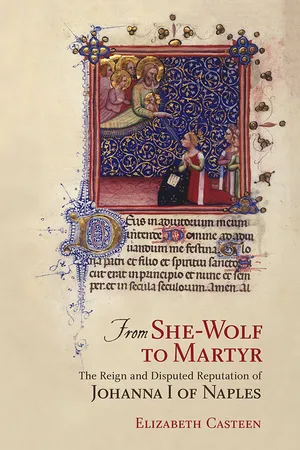
In 1343 a seventeen-year-old girl named Johanna (1326–1382) ascended the Neapolitan throne, becoming the ruling monarch of one of medieval Europe's most important polities. For nearly forty years, she held her throne and the avid attention of her contemporaries. Their varied responses to her reign created a reputation that made Johanna the most notorious woman in Europe during her lifetime. In From She-Wolf to Martyr, Elizabeth Casteen examines Johanna's evolving, problematic reputation and uses it as a lens through which to analyze often-contradictory late-medieval conceptions of rulership, authority, and femininity.When Johanna inherited the Neapolitan throne from her grandfather, many questioned both her right to and her suitability for her throne. After the murder of her first husband, Johanna quickly became infamous as a she-wolf—a violent, predatory, sexually licentious woman. Yet, she also eventually gained fame as a wise, pious, and able queen. Contemporaries—including Francesco Petrarch, Giovanni Boccaccio, Birgitta of Sweden, and Catherine of Siena—were fascinated by Johanna. Drawing on a wide range of textual and visual sources, Casteen reconstructs the fourteenth-century conversation about Johanna and tracks the role she played in her time's cultural imaginary. She argues that despite Johanna's modern reputation for indolence and incompetence, she crafted a new model of female sovereignty that many of her contemporaries accepted and even lauded.
eBook - ePub
From She-Wolf to Martyr
The Reign and Disputed Reputation of Johanna I of Naples
- 288 pages
- English
- ePUB (mobile friendly)
- Available on iOS & Android
eBook - ePub
About this book
Information
CHAPTER 1
The Murder of Andrew of Hungary and the Making of a Neapolitan She-Wolf
According to Aristotle … woman is a failed male, that is, the matter that forms a human being will not result in a girl except when nature is impeded in her actions … thus it has been said that woman is not human, but a monster in nature.
Commentary on Pseudo-Albertus Magnus’s On Women’s Secrets (late thirteenth/early fourteenth century)
If a husband is forced to be his wife’s serf, it’s a terrible calamity, for he ought to be the boss. The natural order of things has been overturned by women in their madness… . The governor was governed and the roles of the sexes reversed, for she was active and he passive, willing to neigh under her. Thus the natural order of things was turned upside down. What was normally underneath was on top, and confusion reigned.
Jean le Fèvre, The Lamentations of Matheolus (ca. 1371–72)
No woman in this world is so faithful or so committed to any betrothal that if a lusting lover appears and entices her with expertise and persistence to enjoy love, she is minded to reject his request or defend herself against his advances… . A woman behaves like this because she is plagued by oppressive lust.
Andreas Capellanus, On Love (ca. 1185)
On the morning of September 19, 1345, the Regno awoke to scandal. During the night, assailants had murdered the seventeen-year-old prince-consort, Andrew of Hungary (b. 1328). Within days, Andrew was to have celebrated a joint coronation with his wife, Johanna of Naples, an event that he had awaited since Johanna’s 1343 succession to the Neapolitan throne. The murder of a prince was scandalous in itself. The brutality of Andrew’s death compounded the scandal: He was suffocated and strangled, mutilated, and defenestrated.
In Johanna’s long reign, no scandal exceeded this one in its enduring value to her enemies and critics. The circumstances surrounding Andrew’s death inspired speculation about who had murdered him and who gained the most from his death. Rumor held that Johanna and her many lovers had murdered Andrew to prevent his coronation. The crime provoked two invasions of Naples by Andrew’s vengeful brother, Louis of Hungary, who insisted on Johanna’s guilt and whose vendetta drew widespread military and moral support. Johanna became internationally known as a viricide—a husband murderer—a reputation that remained with her throughout her life and for posterity, even though a papal tribunal officially cleared her name in 1350. Contemporaries described her court as rife with immorality and violence, and gossip tied Andrew’s death directly to Johanna’s reputed infidelity, lust, and greed. These traits and her identification as a murderess became hallmarks of Johanna’s public image.
Although no evidence definitively links Johanna to Andrew’s murder, it has remained the defining characteristic of her reign in historical memory. Modern scholars have tended to exculpate Johanna, arguing that she gained little from Andrew’s death and that there is no proof that she was involved. Others have argued that, while she may well have been complicit, nothing exists to indicate her direct guilt. Modern skepticism, however, is at variance with traditional perceptions of Andrew’s murder. Within little more than a century of her death, it stood, with Johanna’s own murder, as her legacy to history. A summary of her reign prepared in the late fifteenth century for Louis XII of France to demonstrate his rights to the Kingdom of Naples presents Andrew’s death as the decisive moment in Johanna’s life. It collapses her eventful four-decade reign into a single sequence of events that began with Andrew’s death and ended almost immediately in Johanna’s own justly deserved murder:
Louis of Hungary, because Queen Johanna had strangled and killed Andrew, her husband, brother of this same Louis, went from Hungary to the Kingdom of Naples to avenge the death of Andrew, his brother, against the aforesaid Johanna … and, with the favor of Pope Urban VI, made Charles of Durazzo her successor and gave him possession [of the Kingdom].—Charles of Durazzo, after he had taken the aforesaid Johanna prisoner … suffocated her between two pillows.1
The tidiness of this account, which depicts Johanna’s death in 1382 as the retributive outcome of Andrew’s murder in 1345, provides eloquent testimony to how pervasive belief in Johanna’s guilt became, particularly since it was from Johanna that Louis XII traced his claim to Naples.
Perhaps even more telling is the popularity of the story of Andrew’s death in plays, romances, and operas in the centuries that followed. Johanna came to be remembered in some quarters as a tragic and maligned heroine, but even when this was the case, she was most famous for murdering Andrew. The Golden-Age Spanish playwright Lope de Vega’s La reina Juana de Nápoles (written 1597–1603) is a case in point. Lope’s Juana is heroic and selfless. She sacrifices her own happiness to protect her kingdom from the tyrant Andrés, who threatens to invade Naples if Juana will not marry him. When Andrés’s cruelty imperils her realm and she discovers that he intends to murder her and usurp her throne, Juana again makes a sacrifice, killing Andrés to protect her people.2 Thus, while it became a point of debate whether Andrew deserved his fate and whether Johanna was a victim or villain, Johanna’s responsibility for his death remained a constant in historical memory.
The clarity with which succeeding generations perceived Johanna’s guilt obscures both the uncertainty surrounding the details of Andrew’s murder in its immediate aftermath and the process by which Johanna became a regicide and viricide in popular imagination. Andrew’s family and supporters waged a campaign to defame Johanna that influenced how chroniclers and others described the events surrounding his murder. Johanna’s enduring reputation as a she-wolf grew out of the accretion and elaboration of the story of Andrew’s death, told in chronicles, letters, and other texts by commentators with varying purposes, ranging from Johanna’s deposition to her exoneration. The story differed from one teller to another and became inextricably intertwined with each narrator’s stake in Italian and papal politics and in Angevin history. Each rendition reflected a larger concern as well with the feasibility and meanings of regnant queenship. Among Johanna’s supporters, the story became a means to present her as a victim of circumstance beleaguered by the enemies of the Church. In the hands of her detractors, Andrew’s death became a cautionary tale about the dangers of female rule and proof of the illegitimacy of Johanna’s claim to Naples.
Historical Background and Dramatis Personae
When Robert of Naples named Johanna his successor, he faced the lingering question of the Hungarian Angevin claim to Naples. Johanna’s sex left her vulnerable to charges that her reign was illegitimate and reignited charges that Robert had usurped his throne from his nephew, Carobert of Hungary. With these concerns in mind, and in the interest of stability, Robert arranged a compromise with the Hungarian Angevins: Johanna’s younger sister, Mary (1329–66), would marry Louis, Carobert’s eldest son and the heir to the Hungarian throne, while Johanna would marry Andrew.3 In 1333, Andrew, then only five years of age, came to Naples to be educated in what was widely understood as his future kingdom.4 Indeed, Robert preached a sermon in honor of his arrival on Matthew 3:17, greeting the young prince with the words, “This is my beloved son, in whom I am well pleased,” thus seeming to proclaim Andrew his heir.5
The Neapolitan court was among the most cosmopolitan in Western Europe. It was multilingual and culturally polyglot, yet Andrew and the Hungarian courtiers who accompanied him appear to have remained outsiders. Charles I’s court had been substantially French, although it had included Provençal, Neapolitan, and northern Italian courtiers. French remained one of the languages of the court, but by Johanna’s time, while many Provençal families—such as the des Baux, who soon became known as the del Balzo—remained, the northern French courtiers who had accompanied Charles were largely gone. In all likelihood, when Andrew first arrived at court, he spoke French with his Neapolitan cousins and was not wholly a linguistic outsider. French dynastic identity and an appreciation of chivalric literature and manners continued to shape Neapolitan court culture during Johanna’s reign. Indeed, the Catalan Franciscan Francesc Eiximenis (1330–1409) reports with disgust in his Llibre de les Dones (1396) that while Robert’s queen, the pious Sancia of Majorca, was briefly able to check the court’s frivolous impulses, its ladies’ fashions emulated those of the French court, as did the songs they sang and their conversation, which revolved entirely around love.6 Over time, however, the court had come to have a distinctive culture that fused French, Occitan, and Italian—both Neapolitan and northern—elements.7 Naples’s noble culture was literate (indulging in a taste for Latin scholarship as well as French and Occitan literature), sophisticated, and cosmopolitan, but it was also increasingly and distinctively Neapolitan. During Johanna’s reign a true Neapolitan literary volgare—a hybrid of native, Sicilian, Tuscan, and French linguistic elements—emerged that she and her court circle popularized.8 Andrew was called upon to acculturate, to find a place for himself in a distinctive, fashion-conscious court. To some extent, he must have done so, but court records and reports by observers suggest that he never became a true member of court society, and instead that he remained separate from his Neapolitan cousins, including his future wife, who slighted and mocked him. Indeed, numerous chroniclers report that Andrew was subject to constant taunts and humiliation.9
In 1343, Robert died, and the throne passed to Johanna. She was seventeen; Andrew was only fifteen. The court at whose head they found themselves was split into multiple factions that vied to influence, control, or supplant the young couple. The most prominent divisions were between Provençal and Italian (primarily Neapolitan and Florentine) courtiers and the Hungarians who had accompanied Andrew to Naples and gradually won their own supporters.10 Added to this already volatile mixture were the three Tarantini (descended from Philip of Taranto) and three Durazzeschi (descended from John of Gravina), who, as Angevin princes, had hoped to succeed ahead of Johanna or to ascend the throne through marriage to Robert’...
Table of contents
- Acknowledgments
- List of Abbreviations
- Introduction
- 1. The Murder of Andrew of Hungary and the Making of a Neapolitan She-Wolf
- 2. From She-Wolf to Radiant Queen
- 3. A Most Loving Daughter
- 4. An “Especially Good Friend” to Saints
- 5. The Schism of the Western Church and the Division of Johanna of Naples
- Epilogue
- Conclusion
- Bibliography
- Index
Trusted by 375,005 students
Access to over 1.5 million titles for a fair monthly price.
Study more efficiently using our study tools.
Frequently asked questions
Yes, you can cancel anytime from the Subscription tab in your account settings on the Perlego website. Your subscription will stay active until the end of your current billing period. Learn how to cancel your subscription
No, books cannot be downloaded as external files, such as PDFs, for use outside of Perlego. However, you can download books within the Perlego app for offline reading on mobile or tablet. Learn how to download books offline
Perlego offers two plans: Essential and Complete
- Essential is ideal for learners and professionals who enjoy exploring a wide range of subjects. Access the Essential Library with 800,000+ trusted titles and best-sellers across business, personal growth, and the humanities. Includes unlimited reading time and Standard Read Aloud voice.
- Complete: Perfect for advanced learners and researchers needing full, unrestricted access. Unlock 1.5M+ books across hundreds of subjects, including academic and specialized titles. The Complete Plan also includes advanced features like Premium Read Aloud and Research Assistant.
We are an online textbook subscription service, where you can get access to an entire online library for less than the price of a single book per month. With over 1.5 million books across 990+ topics, we’ve got you covered! Learn about our mission
Look out for the read-aloud symbol on your next book to see if you can listen to it. The read-aloud tool reads text aloud for you, highlighting the text as it is being read. You can pause it, speed it up and slow it down. Learn more about Read Aloud
Yes! You can use the Perlego app on both iOS and Android devices to read anytime, anywhere — even offline. Perfect for commutes or when you’re on the go.
Please note we cannot support devices running on iOS 13 and Android 7 or earlier. Learn more about using the app
Please note we cannot support devices running on iOS 13 and Android 7 or earlier. Learn more about using the app
Yes, you can access From She-Wolf to Martyr by Elizabeth Casteen in PDF and/or ePUB format, as well as other popular books in History & Historical Biographies. We have over 1.5 million books available in our catalogue for you to explore.