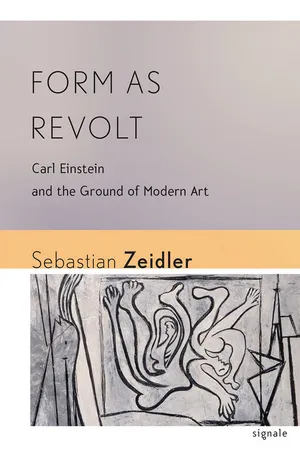
The German writer and art critic Carl Einstein (1885–1940) has long been acknowledged as an important figure in the history of modern art, and yet he is often sidelined as an enigma. In Form as Revolt Sebastian Zeidler recovers Einstein's multifaceted career, offering the first comprehensive intellectual biography of Einstein in English.Einstein first emerged as a writer of experimental prose through his involvement with the anarchist journal Die Aktion. After a few limited forays into art criticism, he burst onto the art scene in 1915 with his book Negro Sculpture, at once a formalist intervention into the contemporary theory and practice of European sculpture and a manifesto for the sophistication of African art. Einstein would go on to publish seminal texts on the cubist paintings of Georges Braque and Pablo Picasso. His contributions to the surrealist magazine Documents (which Einstein cofounded with Georges Bataille), including writings on Picasso and Paul Klee, remain unsurpassed in their depth and complexity.In a series of close visual analyses—illustrated with major works by Braque, Picasso, and Klee—Zeidler retrieves the theoretical resources that Einstein brought to bear on their art. Form as Revolt shows us that to rediscover Einstein's art criticism is to see the work of great modernist artists anew through the eyes of one of the most gifted left-wing formalists of the twentieth century.
- 320 pages
- English
- ePUB (mobile friendly)
- Available on iOS & Android
eBook - ePub
About this book
Information
Topic
ArtSubtopic
History of Modern Art1
THE LOST WANDERER
Toward Infinity
Throughout Einstein’s prose from the 1910s and the enigmatic notes he compiled while writing it, one finds him returning over and over again to an issue that moved him deeply: the issue of what he variously called an origin, ground, or essence. Einstein’s thoughts on the matter do not amount to a systematic argument; they are brief, elliptical, and sometimes rigorously coded. But they do state one of his most deeply felt convictions clearly enough. That conviction was that the origin of anything at all—the origin of a human adult in his or her personal biography, the origin of textual meaning in the real world, the origin of a given present in a historical past—is fundamentally inaccessible; and that this is so because at any one moment that origin is receding away from us as a causal chain whose links disappear back into the infinity of time: from a point A in our present on to A′, A″, and beyond. That is why, as I suggested in my introduction, for Einstein our selves and our work, our identity and our poetic meaning, are always precarious achievements built on a void, grounded in a fundamental groundlessness.
Einstein’s conviction did not come out of nowhere. We can discern the diffuse but powerful presence in his work of a seminal phase of German Romantic philosophy that is associated with the names of Novalis and Schelling.1 Around 1800, these two thinkers went a decisive step beyond Kant and Fichte in declaring that human thought and experience unfold on a ground that is itself unavailable to them.2 For this is a ground that precedes both the Kantian subject and object and the Fichtean I and not-I: it serves as the origin for the human cognition of the things in the world and the ways in which they take shape for that cognition; yet even as it does so, it also retreats away from them, leaving only traces of itself in the aftermath of its departure. “Every actual origin is a second moment,” Novalis had argued. “Everything that is, everything that appears, is and appears only on one condition: that its individual ground, its absolute self, precedes it, or at least must be thought as preceding it.”3 In turn, in his Freiheitsschrift Schelling had insisted that “there must be an essence before any ground and before all that exists, thus generally before any duality—how can we call it anything other than the arch-ground [Urgrund], or rather the non-ground [Ungrund]? Since it precedes all opposites, these cannot be distinguishable in it nor can they be present in any way. Therefore, it cannot be described as the identity of opposites; it can only be described as the absolute indifference of both.”4 Not only do versions of these arguments and their terminology recur throughout Einstein’s early writing, condensed into single apodictic sentences; we will also find them and their terminology structuring the very fabric of his prose.5
Modern science and Judeo-Christian theology, Einstein believed, had invented two stopgaps for sealing the void of the receding origin, and he felt compelled to reject them both: the scientific notion of causality, and its religious equivalent, the notion of God.6 “Causal thought,” Einstein argued in a short text on “The Problem of the Origin,” “is founded on individuation in the temporal sense, which is posited by the concept of the origin.”7 And that is why scientific causality must be dismissed. For, by positing an absolute beginning for the things in the world, it “individuates” history, reduces its complexity and open-endedness. Causal thought assumes the existence of a single point back in time from which a stable, meaningful history then projects forward as a linear chain of causes and effects all the way into the present. There, it grounds and so limits one’s self and one’s work, replacing the actual threat, and the real opportunity, of a groundless infinity with the fictive determinism of a restrictive identity: “In causal thought, man posits his own finiteness as norm.”8
The same was true for God, Einstein believed, and that belief was painful to him. His early notes include many pages of spiritual reflections. These too are coded in ways that will become apparent, but some of them are genuinely anguished. Still, while in the 1910s Einstein was reluctant to dismiss his existence altogether, even then God for him seems to have been the God of Meister Eckhart, the late medieval German mystic: an elusive, spectral nothingness who, like certain privative words in Stéphane Mallarmé’s poetry, withdrew his presence from the page the moment one summoned his name onto it.9 Not to accept this elusiveness of God, Einstein decided, was to settle for the consolation of an origin that was as coercive and unreal as that of scientific causality.
The decision was not made in cold blood. Einstein’s resolve was based on a harrowing experience of personal uprootedness. When in the 1910s he tried to remember his childhood in detail—not an intuitive thing to do for a writer in his midtwenties—he found he could no longer recall whether he had once believed in God, or whether even then the origin of his own origin had been just a word on the page of a prayer book.10 Decades later, this failure of memory, which may have been real, programmatic, or both, would draw Einstein to the childhood cosmogonies of Paul Klee: to an adult’s invention of a poetic origin for the present in the wake of his real origin’s disappearance into the past. But already in the 1910s, this severance from his own childhood compelled Einstein to make a case for human creativity as part of his renunciation of God as primal cause.
“Creation never was,” he declared in a text called “The Treatise on the Word and the Cross”: “There is a God because we need the idea of a sheer, undiluted productivity.” But in reality, biblical “creation is just as inexplicable as any other kind of emergence, which oughtn’t be made to conform to retrospective reflection.”11 The Book of Genesis, Einstein was saying, is a causal origin story made up eons after the elusive fact. People find themselves adrift in the present at a point A; and to anchor themselves ontologically, to seal the abyss of temporal recession, they trace a line back to A”, calling it God. But they are paying a heavy toll in exchange for this anchorage: they relinquish their own originality, their capacity for producing a world, to the first link in the causal chain. In the process, they also relinquish any strong notion of emergence in general, of the wild, unpredictable mystery of a noncausal novelty.
In his early writing, Einstein wanted the line not to terminate but to extend ever further in both directions. Instead of declaring the causal chain finite, he resolved to render human finiteness infinite. There was an ambition here, and there was a hope. The ambition was to create a poetic world that, rather than sealing off the retreat of the origin, would internalize that retreat as its very formal structure. The hope was that in this way an existential predicament would be converted into a creative project. The infinity that kept receding away from Einstein back into time would be transformed into an infinity that expanded out before him on the page, with the writer serving as the funnel between the two. Groundlessness would be turned into poetry, and the writer would be its origin.
In a very important collection of notes for an abortive book project, “The Lost Wanderer,” Einstein went on to mull over the formal structure of the world he was going to build. He described it as a “mathematically self-enclosed fantasy, one grounded so universally and lawfully that it is a world ad infinitum; not a merely quantitative infinity, though, but one that presents itself to an infinitely different intensity and perspective (individual).”12
The terminology here is very specific; it is borrowed from the celebrated “Mathematical Fragments” of Novalis.13 In Novalis Einstein had found a kindred spirit: a daringly speculative world builder who, he too, had sought to confront the infinite groundlessness of being head-on.14 If the origin of human existence was ever receding away from it, Novalis had reasoned, then human thought and poetry must themselves become infinite in response.15 How so? By converting a vertical threat into a horizontal virtue, so to speak. Instead of staring into the abyss of an infinite recession opening up underneath the things in the world, Novalis suggested we instead focus on the infinite lateral relations among these things; that we contemplate them in our philosophy, study them in our science, give form to them in our literature.16 It was in order to think this form that Novalis in his “Fragments” famously drew a parallel between language and mathematics.17 “Just like signs and words, numbers are appearances, representations kat exochen,” he argued. The world of language was like the world of number, and the world of number opened onto infinity.
Let me read Novalis the way Einstein read him. Mathematics is a miniature world, a system of differences that relates all its elements through rules of reciprocal determination: 2 is 2 insofar as it is neither 1 nor 3. But while it is a finite system, mathematics is nonetheless able to capture infinity within this relationality; for anything that makes an appearance within the system makes it as an element that is precisely determined by the others, and be it as the infinity sign, the ∞. The world of number, therefore, is at once closed and unlimited, tightly structured but ever expanding.
Needless to say, for a writer pledged to making Novalis productive for modern literature, significant adjustments would be required in the transition from mathematics to prose. In “The Lost Wanderer,” trying to bridge the gap, Einstein asked himself exactly what he was doing: “Isn’t this merely a confusion of words between fantasy and science? No, for fantasy must create pregnant, sensuous constructs—yet constructs that are mathematically typical.”18 “Fantasy” (Fantasie) is another technical term from Novalis, and so is the noun “fantastic” (Fantastik), it too used by Einstein, and about which Novalis had speculated thus: “If we had a fantastic in the manner we have a logic, the art of invention would have been—invented.”19
What Einstein and Novalis were getting at was this: a mathematically poetic world is neither like the logic of academic philosophy nor like the fantasy of Blue Flower Romanticism; it is rather both. Logic is a relational system at once perfect and inert; fantasy is a figment of the imagination at once searing and evanescent. Neither will do on its own. But if the two could be dovetailed, if logic and fantasy could be merged into a single “fantastic,” one would have the structure of a poetic world at one’s hands in which rigor would become inventive and be everywhere saturated with the contingency of human emotions and actions. Chance events, scattered reveries, dysfunctional obsessions, would no longer be beyond the purview of a system of form but would be brought forth by it, and joined up with one another into a single, self-supporting fabric. A new, fantastically rigorous prose would render human finiteness infinite on the page. And its author would be a kind of God, a God to whom his own poetic world, growing limitlessly, would present itself as if to “an infinitely different perspective,” as Einstein put it.
Comparatively Writing
That was the plan, and it was an exhilarating one. Its failure was just as extreme. Being lodged at the bottleneck between two infinities is a precarious place to find oneself in. As the one passed through Einstein into the other, the groundlessness of the origin transformed itself into the groundlessness of textual meaning. That had been the idea in the first place; but in the event groundlessness turned out to be indistinguishable from arbitrariness, world creation indistinguishable from world dispersal, and creativity indistinguishable from solipsism. Worst of all, the only way for the creator to tolerate this disaster turned out to be to try and embrace it, grimly and gleefully, the smile of a humorist frozen on his face.
A first glimpse of trouble comes into view in another passage from the “The Lost Wanderer,” which can stand as the young Einstein’s most important capsule poetology:
Create laws of symbolism. But detached from religion. Merely formal, like mathematics. The means: grammar, rhythm, sound. A circle of similes. Sentence variations. Rhythm in the broadest sense. Composition of parts, sections, sentences into a coherence that will readily yield events that are contrapuntal, contrastive, now corresponding, now contrastive, etc. These options are to be implemented among all the elements.20
This is a rehearsal of the ways in which mathematics might be transformed into syntax, and once we are ready to examine Einstein’s writerly style in detail we will find it very illuminating. But for now we should explore how another, alien thought is intruding into the Novalisean project here. Its presence is signaled by two terms that play only a minor role in Novalis’s work: symbolism and simile. What is their significance for Einstein? According to the quote from “The Lost Wanderer,” symbolism is the name for the textual system itself; its laws will ensure that the poetic world is self-sustaining (circular), formalized throughout (“like mathematics”), and severed from the origin (“detached from religion”). In turn, simile, which relates two words by way of a comparison, will be the system’s basic building block at the level of figurality.
This is a crucial point. Throughout Einstein’s prose and notes from the 1910s, comparison is a pervasive presence; in fact, it is an obsession, a fixed idea. It recurs over and over again, both as an actual simile (Gleichnis) and as so many cognates for it, whether these are nouns, adjectives, adverbs, or verbs: Gleichheit, Gleichung, Gleichgewicht (Equilibre), das Gleiche, (aus) gleichen, begleichen, geglichen, zugleich, gleich, gleichgültig, gleichsam, (gleich) wie.
Where is this obsession coming from? Who made comparison in general, and simile in particular, the keystone of a theory of symbolism in literature? Georg Wilhelm Friedrich Hegel did in his Lectures on the Aesthetic: in a chapter on “the conscious symbolism of the comparative art form” (die bewußte Symbolik der vergleichenden Kunstform).21 Given that its significance for Einstein will turn out to have been fully on par with Novalis’s “Mathematical Fragments,” that chapter’s argument deserves looking into in some detail.
By the time we reach the chapter, the general point of Hegel’s Lectures has been well established. Hegel had defined art’s fundamental job as the production of meaning; and he had suggested that meaning is produced by formalizing relations (Beziehungen), specifically, the relation between a general concept (idea, content) and some chunk of concrete reality (VA1 395).22 As is known well enough, to Hegel’s mind certain kinds of art are better at formalizing that relation than others. Classical art, whose paradigmatic medium is sculpture, is good at it; symbolic art, whose paradigmatic medium is literature, is not. What makes classical art good...
Table of contents
- List of Abbreviations
- Carl Einstein: A Life
- Carl Einstein: An Introduction
- 1. The Lost Wanderer
- 2. Sculpture Ungrounded
- 3. Cubism’s Passion
- 4. The Double Style
- 5. Private Mythologies
- Acknowledgments
- Notes
- Copyright and Photographic Credits
- Index
Trusted by 375,005 students
Access to over 1.5 million titles for a fair monthly price.
Study more efficiently using our study tools.
Frequently asked questions
Yes, you can cancel anytime from the Subscription tab in your account settings on the Perlego website. Your subscription will stay active until the end of your current billing period. Learn how to cancel your subscription
No, books cannot be downloaded as external files, such as PDFs, for use outside of Perlego. However, you can download books within the Perlego app for offline reading on mobile or tablet. Learn how to download books offline
Perlego offers two plans: Essential and Complete
- Essential is ideal for learners and professionals who enjoy exploring a wide range of subjects. Access the Essential Library with 800,000+ trusted titles and best-sellers across business, personal growth, and the humanities. Includes unlimited reading time and Standard Read Aloud voice.
- Complete: Perfect for advanced learners and researchers needing full, unrestricted access. Unlock 1.5M+ books across hundreds of subjects, including academic and specialized titles. The Complete Plan also includes advanced features like Premium Read Aloud and Research Assistant.
We are an online textbook subscription service, where you can get access to an entire online library for less than the price of a single book per month. With over 1.5 million books across 990+ topics, we’ve got you covered! Learn about our mission
Look out for the read-aloud symbol on your next book to see if you can listen to it. The read-aloud tool reads text aloud for you, highlighting the text as it is being read. You can pause it, speed it up and slow it down. Learn more about Read Aloud
Yes! You can use the Perlego app on both iOS and Android devices to read anytime, anywhere — even offline. Perfect for commutes or when you’re on the go.
Please note we cannot support devices running on iOS 13 and Android 7 or earlier. Learn more about using the app
Please note we cannot support devices running on iOS 13 and Android 7 or earlier. Learn more about using the app
Yes, you can access Form as Revolt by Sebastian Zeidler in PDF and/or ePUB format, as well as other popular books in Art & History of Modern Art. We have over 1.5 million books available in our catalogue for you to explore.