News journalism is in the midst of radical transformation brought about by the spread of digital information and communication technology and the rise of neoliberalism. What does it look like, however, from the inside of a news organization? In The Life Informatic, Dominic Boyer offers the first anthropological ethnography of contemporary office-based news journalism. The result is a fascinating account of journalists struggling to maintain their expertise and authority, even as they find their principles and skills profoundly challenged by ever more complex and fast-moving streams of information.Boyer conducted his fieldwork inside three news organizations in Germany (a world leader in digital journalism) supplemented by extensive interviews in the United States. His findings challenge popular and scholarly images of journalists as roving truth-seekers, showing instead the extent to which sedentary office-based "screenwork" (such as gathering and processing information online) has come to dominate news journalism. To explain this phenomenon Boyer puts forth the notion of "digital liberalism"—a powerful convergence of technological and ideological forces over the past two decades that has rebalanced electronic mediation from the radial (or broadcast) tendencies of the mid-twentieth century to the lateral (or peer-to-peer) tendencies that dominate in the era of the Internet and social media. Under digital liberalism an entire regime of media, knowledge, and authority has become integrated around liberal principles of individuality and publicity, both unmaking and remaking news institutions of the broadcast era. Finally, Boyer offers some scenarios for how news journalism will develop in the future and discusses how other intellectual professionals, such as ethnographers, have also become more screenworkers than fieldworkers.
- 248 pages
- English
- ePUB (mobile friendly)
- Available on iOS & Android
eBook - ePub
About this book
Information
Chapter 1
THE CRAFT OF SLOTTING
Screenwork, Attentional Practices, and News Value
at an International News Agency
at an International News Agency
From a conversation (in German) in October 2009 between the author and two Associated Press journalists at a Frankfurt music club:
AP1 [to AP2, gesturing to DB]: Guess what he is writing about now? “The Craft of Slotting” [laughs].
AP2: Hmm [eyeing DB doubtfully].
DB to AP1: Or, maybe I should have said “The Kunst of Slotting.” Is it art or craft?
AP1: [laughing] Please not Kunst, that sounds too dignified [veredelt] . . .
DB: Or . . .
AP1: [in English, laughing] “The Treadmill of Slotting”!
Screens
There is no way to begin talking about the craft of slotting without talking about the screens. They are the centering point of a slotter’s work, the alpha and omega as the Germans would say. To be sure, the taskscape of slotting is manifold and its interruptions and distractions are many—the news ticker scrolling across the large television monitor above, a query from one of the writers, a phone call, what has just been disgorged by the fax machine or the printer, the radio blaring out the top-of-the-hour news. Observing slotters at work, I tracked an average of ninety-seven different discrete activities every hour. That meant a change in focus or medium roughly every thirty-seven seconds. But, even so, no matter where the slotter’s attention roams, it always returns to the screens in a magnetic, almost devotional way. When the slotter loses focus, just for a moment, he or she instinctively looks to the screens for cues as to how to resynchronize with the newsflow. All of the other activities of slotting deviate from this norm of remaining poised, inclined slightly forward in one’s desk chair, focusing in on one of the screens.
At the Associated Press office in Frankfurt (the headquarters of AP Deutscher Dienst, or simply, AP-DD) where I did fieldwork in 2008,1 the slotter screens came2 in rows of three, occupying the spatial center point of each slot desk, oases of order above shifting stacks of paper, ringing phones, rows of idle reference manuals, and the remains of whatever food or drink the slotter managed to find the time to gulp down during the shift. AP-DD had three slot desks (one for international news, one for national news, and one for business news) that were arranged as the sides of an equilateral triangle, creating in their centers a smaller triangle of nine screens. The Slotinsel (slot island) as it was sometimes described, sat in one corner of AP-DD’s U-shaped newsroom where it had excellent sight- and shoutlines to several rows of desks where writers on shift worked at their single screens. Likewise, the slot island was positioned near to the glass-walled offices of the editor in chief and assistant editor in chief of AP-DD, who occasionally emerged from their own assignments to discuss events and coverage with the slotters. Overall, the newsroom was deceptively quiet. I made dozens of hours of tapes of the ambient sonic environment of AP-DD and these are dominated by the quiet click-click of dozens of hands word processing. Except for the phone calls. Except for a slotter shouting out a work assignment and a writer announcing he or she has sent a text in. Except for the automated “AP news alert!” which sounds whenever an Eilmeldung (the most urgent class of news bulletin) comes across the wire. Except for the quiet chatting between colleagues, mostly to coordinate and to comment on works in progress. Except for the not infrequent joke or ironic comment made by one of the slotters to break the work tension and the laughs and responses circulating, like a musical round, through the newsroom. Except for the editor in chief strolling through the newsroom, commenting on the themes of the day, nudging on the troops.
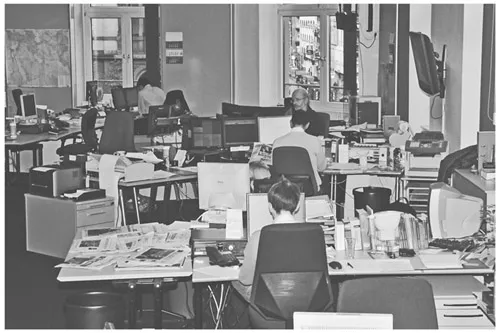
1.1 The “slot island” at AP-DD (photo credit: Peter Zschunke)
The office environment itself lay fallow, its white walls, slate grey carpets, taupe cabinetry, its light grey desks and filing cabinets, its fluorescent lights and blue chairs utterly mundane and unremarkable. Ditto the maps, the framed, neatly organized photographs on the wall, the bulletin boards, the plants. Occasionally the stack of daily newspapers was shuffled and one opened and scanned. More often, the fax machines and printers hummed into life. In my many observations of the AP-DD newsroom I did not once see a single journalist look out one of its many windows. Outside the vertical blinds there was not so much to see, a side street near the Frankfurt main train station, a sex emporium on the corner marking the edge of Frankfurt’s red light district. As elsewhere in the office side of contemporary news journalism, the real action always took place on the screens.
Technologically speaking, the screens were ordinary flat panel LCD displays, with 40-centimeter diagonals. In each set of three slot screens, there was a center screen that the slotter used for word processing, for receiving, editing, spell-checking and sending news reports auf den Draht (on the wire), for sending e-mail messages and instant messages to their colleagues in AP-DD’s other bureaus. There was a left screen which was known as the “smurf” screen because it contained several color-coded continuously updating message feeds called “smurfs” by their whimsical (American) programmer: a blue smurf for press releases from the police, a green smurf for all other releases which incorporated a news ticker, News Aktuell,3 produced by dpa, AP-DD’s main competitor in the German news agency market, and a red smurf for AP’s own output. And then there was the right screen whose use was more personalized but which was normally reserved for open browser windows showing the websites of AP-DD’s major news clients and competitors like Spiegel.de, n-tv, and bild.de. These are counted among the Leitmedien (lead media), the media organizations that powerfully influence the Tagesthemen (themes of the day) in German national and international news. These windows refreshed every minute or so, guaranteeing that the slotter knew exactly what messages were moving through the news channels that interconnected with the slot desk.
Together, the screens offered apertures into what Karin Knorr-Cetina has termed world-making “scopic systems.”4 They were certainly panoptica but more than this they were operationally flexible, scalable interfaces, allowing the slotters to compose and edit texts and to message locally as well as to track, organize and engage a multiplicity of translocal information feeds. Although the question might seem disingenuous given computerization, we might still ask why screens center the slotters’ craft. Georg S., a junior but very talented slotter at AP, explained to me that normale Slotarbeit, normal slotwork, was the simultaneous combination of Sichten (screening), Beaufsichtigen (observation, surveillance) and Texte rausgeben (sending out texts). Sichten and Beaufsichtigen both find their nominal root in the Old High German siht, which is not coincidentally also the root of the English word “sight.” Visual attention is enormously important in slotwork. The vast majority of the cues for engaging fast-time newsflow, both on- and offscreen, are organized visually. Indeed, slotters typically described the normative ideal of slotting as Überblick zu haben (having an overview), as being positioned somehow panoramically above the torrent below. Überblick (overview), any slotter would tell you, is however at best a fragile, fleeting condition, won only through concentrated multiattentionality and easily lost in the constant distractions of practice. Which is why the electronic co-location of incoming and outgoing newsfeeds on the slot screens is the best material approximation of Überblick. The screens are the slotter’s primary attentional compass and navigational equipment as they chart a course through the fast moving waters of the news. If newsmaking today confronts the outside observer as a dizzying spectacle of circulation and flow, in other words if it appears as a space of intense informational mediation, screenwork was surely one of the slotters’ most reliable techniques of immediating newsflow into forms susceptible to their professional agency.5 The screens channeled “synechdochical power,”6 assembling chaotic parts into flowing wholes, gathering up “a lifeworld while simultaneously projecting it.”7 They represented, as much as anything could, “the news.” At AP-DD, I would often sit near the slot island—staring over shoulders at the clutter of overlaid smurfs, web browser windows, word-processing windows, and instant-message windows—and find myself thinking that three screens were almost too few.8
The Nodal Importance of Slotting in Contemporary News
The terms “slotter” and “slotting” are material metaphors themselves. They reference a predigital division of labor in newsmaking in which an editor distributed writing assignments by putting sheets of paper into wooden boxes, pigeonholes, or “slots.” In print journalism this was a relatively low-status form of editorial activity often lumped in with copyediting. And, in the digital era of print and broadcast journalism, slotting has dwindled into a terminological archaism. But, in news agency journalism, the role took on greater significance because of the pressure to manage breaking news on a fast-time basis. Slotters operated as managing editors9 whose job it was to survey incoming news, to assign tasks to their shift’s writers, to edit their draft Meldungen (reports, bulletins) and to send these out on the agency wire. As agency news practitioner and analyst Peter Zschunke explains, “with the order to send out a report, the slotter creates the possibility for millionfold distribution. Given the immense responsibility the slotter has over news-output during his shift, he also inherits a correspondingly far-reaching decisional authority. Reuters’ maxim, ‘the slot is always right,’ captures this well. And, no less important than sending out reports is the slotter’s constant supervision over the general news scene [Nachrichtenlage] and the organization of the real-time news production.”10
The decisional authority of the slotter is amplified far beyond the confines of the news agency as well. News media organizations have long relied upon news agencies like AP, Reuters and dpa to deliver maximally accurate, maximally fast, maximally factual information. Indeed, news agencies developed historically in the 1830s and 1840s as newspaper cooperatives (like AP) and private service agencies (like Reuters or AFP) sought to share the significant costs of foreign correspondence and to extend the scope of their international news coverage beyond what their clients could otherwise afford. By the mid-1860s, with the laying of transatlantic telegraphic cable that reduced message communication speeds from days to minutes, the business in international correspondence boomed and news agencies thrived in both Europe and North America. News agencies have thus long been important nodes in the production and distribution of facts and messages from afar.11 But, in our current era of European and North American news, which has been marked above all by the powerful intersection of digital information technology and global (neo)liberalism since the 1980s, the core role of news agencies has, in certain respects, expanded.
I asked Friedrich H., the head of AP-DD’s national news desk, to reflect on the changing position of news agencies in the twenty years he had worked in news journalism:
DB: Can you say more about how news agency work has changed in the time you’ve been at AP?
FH: Our Themen [themes, stories] used to be clearer or better defined somehow. The division of labor between the news desks was clearer and it was clearer what was worthy of being reported and what wasn’t. The role of the news agency was also clearer. People didn’t demand so much analysis, so many background stories, or service pieces. It was just expected that we would go to the press conferences and write reports about them. And that has clearly changed. . . . There’s a tendency across the media to move away from the stiff news reports [weg von den starren Nachrichten]. Our clients don’t want what appeared last night on the evening news from us. They want to present their readers the next day with a further development of a story with a background piece, something that embeds a political event in its context. That simply wasn’t the case before. In the old days, we just reported a political event in the style, ‘On Tuesday, the Federal Government in Bonn made this or that decision . . .’ Today we write about the consequences of those decisions for consumers.
DB: So, has that changed the importance of the news agencies in the news industry today? I mean, the fact that you’re not just offering short news bulletins anymore but longer texts with more context?
FH: Yes, I think of these completely new formats that would have been unthinkable back then. These question-answer formats, these graphic infoboxes [shakes his head]. I would say that the news agencies a...
Table of contents
- Acknowledgments
- Introduction: News Journalism Today
- 1. The Craft of Slotting: Screenwork, Attentional Practices, and News Value at an International News Agency
- 2. Click and Spin: Time, Feedback, and Expertise at an Online News Portal
- 3. Countdown: Professionalism, Publicity, and Po liti cal Culture in 24/7 News Radio
- 4. The News Informatic: Five Reflections on News Journalism and Digital Liberalism
- Epilogue: Informatic Unconscious: On the Evolution of Digital Reason in Anthropology
- Notes
- Bibliography
Trusted by 375,005 students
Access to over 1.5 million titles for a fair monthly price.
Study more efficiently using our study tools.
Frequently asked questions
Yes, you can cancel anytime from the Subscription tab in your account settings on the Perlego website. Your subscription will stay active until the end of your current billing period. Learn how to cancel your subscription
No, books cannot be downloaded as external files, such as PDFs, for use outside of Perlego. However, you can download books within the Perlego app for offline reading on mobile or tablet. Learn how to download books offline
We are an online textbook subscription service, where you can get access to an entire online library for less than the price of a single book per month. With over 1.5 million books across 990+ topics, we’ve got you covered! Learn about our mission
Look out for the read-aloud symbol on your next book to see if you can listen to it. The read-aloud tool reads text aloud for you, highlighting the text as it is being read. You can pause it, speed it up and slow it down. Learn more about Read Aloud
Yes! You can use the Perlego app on both iOS and Android devices to read anytime, anywhere — even offline. Perfect for commutes or when you’re on the go.
Please note we cannot support devices running on iOS 13 and Android 7 or earlier. Learn more about using the app
Please note we cannot support devices running on iOS 13 and Android 7 or earlier. Learn more about using the app
Yes, you can access The Life Informatic by Dominic Boyer in PDF and/or ePUB format, as well as other popular books in Social Sciences & Media Studies. We have over 1.5 million books available in our catalogue for you to explore.