The idea that citizens' advancement should depend exclusively on merit, on qualities that deserve reward rather than on bloodlines or wire-pulling, was among the Founding ideals of the American republic, Joseph F. Kett argues in this provocative and engaging book. Merit's history, he contends, is best understood within the context of its often conflicting interaction with the other ideals of the Founding, equal rights and government by consent. Merit implies difference; equality suggests sameness. By sanctioning selection of those lower down by those higher up, merit potentially conflicts with the republican ideal that citizens consent to the decisions that affect their lives.In Merit, which traces the history of its subject over three centuries, Kett asserts that Americans have reconciled merit with other principles of the Founding in ways that have shaped their distinctive approach to the grading of public schools, report cards, the forging of workplace hierarchies, employee rating forms, merit systems in government, the selection of officers for the armed forces, and standardized testing for intelligence, character, and vocational interests. Today, the concept of merit is most commonly associated with measures by which it is quantified.Viewing their merit as an element of their selfhood—essential merit—members of the Founding generation showed no interest in quantitative measurements. Rather, they equated merit with an inner quality that accounted for their achievements and that was best measured by their reputations among their peers. In a republic based on equal rights and consent of the people, however, it became important to establish that merit-based rewards were within the grasp of ordinary Americans. In response, Americans embraced institutional merit in the form of procedures focused on drawing small distinctions among average people. They also developed a penchant for increasing the number of winners in competitions—what Kett calls "selection in" rather than "selection out"—in order to satisfy popular aspirations. Kett argues that values rooted in the Founding of the republic continue to influence Americans' approach to controversies, including those surrounding affirmative action, which involve the ideal of merit.
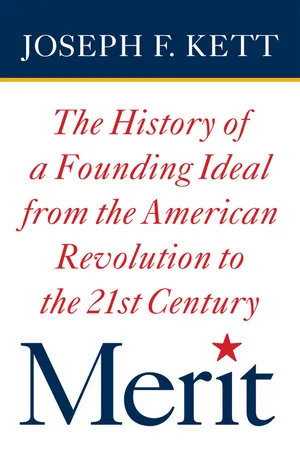
eBook - ePub
Merit
The History of a Founding Ideal from the American Revolution to the Twenty-First Century
- 344 pages
- English
- ePUB (mobile friendly)
- Available on iOS & Android
eBook - ePub
Merit
The History of a Founding Ideal from the American Revolution to the Twenty-First Century
About this book
Information
Subtopic
North American HistoryIndex
HistoryTable of contents
- Acknowledgments
- Introduction
- 1. Republic of Merit
- 2. Merit and the Culture of Public Life
- 3. Small Worlds
- 4. Making the Grade
- 5. The Scientific Measurement of Merit
- 6. The “Presumption of Merit”
- 7. Squeeze Play
- 8. Merit in Crisis
- Epilogue
- Notes
Trusted by 375,005 students
Access to over 1.5 million titles for a fair monthly price.
Study more efficiently using our study tools.
Frequently asked questions
Yes, you can cancel anytime from the Subscription tab in your account settings on the Perlego website. Your subscription will stay active until the end of your current billing period. Learn how to cancel your subscription
No, books cannot be downloaded as external files, such as PDFs, for use outside of Perlego. However, you can download books within the Perlego app for offline reading on mobile or tablet. Learn how to download books offline
Perlego offers two plans: Essential and Complete
- Essential is ideal for learners and professionals who enjoy exploring a wide range of subjects. Access the Essential Library with 800,000+ trusted titles and best-sellers across business, personal growth, and the humanities. Includes unlimited reading time and Standard Read Aloud voice.
- Complete: Perfect for advanced learners and researchers needing full, unrestricted access. Unlock 1.5M+ books across hundreds of subjects, including academic and specialized titles. The Complete Plan also includes advanced features like Premium Read Aloud and Research Assistant.
We are an online textbook subscription service, where you can get access to an entire online library for less than the price of a single book per month. With over 1.5 million books across 990+ topics, we’ve got you covered! Learn about our mission
Look out for the read-aloud symbol on your next book to see if you can listen to it. The read-aloud tool reads text aloud for you, highlighting the text as it is being read. You can pause it, speed it up and slow it down. Learn more about Read Aloud
Yes! You can use the Perlego app on both iOS and Android devices to read anytime, anywhere — even offline. Perfect for commutes or when you’re on the go.
Please note we cannot support devices running on iOS 13 and Android 7 or earlier. Learn more about using the app
Please note we cannot support devices running on iOS 13 and Android 7 or earlier. Learn more about using the app
Yes, you can access Merit by Joseph Kett in PDF and/or ePUB format, as well as other popular books in History & North American History. We have over 1.5 million books available in our catalogue for you to explore.