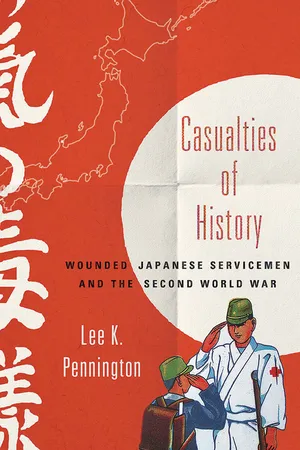
Thousands of wounded servicemen returned to Japan following the escalation of Japanese military aggression in China in July 1937. Tens of thousands would return home after Japan widened its war effort in 1939. In Casualties of History, Lee K. Pennington relates for the first time in English the experiences of Japanese wounded soldiers and disabled veterans of Japan's "long" Second World War (from 1937 to 1945). He maps the terrain of Japanese military medicine and social welfare practices and establishes the similarities and differences that existed between Japanese and Western physical, occupational, and spiritual rehabilitation programs for war-wounded servicemen, notably amputees. To exemplify the experience of these wounded soldiers, Pennington draws on the memoir of a Japanese soldier who describes in gripping detail his medical evacuation from a casualty clearing station on the front lines and his medical convalescence at a military hospital. Moving from the hospital to the home front, Pennington documents the prominent roles adopted by disabled veterans in mobilization campaigns designed to rally popular support for the war effort. Following Japan's defeat in August 1945, U.S. Occupation forces dismantled the social welfare services designed specifically for disabled military personnel, which brought profound consequences for veterans and their dependents. Using a wide array of written and visual historical sources, Pennington tells a tale that until now has been neglected by English-language scholarship on Japanese society. He gives us a uniquely Japanese version of the all-too-familiar story of soldiers who return home to find their lives (and bodies) remade by combat.
eBook - ePub
Casualties of History
Wounded Japanese Servicemen and the Second World War
- 304 pages
- English
- ePUB (mobile friendly)
- Available on iOS & Android
eBook - ePub
About this book
Information
1
Fundamentals of Military Support in Prewar Japan
In April 1923, Japanese sixth-graders scampered into their classrooms for the start of the new school year, possibly animated by knowing that this was to be their final year as elementary school students but more likely dismayed to be back at their desks. Whether gleeful or glum, those eleven- and twelve-year-olds eventually opened their textbooks to find out what the coming term had in store for them. In their two-volume ethics readers—standardized texts published by Japan’s Education Ministry that teachers used to supplement language lessons and foster civic virtues—students encountered that year’s parade of exemplary youths from whom they were expected to take inspiration and moral instruction. There sat a young Isaac Newton, hunched over his desk in his workshop as he studiously assembled miniature waterwheels and other contraptions. Straining against rough waves was Grace Darling, the lighthouse keeper’s daughter who in 1838 took to the sea in a rowboat to rescue survivors of the Forfarshire after that ship cracked in half off the windswept northern coast of England. Closer to home, sixth-graders made the acquaintance of Sasaki Kenji, an amputee veteran living at the Crippled Soldiers Institute (Haiheiin) located in the Sugamo district of Tokyo.
The 1923 revised edition of the sixth-grade ethics reader not only introduced Japanese schoolchildren to a casualty of war (albeit an apocryphal one) but also taught those young imperial subjects that war-wounded servicemen deserved the gratitude and support of the nation. In a lesson filled with challenging vocabulary such as shussei (“departure to the front”), kisei (“homecoming”), and senshō (“war wound”), juvenile readers were told to imagine themselves traveling from the countryside to the capital to visit Sasaki, a family maidservant’s nephew who years earlier had fallen wounded as a “distinguished hero” of the Russo-Japanese War (see figure 1.1). Described as a “sturdy-looking guy” and a “fine fellow who clearly seems like a hero,” Sasaki leads his visitors around the grounds of the Crippled Soldiers Institute, his home, where he cheerily states he wants for nothing. Drawing quiet attention to his artificial leg, Sasaki emphasizes that even though some of his fellow residents have lesser wounds and others have graver ones, he and all his colleagues receive excellent care and attention. Kept busy by diversions ranging from pianos to pool tables and by opportunities such as studying calligraphy and photography, the men of the Crippled Soldiers Institute spend their time engaged in a quiet convalescence. At the end of the lesson, the sixth-grade pupils exited the grounds of the Crippled Soldiers Institute on friendly terms with Sasaki and better informed about the “kind treatment” that the state extends to him and his cohort.1
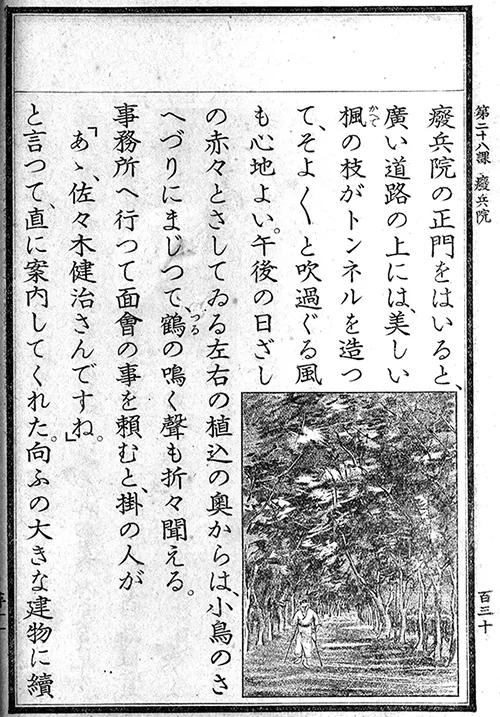
Fig 1.1 . Text and illustration from chapter 28 of the 1923 edition of the sixth-grade ethics reader Ordinary Elementary School Reader, which focused on the Haiheiin; the illustration depicts a “crippled soldier” on crutches as he walks down the wooded driveway leading into the Haiheiin. Source: Monbushō, Jinjō shōgaku dokuhon, 130. Collection of the author.
War-wounded men were not new to Japanese society during the 1920s, but providing for their livelihood was a recent endeavor of the Japanese state. For decades, Japan’s government had resisted using its monies to support impoverished crippled soldiers and their families. Instead, during the late Meiji Period and early Taishō Period (1912–1926) the state had regarded military support (gunji engo), or the mustering of actions and resources to strengthen the morale and improve the well-being of servicemen in need and their families, as a private pursuit best animated by the spirit of mutual assistance (rinpo sōfu) said to exist within local communities. As such, during and after the Sino-Japanese War of 1894–1895 and the Russo-Japanese War of the early 1900s, it was Japan’s people, not its government, who bore the burden of alleviating the financial hardships of crippled soldiers. When state-funded assistance did appear, it was token, not total, in nature.
Rather than assuming financial responsibility for men rendered economically unproductive because of military service, the state insisted that assisting the wounded was a private concern that depended on the kindness of neighbors. Only in the wake of the First World War did voices within the government begin to clamor for greater state-funded support for the seriously wounded and their families as well as for the bereaved families of the military dead. Thanks to a rising sense of the importance of maintaining home-front support for military efforts, during the late 1910s Japan’s government began to enact legislation that addressed the plight of war-wounded men. By the 1920s, these laws and modest initiatives such as the Crippled Soldiers Institute served as the public face of state-funded military support in Japan. Even so, the government resisted the notion that these and later programs symbolized the right of wounded servicemen to receive livelihood assistance from the state; instead, state-funded military support was cast as a manifestation of imperial benevolence, not an entitlement that accompanied military service.
Military support was transformed from a private undertaking in the mid-1890s into a state-funded enterprise by the start of Japan’s Second World War in July 1937. In the process, the Japanese government devised ways to unmake the prevailing image of war-wounded men that had emerged in the wake of the Russo-Japanese War, from one of indolent crippled soldiers (haihei) to economically and socially productive disabled veterans (shōi gunjin), the latter term a neologism of the 1930s. Although this revision did not attain full force until after July 1937, developments between 1910 and 1930 paved the way for the rapid mustering of governmental and private-sector support for war-wounded men that took place in the late 1930s. Private-sector initiatives remained significant, but the decisive roles played by politicians, government bureaucrats, and military planners when it came to shaping state-funded military support demonstrate the “elitist origins” of prewar welfare programs for wounded servicemen.2 Over time, state-funded military support evolved from its early focus on extending limited financial aid only to needy military families into the later comprehensive services that embedded all war-wounded men in government programs geared toward improving their physical, economic, and spiritual well-being. This was a transformation that, unknown to them in 1923, the young male readers of sixth-grade ethics textbooks would later appreciate—in the 1930s and 1940s, many of those lads became disabled veterans like Sasaki Kenji, their one-legged host at the Crippled Soldiers Institute in their childhood textbook.
An Emphasis on Private Assistance
The path leading towards social welfare services for Japanese disabled veterans of the Second World War begins with the long-standing state preference for relying on private assistance to lessen the financial burdens associated with military service, a stance assumed during the Meiji Period. During the 1890s, private actors rather than the state held the lion’s share of the responsibility for coping with the social and economic upheavals caused by military service, including the woes of disabled veterans. The Sino-Japanese War marked the first nationwide round of private efforts to diminish the adverse effects that military service brought to servicemen and their families. Approximately 220,000 inductees were deployed to mainland northeast Asia during the war with Qing China. At that time, conscripts served in active-duty status for three years; after returning home, they spent four years in the first reserves and then five years in the second reserves. During the war, 40% of IJA noncommissioned officers (NCOs) and soldiers came from the reservist ranks, which meant that conscription cut deep into Japan’s villages, towns, and cities.3 Military conscription up-ended life for families throughout Japan, many of which depended on their able-bodied men to generate the financial income needed for everyday existence. Households could not appeal to the state for livelihood aid to counter conscription-related financial duress, a condition established by the Relief Regulations (Jukkyū kisoku) of December 1874. Ostensibly, that statute put to rest the poor relief measures of the Tokugawa Shogunate and laid the foundation for new forms of imperial benevolence shaped by Western (notably English) practices. In actuality, the regulations perpetuated a way of thought that held that livelihood assistance should come from local, private sources. The Relief Regulations stoked the state belief that poor relief ought to be “based on mutual fellowship among the people”; the statute touted benevolent rule on the part of the government, but the extension of financial aid to the public was limited.4
The Relief Regulations granted state assistance only to people who could not rely on self- or externally generated means of financial support; thus, the families of conscripts—in other words, men receiving military stipends—were not eligible for relief. Moreover, the Meiji government did not want to undermine conscription by suggesting that military service brought with it hardships that required financial assistance from the state, hence the attitude that military families in need, including those of disabled veterans, ought to rely on mutual assistance from their local communities. In fact, during the 1890s demands for state-funded assistance for disabled veterans and their households would have been relatively modest. History of the Sino-Japanese War of 1894–1895, an eight-volume opus published by the IJA’s General Staff Office in 1904, asserted that 171,164 Japanese servicemen and civilians were hospitalized during the conflict; only a scant 4,519 men suffered from war wounds, while a staggering 166,645 men were treated for illnesses and ailments ranging from beriberi to frostbite.5 Put another way, the Sino-Japanese War left comparatively few physically disabled veterans in its wake; thus, at the time the state had little impetus to devise assistance programs for servicemen with acquired physical disabilities.
The Meiji state hesitated to establish institutional assistance for disabled veterans in part because the military pension system provided benefits to injured servicemen to help offset the social and economic dislocations associated with war injuries. The Servicemen’s Pension Law (Gunjin onkyū hō) of June 1890 extended financial aid to injured servicemen in three ways. First, officers, NCOs, and career servicemen being discharged from the military after eleven or more years of active-duty service received an increased pension—essentially a disability increase, although the law did not call it such—in addition to their regular pensions if they left because of permanent, duty-impeding medical conditions that fell within six grades of severity. In descending order, these conditions were full blindness or the loss of two or more limbs (grades 1 and 2), the loss of one limb or paralysis in two limbs (grades 3 and 4), and blindness in one eye or paralysis in one limb (grades 5 and 6).6 Second, nonpensioned servicemen with injuries ranked in these six grades of severity were automatically granted regular pensions with a commensurate disability increase. For example, in 1890 an IJA soldier with a grade 1 medical condition received an annual pension increase of ¥32, while a soldier with a grade 5 condition took home an additional ¥14. (The average annual income of a carpenter was ¥80.6 in 1887.)7 Third, rank-and-file troops with injuries or illnesses classified below the six grades but that nonetheless required their being discharged from military service received a one-time relief fund payment on being dismissed.8 Thus, during the late nineteenth century the Japanese state probably saw little need to create institutional support for disabled veterans because it was already providing injured servicemen with assistance in the form of increased pensions or one-time relief fund payments.
The significance of the Sino-Japanese War vis-à-vis later military support for disabled veterans lies in its confirmation of extra-governmental relief initiatives for military men in need, not the creation of state-funded institutions providing livelihood assistance to war-wounded men. Privately organized associations were coevally patriotic and charitable undertakings; by collecting and dispensing financial aid and foodstuffs to military families in need, the public satisfied its desires to support the war and to sustain communal solidarity. In his study of wartime assistance movements in Tokyo, Shiraishi Hiroyuki highlights some of the numerous military support associations formed in the capital once its young men began to be sent to the front. In Shiba Ward, for example, which now forms part of present-day Minato Ward, a temporary ward assembly convened in early August 1894 and decided to solicit donations from ward residents to distribute to the families of mobilized men. Four days later, the ward office acknowledged the creation of a Shiba Ward Military Contribution Association, which by August 1895 had amassed ¥6,190 in donations, out of which ¥4,625 had been distributed to needy families.9 Similar philanthropy took place in the provinces. Arakawa Shōji details the wide range of patriotic benefaction that took place in Shizuoka Prefecture during and after the war.10 No matter whether they were formed by individual initiatives or at the behest of local authorities, private relief associations quickly became a driving force behind military support.
The private-sector relief associations that remained in place at the start of the Second World War provided the key links between military support endeavors of the 1890s and the 1930s. Two nationally constituted civic relief organizations of note that sprang out of the Sino-Japanese War were the Teikoku Gunjin Kōenkai (Imperial Servicemen’s Support Association) and the Aikoku Fujinkai (Patriotic Women’s Association). These two groups benefited from the patronage of political and social elites and, thus, cannot be categorized as strictly grassroots organizations because lofty supporters filled their rosters; nevertheless, in their early decades neither association professed formal ties to the Japanese state. The Teikoku Gunjin Kōenkai came into being when Viscount Kawakami Sōroku, IJA chief-of-staff and a distinguished military strategist during the Sino-Japanese War, persuaded two members of the Lower House of the Imperial Diet to redirect contributions that they had amassed for erecting a war memorial and instead use the monies to “protect and console the bereaved families of active-duty servicemen.” This suggestion led the two representatives to convene a charitable relief council in January 1896 that renamed itself the Teikoku Gunjin Kōenkai in January 1906. The group’s stated purpose was to relieve (kyūgo suru) bereaved families of killed-in-action and wounded-treated-died servicemen, as well as “impoverished persons in the bereaved families of servicemen killed during peacetime military service.” In its eyes, providing livelihood aid to wounded veterans with chronic ailments aligned with lessening the financial burdens caused by mi...
Table of contents
- List of Illustrations
- Acknowledgments
- Notes for the Reader
- Introduction
- 1. Fundamentals of Military Support in Prewar Japan
- 2. Medical Treatment across the Sea
- 3. Comprehensive Care behind the Guns
- 4. Protecting Disabled Veterans during Wartime
- 5. “White-Robed Heroes” in Wartime Mass Culture
- 6. Occupational Rehabilitation
- Notes
- Bibliography
- Index
- Color Plates
Trusted by 375,005 students
Access to over 1.5 million titles for a fair monthly price.
Study more efficiently using our study tools.
Frequently asked questions
Yes, you can cancel anytime from the Subscription tab in your account settings on the Perlego website. Your subscription will stay active until the end of your current billing period. Learn how to cancel your subscription
No, books cannot be downloaded as external files, such as PDFs, for use outside of Perlego. However, you can download books within the Perlego app for offline reading on mobile or tablet. Learn how to download books offline
Perlego offers two plans: Essential and Complete
- Essential is ideal for learners and professionals who enjoy exploring a wide range of subjects. Access the Essential Library with 800,000+ trusted titles and best-sellers across business, personal growth, and the humanities. Includes unlimited reading time and Standard Read Aloud voice.
- Complete: Perfect for advanced learners and researchers needing full, unrestricted access. Unlock 1.5M+ books across hundreds of subjects, including academic and specialized titles. The Complete Plan also includes advanced features like Premium Read Aloud and Research Assistant.
We are an online textbook subscription service, where you can get access to an entire online library for less than the price of a single book per month. With over 1.5 million books across 990+ topics, we’ve got you covered! Learn about our mission
Look out for the read-aloud symbol on your next book to see if you can listen to it. The read-aloud tool reads text aloud for you, highlighting the text as it is being read. You can pause it, speed it up and slow it down. Learn more about Read Aloud
Yes! You can use the Perlego app on both iOS and Android devices to read anytime, anywhere — even offline. Perfect for commutes or when you’re on the go.
Please note we cannot support devices running on iOS 13 and Android 7 or earlier. Learn more about using the app
Please note we cannot support devices running on iOS 13 and Android 7 or earlier. Learn more about using the app
Yes, you can access Casualties of History by Lee K. Pennington in PDF and/or ePUB format, as well as other popular books in History & Japanese History. We have over 1.5 million books available in our catalogue for you to explore.