Across the course of American history, imperialism and anti-imperialism have been awkwardly paired as influences on the politics, culture, and diplomacy of the United States. The Declaration of Independence, after all, is an anti-imperial document, cataloguing the sins of the metropolitan government against the colonies. With the Revolution, and again in 1812, the nation stood against the most powerful empire in the world and declared itself independent. As noted by Ian Tyrrell and Jay Sexton, however, American "anti-imperialism was clearly selective, geographically, racially, and constitutionally." Empire's Twin broadens our conception of anti-imperialist actors, ideas, and actions; it charts this story across the range of American history, from the Revolution to our own era; and it opens up the transnational and global dimensions of American anti-imperialism.By tracking the diverse manifestations of American anti-imperialism, this book highlights the different ways in which historians can approach it in their research and teaching. The contributors cover a wide range of subjects, including the discourse of anti-imperialism in the Early Republic and Civil War, anti-imperialist actions in the U.S. during the Mexican Revolution, the anti-imperial dimensions of early U.S. encounters in the Middle East, and the transnational nature of anti-imperialist public sentiment during the Cold War and beyond.Contributors: Laura Belmonte, Oklahoma State University; Robert Buzzanco, University of Houston; Julian Go, Boston University; Alan Knight, University of Oxford; Ussama Makdisi, Rice University; Erez Manela, Harvard University; Peter Onuf, Robert H. Smith International Center for Jefferson Studies, Monticello, and University of Virginia; Jeffrey Ostler, University of Oregon; Patricia Schechter, Portland State University; Jay Sexton, University of Oxford; Ian Tyrrell, University of New South Wales
eBook - ePub
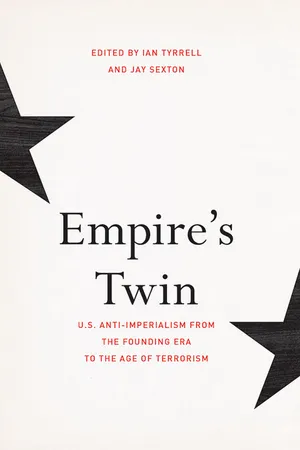
Empire's Twin
U.S. Anti-imperialism from the Founding Era to the Age of Terrorism
- 312 pages
- English
- ePUB (mobile friendly)
- Available on iOS & Android
eBook - ePub
Empire's Twin
U.S. Anti-imperialism from the Founding Era to the Age of Terrorism
About this book
Information
PART I
CONQUEST AND ANTICOLONIALISM IN THE NINETEENTH CENTURY
Chapter 1
Imperialism and Nationalism in the Early American Republic
PETER S. ONUF
In the early United States, the concepts of “empire” and “nation” were inextricably linked. In the original and still conventional understanding, the relationship is dialectical and sequential: in the process of overthrowing the British Empire, rebellious colonists became a nation. As they killed the king, these self-designated “Americans” recognized themselves and each other as countrymen, patriots who proclaimed their right to a “continent” that their ancestors had conquered, cultivated, and civilized. Independent Americans set a precedent for anti-imperial nation making, boldly proclaiming to the world a new standard of legitimacy: the “consent” of a sovereign people to its own government.1
It is the contention of this chapter that the sequence of empire and nation on which the American national narrative pivots is fundamentally mistaken and misleading. If this is so, anti-imperialism—the opposition to putatively “imperial” tendencies in the new national regime—would necessarily have an equally tangled and complicated history. Our challenge is to distinguish the protean idea of “empire” from the British Empire as patriots came to understand it through the imperial crisis and Revolutionary War. Colonists mobilized on behalf of their understanding of what they thought the empire was or should be, rallying in defense of colonial “constitutions” and the constitution of the empire that protected them. If, as exponents of parliamentary sovereignty argued and the Declaratory Act of 1766 made explicit, there was no such thing as an imperial constitution, then it was incumbent on enlightened statesmen on both sides of the Atlantic to negotiate one and thus to forge “a more perfect union.” Before they belatedly realized, in the midst of violent resistance, that they were a distinct “people” and that their goal was independence, patriots could only be described as—and understand themselves to be—“imperialists.”
The patriots’ idea of empire did not disappear with independence. If the British king and the empire over which he reigned epitomized all that was evil and despotic in the old regime, an “empire for liberty” now extended across the former colonies. That the term would not be contaminated by associations with Britain was testimony to the powerful hold of the imperial idea in the American political imagination. A corrupt king and administration had betrayed the empire: arguably, they were the real anti-imperialists, not the Americans. “Nation” was a similarly protean concept. Colonists’ strong identification with the empire and persistent allegiance to George III reflected a broader process of Anglicization that was fueled by the consumer revolution and their closer integration in commercial and cultural networks.2 Americans’ national identity clearly betrayed a British genealogy, for it was only by imagining themselves as Britons—and proclaiming their English rights—that they could transcend the narrowly provincial identities that historically divided them and threatened to subvert their common cause. As Jefferson plaintively told fellow Britons in the metropolis in his original draft of the Declaration, “we might have been a free and a great people together; but a communication of grandeur & of freedom it seems is below their dignity.”3 Now Americans would have to transform themselves into the “free and great people” they could not be in the British Empire. Nation and empire thus were hardly incompatible terms for revolutionary Americans: indeed, nationhood was meaningless outside the context of empire, as colonial Americans understood it, or of the federal union, its successor.4
American Exceptionalism
Focusing on a reluctantly exercised right of revolution, patriots were the first “idealists,” brandishing universally applicable principles of self-determination to a “candid world.” Their self-understanding became the “American creed,” an inspiring conception of the new nation’s exalted role in world history that was most memorably expressed by Abraham Lincoln in his Gettysburg Address: “we here highly resolve that these dead shall not have died in vain—that this nation, under God, shall have a new birth of freedom—and that government of the people, by the people, for the people, shall not perish from the earth.”5 This creedal nationalism has defined a dynamic, demographically diverse people across more than two centuries. Projected across time and space, the American nation has become indistinguishable from “democracy,” the fundamental character or ethos of a regime that, as Thomas Jefferson wrote at the end of his life, was “opening…all eyes” to “the rights of man.”6 In America, the right of national self-determination had overcome the might of a great empire.
“Realists” offer a complementary counter-narrative, emphasizing interests over ideas but also insisting on the fundamental principle of self-determination. Harking back to the first settlers’ conquest of the wilderness, they celebrated a history of self-sufficiency, self-government, and continuous improvement. The empire had always been an empty shell, incapable of enforcing edicts that seriously compromised the vital interests of a rights-conscious settler population. The challenge for patriots was to alert their countrymen to immanent threats and overcome the habitual loyalties of lightly governed, enterprising subjects with better things to do: “our ancestors,” as Jefferson wrote in 1774, “were farmers, not lawyers.”7 The moment for lawyers like Jefferson would come with the imperial crisis. They spoke “common sense” and “self-evident” principles to a mobilized people, aroused from their slumbers and newly conscious of their collective power. The author of the Declaration of Independence later acknowledged that these were not “new principles, or new arguments, never before thought of,” but rather “the common sense of the subject.”8
Idealists and realists, then and now, offer variations on the exceptionalist theme. They differ on the relative importance or primacy of ideas and material interests in explaining patriot intentions, and therefore on the exportability and universality of republican principles. At one extreme, a realist might argue that the facts on the ground in British America were unique (or exceptional) and would never be replicated elsewhere: the role of patriot propaganda was to alert their fellow colonists to their endangered interests and arouse them in their defense. The Revolution was nothing more or less than a tax revolt, and the Declaration was therefore “a merely revolutionary document” of local significance.9 The invocations of natural rights were, as Lincoln quoted his opponents, “glittering generalities” and “self evident lies”; the promise of nationhood was extended by Americans to themselves: “it meant nobody else.”10 Lincoln positioned himself at the other, idealist extreme with Jefferson, who had introduced “an abstract truth” into the Declaration, “applicable to all men and all times, and so to embalm it there, that to-day, and in all coming days, it shall be a rebuke and a stumbling-block to the very harbingers of re-appearing tyranny and oppression.”11 But even in their most polarized positions, idealists and realists embraced the logic of nationhood, cherishing their independence and disentanglement from European alliances and imagining a glorious future. The new nation’s ascendancy might be realized in history, as realists imagined, with the United States extending its influence and promoting its interests on the continent, through the hemisphere, and around the world; or it might take place at the “end of history,” when all the nations of the world embraced the liberal democracy that the new nation first modeled to the world.12
Historians have long argued about whether the American Revolution was “radical” or “conservative.” Controversy revolves around the putative character of regime change: how sharp was the break between provincial and republican America, the British Empire and the new federal republic? Following the lead of the revolutionaries themselves, exceptionalists of all stripes accentuate discontinuities, differing on when, why, and how colonists became alienated from the mother country and therefore conscious of their distinctive collective identity.
A conservative, “consensus” interpretation looks for Revolutionary causation in the distant past, as colonies set forth on largely autonomous trajectories and adapted English institutions to novel American conditions. When imperial reformers challenged this benign status quo, patriotic colonists mobilized against change in order to defend their liberty and property. Americans were pragmatic conservatives, “born liberal” in an environment that fostered enterprise and self-sufficiency.13 By contrast, the now dominant ideological interpretation, most fully and eloquently developed by Bernard Bailyn and Gordon S. Wood, rises above material interests and focuses instead on questions of identity that came to the fore with the imperial crisis. The Revolution’s most momentous, radical changes were enacted in the “minds” of British colonists who became Americans.14 The ideological interpretation coincided with an emerging historiography that depicted the British colonies as far-flung fragments—or “marchlands”—of early modern Europe. The “Europeanization”—and Anglicization—of early American history set the stage for reimagining the Revolution as a radical ideological transformation: colonists had to overcome a deep-seated sense of cultural inferiority and dependence in order to recognize themselves as Americans and declare themselves an independent people.
Both “conservative” and “radical” approaches to Revolutionary causation are exceptionalist, Whiggishly assuming the irresistible and inevitable emergence of a new nation destined for greatness. Revisionists might question whether this is a good thing, emphasizing the human and environmental costs of expansion and reflexively indicting the United States as a latter-day imperial hegemon, but they take the nation’s ascendancy for granted; like Lincoln, they take their bearings from Jefferson’s Declaration, hoping for a course correction that will one day redeem the revolutionaries’ “promissory note” to the American people and to the peoples of the world.15 Whether they emphasize nation-making material interests or nation-defining ideals, whether they are patriotic celebrants or revisionist critics, exceptionalists assume a fundamental opposition between empire and nation, Old World from New. As legal historian Christopher Tomlins writes, “American historical orthodoxy has long seized upon the social and political modernity colonizing made possible and has lashed it to an idealized temporality of progress that leaves…the pre-modern in its wake.”16 Like the revolutionaries, whose ultimate success depended on demonstrating that the rupture between the metropolis and its erstwhile provinces was complete, exceptionalists deny and suppress continuities: phoenix-like, the new nation rose from the ashes of Revolutionary battlefields where the empire died.
Recent trends in historiography suggest that the powerful hold of the exceptionalist paradigm may be waning. As exceptionalism wanes, the legacies of imperial practices as well as ideas about empire in the early American republic come more clearly into view. The long shadow of empire shaped a protean, Anglophobic anti-imperialist, nationalist discourse. Succeeding generations of American partisan patriots remembered and refought the Revolution, projecting aristocratic and monarchical ambitions onto electoral opponents. Yet as they did so, these anti-imperialists projected more benign, republicanized images of “empire” across the continent. Independent Americans thus turned the old empire inside out, demolishing the structures of transatlantic governance while they unleashed the energies of colonizing settlers, land speculators, and slaveholders. If they would “consecrate their union,” James Madison promised in Federalist 14, Americans across the continent would remain “fellow citizens of one great respectable and flourishing empire.”17
The protean character of the terms “empire” and “nation” and their inextricable relation confused contemporaries and confuses us still. To the extent independent Anglophobic Americans identified “empire” with the insidious influence and power of the former metropolis, they could see themselves as anti-imperialists: from this perspective, imperialism—the quest for “universal monarchy”—was a leading pathology of the old regime, characteristic of all the great powers in their never-ending struggle for advantage. But the focus on the metropolis and the exaggerated opposition between monarchical and republican America obscured fundamental continuities between old regime and new. Americans broke with Britain in order to preserve the cherished liberties that a progressive and enlightened empire was supposed to have secured; they were also determined to sustain the colonizing impulses that the British Empire had—before the imperial crisis—so vigorously promoted.
Languages of Empire
Republican revolutionaries saw the break with Britain and the rejection of monarchical government as a decisive turning point in their own histories and in the progress of political civilization. Yet their greatest achievement, the construction of a federal union that would secure provincial liberties (or state rights) and the rights of Englishmen (or the civil rights of citizens), harked back to an idealized version of the old empire: federalism was a republicanized version of imperialism. As a result, the “languages of empire” that David Armitage, Jack Greene, and other scholars have been reconstructing remained salient in the new United States long after independence.
Armitage links an emerging “ideology” of empire in mid-eighteenth-century Britain and its overseas provinces with the broader development of British nationalism. The British Empire was depicted as “Protestant, commercial, maritime and free,” a formulation that avoided hard questions about imperial governance and the identity or status of Anglo-Americans.18 As Kathleen Wilson has written, this broadly appealing, “nationalistic” vision was “rose colored and self-serving, mystifying and obscuring the brutal and violent processes of ‘trade’ and colonization.”19 That Anglicizing Americans should find this conception of empire attractive is hardly surprising, for it helped suppress less flattering and widely shared images of creole barbarism and degeneracy that underscored differences between metropolitan and provincial Britons. In Armitage’s terms, the ideology of British imperial grandeur enabled provincials to imagine that they shared an identity with their metropolitan counterparts. But that imperial ideology was contestable, and would be demolished during the imperial crisis.
Greene offers the fullest account of the various “languages of empire” circulating in the Anglophone world during the colonial and Revolutionary period.20 Languages of commerce and liberty simultaneously fostered provincial attachments and imperial patriotism: before the imperial crisis, creoles experienced little cognitive dissonance in reconciling local and cosmopolitan identities.21 Quite the contrary, participating in a metropolitan culture of politeness and civility enabled creoles to overcome their civilizational deficit and to imagine their provinces as civil—British—places. But other ways of talking about empire were more problematic. The “language of national grandeur” that emerged with the triumph of British arms in the Seven Years’ War was broadly appealing to Anglo-Americans, particularly as they looked to an expanding hinterland, now freed from the incubus of French power, and dilated on the “westward course of empire.” Yet, at the same time, Greene writes, metropolitan observers attributed the war’s glorious outcome to the imperial government’s “fiscal and military exertions.” “British fame and power no longer appeared to be the virtually spontaneous and largely self-sustaining products of settler initiative and industry,” but rather the happy result of “Britain’s own commercial, political, maritime, and military genius.”22
The language of national grandeur exposed a widening rift in conceptions of empire. The British “nation” or people did not necessarily include Anglo-American subjects of imperial administration. Parliamentary sovereignty claims mapped neatly onto a new geography of empire, centered on the metropolis, with Britain consolidating its dominant position in a European state system. As Britain shouldered the burdens of empire—including a staggeringly large national debt—it also c...
Table of contents
- Acknowledgments
- Introduction
- PART I CONQUEST AND ANTICOLONIALISM IN THE NINETEENTH CENTURY
- PART II ANTI-IMPERIALISM AND THE NEW AMERICAN EMPIRE
- PART III THE EXTENT AND LIMITS OF ANTI-IMPERIALISM
- PART IV ANTI-IMPERIALISM IN THE AGE OF AMERICAN POWER
- Notes
- Contributors
- Index
Trusted by 375,005 students
Access to over 1.5 million titles for a fair monthly price.
Study more efficiently using our study tools.
Frequently asked questions
Yes, you can cancel anytime from the Subscription tab in your account settings on the Perlego website. Your subscription will stay active until the end of your current billing period. Learn how to cancel your subscription
No, books cannot be downloaded as external files, such as PDFs, for use outside of Perlego. However, you can download books within the Perlego app for offline reading on mobile or tablet. Learn how to download books offline
Perlego offers two plans: Essential and Complete
- Essential is ideal for learners and professionals who enjoy exploring a wide range of subjects. Access the Essential Library with 800,000+ trusted titles and best-sellers across business, personal growth, and the humanities. Includes unlimited reading time and Standard Read Aloud voice.
- Complete: Perfect for advanced learners and researchers needing full, unrestricted access. Unlock 1.5M+ books across hundreds of subjects, including academic and specialized titles. The Complete Plan also includes advanced features like Premium Read Aloud and Research Assistant.
We are an online textbook subscription service, where you can get access to an entire online library for less than the price of a single book per month. With over 1.5 million books across 990+ topics, we’ve got you covered! Learn about our mission
Look out for the read-aloud symbol on your next book to see if you can listen to it. The read-aloud tool reads text aloud for you, highlighting the text as it is being read. You can pause it, speed it up and slow it down. Learn more about Read Aloud
Yes! You can use the Perlego app on both iOS and Android devices to read anytime, anywhere — even offline. Perfect for commutes or when you’re on the go.
Please note we cannot support devices running on iOS 13 and Android 7 or earlier. Learn more about using the app
Please note we cannot support devices running on iOS 13 and Android 7 or earlier. Learn more about using the app
Yes, you can access Empire's Twin by Ian Tyrrell, Jay Sexton, Ian Tyrrell,Jay Sexton in PDF and/or ePUB format, as well as other popular books in History & North American History. We have over 1.5 million books available in our catalogue for you to explore.