Much current theorizing about literature involves efforts to renew our sense of aesthetic values in reading. Such is the case with new formalism as well as recent appeals to the notion of "surface reading." While sympathetic to these efforts, Charles Altieri believes they ultimately fall short because too often they fail to account for the values that engage literary texts in the social world. In Reckoning with the Imagination, Altieri argues for a reconsideration of the Kantian tradition of Idealist ethics, which he believes can restore much of the power of the arguments for the role of aesthetics in art. Altieri finds a perspective for that restoration in a reading of Wittgenstein's later work that stresses Wittgenstein's parallel criticisms of the spirit of empiricism. Altieri begins by offering a phenomenology of imagination, because we cannot fully honor art if we do not link it to a distinctive, socially productive force. That force emerges in two quite different but equally powerful realizations in his reading of John Ashbery's "Instruction Manual," which explicitly establishes a model for a postromantic view of imagination, and William Butler Yeats's "Leda and the Swan." He then turns to Wittgenstein with chapters on the role of display as critique of Enlightenment thinking, the honoring of qualities like sensitivity and the ability to attune to the actions of others, the role of expression in the building of models, and the contrast between ethical and confessional modes of judgment. Finally, Altieri produces his own model of aesthetic experience as participatory valuation and makes an extended argument for the social significance of appreciation as a way to escape the patterns of resentment fundamental to our current mode of politics. A masterful work by one of our foremost literary and philosophical theorists, Reckoning with the Imagination will breathe new life into ongoing debates over the value of aesthetic experience.
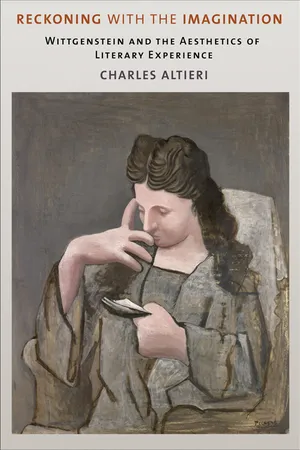
eBook - ePub
Reckoning with the Imagination
Wittgenstein and the Aesthetics of Literary Experience
- English
- ePUB (mobile friendly)
- Available on iOS & Android
eBook - ePub
Reckoning with the Imagination
Wittgenstein and the Aesthetics of Literary Experience
About this book
Information
Topic
FilosofiaSubtopic
Biografie in ambito filosoficoChapter 1
Why Wittgenstein Matters for Literary Theory
The reality of things is the work of the things; the
appearance of things is the work of Man, and a
nature which delights in appearance no longer takes
pleasure in what it receives but in what it does.
—Friedrich Schiller, On the Aesthetic Education of Man
Among the several theoretical efforts to restore our attention to the virtues of close reading in the past few years, Heather Dubrow’s foreword to the volume New Formalisms and Literary Theory stands out for its historical scope, its intellectual generosity, and its impassioned plea for uniting the interests of critics and writers through a shared interest in literary craft.1 For Dubrow, as for many of the other New Formalists and those disillusioned with the promises of the now old New Historicism, one of the principal skills the profession should endorse and transmit is close reading, shorn of the ideological roles the New Critics were perceived to have imposed on it.
But this enterprise faces what I consider a large and troubling problem. How do we treat the distinctly literary as also worthy of attention beyond the domain of professional literary study? How can we have a professional skill that we cultivate without depending on other disciplines and still show that this skill has important ramifications well beyond the world of its practitioners? How can we treat literature as both a distinctive cultural enterprise and one that is arguably central to the quality of social life for everyone, or at least potentially central for enough people that this would make a substantial difference in the quality of collective life?
The opponents of aesthetic orientations during the past three decades were motivated largely by the fact that they could not give satisfying answers to such questions. It proved impossible for them to correlate their social consciences with their aesthetic sensibility, so many of them chose to pursue what could better satisfy those consciences. They tried to align literary studies with the disciplinary focus of various social sciences in the hope of developing clear agendas for the social information provided by imaginative tests. Then they could preserve some of the discipline’s traditional emphases on close reading but focus those skills on practical rather than aesthetic concerns by asking how the skills of close readers and the canons of literary critics could illuminate fundamental social questions about political orientations, economic interests, and psychological tendencies to blind the self to what one was actually performing or producing.2
I believe some of us reviewing this history have to challenge those emphases. But I doubt Dubrow’s defense of the literary can afford a sufficiently powerful challenge. In the effort to bring literary studies closer to the worlds writers inhabit, Dubrow suggests that we replace an “emphasis on the aesthetic with an adoption of the writers’ emphasis on craft or techne” (DF xvi–xvii). One understands why she proposes this because it promises a telling response to critics who suspect that philosophical aesthetics has concentrated only on beauty rather than on any kind of power artists make available. Yet this seems to me exactly the wrong move. This turn to craft forecloses the possibility of recovering how aesthetics might be a discourse ultimately about the power of discrete objects to make differences in the sensibilities of those who engage them. And the emphasis on craft seems to me necessarily to preach to the converted because attention to craft only makes sense to those who already take pleasure in close reading. Our pressing need is to address the social uses possible for those pleasures.
This book is devoted to developing a very different response to the basic concerns I share with Dubrow. I argue that attention to the particular craft composing literary texts makes it possible to provide fresh perspectives on larger questions about values that necessarily engage literary texts in the social world—but as particular events rather than as sources of evidence for sustaining general explanatory accounts of social phenomena. In order to show how specific experiences of made objects can modify sensibilities and cultivate habits of judgment that go beyond the particulars, I believe we have to return to the Kantian heritage that Dubrow tries to evade—precisely because Kant and his heirs through Schiller were less concerned with beauty as a state than with judgments about beauty as capable of cultivating distinctive forms of power crucial for social life.3
This Kantian tradition in the early nineteenth century affords the richest discourse our culture has produced about the aesthetic and its relation to powers that extend beyond the aesthetic. For Kant and his direct heirs it even seemed possible for aesthetic theory to have significant force in shaping several domains of philosophy.4 Think of how Kant’s concept of imagination challenges the sufficiency of the understanding, how his concept of beauty as a symbol of the moral good provides alternative routes to the universality necessary to moral reason, and how Hegel deploys an essentially aesthetic idea of expression to challenge the Enlightenment’s sharp distinction between subject and object.
For these reasons it would be a pity to throw these lines of thinking away because they have been aestheticized or remain trapped within idealist discourses. Instead I hope to restore many of the core concepts of the revolution in aesthetics created by German idealist arguments about expression in art, especially its claims for the importance of imagination.5 But we cannot just repeat the concepts emphasized in that discourse. We also have to make these respectable within the languages that have at least some contemporary philosophical currency.
“Restore” is the challenging term here because we probably have to adapt these core concepts in terms of practices and values that are continuous with what seems acceptable to at least some plausible twenty-first-century philosophical perspective. Then the reformulation of those discourses may get a hearing. Therefore Wittgenstein plays the central role in this book. His later writings in particular make it possible to develop a very different framework for reconsidering how idealist claims about art might still make claims on us—especially in literary criticism, which tends to cultivate an uneasy relationship with contemporary philosophical aesthetics.
The Wittgenstein who emerges as relevant to these tasks in literary theory may even be of some interest to those primarily interested in philosophy. For I have to concentrate on his complex and rarely explicit thinking about subjectivity, primarily in relation to “aspect-seeing.” In addition, I want to concentrate on the fact that, contra the claims of many philosophers dealing with his work, Wittgenstein had good reasons for not talking much about ethics: he preferred to think about questions of values in terms of religious concerns, which are, according to Hegel (the second hero of this book), much closer to art than to the ethics that can never reconcile forms of desire with systems for evaluating those desires.
This different framework for dealing with idealist aesthetics enables me to replace the fantasy of a grand theory of literature with an effort to characterize specific concepts and values that can be basic to our reading practices—but because of the interests they serve rather than because they are adequate to some essential properties that make something a work of literature. I cannot specify in conceptual terms which kinds of texts these concerns about reading will serve best and which will be relatively ill served: working out the limits of these concerns is a question resolvable only on a case-by-case basis. Nonetheless, I have certain bodies of literature in mind. Obviously I shape my discourse to accord with writing in the expressivist nexus of values elaborated in this idealist tradition because those ideals shaped most ambitious European literature at least from romanticism through modernism. But it would also be silly to not recognize that these philosophers were also talking about bodies of canonical European and some Asian materials not written in accord with expressivist principles. So I want to appreciate what they saw in their critical reading by speculating on how work such as classical Greek drama and Dante and Shakespeare at least might display and often model for their own cultures, and for ours, values similar to what the idealist philosophers found compelling in these authors.
The Four Basic Principles of Expressivist Views of Art
Let me first describe how antiempiricist thinkers from Kant to Schiller taught us to view art and how they produced quests such as Coleridge’s to contrast the esemplastic (form-establishing) imagination with the indulgences of mere fancy. These thinkers produced four major principles for understanding how we experience works of art. Those principles differ fundamentally from views that treated literary texts primarily as rhetorical structures intended to instruct and delight or as realist efforts to produce the sensations and interests we find in the actual world.
1. The experience of art is intensely sensual. This principle has many features, but they all come down to an emphatic insistence that one’s experience of art is the product of imaginative intuition uniting intellectual passion with something like the vital force of nature. This sensuousness in turn has the capacity to produce a harmony of the senses desperately needed if we are to retain an adequate sense of human powers under threat from both Enlightenment rationality and the isolating effects of living increasingly in a marketplace mentality. This is Friedrich Schiller:
Every phenomenon whatsoever may be thought of in four different connections. A thing may relate directly to our sensuous condition…; that is its physical character. Or it can relate to our reason, and furnish us with knowledge; that is its logical character. Or it can relate to our will, and be regarded as an object of choice for a rational being; that is its moral character. Or, finally, it can relate to the totality of our various powers, without being a specific object for any single one of them; that is its aesthetic character. (On the Aesthetic Education of Man, trans. Reginald Snell [New York: Frederic Ungar, 1954], 99, Letter 20; cited hereafter as OAE)
Embedded in this idealization of the sensuous is the corollary idea that the work of art resists being subsumed under concepts and adapted to rationalist or empiricist modes of thinking. I am thinking here of the elaborate patterning of interrelated characters in Shakespearean drama as well as the ways in which Jane Austen and George Eliot elaborate within the realistic textures of their fiction similar intricate relations among characters capable of considerable breadth of feeling that cannot be fixed by conceptual analysis. Here Kant provides the richest formulation of what in art resists the conceptual, although Wittgenstein substantially modifies our sense of how this resistance takes place: “Just as in the case of an idea of reason the imagination, with its intuitions, never attains to the given concept, so in the case of an aesthetic idea the understanding by means of its concepts never attains to the complete inner intuition of the imagination which it combines with a given representation.”6 For Wittgenstein, many practices, not just in art, resist being subsumed under practices of knowing. His later work takes as one of its fundamental tasks the drawing of conceptual boundaries that limit the tyranny that “scientific protocols for knowing” have exercised over philosophy at least since Descartes.7
Wittgenstein shifts the focus from how claims about knowledge can be formulated to an appreciation for how we as human beings learn to respond to cues and participate in a wide variety of social practices where concerns for knowledge are at best marginally significant. He calls attention to how the variety of practices themselves constitutes the fields of significance for our actions. Intelligibility in many domains is a matter of participation made possible by our learning languages in social settings. Intelligibility is not grounded in observation that sees through appearance but in the recognitions and attunements these practices make possible. Wittgenstein then can redo classical idealist themes such as expression and display and participation in ways that concentrate on learned behaviors woven into shared modes of social life.8 The skills we need to engage art objects are basically the same skills we need to negotiate the many interpretive situations we encounter in our daily lives.9 Indeed, we spend much of our lives adjusting our actions to fit these situations, and we find in the grammars that shape our actions significant resources for understanding all sorts of displays—from how people express feelings to their earnest efforts to make changes in their local worlds. Wittgenstein goes so far as to claim that “What is new (spontaneous, ‘specific’) is always a language game.”10 So, however much literary works have their own formal coherence, that coherence also has a functional role. We can imagine fundamentally aesthetic attitudes toward art that nonetheless do not require essentially formalist responses.11 Rather, the work gives shape to a specific mode of utterance that has significant affinities with our expectations for making sense (even if the utterance resists the authority of those expectations, as is the case with much avant-garde writing).
Art, then, does not typically construct a formal cocoon, protected from the messiness of life. Instead, literary art invites ways of talking about concreteness that emphasize meaningfulness rather than the materiality of the medium. This art cannot avoid participating in struggles to align and to resist the forms of behavior that we come to understand through speech acts. We can treat the works as displays of states of mind or of attention that invite modes of responsiveness to how they compose situations and deploy language.12 Particularity is entirely compatible with intelligibility, so long as we recognize that intelligibility does not depend only on propositions. We test our capacities for responsiveness to such statements constantly in our everyday practices.
2. “The beautiful must not be judged in accordance with concepts” (CJ, 219) because the work of art is not a description or a chain of arguments but a making in accord with an intuition. This stress on making is crucial because it allows theory to treat how the artwork resists concepts as affording a distinctive relation to subjectivity. In shaping the set of internal relations that constitute the piece of art, the subject works on its own expressive drives to turn them into objects for consciousness. The language of “object” would then suffice were the artists to seek concepts. But the artists give body to intuitions, so the made object takes on a power to act virtually as a subject. The objectification itself embodies a mode of active existence, as if the object were the dynamic substance that affords the feeling of being situated as a subject in the first place. For now two remarks by Schiller will have to suffice: “Beauty is therefore certainly an object for us, since reflection is the condition under which we have a sensation of it; but it is at the same time a state of our personality, since feeling is the condition under which we have a conception of it” (OAE, 122). Then he caps this statement with brilliant synthesis. The object as perceived form becomes correlated with what we must do to bring it within consciousness as something other than a concept: “It is then certainly form, because we contemplate it, but it is at the same time life becau...
Table of contents
- Preface
- List of Abbreviations
- 1. Why Wittgenstein Matters for Literary Theory
- 2. The Work Texts Do
- 3. Where Doubt Has No Purchase
- 4. The Concept of Expression in the Arts
- 5. Expression and Exemplification
- 6. What Literary Theory Can Learn from Wittgenstein’s Silence about Ethics
- 7. Appreciating Appreciation
- Notes
- Bibliography
- Permissions
- Index
Trusted by 375,005 students
Access to over 1.5 million titles for a fair monthly price.
Study more efficiently using our study tools.
Frequently asked questions
Yes, you can cancel anytime from the Subscription tab in your account settings on the Perlego website. Your subscription will stay active until the end of your current billing period. Learn how to cancel your subscription
No, books cannot be downloaded as external files, such as PDFs, for use outside of Perlego. However, you can download books within the Perlego app for offline reading on mobile or tablet. Learn how to download books offline
Perlego offers two plans: Essential and Complete
- Essential is ideal for learners and professionals who enjoy exploring a wide range of subjects. Access the Essential Library with 800,000+ trusted titles and best-sellers across business, personal growth, and the humanities. Includes unlimited reading time and Standard Read Aloud voice.
- Complete: Perfect for advanced learners and researchers needing full, unrestricted access. Unlock 1.5M+ books across hundreds of subjects, including academic and specialized titles. The Complete Plan also includes advanced features like Premium Read Aloud and Research Assistant.
We are an online textbook subscription service, where you can get access to an entire online library for less than the price of a single book per month. With over 1.5 million books across 990+ topics, we’ve got you covered! Learn about our mission
Look out for the read-aloud symbol on your next book to see if you can listen to it. The read-aloud tool reads text aloud for you, highlighting the text as it is being read. You can pause it, speed it up and slow it down. Learn more about Read Aloud
Yes! You can use the Perlego app on both iOS and Android devices to read anytime, anywhere — even offline. Perfect for commutes or when you’re on the go.
Please note we cannot support devices running on iOS 13 and Android 7 or earlier. Learn more about using the app
Please note we cannot support devices running on iOS 13 and Android 7 or earlier. Learn more about using the app
Yes, you can access Reckoning with the Imagination by Charles Altieri in PDF and/or ePUB format, as well as other popular books in Filosofia & Biografie in ambito filosofico. We have over 1.5 million books available in our catalogue for you to explore.