In Erotic Exchanges, Nina Kushner reveals the complex world of elite prostitution in eighteenth-century Paris by focusing on the professional mistresses who dominated it. In this demimonde, these dames entretenues exchanged sex, company, and sometimes even love for being "kept." Most of these women entered the profession unwillingly, either because they were desperate and could find no other means of support or because they were sold by family members to brothels or to particular men. A small but significant percentage of kept women, however, came from a theater subculture that actively supported elite prostitution. Kushner shows that in its business conventions, its moral codes, and even its sexual practices, the demimonde was an integral part of contemporary Parisian culture.Kushner's primary sources include thousands of folio pages of dossiers and other documents generated by the Paris police as they tracked the lives and careers of professional mistresses, reporting in meticulous, often lascivious, detail what these women and their clients did. Rather than reduce the history of sex work to the history of its regulation, Kushner interprets these materials in a way that unlocks these women's own experiences. Kushner analyzes prostitution as a form of work, examines the contracts that governed relationships among patrons, mistresses, and madams, and explores the roles played by money, gifts, and, on occasion, love in making and breaking the bonds between women and men. This vivid and engaging book explores elite prostitution not only as a form of labor and as a kind of business but also as a chapter in the history of emotions, marriage, and the family.
eBook - ePub
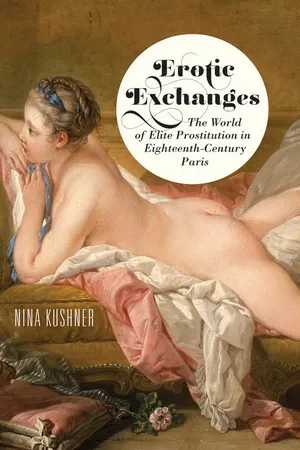
Erotic Exchanges
The World of Elite Prostitution in Eighteenth-Century Paris
- 308 pages
- English
- ePUB (mobile friendly)
- Available on iOS & Android
eBook - ePub
About this book
Information
CHAPTER 1
The Police and the Demimonde
On Thursday, March 20, 1755, Paris police inspector Jean-Baptiste Meusnier sat down to write a bulletin (report) at his hotel on the rue des Canettes, in the faubourg St. Germain. The subject was Demoiselle St. Hylaire, a twenty-year-old woman who was a singer in the Opéra and was working as a dame entretenue. She had been under surveillance for four years.
Meusnier wrote:
The constant attention of Monsieur Moreau, Officer of the Guard, towards Demoiselle Hugault—he eats and sleeps at her place, refusing to leave—has made it impossible for Monsieur Amelot de Chaillou to continue his relationship with the girl. 1 Amelot has since left her and returned, with a renewed devotion, to his former mistress, Demoiselle St. Hylaire. She lives on rue de Bourbon in the quarter Villeneuve. However, he only comes [to visit her] in the evenings. It was reported that he had supper there yesterday. He arrived at 8:00 and [then] sent his carriage and servants away.
I am assured that Demoiselle St. Hylaire has a new patron, whose name we have not yet been able to ascertain. That will be a task for next week.2
The third week in March 1755 was a fairly average one for the inspector. He wrote a report almost every day, each one on a different dame entretenue. In his reports, the inspector recorded in exacting detail the emotional and material exchanges that constituted the professional lives of his subjects: Demoiselle Hugault’s infidelity supposedly drove her patron back to his former mistress Demoiselle St. Hylaire, to whom he was especially attentive. St. Hylaire, in the meantime, was being maintained by someone else. Demoiselle Maupin, another subject of that week, was fired by her patron, the prince de Nassau-Sarbruck, yet she continued to quarrel with him over a four to five hundred livre bill for a gold-laced dress and a feathered hat, which she had ordered and was expecting to be delivered shortly.3
Each report was placed in a thickening dossier, which was filed by subject name in an expanding archive Meusnier kept at his hotel on the rue des Canettes. St. Hylaire, Hugault, and Maupin were just 3 of the more than 150 women Meusnier had followed in 1755, and among the some 550 he observed in his ten-year career with a police unit, the Département des femmes galantes, whose purview was the demimonde. Meusnier was followed in 1757 by his assistant, Inspector Louis Marais, who kept track of an equal number of women, at least until 1761. In that year, he dismantled the dossier system, submitting instead long, detailed weekly reports titled Notes sur differentes dames entretenues (Notes on Different Kept Women). These Notes reflected a considerable broadening of surveillance, increasing the total number of people under observation.
By 1764, Marais combined these Notes with submissions of Anecdotes Galantes, reporting the extramarital affairs of men and women in elite society, le monde, as well as those in the demimonde. The reporting stopped, for the most part, in 1771, although there were a few scattered bulletins until 1777. Together, the inspectors reported on the doings of at least one thousand women and an equal number of men in the course of a quarter century. These men included princes of blood, peers of the realm, robe nobles, and financiers, a veritable “who’s who” of le monde. Given the ransacking during the Revolution of the archive in which these documents were kept, the total number of individuals under surveillance might have been far more numerous.4
Understanding how and why the demimonde was policed is intrinsic to understanding how it operated. This is the case, first, because police operations had a hand in shaping the demimonde. Second, we owe our knowledge of many of the details of daily life in the demimonde to police efforts to record them. The reports are not, by any means, the only source of information on this world of elite prostitution. Police attention to kept women echoed a popular interest much akin to our own obsession with Hollywood gossip. What the most famous femmes galantes did made news. Their affairs, infidelities, sexual proclivities, earnings, and scandalous behaviors were mentioned in private correspondence and recorded by memoirists, chroniclers, and journalists. Nouvelles à la main (handwritten news sheets), including the famous Mémoires secrets, reported many anecdotes galantes. The habits of kept women and their patrons were frequently mocked by satirists and were also the subject of an entire genre of libertine literature, as well as of more serious works of fiction. Artists like Fragonard depicted galante scenes on canvas. Moralists and police theorists addressed the risks mistress keeping posed to patrimony and society. Madams under police protection submitted regular reports. Notaries recorded the marriage contracts of kept women and the rente (annuities) gifted to them by patrons. Kept women and their patrons also spoke for themselves: they wrote letters to the inspectors, and when they understood themselves to be the victims of theft, violence, or fraud, they filed complaints with police commissioners. Collectively, this rich body of evidence paints a clear picture of the grand contours of the demimonde. It is to inspectors Meusnier and Marais, however, that we owe much of our detailed knowledge of this world.
What was the relationship of the police to the demimonde? Why were they interested in kept women and their patrons? What form did their policing take? And what did it mean for those under their watch? These reports were produced as part of an effort by the police and the monarchy, for different reasons, to learn what was happening in Paris, to render the capital visible. Hence the bulletin on Demoiselle St. Hylaire was in many respects not unlike hundreds of others being written by agents in other departments at the very same time. It would be a mistake, however, to assume that the bulletin on St. Hylaire was just like those being produced elsewhere, or to think that it was simply a reflection of larger institutional trends. Report writing had yet to become so bureaucratized as to eliminate the voice of the author.5 Inspector Meusnier’s personality, his worldview, and his social and political relationships informed his construction of the dossier system and its daily workings as much as any long-term evolution in policing. Making sense of these documents, then, necessitates moving beyond understanding why the Département was founded to examining how it operated, both within and against the interests of the police and the monarchy.
The evolution of the modern police force has long been associated with repression.6 In establishing government over a community that previously had no official oversight, the inspectors expanded the power of the police, the state, and themselves. In creating the dossier system, they “made visible” to the state the private lives of a good portion of Paris’s male elite and solidified the identities of specific women as elite prostitutes. Yet it is difficult to apply the repression argument—at least in its most aggressive incarnation—to the activities of the Département. In practice, the police mediated between the demimonde and Paris’s more respectable communities. In doing so they set the boundaries of permissible behavior, yet these limitations were few. The inspectors rarely tried to repress behaviors deemed repugnant to outsiders. More than anything, in fact, the police helped to enforce the demimonde’s own rules. Meusnier and Marais acted as de facto magistrates, commissioners of the demimonde. As such, they reified the demimonde’s institutions and practices. This benefited many kept women, because the clarity of the rules and customs made it easier for them to build careers.
The Parisian Police at Midcentury: Why Kept Women?
The Département des femmes galantes was one of many that Nicolas René Berryer (lieutenant general, 1747–57) and one of his successors, Antoine de Sartine (1759–74), established at midcentury as part of a general reorganization of the institutions that policed the capital. By 1760, twenty-five of these departments existed.7 Six of them handled the city’s livestock and food markets, while another six policed groups of people thought to be particularly threatening or innately subversive. These included charlatans, confidence men, usurers and pawnbrokers, foreigners, and foreign and French Protestants. There were three departments overseeing the prisons and their occupants and one that functioned as a military police. Parisian social life was the focus of at least three departments. A very large one watched over the theaters. Another policed gambling, and a third, clubs and circles.8 Sexual activity was the concern of two, one for the demimonde and another for public sodomy.9 A single department monitored and policed the book trade, and another, which by century’s end was the largest, investigated crimes.10 Finally, late in the century, the police established a department that functioned as a wetnurse registry, helping to match newborns to nursing women.
Departmental missions, however, do not represent the full range of police activity, nor did they absorb all of its personnel. The lieutenant general had twenty different kinds of officials under his authority and numerous other categories of employees, ranging from the Garde that patrolled the streets to the men who cleaned them.11 Among the most important “police” officers at midcentury were the commissioners and the inspectors. About a third of the commissioners were assigned to specific departments, but the main duties of these men lay elsewhere. Officially titled commissiares-enquêteurs-examinateurs, the commissioners functioned, and had since the fourteenth century, as minimagistrates in each of the city’s quarters. Trained in law, by midcentury they numbered forty-eight and were stationed two or three per quarter, where their docket combined judicial, administrative, and to a lesser degree, investigative functions.12 It was to the local commissioner that anyone with a grievance went first, often for adjudication, and if the magistrate was unable to resolve the conflict, he would initiate the necessary legal proceedings to take it to court. Often posted in the same quarter for decades, many commissioners were well known and trusted by the communities they served.13
Inspectors, as the investigatory arm of the police, had an entirely different mission from that of the commissioners.14 Like Meusnier, most were assigned to different departments where they fulfilled various information-gathering needs in the policing of particular beats. In addition, each had regular obligations in the quarters in which they were stationed, notably open surveillance (for example, checking to make sure the wares sold by dealers in secondhand goods had not been stolen). Inspectors were also tasked with specific investigations, for instance, ascertaining the facts behind a request for a lettre de cachet (royal order for incarceration).15 To gather information, the inspectors relied heavily on networks of informants cultivated over a long tenure in the quarter. The public called all informants mouches or mouchards, although the police established a hierarchy among them.16 Mouche networks could be quite extensive. One historian of the police identified fifty-two different informants working “for the police” or “for an inspector” in the notes of Commissioner Chénon.17 Traditionally recruited from the lowest levels of society, mouches increasingly came from every social echelon as the century progressed, a fact not lost on contemporary observers, who believed mouches to be absolutely everywhere, listening and reporting. Denis Diderot, for example, claimed in his Mémoire on policing for Catherine II that “our entire lives and all our habits are reported to the police…they know our every action and opinion.”18 While this was hardly the case generally, men like Diderot were under police surveillance.
This brief survey should make clear that the duties of the police in the early modern period extended beyond fighting crime. In the eighteenth century, “la police” referred not to a group of people but to a series of actions, all that was necessary for the good regulation of a city.19 By the Revolution, the Paris police regulated the city’s markets; ensured the honesty of its merchants; lit, cleaned, and made safe the city’s streets; fought its fires; regulated its prisons; solved its crimes; kept its wayward elements in order; enlightened its public; and made sure its foundlings were nursed. The police were supposed to maintain some sort of moral order by containing prostitution, preventing Parisians from spending themselves into ruin in the city’s many illegal gambling dens, and supporting families in their efforts to discipline unruly members. The lieutenant general was the man responsible for making sure the city was provisioned with all that it needed, even in times of dearth.
When inadequate distribution of flour resulted in riots, criminal gangs controlled certain quarters of the city, and pedestrians were regularly injured fatally by speeding carriages or falling masonry, why did the police devote any resources whatsoever, not to mention an entire administrative unit, to the demimonde? Clearly the demimonde mattered to the police. Our question is why.
Disappointingly, the archives have failed to cough up a definitive answer, and none of the more logical explanations stand up to the evidence.20 It is unlikely that the dossiers were used for judicial purposes, for example, as galanterie was not illegal. Prostitution was. But while officials liked to disparage dames entretenues by calling them prostitutes, they did not treat them as such. Patron blackmail, another possibility, would have been hard to execute, as each dossier was filed under the name of the kept woman and not that of her patron(s). Without a cross-index (if it existed, it has been lost), the only means by which an inspector could retrieve information on a particular man would have been to rely on his own memory. After 1761, when the dossier system dissolved, retrieving information on any one person—man or woman—would have been even more difficult. Moreover, the blackmail hypothesis assumes patrons wanted their affairs hidden. Some did. For many others, however, mistress keeping was a display of status and hence required publicity. Robert Muchembled suggests that the archive was used by Meusnier, Marais, and a cabal of police officials to extort money from kept women and their patrons. While this was certainly possible, it would not explain why the Département was set up. Moreover, the only proof Muchembled offers is either circumstantial—the wealth Meusnier had accrued by the time of his death (which Muchembled claims he faked)—or fantastic, namely some comments from one of the many antipolice “exposés” written at the end of the century, which Muchembled attributes to (the legally dead) Meusnier.21
One theory is that the police may have watched kept women so that they could arrest the depletion of those family fortunes made vulnerable by infatuated sons. In his treatise La police de Paris en 1770, the police commissioner Jean-Baptiste-Charles Le Maire argued that femmes galantes were dangerous by definition because they supported themselves though bankrupting men. The commissioner instructed police to take action wh...
Table of contents
- Acknowledgments
- Introduction
- 1. The Police and the Demimonde
- 2. Leaving Home
- 3. Being Sold into the Demimonde
- 4. Madams and Their Networks
- 5. Contracts and Elite Prostitution as Work
- 6. Male Experiences of Galanterie
- 7. Sexual Capital and the Private Lives of Mistresses
- Conclusion
- List of Abbreviations
- Notes
- Selected Bibliography
Trusted by 375,005 students
Access to over 1.5 million titles for a fair monthly price.
Study more efficiently using our study tools.
Frequently asked questions
Yes, you can cancel anytime from the Subscription tab in your account settings on the Perlego website. Your subscription will stay active until the end of your current billing period. Learn how to cancel your subscription
No, books cannot be downloaded as external files, such as PDFs, for use outside of Perlego. However, you can download books within the Perlego app for offline reading on mobile or tablet. Learn how to download books offline
We are an online textbook subscription service, where you can get access to an entire online library for less than the price of a single book per month. With over 1.5 million books across 990+ topics, we’ve got you covered! Learn about our mission
Look out for the read-aloud symbol on your next book to see if you can listen to it. The read-aloud tool reads text aloud for you, highlighting the text as it is being read. You can pause it, speed it up and slow it down. Learn more about Read Aloud
Yes! You can use the Perlego app on both iOS and Android devices to read anytime, anywhere — even offline. Perfect for commutes or when you’re on the go.
Please note we cannot support devices running on iOS 13 and Android 7 or earlier. Learn more about using the app
Please note we cannot support devices running on iOS 13 and Android 7 or earlier. Learn more about using the app
Yes, you can access Erotic Exchanges by Nina Kushner in PDF and/or ePUB format, as well as other popular books in History & French History. We have over 1.5 million books available in our catalogue for you to explore.