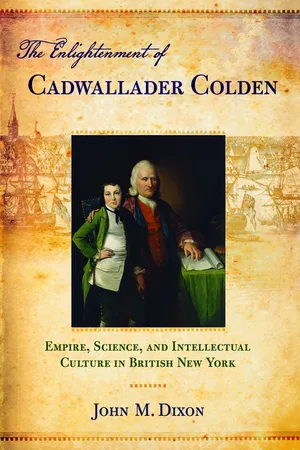
Was there a conservative Enlightenment? Could a self-proclaimed man of learning and progressive science also have been an agent of monarchy and reaction? Cadwallader Colden (1688–1776), an educated Scottish emigrant and powerful colonial politician, was at the forefront of American intellectual culture in the mid-eighteenth century. While living in rural New York, he recruited family, friends, servants, and slaves into multiple scientific ventures and built a transatlantic network of contacts and correspondents that included Benjamin Franklin and Carl Linnaeus. Over several decades, Colden pioneered colonial botany, produced new theories of animal and human physiology, authored an influential history of the Iroquois, and developed bold new principles of physics and an engaging explanation of the cause of gravity.The Enlightenment of Cadwallader Colden traces the life and ideas of this fascinating and controversial "gentleman-scholar." John M. Dixon's lively and accessible account explores the overlapping ideological, social, and political worlds of this earliest of New York intellectuals. Colden and other learned colonials used intellectual practices to assert their gentility and establish their social and political superiority, but their elitist claims to cultural authority remained flimsy and open to widespread local derision. Although Colden, who governed New York as an unpopular Crown loyalist during the imperial crises of the 1760s and 1770s, was brutally lampooned by the New York press, his scientific work, which was published in Europe, raised the international profile of American intellectualism.
eBook - ePub
The Enlightenment of Cadwallader Colden
Empire, Science, and Intellectual Culture in British New York
- 264 pages
- English
- ePUB (mobile friendly)
- Available on iOS & Android
eBook - ePub
The Enlightenment of Cadwallader Colden
Empire, Science, and Intellectual Culture in British New York
About this book
Information
Subtopic
Historical BiographiesIndex
HistoryPART I
Beginnings
Chapter 1
ENLIGHTENED AGE
With a series of concussive booms, pyrotechnics created at a laboratory in Greenwich, London, not far from a recently built observatory, exploded above the River Thames in July 1688 in celebration of the birth of a new royal.1 As the only legitimate son of the King of England, Ireland, and Scotland, the infant Prince of Wales was heir to three crowns and an empire of Caribbean islands and North American colonies. His family—the Stuarts—had returned to power in 1660, after eleven years of republicanism, and overseen an age of cultural splendor that encompassed the poetry and plays of John Dryden, the music of Henry Purcell, and the architecture of Sir Christopher Wren. The Restoration had also brought an unprecedented institutionalization and legitimization of English and Scottish science. The Royal Society of London, chartered in 1662, had added visibility and prestige to English natural history and natural philosophy. Meanwhile, in Scotland’s capital, the botanist, royal physician, and royal geographer, Sir Robert Sibbald, had founded Edinburgh’s first physic garden, co-organized the Royal College of Physicians of Edinburgh, and gathered a “virtuoso” circle of scientifically minded gentlemen.2
These developments helped to nurture an exciting age of international intellectual innovation, cultural experiment, and political transformation that started in the second half of the seventeenth century and lasted well into the nineteenth century. This is by no means to say that the Enlightenment—as it is now known—began solely in England and Scotland, or for that matter in Europe. Rather, it was a global and polycentric phenomenon that owed much to the remarkable exchange of peoples, ideas, information, natural objects, and human inventions that happened during the early modern era, albeit often under the aegis of European imperialism and commercialism. The Enlightenment covered a great deal of ideological as well as geographical ground, combining diverse conservative, moderate, and radical opinions—some secular, some religious. Its intellectual coherence came from its general advocacy of reason, pursuit of self-improvement and societal progress, and assertion that the eighteenth century was a pivotal moment in a centuries-long battle against dogma and ignorance.3
Enlightenment Scotland and America enjoyed a particularly close intellectual relationship.4 Historians have paid a great deal of attention to the transatlantic reach of the mid and late eighteenth-century Scottish philosophers Francis Hutcheson, David Hume, Thomas Reid, and Adam Smith. By comparison, the sizable impact in America of learned Scots born around 1688 remains underappreciated. This generation came of age during a difficult period of religious tumult, famine, and exodus, but simultaneously benefited from modernizing academic reforms, the support of an aristocracy interested in scientific improvement, and the thrill of living at what seemed like a crucial point in intellectual history—a moment of sweeping philosophical change and scientific breakthroughs.
Cadwallader Colden was arguably the most important of the several educated Scots who immigrated to America in the early eighteenth century. After a period in Philadelphia, he moved to New York in 1718 and spent much of his remaining life constructing and justifying a transatlantic intellectual culture. Around 1760, he told his American grandchildren a historical narrative that he may well have learned more than fifty years earlier as a student at the University of Edinburgh.5 It was a stock eighteenth-century tale that recalled how Popish priests and Aristotelian scholars had imposed a cultural hegemony of useless knowledge on the world, and how two great thinkers, René Descartes and Sir Isaac Newton, had cleared away much of that intellectual fog in the seventeenth century. Colden acknowledged that more needed to be done, but also asserted that the world stood on the verge of an “enlightened” age. He then impressed upon his grandchildren that his own intellectual work was an integral part of that historic moment. In this way, he used a story of enlightenment to reflect on his life’s meaning and purpose.6
Colden was correct to view the decline of Aristotelian scholastic tradition and development of new understandings of the natural world as important precursors to eighteenth-century intellectual culture. The Aristotelian universe was very different from our own. Whereas we now accept that our planet rotates around the Sun, Aristotelians generally put the Earth at the center of the cosmos. They also usually agreed that the orbit of the Moon separated a celestial realm where stars and planets moved in perfect circles from a set of corrupt sublunary spheres composed of four elements—earth, water, air, and fire. Each of these elements had characteristic qualities and innate tendencies. Aristotelians claimed that cold, dry, and heavy earth constantly tried to reach the center of the world. So did cold, wet, and heavy water. By contrast, hot, wet, and light air and hot, dry, and light fire sought to rise upward. In this scheme, bodies fell downward not because of some external gravitational force, but because of the inner strivings of earth and water to reach their natural place at the Earth’s core.7
Aristotelian tradition additionally viewed terrestrial bodies as interactions of prime matter and substantial form. We are now used to thinking of matter as an actual material substance, but Aristotelians considered prime matter to be something else—an inert potential to become substance. Substantial form was the active principle that realized that latent transformation. It imbued prime matter with essential, as well as nonessential, qualities.8 The recovery of ancient pre-Socratic, Platonic, Hermetic, Epicurean, and Stoic writings during the Renaissance encouraged a significant number of early modern natural philosophers to read beyond the Aristotelian corpus. Even though some of these scholars subsequently adopted alchemical or magical explanations that were fiercely anti-Aristotelian in many respects, European natural philosophy continued to view matter as animate. The cosmos, in other words, remained in the view of most educated Europeans something like a living organism.9
The rise of an alternative mechanistic physics was a prolonged, contingent, and contested event, and not the automatic progression of scientific knowledge it has sometimes been described as. Aristotelianism, which was varied and flexible enough to adapt to new discoveries, could not be swiftly or easily dislodged in Europe, where political authorities limited and monitored the assimilation of novel systems of knowledge.10 Nevertheless, new philosophy, new astronomy, and new forms of scientific experimentation gained traction over time, and matter eventually came to be widely seen as a nonliving or inert substance in the seventeenth century. The growing prevalence in Europe of machines such as windmills and clocks perhaps contributed to this shift.11 It is also easy to imagine that Europe’s religious authorities and possessing classes thought that the notion of a predictable, law-bound universe might encourage social, political, and religious calm during a tempestuous age.12
A number of seventeenth-century European scholars, fueled by the ancient writings of Epicurus and Lucretius, created systems that emphasized the order and regularity of the universe. One French philosopher, Pierre Gassendi, drew heavily on ancient Epicureanism to conceive of the natural world as a multitude of indivisible and interlocked atoms moving in a void. Another Frenchman, Descartes, abandoned all ancient knowledge and began with the simple proposition, “Cogito ergo sum” (I think therefore I am), from which he extrapolated a complicated account of the cosmos. Descartes’s substantial and compelling alternative to Aristotelian physics claimed matter was omnipresent and infinitely divisible. It also described the universe as a combination of large material bodies and swirling vortices of extremely fine matter, or aether.13
As advocates of Cartesianism overcame resistance from clerical and civic powers to achieve significant influence in parts of Continental Europe, especially the Netherlands and France, a confusing mess of philosophical systems persisted in mid-seventeenth-century England and Scotland. Walter Charleton issued an English-language version of Gassendi’s Animadversiones in the 1650s. Robert Boyle developed a natural philosophy that combined elements of both Descartes and Gassendi. Thomas Hobbes created a shockingly materialistic account of nature that became synonymous with atheism. Henry More, the leader of a group of seventeenth-century English theologians and philosophers known as the Cambridge Platonists, complained that Cartesianism reduced the role of God to the point where he did no more than get the universe up and running. And Baconian empiricism, which gained important institutional support at the Royal Society of London, prioritized the scientific pursuit of useful facts and so provided a more general ideological bulwark in Britain against Descartes’s rationalism.
That was the intellectual context in which Newton, the son of a well-to-do Lincolnshire farmer, set out to understand the universe while a student at Cambridge University in the 1660s. During the remainder of his life, he became fascinated by many religious and natural problems, including, of course, the cause of gravitation. Newton initially considered gravity to be the mechanical result of fine aether particles hitting material bodies. He reassessed that explanation in the 1680s, when he discovered through mathematics and experiment that the motion of celestial bodies was not slowed by resistance as it should have been if these bodies were actually moving through a purely material aether. By the time that his greatest work, the Principia, was published in 1687, Newton was prepared only to identify gravitation as a centripetal force without venturing any real explanation of its workings. Later, he became convinced that this force derived from the will of God. The second English edition of the Opticks, Newton’s other major work, published in 1718, speculated that a subtle fluid filled space and communicated gravity through its inherent elasticity. In private, Newton had begun to think of this aether as a critical linkage between the natural and the supernatural. It served, as one historian has aptly noted, “as a cosmic mediator between God and matter.”14
Not all Newtonians agreed with Newton that God intervened in this way in the regular operation of the universe. Like Aristotelianism and Cartesianism, Newtonianism was a complex and evolving set of beliefs rather than a static doctrinal monolith. It gathered momentum as Newtonian ideas of one sort or another gained acceptance in Scottish and English universities in the last decades of the seventeenth century, earlier than in most other parts of Europe. At Edinburgh, Newton’s theories of light and color, as well as his physics, entered the curriculum in the 1670s and 1680s.15 Simultaneously, two reputedly hard-drinking friends, the physician Archibald Pitcairne and the mathematician David Gregory, later a professor at Oxford, hosted a clique of Scottish Newtonians in the taverns of Scotland’s capital.16 Newtonianism gained even more currency when leading proponents such as Samuel Clarke, an Anglican clergyman, and Jean Le Clerc, a liberal minister and publisher of the Bibliothèque universelle et historique, a French-language journal printed in Holland and read throughout Europe, asserted that matter was inert and God was the ultimate source of cosmic movement.17 A Whig regime put in place by the recent Glorious Revolution appreciated the political and religious tameness of these claims, which in turn helped to give eighteenth-century British thought a distinctly moderate flavor.
Intellectual and political change were never far apart in late seventeenth- and early eighteenth-century England and Scotland. The London fireworks of July 1688 provided a striking display of this relationship by at once illuminating the enhanced capabilities of Restoration science and demonstrating the extravagance and pomposity of the Crown. What is more, the impressive pyrotechnics effectively declared the start of a Catholic dynasty in two countries that were 98 percent Protestant. Everyone expected in 1688 that the newborn Prince of Wales would be raised in his father’s faith, even though his two older half-sisters had been brought up as Protestants. Alarmed at that prospect, Scottish and English exiles in Holland convinced a Dutch Stadhouder to invade the British Isles. Prince William of Orange, a staunch Protestant married to one of King James’s daughters, landed on the south coast of England in November 1688 with a force of fifteen thousand professional fighters. James tried to rally his troops for a battle, but his courtiers and soldiers deserted in large numbers. Confronted by this desperate military and political predicament, the Catholic king fled to France with his infant son.18
Once remembered as a bloodless rejection of tyranny, as well as a very English return to business as usual, the Glorious Revolution was in actuality a violent and transformative event, especially in Scotland. After news of James’s departure traveled north of the border, angry gangs rampaged in the streets against the Stuart monarchy and the Restoration Settlement. They targeted Catholics at first, and then turned on the Episcopalian clergy, tormenting and expelling between two hundred and three hundred ministers, mostly in the south and the west of the country.19 A new political order took shape amid this turmoil. Elections held in the winter of 1688–1689 determined the form of the Convention of the Estates, a quasi-parliament called by the as-yet-uncrowned William. Hard-campaigning Presbyterians won a majority of seats, dominated the convention when it met in March 1689, a...
Table of contents
- Acknowledgments
- A Note on Dates
- Introduction
- Part I. Beginnings
- Part II. Active Matters
- Part III. Politics
- Abbreviations
- Notes
- Bibliographic Note
- Index
Trusted by 375,005 students
Access to over 1.5 million titles for a fair monthly price.
Study more efficiently using our study tools.
Frequently asked questions
Yes, you can cancel anytime from the Subscription tab in your account settings on the Perlego website. Your subscription will stay active until the end of your current billing period. Learn how to cancel your subscription
No, books cannot be downloaded as external files, such as PDFs, for use outside of Perlego. However, you can download books within the Perlego app for offline reading on mobile or tablet. Learn how to download books offline
Perlego offers two plans: Essential and Complete
- Essential is ideal for learners and professionals who enjoy exploring a wide range of subjects. Access the Essential Library with 800,000+ trusted titles and best-sellers across business, personal growth, and the humanities. Includes unlimited reading time and Standard Read Aloud voice.
- Complete: Perfect for advanced learners and researchers needing full, unrestricted access. Unlock 1.5M+ books across hundreds of subjects, including academic and specialized titles. The Complete Plan also includes advanced features like Premium Read Aloud and Research Assistant.
We are an online textbook subscription service, where you can get access to an entire online library for less than the price of a single book per month. With over 1.5 million books across 990+ topics, we’ve got you covered! Learn about our mission
Look out for the read-aloud symbol on your next book to see if you can listen to it. The read-aloud tool reads text aloud for you, highlighting the text as it is being read. You can pause it, speed it up and slow it down. Learn more about Read Aloud
Yes! You can use the Perlego app on both iOS and Android devices to read anytime, anywhere — even offline. Perfect for commutes or when you’re on the go.
Please note we cannot support devices running on iOS 13 and Android 7 or earlier. Learn more about using the app
Please note we cannot support devices running on iOS 13 and Android 7 or earlier. Learn more about using the app
Yes, you can access The Enlightenment of Cadwallader Colden by John M. Dixon in PDF and/or ePUB format, as well as other popular books in History & Historical Biographies. We have over 1.5 million books available in our catalogue for you to explore.