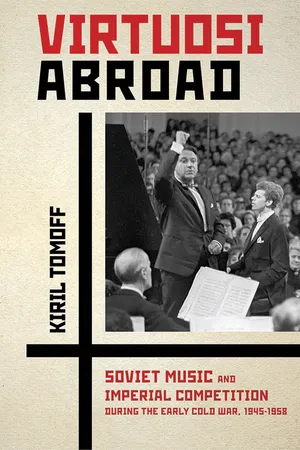
In the 1940s and 1950s, Soviet musicians and ensembles were acclaimed across the globe. They toured the world, wowing critics and audiences, projecting an image of the USSR as a sophisticated promoter of cultural and artistic excellence. In Virtuosi Abroad, Kiril Tomoff focuses on music and the Soviet Union's star musicians to explore the dynamics of the cultural Cold War. He views the competition in the cultural sphere as part of the ongoing U.S. and Soviet efforts to integrate the rest of the world into their respective imperial projects.Tomoff argues that the spectacular Soviet successes in the system of international music competitions, taken together with the rapturous receptions accorded touring musicians, helped to persuade the Soviet leadership of the superiority of their system. This, combined with the historical triumphalism central to the Marxist-Leninist worldview, led to confidence that the USSR would be the inevitable winner in the global competition with the United States. Successes masked the fact that the very conditions that made them possible depended on a quiet process by which the USSR began to participate in an international legal and economic system dominated by the United States. Once the Soviet leadership transposed its talk of system superiority to the economic sphere, focusing in particular on consumer goods and popular culture, it had entered a competition that it could not win.
eBook - ePub
Virtuosi Abroad
Soviet Music and Imperial Competition during the Early Cold War, 1945–1958
- 256 pages
- English
- ePUB (mobile friendly)
- Available on iOS & Android
eBook - ePub
Virtuosi Abroad
Soviet Music and Imperial Competition during the Early Cold War, 1945–1958
About this book
Information
Subtopic
Russian HistoryChapter 1
Shostakovich and The Iron Curtain
Intellectual Property and Transimperial Integration
On 12 May 1948, New York moviegoers picked their way through crowds of protestors and counter-demonstrators to take in a new film announced as a “semi-documentary spy drama,” William A. Wellman’s The Iron Curtain. As the demonstrators outside came to blows and a few of them were hauled away by police, the film’s audience settled in to what contemporaries trying to present an evenhanded account called a slowly moving drama, “competent enough, carefully photographed and directed.” Based on events that took place in Ottawa in 1945, much of the cloak-and-dagger story was shot on location in the Canadian capital.1 It centered on the activities of Igor Gouzenko (played by Dana Andrews), a Soviet cipher clerk stationed in Ottawa who defected to Canada in 1945, taking with him a sheaf of documents that revealed Soviet espionage activities and the participation of Canadians in efforts to uncover the secret of the atom bomb.2
Observant members of that first New York audience would have recognized—or would soon come to recognize—a number of tropes common to North American portrayals of the Soviet Union and the cultural clash between the West and the Soviet Union. They would not have been surprised to see the seductive call of capitalism’s material comforts reach Gouzenko’s wife (played by Gene Tierney) in a continuation of a theme that stretched back to one of Hollywood’s first portrayals of Soviets in the West, Ninotchka (Ernst Lubitsch, 1939). They would see it again in a more dazzling remake, Silk Stockings (Rouben Moulian, 1957), and in countless other Cold War films. Certainly the alcoholic and depressed army officer ominously recalled to Moscow would have struck familiar chords.3 And the film’s dark, shadowy, claustrophobic cinematography was fast becoming a trademark of Twentieth-Century Fox’s crime-thriller collaborations with the FBI, not to mention stock-in-trade for portrayals of the cold, bleak home of communism.4
Perhaps less commonplace was the film’s soundtrack. Arranged and conducted by Alfred Newman, the score consisted largely of music written by the Soviet Union’s most internationally renowned composers: Dmitrii Shostakovich, Sergei Prokofiev, Aram Khachaturian, and Nikolai Miaskovsky. In otherwise bland reviews of the film, the music stood out.5 Otherwise, the film appears to have paled in comparison to the events it docu-dramatized and the struggles over whether it could be shown to the public, first in the United States, then in the rest of the world.
Immediately after his defection, the real-life Gouzenko needed nearly forty hours to convince the Royal Canadian Mounted Police that his story—and the documents he carried with him—were authentic. His defection was the first from a Soviet embassy and the first of any sort after the war. It caused an international media sensation, resulted in twenty Canadian espionage trials and a dozen convictions, gave impetus to J. Edgar Hoover’s attack on American leftists, and was later credited with nothing less than starting the Cold War.6 Gouzenko himself went into hiding under an assumed name near Toronto, occasionally making public appearances in a dramatic hood to conceal his appearance. By 1948, he published an account of his defection and collaborated on the film script for Twentieth-Century Fox.7 Gouzenko’s personal story is a dramatic one in which The Iron Curtain plays only a small role.
The few film historians who have concentrated on The Iron Curtain have hailed it as “Hollywood’s first Cold War movie” and a “premature anti-communist film,” arguing for fresh evaluations of its place in the history of Hollywood’s political engagement in the struggle against the Soviet Union and suggesting that the history of its overseas reception indicates the extent to which government officials in Washington sought to mold international taste according to their political agenda.8 While the film is certainly important in these contexts, Soviet reactions to the film reveal just as much about Soviet strategies of cultural confrontation in the early Cold War.
This chapter analyzes one particular strategy that the Soviets devised and deployed to fight The Iron Curtain. The strategy was one among several, but it is particularly important for understanding the post-Cold War world because it suggests how significantly the cultural confrontation between the United States and the Soviet Union shaped the development of the international economic, cultural, and legal system commonly attributed to post-1989 “globalization” by revealing Soviet participation—through competition—in the Western system from the very beginning of the Cold War.9 To wit, the echoes of The Iron Curtain affair can be heard in areas as diverse as the nascent development of jurisprudence regulating content on the Internet, the success of universal copyright conventions, and the collapse of the Soviet Union itself. The development of the Soviet strategy for cultural confrontation that was deployed against The Iron Curtain, first in the United States and then in Europe, reveals a surprising reliance on non-Soviet representatives abroad for the interpretation of the terms of cultural conflict, a high degree of practical flexibility in the pursuit of ideological goals, and a hubristic willingness to engage the West in the West’s own terms. The Iron Curtain affair demonstrates that Soviet strategies of engagement were crafted largely through the agency of low-ranking Soviet officials and friends from abroad, and they often proved successful in the short term and in the arena of high artistic culture. But that visible success, here as elsewhere, masked a quieter but eventually more consequential integration into the U.S.-dominated global regime. Accepting the West’s terms of conflict eventually proved fatal.
Terms of Engagement: Soviet Institutions, Helen Black, and Initial Opposition to The Iron Curtain
Soviet officials and representatives had ideological objections to The Iron Curtain: it was an anti-Soviet film. They opposed it with political activism, organizing demonstrations against the film in virtually every country in which Twentieth-Century Fox showed it. But the eventually successful Soviet strategy to suppress the film did not depend on these demonstrations. Instead, it hinged on the legal and moral status of the film’s use of music written by Soviet composers. Though the composers were credited in the film, their permission—not surprisingly—had never been secured and surely would have been denied. Representatives of the Soviet Union abroad and Soviet apparatchiki in Moscow sought to suppress the film on the basis of its appropriation of Soviet music. In the United States, these efforts were initially spearheaded by one Helen Black. Soon after Soviet officials learned of the film, Black began directing the first efforts to prevent its release. When those efforts failed, she interpreted for her contacts in Moscow the terms of engagement for this early Cold War cultural struggle and crucially helped to shape Soviet strategy.
In 1948 and 1949, Black worked for an institution known in the United States as Preslit Literary Agency, Moscow, and in Moscow as Litmuzagentstvo, an affiliate of the All-Union Society for Cultural Ties Abroad (VOKS).10 She imported and distributed literary and musical works supplied to her by VOKS, constituting one of the main conduits into the United States of Soviet artistic production. Black had long been an active proponent of art infused with leftist political ideology, whether or not it was directly connected to the Soviet Union. In the 1920s and early 1930s, she was an active organizer of the leftist literary journal The New Masses, she translated Soviet literature for dissemination in the United States, and she demonstrated interest in populist musical forms. In fact, she apparently wrote the piano accompaniments in one of the first widely distributed songbooks of so-called “cowboy music,” folk music of the American West.11
That Black could play such a crucial role in shaping Soviet opposition to the film was a result of the fact that Soviet institutions of cultural diplomacy in the West were underdeveloped and perpetually starved for resources. In the postwar 1940s, the two institutions that were charged with managing cultural exchange abroad were VOKS and the Soviet government’s Committee on Artistic Affairs. In the West, VOKS typically took the lead and depended on the Committee on Artistic Affairs to provide information about Soviet artists and, increasingly during the late 1940s and early 1950s, to suggest candidates for exchanges and provide logistical support. These institutions’ collaborative activities were supposed to be coordinated with the Ministry of Foreign Affairs and its overseas diplomatic corps and staff. The whole cultural exchange operation was overseen by an ever-mutating cultural oversight department within the bureaucratic apparatus of the Communist Party Central Committee and, ultimately, the Politburo, which approved virtually every foreign trip throughout the Stalin period and beyond.
VOKS was founded in 1925, and over the course of the 1920s and 1930s, it established itself as the most important institution of Soviet cultural diplomacy, concentrating its efforts on attracting “friends” among foreign intellectuals abroad, especially in Europe. It also provided an interface with a diverse range of societies of friends of the Soviet Union. But by the end of the 1930s, Stalin’s shifting priorities and the decimation of the intelligentsia and other Soviet elites with foreign connections abroad during the Great Terror had left VOKS a mere shell of its formerly robust self.12
After the war, VOKS’s raison d’être mutated from primarily cultivating friendly relations with prominent foreign intellectuals to mainly managing the rapidly expanding system of Soviet friendship societies. The nature and distribution of these friendship societies underwent a profound change in the postwar 1940s as they became crucial institutions of mass mobilization in the Soviet empire’s emerging East European periphery. A series of unsuccessful requests from the VOKS leadership to increase its number of staff in 1946 and 1947 illustrates the tremendous change in VOKS’s operating conditions after the war. The postwar VOKS leadership claimed that just before the war, VOKS supported a significant volume of cultural ties with only four or five countries. By the end of 1946, it was charged with working in fifty-four countries, coordinating the activities of sixty-two friendship societies with more than four thousand affiliates and almost two and a half million members, supporting regular ties of an additional one and a quarter thousand scholarly and cultural institutions, and managing relationships with nearly two thousand “of the greatest foreign cultural and community figures.” The VOKS institutional system within the Soviet Union was growing as well, with four societies for cultural ties abroad in national republics and a system of clubs for the entertainment of foreign sailors visiting Soviet ports. It attempted to meet these new responsibilities with a small staff and a few dedicated representatives stationed in Soviet embassies abroad.13 By the middle of 1946, it was clear to the VOKS leaders that they simply could not manage, even with a substantial budget increase that they had already received. They repeatedly requested a massive expansion in VOKS’s staff and available resources.14 Instead, in 1947, the VOKS budget was actually cut.15
VOKS’s decreased resources in the face of expanding responsibilities made it vulnerable to attacks from all the other cultural and diplomatic institutions with which it was intertwined. For example, in late 1946 and early 1947, the cultural attaché in the Soviet Embassy in Paris and a former vice consul who had been stationed in both New York and San Francisco each complained to the Central Committee that VOKS was not effectively managing cultural diplomacy in the country they knew. The former vice consul in the United States complained with particular energy, describing VOKS’s efforts as primitive, unsystematic, horribly slow, colorless, and out of touch with American realities.16 Similarly, the Committee on Artistic Affairs sent a delegation of two high-status music professors to Italy to investigate hiring Italian opera singers to teach at Soviet conservatories. These professors included in their final report a familiar complaint about VOKS: it sent few, completely random materials to Italy, three-quarters of which elicited no interest in Italian music circles that were otherwise prepared to be drawn to Soviet culture, thus squandering an opportunity to expand Soviet influence.17 Most damaging of all, the Central Committee oversight department conducted investigations of VOKS in 1947 and 1948, eventually recommending a change in leadership and reorganization of the institution.18 Even though it could sometimes counterattack, VOKS was being watched by the party leadership very closely.19
One of the ways that VOKS tried to cope with its poverty of resources while it was subjected to nearly constant criticism was to cultivate its foreign partners. Even though the bureaucratic apparatus that administered cultural diplomacy would change over the course of the next decade, Soviet officials would continue to depend on partners in the West to mediate between the Soviets and the various Western audiences they targeted. In the earliest days of the Cold War, those partners were still linked to VOKS-affiliated and Soviet-funded institutions, like Preslit’s Helen Black.
In early April 1948, Black tried to prevent Twentieth-Century Fox from utilizing the music of Soviet composers in the film before its release. She sent urgent telegrams to VOKS starting on 13 April, one day after the New York Times reported Soviet objections to the film, but her contacts in Moscow struggled to decipher them.20 On 15 April 1948, the message finally got through: Black urgently required “a telegram signed by Prokofiev, Shostakovich, Miaskovsky, and Khachaturian…[saying] ‘we protest against the use of our music for the film The Iron Curtain and request that immediate steps be taken for its withdrawal.’” Black further noted, “in the absence of copyright protection, this telegram is absolutely indispensable for the continuation of efforts to prohibit the use of the music.” Unable to act on its own, the VOKS leadership sent Black’s request to the Communist Party Central Committee and awaited instructions about what to do.21
Twentieth-Century Fox worked faster than the Central Committee’s cultural oversight apparatus. Black sent increasingly curt requests, ending with another urgent telegram on 23 April, this time indicating some irritation that her earlier request had not been fulfilled. She explained that her organization had neither given permission to use Soviet music in The Iron Curtain nor received any ...
Table of contents
- Acknowledgments
- Introduction
- 1. Shostakovich and The Iron Curtain
- 2. Dueling Pianos
- 3. From a Musical Holiday to the Tchaikovsky Competition
- 4. Oistrakh on Tour, Richter at Home
- 5. Oistrakh and the Impresario
- Epilogue
- Notes
- Bibliography
- Index
Trusted by 375,005 students
Access to over 1.5 million titles for a fair monthly price.
Study more efficiently using our study tools.
Frequently asked questions
Yes, you can cancel anytime from the Subscription tab in your account settings on the Perlego website. Your subscription will stay active until the end of your current billing period. Learn how to cancel your subscription
No, books cannot be downloaded as external files, such as PDFs, for use outside of Perlego. However, you can download books within the Perlego app for offline reading on mobile or tablet. Learn how to download books offline
Perlego offers two plans: Essential and Complete
- Essential is ideal for learners and professionals who enjoy exploring a wide range of subjects. Access the Essential Library with 800,000+ trusted titles and best-sellers across business, personal growth, and the humanities. Includes unlimited reading time and Standard Read Aloud voice.
- Complete: Perfect for advanced learners and researchers needing full, unrestricted access. Unlock 1.5M+ books across hundreds of subjects, including academic and specialized titles. The Complete Plan also includes advanced features like Premium Read Aloud and Research Assistant.
We are an online textbook subscription service, where you can get access to an entire online library for less than the price of a single book per month. With over 1.5 million books across 990+ topics, we’ve got you covered! Learn about our mission
Look out for the read-aloud symbol on your next book to see if you can listen to it. The read-aloud tool reads text aloud for you, highlighting the text as it is being read. You can pause it, speed it up and slow it down. Learn more about Read Aloud
Yes! You can use the Perlego app on both iOS and Android devices to read anytime, anywhere — even offline. Perfect for commutes or when you’re on the go.
Please note we cannot support devices running on iOS 13 and Android 7 or earlier. Learn more about using the app
Please note we cannot support devices running on iOS 13 and Android 7 or earlier. Learn more about using the app
Yes, you can access Virtuosi Abroad by Kiril Tomoff in PDF and/or ePUB format, as well as other popular books in Media & Performing Arts & Russian History. We have over 1.5 million books available in our catalogue for you to explore.