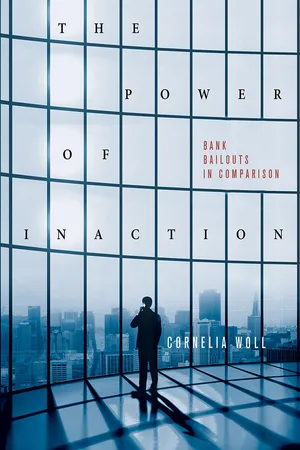
Bank bailouts in the aftermath of the collapse of Lehman Brothers and the onset of the Great Recession brought into sharp relief the power that the global financial sector holds over national politics, and provoked widespread public outrage. In The Power of Inaction, Cornelia Woll details the varying relationships between financial institutions and national governments by comparing national bank rescue schemes in the United States and Europe. Woll starts with a broad overview of bank bailouts in more than twenty countries. Using extensive interviews conducted with bankers, lawmakers, and other key players, she then examines three pairs of countries where similar outcomes might be expected: the United States and United Kingdom, France and Germany, Ireland and Denmark. She finds, however, substantial variation within these pairs. In some cases the financial sector is intimately involved in the design of bailout packages; elsewhere it chooses to remain at arm's length.Such differences are often ascribed to one of two conditions: either the state is strong and can impose terms, or the state is weak and corrupted by industry lobbying. Woll presents a third option, where the inaction of the financial sector critically shapes the design of bailout packages in favor of the industry. She demonstrates that financial institutions were most powerful in those settings where they could avoid a joint response and force national policymakers to deal with banks on a piecemeal basis. The power to remain collectively inactive, she argues, has had important consequences for bailout arrangements and ultimately affected how the public and private sectors have shared the cost burden of these massive policy decisions.
- 200 pages
- English
- ePUB (mobile friendly)
- Available on iOS & Android
eBook - ePub
About this book
Information
1
Bailout Games
Nothing to be done.
—Samuel Beckett, Waiting for Godot
How could the US government let Lehman Brothers fail? Few questions have been discussed as often in recent economic history, with as much fervor or bewilderment. Following the collapse of the investment bank on 15 September 2008, the financial crisis that had built up for more than a year rippled through the global economy with breathtaking speed, destroying $700 billion in value from retirement plans, government pension funds, and other investment portfolios in just one day, and over $11 trillion during the duration of the entire crisis.1 Banks everywhere found themselves in great difficulties as liquidity dried up completely, and the financial industry in many countries came to a near collapse. The picture was very similar in other countries with substantial financial industries. To avoid repeating the experience of Lehman’s failure, governments rushed to stabilize their banking sectors through bailout schemes, most of them devised in the fall of 2008.
This book compares these bank rescue schemes and makes a very simple point: it is impossible to understand government action without looking at the collective action of the financial industry at the time of near collapse. Turning the opening question around, one needs to ask: How could the US financial industry let Lehman Brothers fail?
Clearly, US financial institutions were all negatively affected by the bankruptcy of their competitor. The rationale for the public bank bailouts that followed was precisely the systemic risk caused by the failure of individual firms. Presumably, the stability of the sector as a whole rather than the financial health of these individual firms was what mattered for the governments committing public money to save an ailing financial institution. Should the financial industry not have been equally concerned about preserving this stability, which crucially affects the operations of all other firms? According to Federal Reserve Chairman Ben Bernanke, a scholar of the Great Depression, the pressure that was put on financial firms in the aftermath of Lehman’s failure was the worst in history: “Out of the 13 most important financial institutions in the United States, 12 were at risk of failure within a period of a week or two.”2 Was it not in the interest of these institutions to avoid the shockwaves sent by Lehman Brothers’ bankruptcy?
What might seem like a rather theoretical and scholarly question was in fact the question posed to the CEO’s of America’s major banks, gathered together by the US secretary of the treasury Henry Paulson on Friday evening, 12 September 2008. Based on a proposal from the Federal Reserve Bank of New York, the administration asked the financial industry to establish a private sector liquidation consortium in order to facilitate an acquisition, similar to the rescue engineered for the hedge fund Long Term Capital Management (LTCM) in 1998. As a contingency, they were asked to come up with an alternative, to find another workable solution to deal with the effects of Lehman’s failure.3 Haunted by the criticism of the public guarantee provided for Bear Stearns several months earlier, the US government argued that it could no longer commit public funds for saving the financial industry. “We did the last one,” Paulson told the bankers in the room, “you are doing this one.”4
To push the financial industry to find a collective solution, he insisted that there would be no government support, “not a penny.”5 The message from the US administration was met with incredulity. “We must be responsible for our own balance sheets and now we are responsible for others?” Lloyd Blankfein, CEO and chairman of Goldman Sachs asked. Paulson remembers how troublesome this realization was for businesses priding themselves as free marketeers. “At what point were the interests of individual firms overridden by the needs of the many? It was the classic question of collective action.”6 According to H. Rodgin Cohen, a Wall Street lawyer and Lehman’s legal counsel at the time, the “not a penny” posture was a political strategy. Indeed, the Fed’s internal liquidation consortium plan contemplated a financial commitment from the government that was not divulged. Cohen’s impression was that the government was “playing a game of chicken or poker.”7
A giant and collective game of chicken, indeed! Like the car game that became a household example in game theory, both parties appeared to be driving at full speed at each other in a single lane that crosses a bridge. In such games, where both acknowledge that the worst possible outcome is a crash—the collapse of the economy—the one who yields first, loses. If the government saves Lehman Brothers, it will commit important amounts of taxpayer money and create substantial moral hazard, which may lead to further rescues becoming necessary in the future. If the industry saves Lehman Brothers’, it will have to collectively carry the costs, at a time where almost all of them had considerable difficulties themselves. Both parties had a strong incentive not to yield. Although discussions concerning a consortium did make some progress, neither party was ready to cover the most important portion of the risk emanating from Lehman’s situation. Despite the general agreement that a failure would be disastrous, neither chickened out. At 1:45 a.m. on Monday, 15 September 2008, Lehman Brothers filed for bankruptcy and financial markets crashed and burned, like speeding cars would when meeting in the middle of the bridge.
Perspectives on Financial Power
In the aftermath of the Lehman failure, governments stopped taking chances. As stock markets plummeted and liquidity dried up, it became evident that markets were not prepared for the failure of systemic institutions, as many had hoped. The negative effects of one failure went far beyond the contagion optimistic analysts had assumed. Within less than a month, most industrialized countries reinforced liquidity provisions and developed bailouts schemes to save institutions from collapsing and to prop up their financial systems. Although some exchanges did take place at the international level, the arrangements were all a decidedly national exercise in crisis management. What is more, their details and institutional setups displayed great variation, despite the fact that they were trying to address similar problems.
In all countries, the political decisions to rescue the banking sector were heavily criticized. With extraordinary amounts of public money committed to saving a sector that had reaped considerable profits in recent decades, few observers were sympathetic to the need for public intervention. Bank bailouts became one of the most scrutinized public policies, with an endless number of inquiry reports written, oversight committees put into place, and media attention focused on explaining who got what, when, and why. In many of the public, popular, and scholarly accounts of bank bailouts, the political influence of the financial industry is singled out as a major culprit for seemingly biased decisions. But what exactly did the financial industry influence? What was the nature of power finance wielded over the fate of the economy and the crisis management in 2008, which affected the lives of so many?
Three main approaches to answering this question exist in early analyses of the crisis in the popular and the academic literature. The first focuses on lobbying and the privileged interactions between the financial industry and public authorities. The second examines institutional constraints as fundamental conditions for public intervention. The third focuses on the symbiotic relationship between finance and the state, and highlights how meaning structures shape government action, or in this case, contributed to complacency.
The first strand most closely focuses on individual strategies of financial institutions and their interaction with governments through lobbying activities. Relying on a public choice perspective where political decisions are traded against resources such as financial support or other favors, analysts in this tradition argue that bailouts were granted because public officials were bought off by the excessively wealthy financial sector. The triggers for intervention are calls by financial donors or constituents for a bailout, not any fundamental concern about financial stability. Such analysts portray the rhetoric accompanying bailouts as the dramatization of the actual risk, as insistence on a “perfect storm” simply to help legitimate intervention.8 Analytically, authors focus on resources and links between financial representatives and public officials that would help to explain easy access.9 Others employ a less exchange-focused perspective but nonetheless study the networks between financial and political elites,10 as well as their joint training and exchange of knowledge. Both lead to converging world views on financial regulation, or “cultural capture.”11 Whatever the precise angle, studies in the first strand are motivated by a desire to understand the interactions between the financial industry and public authorities in order to understand the evolution of regulation and the degree of capture the sector has over the government.12
The second strand focuses on institutional constraints rather than individual interactions. Starting from the recognition that institutional choices shape the interests and limit the options of the central stakeholders, institutional analyses focus on the variation in socioeconomic orders to explain industry preferences and government choices. Policymakers in the United States, for instance, expected Europeans to move more readily toward support schemes for the banking sector, because the percentage of bank intermediation was much higher in Europe than in the United States. This belief mirrors the academic literature. According to Weber and Schmitz, varieties of capitalism are decisive in explaining bailout efforts.13 In the varieties of capitalism literature, the emphasis is on the role of finance and its relationship to the so-called “real” economy,14 while the law and finance literature focuses on the legal origins of divergent financial systems.15 Both strands tend to distinguish between at least two types of financial systems: a bank-based one and a capital-market-based one.16 The power of financial institutions over government derives from this institutional setting, since banks control very closely the access to funding in the first case and are much more subject to market pressures in the second one.17 Although we may analyze how the financial industry shapes these different institutions and transforms it through European integration,18 the central claim of the institutional perspective is that the different settings determine the interests and choices of individual actors. Once an institutional order is stabilized, it confers structural power to those that hold key positions within each arrangement.
The third strand focuses on the joint production of knowledge that defines the stakeholders of financial regulation and their interests. In this strand individual initiatives or institutional features count for little in understanding the influence of the financial industry over policy; instead, by becoming part of a network all relevant stakeholders produce the features through which its behavior is governed. Some refer to this highly intertwined network as the “Wall Street–Treasury complex”19 or more generally the “state-finance nexus.”20 Politically, the achievement of this network is to move financial regulation from direct s...
Table of contents
- List of Figures and Tables
- List of Abbreviations
- 1. Bailout Games
- 2. Crisis Management across the World
- 3. The Power of Collective Inaction
- 4. From Theory to Practice
- 5. The United States and the United Kingdom
- 6. France and Germany
- 7. Ireland and Denmark
- 8. Lessons Learned
- Acknowledgments
- Appendix: List of Interviews
- Bibliography
Trusted by 375,005 students
Access to over 1.5 million titles for a fair monthly price.
Study more efficiently using our study tools.
Frequently asked questions
Yes, you can cancel anytime from the Subscription tab in your account settings on the Perlego website. Your subscription will stay active until the end of your current billing period. Learn how to cancel your subscription
No, books cannot be downloaded as external files, such as PDFs, for use outside of Perlego. However, you can download books within the Perlego app for offline reading on mobile or tablet. Learn how to download books offline
Perlego offers two plans: Essential and Complete
- Essential is ideal for learners and professionals who enjoy exploring a wide range of subjects. Access the Essential Library with 800,000+ trusted titles and best-sellers across business, personal growth, and the humanities. Includes unlimited reading time and Standard Read Aloud voice.
- Complete: Perfect for advanced learners and researchers needing full, unrestricted access. Unlock 1.5M+ books across hundreds of subjects, including academic and specialized titles. The Complete Plan also includes advanced features like Premium Read Aloud and Research Assistant.
We are an online textbook subscription service, where you can get access to an entire online library for less than the price of a single book per month. With over 1.5 million books across 990+ topics, we’ve got you covered! Learn about our mission
Look out for the read-aloud symbol on your next book to see if you can listen to it. The read-aloud tool reads text aloud for you, highlighting the text as it is being read. You can pause it, speed it up and slow it down. Learn more about Read Aloud
Yes! You can use the Perlego app on both iOS and Android devices to read anytime, anywhere — even offline. Perfect for commutes or when you’re on the go.
Please note we cannot support devices running on iOS 13 and Android 7 or earlier. Learn more about using the app
Please note we cannot support devices running on iOS 13 and Android 7 or earlier. Learn more about using the app
Yes, you can access The Power of Inaction by Cornelia Woll in PDF and/or ePUB format, as well as other popular books in Economics & Banks & Banking. We have over 1.5 million books available in our catalogue for you to explore.