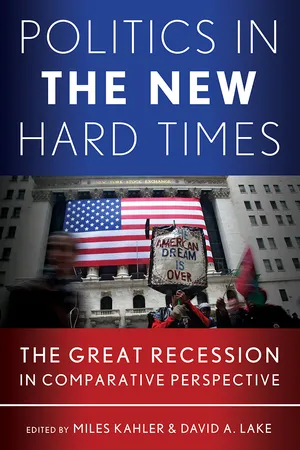
The Great Recession and its aftershocks, including the Eurozone banking and debt crisis, add up to the worst global economic crisis since the Great Depression of the 1930s. Although economic explanations for the Great Recession have proliferated, the political causes and consequences of the crisis have received less systematic attention. Politics in the New Hard Times is the first book to focus on the Great Recession as a political crisis, one with both political sources and political consequences.The authors examine variation in crises over time and across countries, rather than treating these events as undifferentiated shocks. Chapters also explore how crisis has forced the redefinition and reinforcement of interests at the level of individual attitudes and in national political coalitions. Throughout, the authors stress that the Great Recession is only the latest in a long history of international economic crises with significant political effects—and that it is unlikely to be the last.Contributors: Suzanne Berger, MIT; J. Lawrence Broz, University of California, San Diego; Peter Cowhey, University of California, San Diego; Peter A. Gourevitch, University of California, San Diego; Stephan Haggard, University of California, San Diego; Peter A. Hall, Harvard University; Miles Kahler, University of California, San Diego; Peter J. Katzenstein, Cornell University; Ikuo Kume, Waseda University; David A. Lake, University of California, San Diego; Megumi Naoi, University of California, San Diego; Stephen C. Nelson, Northwestern University; Pablo Pinto, Columbia University; James Shinn, Princeton University
eBook - ePub
Politics in the New Hard Times
The Great Recession in Comparative Perspective
- 320 pages
- English
- ePUB (mobile friendly)
- Available on iOS & Android
eBook - ePub
Politics in the New Hard Times
The Great Recession in Comparative Perspective
About this book
Information
Part I
CRISES AND POLITICS
Is This Time Different?
1
ECONOMIC CRISIS AND GLOBAL GOVERNANCE
The Stability of a Globalized World
Miles Kahler
In the public imagination, economic crises seem to offer a simple lesson: economic hard times threaten international cooperation and the institutions of global governance. The cataclysm of the Great Depression has shaped our views of global governance for eight decades. Vivid memories of post-Depression international economic disorder—the demise of the gold standard, rapid descent into competitive currency depreciation, beggar-thy-neighbor trade protectionism and discrimination, and imposition of capital controls—were prominent drivers of institution-building during World War II and in the postwar decades.
The steep economic recession of the early 1980s, which succeeded two oil shocks and an inflation that was unprecedented in the post-1945 era, did not produce a collapse of international economic exchange and cooperation comparable to the Great Depression. Nevertheless, the early 1980s were a threatening period for the global trading system, as Fortress Europe raised protectionist barriers, and the United States embarked on aggressive unilateralism against its Asian trading partners. The Reagan administration in the United States and its European allies in free-market orthodoxy were deeply skeptical of international institutional collaboration, even though the International Monetary Fund (IMF) and the World Bank played a key role in managing the international debt crisis of the 1980s. Japan, although aspiring to economic preeminence, did not appear politically interested or economically equipped to play a leading role in strengthening global or regional governance. The economic downturn posed a threat to both global governance institutions and the great power collaboration that they embodied.
Economic Crisis and Its Effects on International Economic Cooperation
Apart from the easily observed consequences of crisis in both periods, a simple causal model seems to explain the detrimental effects of crisis on international cooperation: the mutual policy adjustments required for cooperation and sustained by international institutions became too costly for politicians facing unparalleled economic distress. Under the pressure of rapidly mounting economic distress—the first meaning of crisis given in the introduction to this volume—unilateral measures, based on national self-interest, promised a higher and more immediate payoff than cooperative steps with longer-run benefits. Although international institutions that sustain cooperation are not synonymous with that cooperation, institutional disruption or collapse is likely to signify that international cooperation—mutual adjustment or coordination of national policies—has eroded or ended in a particular domain. Crisis as an unstable situation of extreme economic difficulty becomes crisis as a turning point in the pattern of international cooperation, the second meaning of crisis.
This simple lesson and the model that links crisis to an undermining of cooperation are both questionable, even for these earlier economic crises. The effects of economic crisis on global economic cooperation and governance—positive or negative, short-term versus long-term—are more ambiguous than a simple equation of international economic crisis with a weakening of global governance institutions. First, that conventional model fails to incorporate possible endogeneity: institutionalized cooperation may itself deepen or prolong economic crisis. Economic historians now assign a major role to the gold standard in deepening the Great Depression, the “golden fetters” that promoted policies of deflation as a first response to an unprecedented economic crisis. As Barry Eichengreen has described, the gold standard prevented unilateral responses by national central banks that were, at the same time, unable to enact a different model of international cooperation that would have permitted them to collaborate in monetary easing to arrest the economic collapse (Eichengreen 1996a, 2002). Why this attachment to a particular modality of international cooperation that was inhibiting a politically and economlcally desirable reflation? Eichengreen and Temin have attributed the power of the gold standard to ideational factors: “the ideology, mentalite, and rhetoric of the gold standard led policymakers to take actions that only accentuated economic distress in the 1930s. Central bankers continued to kick the world economy while it was down until it lost consciousness” (Eichengreen and Temin 1997, 1–2).
The gold standard has also been associated with the disastrous spiral into protectionism that occurred during the Great Depression. Eichengreen and Irwin (2009) demonstrate that those countries that delayed their exit from the gold standard were most likely to implement protectionist measures. Protectionism was less a response to the clamor of domestic interests than a desperate, second-best macroeconomic choice by governments with a (self-) limited menu of policy options. In other words, the content of international cooperation and the policy guides embodied in existing institutions are critical in any assessment of the influence of international collaboration on economic outcomes. Cooperation can deepen crises, just as crises may undermine cooperation. When international monetary collaboration revived in the late 1930s and even more clearly after 1945, governments rejected a revived gold standard as the model for cooperation.
Second, establishing either the independent effects of economic crisis on international cooperation or the sign of those effects is difficult. The trigger event of an economic or financial crisis may reflect ongoing structural change, in this case international cooperation that is already in decline. The 1920s, for example, were not a golden age for economic cooperation and institution building. The gold standard was managed through a loose system of central bank cooperation, which came under increasing strain from democratic demands well before the onset of the Great Depression. In similar fashion, protectionist measures and mercantilist industrial policies multiplied following the first oil shock and recession of 1973–74. Those shocks also confirmed the end of the Bretton Woods fixed exchange rate system. The singular contribution of the 1981–82 recession to a further fraying of the General Agreement on Tariffs and Trade (GATT) and the global trade regime is difficult to estimate.
Finally, any complete calculus of the effects of crisis must also include longer-run positive consequences for international economic cooperation and institutions. Sociological accounts of crisis emphasize the importance of interpretation and learning that occur during and after crises. Because the Great Depression discredited both the old institutional rules (the gold standard) and the subsequent economic disorder, that crisis ultimately produced new global institutions that awarded national governments greater policy autonomy while curbing their impulses toward closure. The recession of the 1980s stimulated interest in a further round of trade negotiations (the Uruguay Round, begun in 1986) and in the Single European Act (also 1986). For regional governance, the effects of crisis may also be positive. When an economic shock affects all states in a regional economy in similar fashion, defensive regional responses may enhance cooperation and regional institution building. The 1930s was an era of regional blocs that were often hierarchical or imperial in design. Monetary disorder in the 1970s spurred European measures to build a regional monetary arrangement. Most notably, the Asian economic crisis—viewed by Asian governments as originating outside the region—lent crucial support to a framework for regional financial cooperation, the Chiang Mai Initiative (Henning forthcoming). The longer run effects of crisis on international cooperation are at best inferred; tracing such effects in any systematic way is even more difficult than evaluating the negative consequences of crisis.
If earlier global economic crises raise doubts about the conventional model in which economic crisis leads to an inevitable deterioration in global economic cooperation and rejection of governance institutions, the Great Recession poses a contemporary and empirical challenge. The economic and political aftershocks of the global economic crisis continue to be felt, and its ultimate effects remain difficult to estimate. Nevertheless, international cooperation during this sharp economic recession has been more sustained and stable than the course of international cooperation during two previous economic downturns that matched or exceeded its severity, the Great Depression of 1929–33 and the global recession of 1981–82. In the present crisis, concrete steps for deepening global economic cooperation have been agreed on, and discussion of such measures continues in multilateral settings, such as the Group of Twenty (G-20) summits. Existing institutions of global economic governance have, in most cases, received additional resources and authority. Only the Eurozone crisis that erupted in 2010 threatened an existing system of governance, in that case, a regional one. Despite the severity of the Great Recession in most of the core industrialized economies, this crisis did not appear to mark a turning point, even a temporary one, in the global economic governance and its existing institutions.
Economic Integration and Global Governance: The Fragility of a Globalized World
The deepest economic recession in the era of globalization might have produced a very different pattern of national policies and international collaboration. In the pre-crisis decades, economic globalization had not produced a uniform strengthening of global governance institutions that could restrain the unilateral impulses of national governments. Although the creation of the World Trade Organization (WTO) in 1995 signaled a strengthened and legalized global trade regime, other globalized sectors did not match this award of greater authority to global economic institutions.
During the 1990s, the IMF expanded its advisory role for economies transitioning from socialism to capitalism. Its role in monetary and financial surveillance, particularly with regard to the major national economies, remained minimal. Efforts at formal macroeconomic policy coordination, which had culminated in the Louvre Accords of 1987, were effectively abandoned during the 1990s. Calls for a reformed international monetary system that would constrain national choices of exchange rates and exchange rate regimes were ignored.
Cross-border financial flows outstripped regulatory and supervisory capacities that were only weakly coordinated at the global level. International oversight of national regulation was vested primarily in the Basel Committee on Banking Supervision, based at the Bank for International Settlements (BIS). Its combination of information sharing and peer pressure served to fill gaps in the oversight of internationally active financial institutions. Apart from its agreement on capital adequacy standards, however, few binding international regulatory standards were implemented. The financial turmoil of the late 1990s produced the Financial Stability Forum, a new mechanism for loose coordination among an expanded collection of national regulators. Demands from the developing countries for regulation of nonbank financial institutions, such as hedge funds, were rejected by the major financial powers (Eichengreen 2003).
In other domains of global economic integration, multilateral governance was minimal or absent. Foreign direct investment has been a major driver of economic globalization, growing more rapidly than trade since 1990. Attempts to create a global investment regime under the Organisation for Economic Cooperation and Development (OECD) failed, however. Bilateral investment treaties (BITs) remained the core instruments in international governance of foreign direct investment. Although it hardly equaled the scale of migration during the pre-1914 era of globalization, cross-border movement of labor became an important component of the new globalized economy. Remittances from migrant labor became an essential contributor to economic development in many poor economies. Yet policies governing economic migration (in contrast to refugee flows) remained subject to national authorities and, occasionally, regional and bilateral agreements. No global migration regime existed; no proposal for such a regime was on the international agenda.
Rather than the runaway, unaccountable international institutions that preoccupy critics of globalization, a more accurate observation in the new century is the limited reach of supranational institutions, given the extent of global economic integration.1 Regional institution building presented a similar mixed picture. The Economic and Monetary Union of the European Union (EU) appeared to succeed with the adoption of the euro as a common currency by most members in 2002. At the same time, European electorates repeatedly demonstrated their skepticism regarding deeper political integration, a costly shortcoming that contributed to the onset of the Eurozone’s sovereign debt crisis in 2010. In the most economlcally dynamic region of the global economy, Asia, modest steps were made toward greater regional collaboration, particularly in the Chiang Mai Initiative and in bilateral and subregional trade agreements. In parallel with the global trend, however, institutional development failed to match the growth and integration of the Asia-Pacific regional economy.2
The Great Recession and the Persistence of International Economic Cooperation
When the global economic crisis began in 2008–9, intergovernmental cooperation and the authority vested in global intergovernmental institutions had not kept up with rapid integration of the world economy. Markets were regarded as stable and market actors as stabilizing; self-regulation or limited regulation became the new norm. Given the thinness of global governance in the face of a transformed international economy, one might have predicted that a global economic and financial crisis would produce a failure of international cooperation as great as that of the early 1930s. Instead, when the crisis began in 2007 and deepened in late 2008, politicians for the most part reached for familiar solutions, encouraged by existing international institutions. Cooperative behavior dominated during a period of deep economic distress and uncertainty. In the face of crisis, existing global institutions have been strengthened, and modest institutional innovations have been promoted. Economic crisis was not transformed into a crisis or turning point in global governance.
The International Monetary Fund experienced the most significant reversal of fortunes. Only a few years before the Great Recession, many feared (or hoped) that the IMF had become obsolete in a world of expanding private capital flows. Resistance to IMF prescriptions after the Asian financial crisis explained in part the rapid buildup of reserves by Asian and other developing countries. The same member countries bridled at their underrepresentation in the IMF’s governance. Countries that had long been on the IMF client list, such as Argentina, hastened to end IMF programs. The loss of clients in a period of apparent financial calm produced unfamiliar budget constraints at the IMF and forced a reduction in staff.
This downturn in the IMF role in global governance was quickly reversed during the economic crisis. The IMF has resumed its familiar role of providing financial assistance to countries that have been excluded from the troubled financial markets.3 In addition, the IMF instituted a new lending facility designed for large, credit-worthy economies beset by global financial turmoil, the Flexible Credit Line (FCL). Steps were taken for an overdue revision of IMF quotas to reflect the growing importance of developing economies, a commitment reinforced at the Pittsburgh Summit of the G-20 in September 2009. (A similar, though smaller, shift in voting power and quotas was agreed for the World Bank.) Governments of the largest emerging economies, such as China, found additional leverage in their commitments to increase the resources of the IMF by purchasing IMF-issued bonds. This prospective shift in the balance of influence within the IMF was predicted to strengthen its representative character ...
Table of contents
- Illustrations
- Preface
- Introduction
- Part I CRISES AND POLITICS: IS THIS TIME DIFFERENT?
- Part II INTERESTS, COALITIONS, AND CONSEQUENCES
- Afterword
- References
- About the Contributors
Trusted by 375,005 students
Access to over 1.5 million titles for a fair monthly price.
Study more efficiently using our study tools.
Frequently asked questions
Yes, you can cancel anytime from the Subscription tab in your account settings on the Perlego website. Your subscription will stay active until the end of your current billing period. Learn how to cancel your subscription
No, books cannot be downloaded as external files, such as PDFs, for use outside of Perlego. However, you can download books within the Perlego app for offline reading on mobile or tablet. Learn how to download books offline
Perlego offers two plans: Essential and Complete
- Essential is ideal for learners and professionals who enjoy exploring a wide range of subjects. Access the Essential Library with 800,000+ trusted titles and best-sellers across business, personal growth, and the humanities. Includes unlimited reading time and Standard Read Aloud voice.
- Complete: Perfect for advanced learners and researchers needing full, unrestricted access. Unlock 1.5M+ books across hundreds of subjects, including academic and specialized titles. The Complete Plan also includes advanced features like Premium Read Aloud and Research Assistant.
We are an online textbook subscription service, where you can get access to an entire online library for less than the price of a single book per month. With over 1.5 million books across 990+ topics, we’ve got you covered! Learn about our mission
Look out for the read-aloud symbol on your next book to see if you can listen to it. The read-aloud tool reads text aloud for you, highlighting the text as it is being read. You can pause it, speed it up and slow it down. Learn more about Read Aloud
Yes! You can use the Perlego app on both iOS and Android devices to read anytime, anywhere — even offline. Perfect for commutes or when you’re on the go.
Please note we cannot support devices running on iOS 13 and Android 7 or earlier. Learn more about using the app
Please note we cannot support devices running on iOS 13 and Android 7 or earlier. Learn more about using the app
Yes, you can access Politics in the New Hard Times by Miles Kahler, David A. Lake, Miles Kahler,David A. Lake in PDF and/or ePUB format, as well as other popular books in Economics & Political Economy. We have over 1.5 million books available in our catalogue for you to explore.