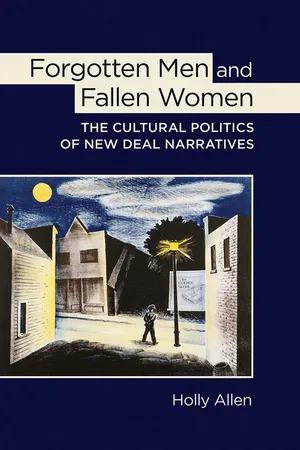
During the Great Depression and into the war years, the Roosevelt administration sought to transform the political, institutional, and social contours of the United States. One result of the New Deal was the emergence and deployment of a novel set of narratives—reflected in social scientific case studies, government documents, and popular media—meant to reorient relationships among gender, race, sexuality, and national political power. In Forgotten Men and Fallen Women, Holly Allen focuses on the interplay of popular and official narratives of forgotten manhood, fallen womanhood, and other social and moral archetypes. In doing so, she explores how federal officials used stories of collective civic identity to enlist popular support for the expansive New Deal state and, later, for the war effort.These stories, she argues, had practical consequences for federal relief politics. The "forgotten man," identified by Roosevelt in a fireside chat in 1932, for instance, was a compelling figure of collective civic identity and the counterpart to the white, male breadwinner who was the prime beneficiary of New Deal relief programs. He was also associated with women who were blamed either for not supporting their husbands and family at all (owing to laziness, shrewishness, or infidelity) or for supporting them too well by taking their husbands' jobs, rather than staying at home and allowing the men to work.During World War II, Allen finds, federal policies and programs continued to be shaped by specific gendered stories—most centrally, the story of the heroic white civilian defender, which animated the Office of Civilian Defense, and the story of the sacrificial Nisei (Japanese-American) soldier, which was used by the War Relocation Authority. The Roosevelt administration's engagement with such widely circulating narratives, Allen concludes, highlights the affective dimensions of U.S. citizenship and state formation.
- 264 pages
- English
- ePUB (mobile friendly)
- Available on iOS & Android
eBook - ePub
About this book
Information
Topic
StoriaSubtopic
Storia nordamericanaChapter 1
The War to Save the Forgotten Man
Gender, Citizenship, and the Politics of Work Relief
In an Albany radio address in the spring of 1932, Franklin Roosevelt introduced the “forgotten man” into the nation’s political imagination. In a speech on national economic policy, he proclaimed, “These unhappy times call for the building of plans that…put faith once more in the forgotten man at the bottom of the economic pyramid.” In describing the forgotten man, he referred to the nation’s unemployed, but also to modest farmers, homeowners, and small investors whose buying and saving power was failing due to the “top-down” policies of the Hoover administration. If elected, Roosevelt declared, he would make resolving the troubles of such “forgotten men” a priority. He would rebuild the nation’s fortunes “from the bottom up,” he claimed, just as an earlier generation of military leaders had done in 1917.1
Although initially representing a much broader group of ordinary Americans, the forgotten man quickly became a figure for the Depression unemployed and particularly for jobless white men dependent on relief. After Roosevelt’s inauguration in March 1933, his administration touted the federal government’s role in recuperating the forgotten man, converting him from a national liability into a harbinger of national recovery. Over the course of the New Deal years, the forgotten man came to represent a combination of old and new American principles: the reassuringly familiar principles of productivity, family providership, and responsible civic membership, and the potentially alarming principle of federal action to protect citizens’ social and economic rights. By aligning emergent federal policies with traditional gender and racial ideals, forgotten-man stories worked to alleviate public anxiety about the expansive bureaucratic authority of the New Deal state.
The New Deal narrative of forgotten manhood was by no means static, and it underwent multiple challenges and revisions over the course of the 1930s. Indeed, an indicator of its effectiveness is the extent to which it captured the popular imagination as well as that of the New Deal’s conservative opposition. As the principles embedded in the forgotten-man narrative gained acceptance, the narrative itself grew more varied. The forgotten-man story spiraled outward from its official origins, finding its way into opposition rhetoric as well as into advertising, popular literature and film, and the correspondence and conversation of ordinary Americans. Those unofficial variations, in turn, reverberated inward, affecting not only New Deal narratives but the actual relief policies with which those narratives were linked. Examining the evolution and variety of forgotten-man stories thus affords us the opportunity not only to consider the gender and racial implications of federal relief policy from a different perspective but also to examine how a particular, emotionally charged story about collective white masculine identity contributed to the hegemonic power of the New Deal state.2 How did various contestants for authorship of the forgotten-man narrative use emotionally charged gender and racial imagery to promote “a useful sense of civic identity”? What “preexisting senses of common identity” did they invoke? And how were federal relief policy and concepts of national citizenship and governmental authority correspondingly changed?
In posing these questions, this chapter approaches forgotten-man narratives as an important genre of civic storytelling during the New Deal years.3 Operating through recurring characters, plot developments, and audience expectations, forgotten-man stories reassured anxious Americans that jobless male householders might be down and out, but they were still privileged members of a virile, white nation imagined in fraternal and familial terms. Such narratives centered on the jobless white man’s affective transformation from bitterness and despair to renewed pride and purposefulness as participants in federally sponsored work relief. They also offered affective assurance that the New Deal was a champion of the very political conventions that its expansive bureaucracy seemed most to upset: local civic autonomy and the self-reliant white-male-headed home.
Within the wide-ranging narrative and iconography of forgotten manhood, three interconnected strands are evident: (1) official narratives that appeared in government publications and in the public addresses and writings of New Deal leaders, (2) unofficial narratives that elaborated sympathetically on official New Deal versions, and (3) conservative counternarratives that used the same basic story line to critique the New Deal. Each kind of story influenced the others as well as the policymaking process.4
In most civic narratives of forgotten manhood, the protagonist was racialized as white. Yet members of other racial groups also identified with the “forgotten man…at the bottom of the economic pyramid” whom Roosevelt had pledged to “remember” in his 1932 campaign. African Americans and Mexican Americans supported and benefited from New Deal programs, but they also endured considerable racism as claimants to New Deal civic membership. As a result, they generated forgotten-man narratives that reflected their own, racially specific experiences of New Deal relief. Considering their stories, along with more prevalent white narratives, illuminates the gender and racial inequities embedded in the stories themselves and in relief policies and concepts of social citizenship that those stories helped to mediate.
The institutional history of federal emergency relief is also intertwined with the broader narrative of forgotten manhood. More than just a context for the other narratives, it stands as another story of forgotten manhood—one that interacted with the others in fascinating ways. What distinguishes the institutional history from the other stories is that its actors include many men and women for whom the vagaries of the Depression and relief were all too real. As clients within a changing system of federal relief, they all had pressing material needs, but not all could conform to the shifting civic ideals embedded in white forgotten-man narratives and in relief policies that emerged in dialogue with them. The contested narrative of forgotten manhood was particularly consequential for them.
Popular Narratives
Introduced in April 1932, Roosevelt’s campaign version of forgotten manhood quickly began to generate alternative narratives. When the Hoover administration forcibly dispersed Bonus veterans in July 1932, commentators labeled the retreating marchers “forgotten men.” When private citizens sent letters to newspapers and public officials, they often signed themselves “The Forgotten Man.” In the year 1933 alone, several books were published under the titles “Forgotten Man” and “Forgotten Men,” to say nothing of articles, opinion pieces, short stories, and verse.5 The frequency of forgotten-man references prompted one magazine editor to wonder whether the “forgotten man,” like other “phrases and expressions [that] suddenly become popular,” would be “overworked and pass away almost as rapidly as [it] sprang into being.”6 Far from passing away quickly, “the forgotten man” remained phenomenally popular throughout the New Deal years. And although it continued to apply to many different groups, its primary referent quickly became jobless white men struggling to provide for their families.
“Who was this Forgotten Man of Mr. Roosevelt’s?,” Julian Aronson, a writer for Scholastic magazine, asked in February 1934. He continued, “He was the man who had no job and was told to rely on charity for relief….”7 Having been forgotten “in the great blizzard of prosperity that blinded us all to the insane nature of our catch-as-catch-can system,” the forgotten man was not responsible for his unemployment, but was rather a victim of forces beyond his control. He was also a householder with family dependents. Aronson continued, “Anybody who had seen…the sheriff confront him with a warrant for non-payment of rent, his children go to school unfed, could now identify with the Forgotten Man.”
Without explicitly naming the forgotten man, sociologist Pauline Young also narrated his composite experience in 1933. Through no fault of their own, she suggested, men who lost their livelihoods in the Depression had been “uprooted from the soil that previously sustained them.” As a result, many “became despondent to the breaking point.” They lost “the sense of their personal worth” and faced “a breach in family relationships.” As Young described him, the forgotten man was not only economically but emotionally destitute: “not only a worker without a job, [ he was]…a citizen without courage, a husband without the moral support of his wife, a father without control over his children.”8 His joblessness spelled disaster not only for his family’s finances but for a whole range of American values and institutions that depended on the emotional hardihood of the white male breadwinner ideal.9
Fictional narratives of forgotten manhood also abounded. In “Fred Salo—Forgotten Man,” Tom Jones Parry describes a white forgotten man who leads a modest yet comfortable life until he falls victim to the economic crisis. Unemployed through no fault of his own, Fred Salo initially meets misfortune with optimism, claiming, “I’ll find something…I’ve never been idle long in my life, you bet.”10 Yet gradually, as his efforts to find work meet with disappointment, he grows demoralized and disaffected. Parry writes, “Fred listlessly walked the streets. He made few calls now, and sometimes whole days would pass without him mustering up courage for one interview.” His family situation deteriorates, leaving Fred “ashamed to go home.”11 He spends more and more time associating with other jobless men at the headquarters of the Unemployed League, whose subversive views he gradually adopts. Salo’s desperation and increasingly radical views only alleviate when his former employer invites him back to work. No longer idle but pleasantly exhausted after his first day back on the job, Salo is effectively restored to productive breadwinning manhood. Domestic harmony is restored as his wife recovers her role tending to his domestic needs. Salo’s renewed optimism suggested the necessary means to national recovery: hard, productive labor for America’s white male breadwinners to keep them from idleness and the demoralization and subversive fraternization that idleness fosters.
The poet Nels Francis Nordstrom similarly depicted the plight of “forgotten” steelworkers. “There are men everywhere. Strange—different. / Their faces are clean, pale, lost.” He likened them to rusting machinery, forced to “serve…days of waiting.” Idle by day, such men were troublesome by night, having no outlet except “the poolrooms, the gang.”12 Like Parry’s story, Nordstrom’s poem raises the specter of improper fraternization that results from jobless men’s demoralization. “There are men everywhere,” Nordstrom comments; women and the stabilizing influence of family ties are absent from the bleak picture he paints.
Other writers likewise depicted the forgotten man as a potentially subversive, homosocial figure who increasingly gravitated to the fraternal “army of the unemployed” in preference to his destitute and unhappy home. “Uprooted from the social soil which previously sustained them, they lose their sense of balance,” Pauline Young observed. One man who described himself as “28 years old with a wife and child to support,” informed the editor of the New York Times that he was “frantic” for work. “I must have a position before I literally go to pieces,” he declared, signing his letter “The Forgotten Man.” People who “went to pieces” behaved in unpredictable ways. “An undercurrent of resentment, disaffection, and threats [is becoming] more prevalent,” one social worker observed. He added, “Fears are expressed that a mounting unrest may begin to assume more violent forms of expression.”13 Prior to the advent of New Deal relief, the individual “forgotten man” was often linked with the aggregate “army of the unemployed,” which posed a threat to American political and social institutions.
Federal Relief
Just as unofficial narratives emphasized the white forgotten man’s joblessness and demoralization in the months following the 1932 campaign, New Deal insiders focused their rhetoric of forgotten manhood more squarely on the unemployed in 1933. In his March 21 message to Congress titled “Three Essentials for Unemployment Relief,” Roosevelt embellished his campaign vision of forgotten manhood. “The overwhelming majority of unemployed Americans, who are now walking the streets and receiving private or public relief, would infinitely prefer to work,” he declared. Through a combination of federal grants of aid to the states, emergency conservation work, and federal public works, Roosevelt pledged to “eliminate to some extent at least the threat that enforced idleness brings to spiritual and moral stability.”14
Assisting the forgotten man to recover emotional and economic equilibrium became a crucial rationale for the Federal Emergency Relief Administration (FERA), established in May 1933. Directed by Harry Hopkins, the FERA was a massive undertaking that brought the federal government directly into the lives of millions of ordinary citizens. Not only individuals, but state and local governments and private welfare agencies were compelled to yield, at least to some extent, to the strong hand of the New Deal administration under the new relief agency. Of course, the FERA was a limited beginning based on the premise that the economic emergency was temporary and joblessness would soon abate. Nevertheless, the agency shifted the balance of power between federal, state, and local civic authorities and challenged the masculine civic ideal of self-reliance by offering jobless Americans a federal helping hand.
The FERA began a fundamental transformation of American relief practices. It began its work at a time when state and local relief agencies had been overtaxed and the infusion of federal funds explicitly for the purpose of emergency relief transformed the relief picture. It imposed a national structure on the administration of general relief, helping to set up state-level relief offices for the first time in forty of the forty-eight states. Prior to the FERA, old-style poor relief—punitive, inadequate, and discriminatory—was the norm in many communities. In it place, FERA imposed professional social work standards in exchange for federal funding. As much as possible, agency administrators tried to enforce employment of trained social workers at every level of public relief administration. Welfare historian William Brock notes that its professional formula for relief giving was remarkably successful. Using its power as a funding agency to encourage compliance, the FERA created a new, federal blueprint for...
Table of contents
- “More Terrible than the Sword”
- 1. The War to Save the Forgotten Man
- 2. “Uncle Sam’s Wayside Inns”
- 3. “Builder of Men”
- 4. “To Wallop the Ladies”
- 5. Civilian Protectors and Meddlesome Women
- 6. The Citizen-Soldier and the Citizen-Internee
- Stories of Homecoming
- Notes
- Index
Trusted by 375,005 students
Access to over 1.5 million titles for a fair monthly price.
Study more efficiently using our study tools.
Frequently asked questions
Yes, you can cancel anytime from the Subscription tab in your account settings on the Perlego website. Your subscription will stay active until the end of your current billing period. Learn how to cancel your subscription
No, books cannot be downloaded as external files, such as PDFs, for use outside of Perlego. However, you can download books within the Perlego app for offline reading on mobile or tablet. Learn how to download books offline
Perlego offers two plans: Essential and Complete
- Essential is ideal for learners and professionals who enjoy exploring a wide range of subjects. Access the Essential Library with 800,000+ trusted titles and best-sellers across business, personal growth, and the humanities. Includes unlimited reading time and Standard Read Aloud voice.
- Complete: Perfect for advanced learners and researchers needing full, unrestricted access. Unlock 1.5M+ books across hundreds of subjects, including academic and specialized titles. The Complete Plan also includes advanced features like Premium Read Aloud and Research Assistant.
We are an online textbook subscription service, where you can get access to an entire online library for less than the price of a single book per month. With over 1.5 million books across 990+ topics, we’ve got you covered! Learn about our mission
Look out for the read-aloud symbol on your next book to see if you can listen to it. The read-aloud tool reads text aloud for you, highlighting the text as it is being read. You can pause it, speed it up and slow it down. Learn more about Read Aloud
Yes! You can use the Perlego app on both iOS and Android devices to read anytime, anywhere — even offline. Perfect for commutes or when you’re on the go.
Please note we cannot support devices running on iOS 13 and Android 7 or earlier. Learn more about using the app
Please note we cannot support devices running on iOS 13 and Android 7 or earlier. Learn more about using the app
Yes, you can access Forgotten Men and Fallen Women by Holly Allen in PDF and/or ePUB format, as well as other popular books in Storia & Storia nordamericana. We have over 1.5 million books available in our catalogue for you to explore.