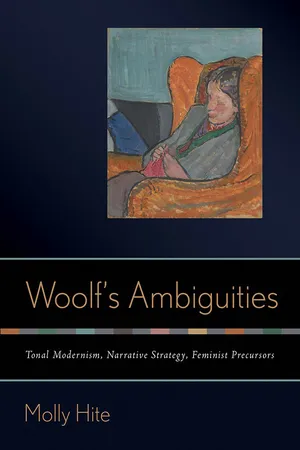
In a book that compares Virginia Woolf's writing with that of the novelist, actress, and feminist activist Elizabeth Robins (1862–1952), Molly Hite explores the fascinating connections between Woolf's aversion to women's "pleading a cause" in fiction and her narrative technique of complicating, minimizing, or omitting tonal cues. Hite shows how A Room of One's Own, Mrs. Dalloway, and The Voyage Out borrow from and implicitly criticize Robins's work.
Hite presents and develops the concept of narrative tone as a means to enrich and complicate our readings of Woolf's modernist novels. In Woolf's Ambiguities, she argues that the greatest formal innovation in Woolf's fiction is the muting, complicating, or effacing of textual pointers guiding how readers feel and make ethical judgments about characters and events. Much of Woolf's narrative prose, Hite proposes, thus refrains from endorsing a single position, not only adding value ambiguity to the cognitive ambiguity associated with modernist fiction generally, but explicitly rejecting the polemical intent of feminist novelists in the generation preceding her own. Hite also points out that Woolf reconsidered her rejection of polemical fiction later in her career. In the unfinished draft of her "essay-nove;" The Pargiters, Woolf created a brilliant new narrative form allowing her to make unequivocal value judgments.