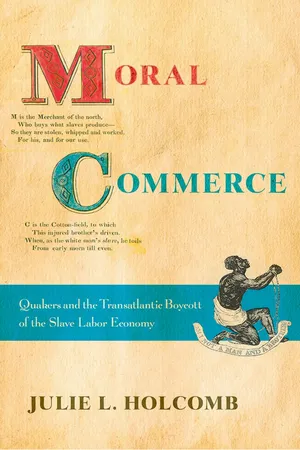
Moral Commerce
eBook - ePub

Moral Commerce

Quakers and the Transatlantic Boycott of the Slave Labor Economy

  1. 272 pages
  2. English
  3. ePUB (mobile friendly)
  4. Available on iOS & Android
eBook - ePub

Moral Commerce

Quakers and the Transatlantic Boycott of the Slave Labor Economy

About this book

How can the simple choice of a men's suit be a moral statement and a political act? When the suit is made of free-labor wool rather than slave-grown cotton. In Moral Commerce, Julie L. Holcomb traces the genealogy of the boycott of slave labor from its seventeenth-century Quaker origins through its late nineteenth-century decline. In their failures and in their successes, in their resilience and their persistence, antislavery consumers help us understand the possibilities and the limitations of moral commerce.

Quaker antislavery rhetoric began with protests against the slave trade before expanding to include boycotts of the use and products of slave labor. For more than one hundred years, British and American abolitionists highlighted consumers' complicity in sustaining slavery. The boycott of slave labor was the first consumer movement to transcend the boundaries of nation, gender, and race in an effort by reformers to change the conditions of production. The movement attracted a broad cross-section of abolitionists: conservative and radical, Quaker and non-Quaker, male and female, white and black.

The men and women who boycotted slave labor created diverse, biracial networks that worked to reorganize the transatlantic economy on an ethical basis. Even when they acted locally, supporters embraced a global vision, mobilizing the boycott as a powerful force that could transform the marketplace. For supporters of the boycott, the abolition of slavery was a step toward a broader goal of a just and humane economy. The boycott failed to overcome the power structures that kept slave labor in place; nonetheless, the movement's historic successes and failures have important implications for modern consumers.

Frequently asked questions

Yes, you can cancel anytime from the Subscription tab in your account settings on the Perlego website. Your subscription will stay active until the end of your current billing period. Learn how to cancel your subscription.
No, books cannot be downloaded as external files, such as PDFs, for use outside of Perlego. However, you can download books within the Perlego app for offline reading on mobile or tablet. Learn more here.
Perlego offers two plans: Essential and Complete
  • Essential is ideal for learners and professionals who enjoy exploring a wide range of subjects. Access the Essential Library with 800,000+ trusted titles and best-sellers across business, personal growth, and the humanities. Includes unlimited reading time and Standard Read Aloud voice.
  • Complete: Perfect for advanced learners and researchers needing full, unrestricted access. Unlock 1.4M+ books across hundreds of subjects, including academic and specialized titles. The Complete Plan also includes advanced features like Premium Read Aloud and Research Assistant.
Both plans are available with monthly, semester, or annual billing cycles.
We are an online textbook subscription service, where you can get access to an entire online library for less than the price of a single book per month. With over 1 million books across 1000+ topics, we’ve got you covered! Learn more here.
Look out for the read-aloud symbol on your next book to see if you can listen to it. The read-aloud tool reads text aloud for you, highlighting the text as it is being read. You can pause it, speed it up and slow it down. Learn more here.
Yes! You can use the Perlego app on both iOS or Android devices to read anytime, anywhere — even offline. Perfect for commutes or when you’re on the go.
Please note we cannot support devices running on iOS 13 and Android 7 or earlier. Learn more about using the app.
Yes, you can access Moral Commerce by Julie L. Holcomb in PDF and/or ePUB format, as well as other popular books in History & North American History. We have over one million books available in our catalogue for you to explore.

Information

Table of contents

  1. List of Illustrations
  2. Acknowledgments
  3. Introduction
  4. 1. Prize Goods: The Quaker Origins of the Slave-Labor Boycott
  5. 2. Blood-Stained Sugar: The Eighteenth-Century British Abstention Campaign
  6. 3. Striking at the Root of Corruption: American Quakers and the Boycott in the Early National Period
  7. 4. I Am a Man, Your Brother: Elizabeth Heyrick, Abstention, and Immediatism
  8. 5. Woman’s Heart: Free Produce and Domesticity
  9. 6. An Abstinence Baptism: American Abolitionism and Free Produce
  10. 7. Yards of Cotton Cloth and Pounds of Sugar: The Transatlantic Free-Produce Movement
  11. 8. Bailing the Atlantic with a Spoon: Free Produce in the 1840s and 1850s
  12. Conclusion
  13. Notes
  14. Index