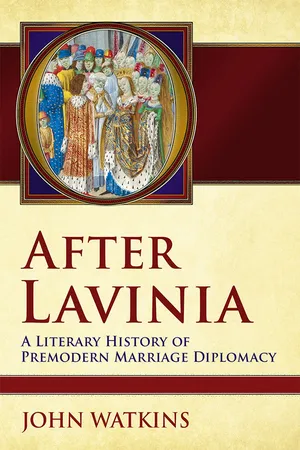
The Renaissance jurist Alberico Gentili once quipped that, just like comedies, all wars end in a marriage. In medieval and early modern Europe, marriage treaties were a perennial feature of the diplomatic landscape. When one ruler decided to make peace with his enemy, the two parties often sealed their settlement with marriages between their respective families. In After Lavinia, John Watkins traces the history of the practice, focusing on the unusually close relationship between diplomacy and literary production in Western Europe from antiquity through the seventeenth century, when marriage began to lose its effectiveness and prestige as a tool of diplomacy.Watkins begins with Virgil's foundational myth of the marriage between the Trojan hero Aeneas and the Latin princess, an account that formed the basis for numerous medieval and Renaissance celebrations of dynastic marriages by courtly poets and propagandists. In the book's second half, he follows the slow decline of diplomatic marriage as both a tool of statecraft and a literary subject, exploring the skepticism and suspicion with which it was viewed in the works of Spenser and Shakespeare. Watkins argues that the plays of Corneille and Racine signal the passing of an international order that had once accorded women a place of unique dignity and respect.
- 288 pages
- English
- ePUB (mobile friendly)
- Available on iOS & Android
eBook - ePub
About this book
Information
Index
LiteraturePart One
Origins
Chapter 1
After Rome
Interdynastic Marriage during the First Christian Centuries
On October 24, 1441, Francesco Sforza’s wedding to Bianca Maria Visconti staved off a succession crisis. Bianca was the illegitimate daughter of Filippo Visconti, the last Visconti duke of Milan. Filippo had betrothed her to Sforza when she was six years old, in order to ensure the celebrated mercenary’s loyalty. But the scheme did not work particularly well, since Sforza ended up fighting for the Venetians against Visconti. Nevertheless, the two men were eventually reconciled, and the marriage took place.
During the festivities, the Lombard poet Ludovico Carbone honored the couple with an oration praising Bianca in Virgilian terms as a second Lavinia:
I ask you, esteemed gentlemen, what would have been the state of Italy? How utterly wretched the condition of everything? What a disturbance when the Milanese prince Filippo Maria passed away without any male heir and only the divine Bianca, like another Lavinia, preserving the Visconti house and all its lands, had not the great prince Francesco Sforza, afterwards strongest in the memory of men, been found worthy, who received that government by right of marriage?
[Quaero a vobis, viri praesentissimi, quisnam futurus erat Italiae status? Quam miserrima rerum conditio? Quanta perturbatio cum Mediolani princeps Philippus Maria sine ulla virili prole diem suum obiisset et sola Diva Bianca, tanquam altera Lavinia, Vicecomitum domum et tantas sedes servaret, nisi magnanimus et post hominum memoriam fortissimus imperator Franciscus Sfortia dignus esset inventus qui id gubernaculum iure coniungii exciperet?]1
The Virgilian allusion transforms the potentially embarrassing fact of Bianca’s marriage to her father’s sometime enemy into a reenactment of the marriage that laid the foundation for the Roman Empire. Just as the Trojan Aeneas first waged war against the Latin King Turnus but later married his daughter Lavinia, Francesco’s past enmity against Filippo ends in a marriage establishing a new dynasty. In each case, marriage legitimizes the suitor’s arriviste claims to his father-in-law’s lands. Even as the Roman Empire rose on Latin and Trojan bloodlines, Visconti and Sforza blood will flow in the veins of Bianca and Francesco’s heirs. Allusions to Aeneas’s marriage to Lavinia recur throughout Renaissance poems, orations, paintings, and tapestries honoring particular marriages. Francesco Bertini quoted Virgil’s description of Lavinia’s blush when praising Ippolita Sforza’s beauty on the day she married the Duke of Calabria, “as if someone stained Indian ivory with crimson murex, or myriad white lilies mixed with roses blushed.”2 Aeneas and Lavinia’s wedding was a common subject on cassoni, the chests containing the trousseau a bride brought with her to her husband’s house.3 When Cambridge University students compiled a volume of verses honoring the Princess Elizabeth’s marriage to Frederick V, Elector Palatine, in 1613, they filled it with references to the bride as another Lavinia and the groom as a second Aeneas.4 Many of the period’s great vernacular epics incorporate the Virgilian couple as models for foundational marriages for the dynasties they honor.5 In Orlando Furioso, Ariosto casts Ruggiero and the warrior woman Bradamante as the mythical founders of the Estense dynasty of Ferrara. Spenser followed suit in The Faerie Queene by casting Arthegall and Britomart as progenitors of the Tudors. The fact that Virgil’s narrative ends before the promised marriage takes place did not stop them. The Renaissance assumption that the narrative ought to have concluded with the marriage was so strong that the Italian poet Maphaeo Vegio wrote a “Thirteenth Book of the Aeneid” depicting the ceremony.6 Numerous humanist editions of Virgil included Vegio’s text, giving it a kind of posthumous Virgilian authority.7
These recurrent allusions to Virgil derive from a centuries-old desire to endow the political present with the aura of Roman greatness. As I argue in this chapter, the first texts to imagine later marriages as a repetition of Aeneas’s marriage to Lavinia date from antiquity. Writing in the sixth century, the Goth Jordanes prioritized a marriage between his people and the Byzantines as the final proof of their incorporation into the Roman world. For the Romano-Gallic Gregory of Tours and the Anglo-Saxon Bede, Virgil’s story of an amalgamation between Trojan and Latin cultures provided a model for the Christianization of the barbarian kingdoms that succeeded the Roman Empire in the West.8
From the perspective that numerous medieval and early modern writers adopted, the Aeneid upheld marriage between rival ruling families as a way not only of resolving differences and putting an end to hostilities but even of blending alien races into a single, coherent people drawing on the finest attributes of each. A crucial passage for later encomiasts was Juno and Jupiter’s negotiation of the terms of the Latins’ final surrender in book 12. Within the poem’s Olympian fiction, the war between the Trojans and Latins, like the greater war between the Trojans and the Greeks it mirrors, derives from a conflict among the gods that must be resolved first. Juno, the champion of the Latins as she was before of the Greeks, must accept the will of Jupiter and the Fates ordaining Rome as a second Troy. When she realizes at last that Aeneas will prevail and the Trojans triumph over the native Latins, she makes one final request:
So be it, when with happy marriage rites
they make peace, and join through laws and treaties,
that you neither command them to become Trojans, nor be called
Trojans,
Trojans,
nor change their speech or old attire.
Let Latium remain, let there be Alban kings for centuries,
Let the Roman offspring be powerful through Italian virtue.
Troy fell: Let it remain fallen along with its name.
[cum iam conubiis pacem felicibus (esto)
component, cum iam leges et foedera iungent,
ne vetus indigenas nomen mutare Latinos
neu Troas fieri iubeas Teucrosque vocari
aut vocem mutare viros aut vertere vestem.
sit Latium, sint Albani per saecula reges,
sit Romana potens Itala virtute propago:
occidit, occideritque sinas cum nomine Troia.] (12.821–828)
In Juno’s vision, the Trojans’ destined triumph does not efface their past defeat. Nor does it annul the Latins’ own virtues.
Jupiter accepts her recommendation in great part, although he notes that certain Trojan rites and customs will persist. In the final diplomatic synthesis, neither culture is utterly effaced. While Latin-speaking, the new Roman people arising from the Latins and Trojans derives its character from both civilizations. This compromise finds its perfect emblem and embodiment in the marriage between the Trojan hero and his Latin wife. In coming together as husband and wife, Aeneas and Lavinia unite their countrymen in a common purpose and destiny.
More is involved here than mythic idealism. Throughout dynastic history, such royal marriages sometimes preceded other marriages between the two groups farther down the social scale. Livy, for instance, notes that numerous marriages united the Romans and Albans before the Romans finally annexed the latter. Interdynastic marriages also occasioned cultural exchanges, albeit rarely on the scale of transformation that Virgil imagines. But later marriages certainly precipitated changes in religion, commercial networks, artistic and literary styles, and manners.
Read in this way, the Aeneid provided support for a later ideology of marriage as a proper basis for peacemaking, cultural and economic transformation, and nation building. But this interpretation would strike modern commentators as misleadingly optimistic. As Craig Kallendorf has shown, moreover, some readers throughout the centuries have responded to the Aeneid as a profoundly pessimistic work that resists ideological certainties.9 Instead of glorifying the Augustan regime for bringing peace to the Mediterranean, their Aeneids underscore the fragility of that peace in a cosmos threatening a continual reversion into chaos. From their perspective, chthonic drives, lusts for vengeance, and conquest rather than reason structure the Virgilian universe. In that world, perpetual war rather than a pacified imperium sine fine looms as the true end of history. Diplomacy achieves at most temporary alliances doomed to violation, and the brides who underwrite them are destined for misery.
Virgil’s story lends much to support these darker interpretations. Despite its future as a vehicle of diplomatic compliment, it had an unsettling ending: not with the projected marriage of Aeneas and Lavinia but with Aeneas’s brutal slaying of his enemy Turnus, still pleading for his life. Early codifiers of international law like Alberico Gentili talked less about Jupiter and Juno’s compromise than about this violation of what they saw as a basic moral principle: suppliants ought to be spared. The fact that Gentili excuses Aeneas on the grounds that Turnus could not be trusted to refrain from future violence only reinforces the sense that the Aeneid portrays a profoundly disordered world where fears, doubts, and second-guessing accompany every negotiation.
Nothing measures the poem’s pessimism more effectively than Aeneas’s relations with other human beings, especially women. For a poem that builds toward a union of peoples resting on his marriage to Lavinia, it repeatedly suggests the fragility of human ties. Aeneas leaves behind a company of corpses: his first wife, Creusa; his lover Dido; his friend Pallas; and his noble enemy Turnus. The Dido narrative in particular complicates the poem’s later role in marriage encomia, since, at least from Dido’s perspective, she and Aeneas entered into a marriage agreement that he betrayed. Within the poem, their love affair serves as the antitype of his projected marriage to Lavinia, a parody of the interdynastic marriage it ultimately endorses. Dido and Aeneas do not share a future, but they do share a past in their origin as exiles from the Levant seeking new kingdoms in the western Mediterranean. On an Olympian level, a truce between Juno and Venus heralds their union as much as that between Juno and Jupiter finally sanctions Aeneas’s with Lavinia. Here too the marriage entails a fusion of cultures, although voices within the poem condemn Aeneas for adopting Carthaginian fashions. But unlike the later alliance with the Latins, the one between the Trojans and the Carthaginians fails, with Dido’s funeral pyre foreshadowing the later Punic Wars between Rome and Carthage.
Even the peace associated with Aeneas’s marriage to Lavinia is troubling. Insofar as Virgil structures his poem as a Romanization of the Odyssey, the war in Latium recapitulates Odysseus’s struggle with the suitors and casts Lavinia as a second Penelope waiting to reward the hero with her embrace. But insofar as the second half of the Aeneid also imitates the Iliad, the Latin war repeats the Trojan War, a clash of civilizations triggered by a Trojan’s determination to take a foreign bride away from her husband. In this intertextual frame, Aeneas appears as a second Paris and Lavinia a second Helen, a woman already betrothed to Turnus. Lavinia’s role in the drama of war and peace is contradictory. She is at once the war’s primary cause and a partner in the marriage settlement that concludes it. Writers using the Aeneid as a model for praising later marriages needed to tread carefully, since Virgil’s poem suggested that heterosexual love was just as likely to cause a war as settle one.
The poem’s ambiguities complicate its apparent attitude toward any foreign marriage, whether diplomatic or not. The opposition between Lavinia and Dido, Latium and Carthage, as legitimate and illegitimate alliances might seem to have nothing to do with the acceptability of intermarriage per se. Dido is arguably less foreign to Aeneas than the western, Latin Lavinia. After all, both Dido and Aeneas are city-building urbanites from the ancient, more civilized eastern Mediterranean. To the exiled Trojans, the Latins might seem more primitive than the Carthaginians in their tribal social organization, much as Dido finds herself isolated among the barbarian princes of North Africa. But the poem finally dismisses such cultural similarities between Dido and Aeneas as less significant than ancient genealogies. Aeneas’s deeper mythic and cultural affinities are with Lavinia, since he is descended from the Trojan founder Dardanus, who came originally from Italy.10 This revelation not only justifies his conquest of Latium as a kind of Odyssean homecoming but also makes him seem a more suitable, ultimately less foreign suitor for Lavinia than Turnus, whose Argive ancestry diminishes his status as someone born on Italian soil. The Latins are really not that foreign at all.
As often happens in the Aeneid, things that first seem distant turn out to be familiar: Aeneas is simultaneously the foreign son-in-law predicted by one oracle and a fellow Italian. The reverse happens as well, as when the once familiar Turnus becomes increasingly Hellenized the more he steps into his role as a second Achilles. Dido, too, becomes more foreign by book 4, when she acquires her own Hellenized identity as a second Medea hurling curses at the departing Trojans. By the end of book 4, the reader and Aeneas alike have learned the significance of his misreading of the murals portraying the fall of Troy in Dido’s temple to Juno. Instead of lamenting the Trojans’ defeat, they celebrate it as Juno’s triumph.
The more Virgil depicts Aeneas’s and Lavinia’s alternative lovers as the true foreigners, more aligned with the hated Greeks than either the Trojans or the native Italians, the more he complicates the Aeneid’s legacy as a celebration of interdynastic marriage. The poem endorses exogamy only within carefully circumscribed limits. The cultures that Jupiter and Juno agree to unite through marriage are less disparate than they first appear. In the Latins, the Trojans discover their own primitive, Italic origins; in the Trojans, the Latins see their own glorious, urbanized Roman future. The differences are less those between two civilizations than between early and later phases of a single society. While the Trojans bring a new sophistication to the Latins, the Latins restore to the Trojans their original austere Italian virtues, which were threatened by the effeminizing a...
Table of contents
- Acknowledgments
- Introduction: The Voice of Lavinia
- Part One: Origins
- Part Two: Wanings
- Conclusion
- Notes
- Bibliography
- Index
Trusted by 375,005 students
Access to over 1.5 million titles for a fair monthly price.
Study more efficiently using our study tools.
Frequently asked questions
Yes, you can cancel anytime from the Subscription tab in your account settings on the Perlego website. Your subscription will stay active until the end of your current billing period. Learn how to cancel your subscription
No, books cannot be downloaded as external files, such as PDFs, for use outside of Perlego. However, you can download books within the Perlego app for offline reading on mobile or tablet. Learn how to download books offline
Perlego offers two plans: Essential and Complete
- Essential is ideal for learners and professionals who enjoy exploring a wide range of subjects. Access the Essential Library with 800,000+ trusted titles and best-sellers across business, personal growth, and the humanities. Includes unlimited reading time and Standard Read Aloud voice.
- Complete: Perfect for advanced learners and researchers needing full, unrestricted access. Unlock 1.5M+ books across hundreds of subjects, including academic and specialized titles. The Complete Plan also includes advanced features like Premium Read Aloud and Research Assistant.
We are an online textbook subscription service, where you can get access to an entire online library for less than the price of a single book per month. With over 1.5 million books across 990+ topics, we’ve got you covered! Learn about our mission
Look out for the read-aloud symbol on your next book to see if you can listen to it. The read-aloud tool reads text aloud for you, highlighting the text as it is being read. You can pause it, speed it up and slow it down. Learn more about Read Aloud
Yes! You can use the Perlego app on both iOS and Android devices to read anytime, anywhere — even offline. Perfect for commutes or when you’re on the go.
Please note we cannot support devices running on iOS 13 and Android 7 or earlier. Learn more about using the app
Please note we cannot support devices running on iOS 13 and Android 7 or earlier. Learn more about using the app
Yes, you can access After Lavinia by John Watkins in PDF and/or ePUB format, as well as other popular books in Literature & Medieval & Early Modern Literary Criticism. We have over 1.5 million books available in our catalogue for you to explore.