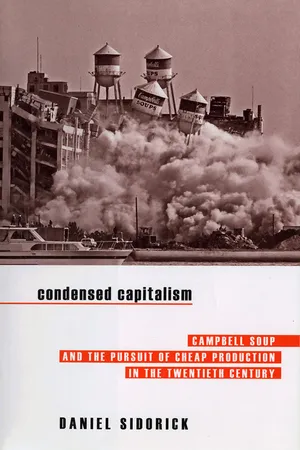
Corporations often move factories to areas where production costs, notably labor, taxes, and regulations, are sharply lower than in the original company hometowns. Not every company, however, followed this trend. One of America's most iconic firms, the Campbell Soup Company, was one such exception: it found ways to achieve low-cost production while staying in its original location, Camden, New Jersey, until 1990.
The first in-depth history of the Campbell Soup Company and its workers, Condensed Capitalism is also a broader exploration of strategies that companies have used to keep costs down besides relocating to cheap labor havens: lean production, flexible labor sourcing, and uncompromising antiunionism. Daniel Sidorick's study of a classic firm that used these methods for over a century has, therefore, special relevance in current debates about capital mobility and the shifting powers of capital and labor.
Sidorick focuses on the engine of the Campbell empire: the soup plants in Camden where millions of cans of food products rolled off the production line daily. It was here that management undertook massive efforts to drive down costs so that the marketing and distribution functions of the company could rely on a limitless supply of products to sell at rock-bottom prices. It was also here that thousands of soup makers struggled to gain some control over their working lives and livelihoods, countering company power with their own strong union local. Campbell's low-cost strategies and the remarkable responses these elicited from its workers tell a story vital to understanding today's global economy. Condensed Capitalism reveals these strategies and their consequences through a narrative that shows the mark of great economic and social forces on the very human stories of the people who spent their lives filling those familiar red-and-white cans.