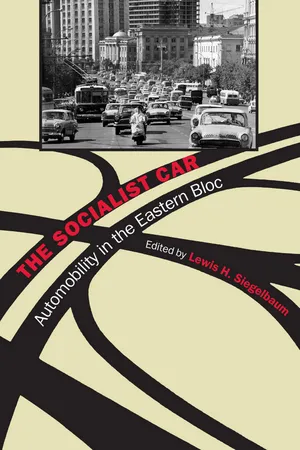
Across the Soviet Bloc, from the 1960s until the collapse of communism, the automobile exemplified the tension between the ideological imperatives of political authorities and the aspirations of ordinary citizens. For the latter, the automobile was the ticket to personal freedom and a piece of the imagined consumer paradise of the West. For the authorities, the personal car was a private, mobile space that challenged the most basic assumptions of the collectivity. The "socialist car"—and the car culture that built up around it—was the result of an always unstable compromise between official ideology, available resources, and the desires of an increasingly restless citizenry. In The Socialist Car, eleven scholars from Europe and North America explore in vivid detail the interface between the motorcar and the state socialist countries of Eastern Europe, including the USSR.In addition to the metal, glass, upholstery, and plastic from which the Ladas, Dacias, Trabants, and other still extant but aging models were fabricated, the socialist car embodied East Europeans' longings and compromises, hopes and disappointments. The socialist car represented both aspirations of overcoming the technological gap between the capitalist first and socialist second worlds and dreams of enhancing personal mobility and status. Certain features of automobility—shortages and privileges, waiting lists and lack of readily available credit, the inadequacy of streets and highways—prevailed across the Soviet Bloc. In this collective history, the authors put aside both ridicule and nostalgia in the interest of trying to understand the socialist car in its own context.Contributors: Elke Beyer, Swiss Institute of Technology; Valentina Fava, Helsinki Collegium for Advanced Studies and University of Helsinki; Luminita Gatejel, European University Institute, Florence; Mariusz Jastrzab, Kozminski University; Corinna Kuhr-Korolev, University of Bochum; Brigitte Le Normand, Indiana University Southeast; Esther Meier, University of the Federal Armed Forces, Hamburg; Kurt Möser, Karlsruhe Institute of Technology; György Péteri, Norwegian University of Science and Technology, Trondheim; Eli Rubin, Western Michigan University; Lewis H. Siegelbaum, Michigan State University
- 256 pages
- English
- ePUB (mobile friendly)
- Available on iOS & Android
eBook - ePub
About this book
Information
Subtopic
Russian HistoryIndex
HistoryTable of contents
- Acknowledgments
- Introduction
- Part One: Socialist Cars and Systems of Production, Distribution, and Consumption
- Part Two: Mobility and Socialist Cities
- Part Three: Socialist Car Cultures and Automobility
- Notes
- Notes on Contributors
Trusted by 375,005 students
Access to over 1.5 million titles for a fair monthly price.
Study more efficiently using our study tools.
Frequently asked questions
Yes, you can cancel anytime from the Subscription tab in your account settings on the Perlego website. Your subscription will stay active until the end of your current billing period. Learn how to cancel your subscription
No, books cannot be downloaded as external files, such as PDFs, for use outside of Perlego. However, you can download books within the Perlego app for offline reading on mobile or tablet. Learn how to download books offline
Perlego offers two plans: Essential and Complete
- Essential is ideal for learners and professionals who enjoy exploring a wide range of subjects. Access the Essential Library with 800,000+ trusted titles and best-sellers across business, personal growth, and the humanities. Includes unlimited reading time and Standard Read Aloud voice.
- Complete: Perfect for advanced learners and researchers needing full, unrestricted access. Unlock 1.5M+ books across hundreds of subjects, including academic and specialized titles. The Complete Plan also includes advanced features like Premium Read Aloud and Research Assistant.
We are an online textbook subscription service, where you can get access to an entire online library for less than the price of a single book per month. With over 1.5 million books across 990+ topics, we’ve got you covered! Learn about our mission
Look out for the read-aloud symbol on your next book to see if you can listen to it. The read-aloud tool reads text aloud for you, highlighting the text as it is being read. You can pause it, speed it up and slow it down. Learn more about Read Aloud
Yes! You can use the Perlego app on both iOS and Android devices to read anytime, anywhere — even offline. Perfect for commutes or when you’re on the go.
Please note we cannot support devices running on iOS 13 and Android 7 or earlier. Learn more about using the app
Please note we cannot support devices running on iOS 13 and Android 7 or earlier. Learn more about using the app
Yes, you can access The Socialist Car by Lewis H. Siegelbaum in PDF and/or ePUB format, as well as other popular books in History & Russian History. We have over 1.5 million books available in our catalogue for you to explore.