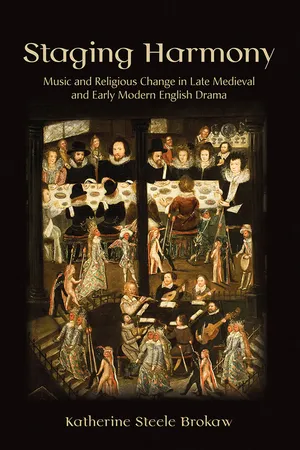
In Staging Harmony, Katherine Steele Brokaw reveals how the relationship between drama, music, and religious change across England's long sixteenth century moved religious discourse to more moderate positions. It did so by reproducing the complex personal attachments, nostalgic overtones, and bodily effects that allow performed music to evoke the feeling, if not always the reality, of social harmony. Brokaw demonstrates how theatrical music from the late fifteenth to the early seventeenth centuries contributed to contemporary discourses on the power and morality of music and its proper role in religious life, shaping the changes made to church music as well as people's reception of those changes. In representing social, affective, and religious life in all its intricacy, and in unifying auditors in shared acoustic experiences, staged musical moments suggested the value of complexity, resolution, and compromise rather than oversimplified, absolutist binaries worth killing or dying for.The theater represented the music of the church's present and past. By bringing medieval and early Tudor drama into conversation with Elizabethan and Jacobean drama, Brokaw uncovers connections and continuities across diverse dramatic forms and demonstrates the staying power of musical performance traditions. In analyzing musical practices and discourses, theological debates, devotional practices, and early staging conditions, Brokaw offers new readings of well-known plays (Marlowe's Doctor Faustus, Shakespeare's The Tempest and The Winter's Tale) as well as Tudor dramas by playwrights including John Bale, Nicholas Udall, and William Wager.
eBook - ePub
Staging Harmony
Music and Religious Change in Late Medieval and Early Modern English Drama
- 296 pages
- English
- ePUB (mobile friendly)
- Available on iOS & Android
eBook - ePub
Staging Harmony
Music and Religious Change in Late Medieval and Early Modern English Drama
About this book
Information
CHAPTER 1
Sacred, Sensual, and Social Music
Wisdom and the Digby Mary Magdalene
Yet when I find the singing itself more moving than the truth which it conveys, I confess that this is a grievous thing, and at those times I would prefer not to hear the singer.
—St. Augustine
It is after all a great bond of unity for the full number of people to join in one chorus.
—St. Ambrose
In the early fifteenth-century treatise Dives and Pauper, a rich man (Dives) and a poor one (Pauper) debate liturgical issues. Pauper synthesizes Wycliffite sentiments about the need for sincerity of heart and the function of music in the church, rebutting Dives’s objections to church music as vain “hackyn.”1 His response is “neither apology for the shortcomings of the clergy nor a plea for a Wyclifian reform of doctrine but rather something between the two.”2 Pauper gives the caveat that a singer must be intent on praising God: “And þerfor what we syngyn in our preyere we don non displesance to God but mychil plesance, inasmychil as we preysyn hym & worchepyn hym with our power, for every note syngynge to God in chirche or in oþir place with good entencion is a preysyng to God.… And but men preysyn God with song, … ellys þey synnyn grevously.”3 That is, Pauper suggests that music may be retained in church only if it is sung with “good entencion.” The treatise thus offers a compromise between the view of music as a vain and sinful distraction (a stance taken in many Wycliffite tracts) and a defense of music as an essential devotional aid. The fifteenth century witnessed a growth in the composition of elaborate church music in England, but also continued conversations about music’s potential dangers. While a written treatise like Dives and Pauper suggests compromise on these issues, it is through performance on the stage that these matters and the debates surrounding them can be more fully realized, and that compromise itself can be enacted.
This chapter will focus on fifteenth-century East Anglia and the music of two plays, Wisdom and the Digby Mary Magdalene. It will also use the particular dramatic content of these two plays and their social and religious context to set up issues regarding the interpretive flexibility of staged music and the confessional complexity of audiences, issues that resonate throughout the plays and periods discussed in this book and that demonstrate the importance of taking a long view of English theatrical and religious history. In the fifteenth century, more plays were produced in East Anglia than in any other region in England.4 Examining the popular drama produced in this area reveals the crucial theological role staged music had in the years leading up to the Henrican reformations. It also highlights the social functions of musical drama, for while East Anglia was the center of late fifteenth-century theatrical life, it was also a region with relatively few persecutions of heretics and a complex and hybridized mixture of religious confessions.
Wisdom and Mary Magdalene stage and embody anxieties about the sensual nature of music that can be traced back to classical philosophy and early Christian theologians. These plays also engage with liturgical debates that stem from these anxieties, debates regarding the role of music in the church and in the life of a pious Christian. In order to explicate the depth and breadth of these issues, this chapter outlines the complexities of religious diversity among audience members and explains the problems we encounter when speaking about historical religious confessions in times of religious dynamism, and more specifically in fifteenth-century East Anglia. It also traces a brief history of classical and early Christian musical theories, theories that continued to inform how audiences and playwrights of all the plays discussed in this book understood music.
After these religious and musical backgrounds are established, the rest of the chapter argues five major points about how staged music can contribute to religious discourse, using Wisdom and Mary Magdalene as examples that have particular implications for fifteenth-century East Anglia, but which at the same time establish recurring functions for dramatic music. Firstly, I use Wisdom to show that music can be employed to depict the moral status of characters, and that liturgical music is often theatricalized in order to portray the innocence or salvation of these characters. Secondly, I explain how Wisdom and Mary Magdalene stage the bodily sensuality that music provokes by using song and dance to index sin and temptation. Thirdly, I look at the parodic rite staged in Mary Magdalene, which I contest is open to multiple doctrinal interpretations even as it unifies audience members in the feeling of Christian solidarity against a perverted Saracen-pagan faith. Fourthly, I argue that staged religious music often capitalizes on the affective power of liturgy and sacrament, and I use Wisdom to show how music’s emotional force empowers it to suggest and urge compromise or at least toleration of theological diversity. The chapter’s final section looks at the way staged music—in this case the “Te Deums” that conclude Mary Magdalene—can be a socializing force that unifies people in the shared experience of literal harmony, building the sensation of concord even in the absence of real consensus. All of these readings of staged music assume a diversity of religious confessions among participants and audience members: it is to this diversity I now turn.
Confessional Identities: East Anglia and Beyond
When we think about the religious identities of late medieval East Anglian audiences—or any audiences—it is quite difficult to use simple confessional markers like “Catholic,” “Lollard,” or “Protestant.” These terms mean different things in different times: it is anachronistic to refer to “Protestants” before the word exists; it is equally inaccurate to conflate the label “Wycliffite” with the often disparaging term “Lollard” or the overly vague “heterodox.” While rituals of inclusion (like baptism) and of exclusion (like heresy trials and public executions) sought to stabilize the definitions of true believers and heretics in order to maximize the power of the official Church (which is always also a state matter in these periods), the truth as lived and experienced by real people was far more nuanced. For example, the term “Lollard,” as Andrew Cole explains, was in the fourteenth and fifteenth centuries a curse word used by those who wanted to employ the “greatest resources of secular and ecclesiastical institutions against individuals at Oxford and elsewhere,” and at the same time a term used by self-professed Wycliffites themselves to describe ideas that were not entirely orthodox.5 Because “Lollardy” is such a contradictory and historically weighty term, I will use the word “Wycliffite” to refer to ideas and tracts that are often labeled “Lollard” in contemporary documents.
Even the marker “Wycliffite,” though, is an overgeneralization when used to describe a person or group, because of the interdependent and mutually constitutive natures of so-called orthodox and heterodox identities and ideas. Historians of religion have shown how discourses of heresy—which have always been present—influence the thinking of even the resolutely “orthodox.”6 In David Aers’s words, the prolific doctrinal conversations of late medieval England “called into question what should count as orthodoxy and heresy,” and the result of these sustained conversations was that “all who participate[d] [were] changed in the process.”7 J. Patrick Hornbeck II localizes this phenomenon in East Anglia: “It is important to note that the interface between mainstream and dissenting religious culture operated in both directions. Not only can dissenting groups be affected by developments within the wider community, but the presence of dissenting viewpoints can provide the impetus for mainstream institutions to stress certain ideas over others.… In East Anglia, the interplay of dissenting and ‘orthodox’ religious culture shaped the theological emphases of both communities.”8 Dramas like Wisdom and Mary Magdalene were a part of this “interplay,” and they drew audience members into such a process of engagement. Scholars of late medieval England view the complex theological leanings of these potential audience members in terms of a “devotional cosmopolitism” that proposes a “radical openness to the suggestions of antithetical theologies” in which “difference is tolerated, re-thought, adapted, and appropriated in the interests of re-imagining Christian community in England”; as we will see, this descriptor could equally be applied to a number of people in the next century, too.9 While East Anglian “Lollards”—as historical documents name them—had previously been persecuted, and three burnt at the stake, prosecutions of Wycliffite dissenters had become rare by the early fifteenth century.10 Indeed, not only were many of the firmly orthodox tolerant of Wycliffites, it also seems that many people were neither die-hard Wycliffites willing to be martyred nor orthodox Catholics ready to expose their neighbor for heresy.
Finally, it is not enough to understand religious identity as a spectrum between stable categories of reformers or radicals occupying one pole and conservative traditionalists occupying the other, with a “great muddled middle” in between.11 Not only was this muddled middle truly great, and not only did those ideological poles reorient frequently throughout the sixteenth century, but moreover individuals undoubtedly experienced significant changes in their own sense of religious identity. Surely this reflects a perennial truth: to varying degrees, everyone considers multiple perspectives on different doctrinal issues to create their own hybridized faith system. Anyone’s views on various theological matters is likely in flux from year to year, possibly even from day to day. No matter the insistence of conviction expressed by a religious person, everyone goes through conversions and is shaped by their culture’s dominant ideological discourses.12 It is my contention that even among those who firmly identify themselves with—indeed, are willing to be martyred for—one particular confessional identity, uniformity of belief is impossible by virtue of the fact that credos are expressed in language and thus interpreted variously by each person who encounters them. And, as we will see in the next chapter, those on the far ends of any religio-political spectrum are subject—as much as those in the “great muddle middle”—to contradictory and changing convictions, positions that are at odds with the implications of “official” dogma (which is itself in flux). So, while I will refer to “Wycliffite” and “traditional” positions in this chapter—and to other confessional labels throughout the book—I refer to these labels inasmuch as they demarcate the terms of debate, and to the extent that they represent the identity markers that were proclaimed by and inflicted on late medieval and early modern English people.
These labels were proclaimed and applied in polemical tracts...
Table of contents
- Acknowledgments
- Note on the Text
- List of Abbreviations
- Introduction
- 1. Sacred, Sensual, and Social Music
- 2. Musical Hypocrisy
- 3. Learning to Sing
- 4. Propaganda and Psalms
- 5. Sound Effects
- 6. Arts to Enchant
- Bibliography
- Index
Trusted by 375,005 students
Access to over 1.5 million titles for a fair monthly price.
Study more efficiently using our study tools.
Frequently asked questions
Yes, you can cancel anytime from the Subscription tab in your account settings on the Perlego website. Your subscription will stay active until the end of your current billing period. Learn how to cancel your subscription
No, books cannot be downloaded as external files, such as PDFs, for use outside of Perlego. However, you can download books within the Perlego app for offline reading on mobile or tablet. Learn how to download books offline
Perlego offers two plans: Essential and Complete
- Essential is ideal for learners and professionals who enjoy exploring a wide range of subjects. Access the Essential Library with 800,000+ trusted titles and best-sellers across business, personal growth, and the humanities. Includes unlimited reading time and Standard Read Aloud voice.
- Complete: Perfect for advanced learners and researchers needing full, unrestricted access. Unlock 1.5M+ books across hundreds of subjects, including academic and specialized titles. The Complete Plan also includes advanced features like Premium Read Aloud and Research Assistant.
We are an online textbook subscription service, where you can get access to an entire online library for less than the price of a single book per month. With over 1.5 million books across 990+ topics, we’ve got you covered! Learn about our mission
Look out for the read-aloud symbol on your next book to see if you can listen to it. The read-aloud tool reads text aloud for you, highlighting the text as it is being read. You can pause it, speed it up and slow it down. Learn more about Read Aloud
Yes! You can use the Perlego app on both iOS and Android devices to read anytime, anywhere — even offline. Perfect for commutes or when you’re on the go.
Please note we cannot support devices running on iOS 13 and Android 7 or earlier. Learn more about using the app
Please note we cannot support devices running on iOS 13 and Android 7 or earlier. Learn more about using the app
Yes, you can access Staging Harmony by Katherine Steele Brokaw in PDF and/or ePUB format, as well as other popular books in Literature & English Literary Criticism. We have over 1.5 million books available in our catalogue for you to explore.